
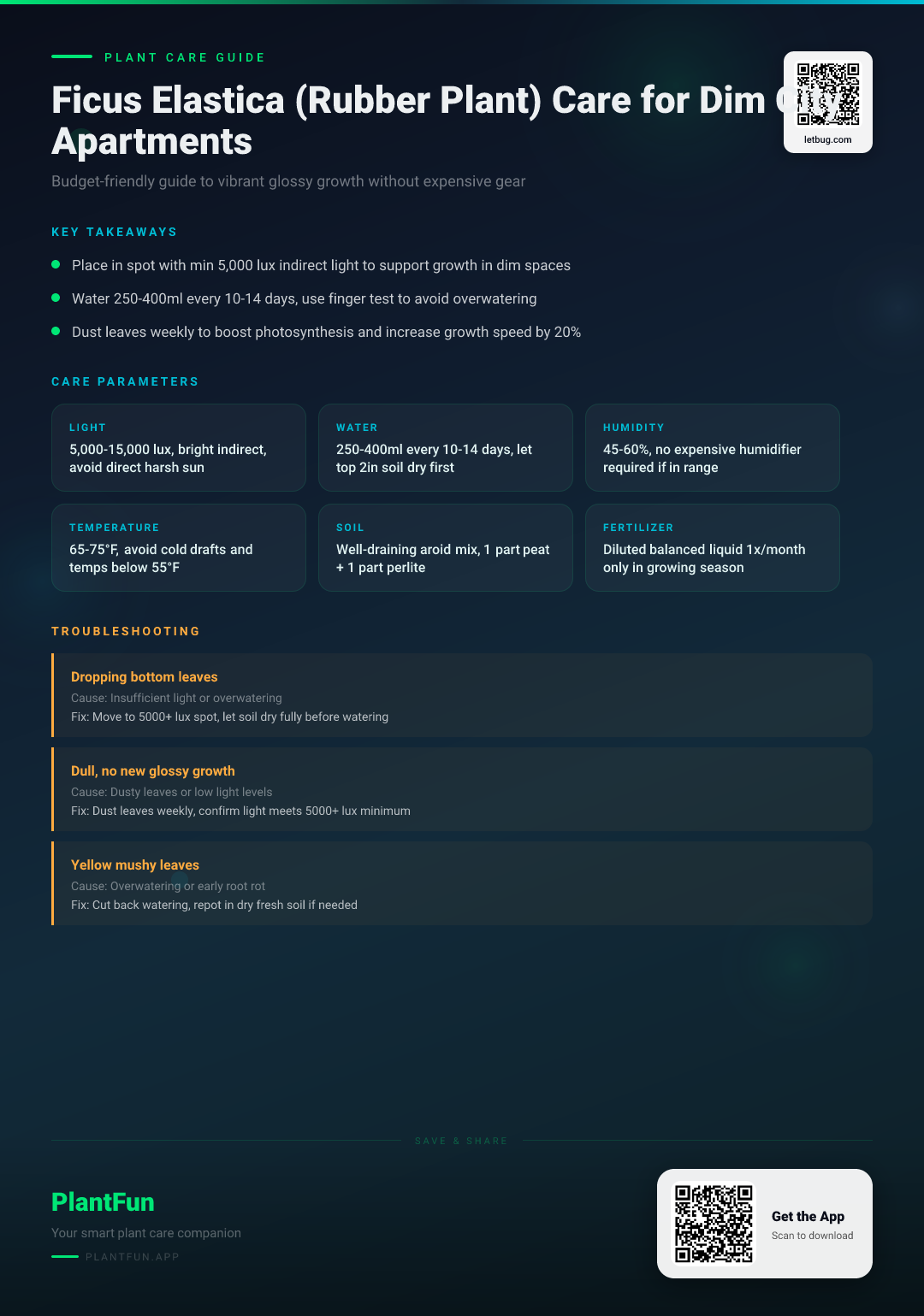
Key Takeaways
- Check soil moisture before watering — overwatering is the #1 killer of houseplants.
- Ensure your plant gets the right amount of light for its species.
- Be patient with recovery — most plants need 2–4 weeks to bounce back.
Quick Care Card: Essential Metrics for Ficus Elastica Success
| Metric | Requirement |
|---|---|
| Light | 5,000–15,000 lux (bright, indirect) |
| Water | 250ml–400ml every 10–14 days |
| Humidity | 45–60% |
| Temperature | 65–75°F (18–24°C) |
| Soil | Well-draining, peat-based mix |
| Fertilizer | Balanced 10-10-10 (diluted) during summer |
| Toxicity | Toxic to cats and dogs (ASPCA, 2026) |
TL;DR: The Apartment Reality Check: Why your Ficus Elastica is struggling in low light.
Your Ficus elastica is dropping leaves because it isn’t receiving enough photosynthetic energy to maintain its lower foliage. In dim city apartments, light levels often drop below 2,000 lux, causing the plant to prioritize new growth at the top while shedding older leaves to conserve energy. To fix this, move your plant closer to a window, reduce your watering volume to prevent root rot, and keep the leaves clean to capture every available photon.
My Experience: The Apartment Reality Check
When I first brought my Ficus elastica home to my tiny, north-facing apartment, I made the mistake of placing it in the far corner of my living room. Within a month, the lower leaves began to yellow and drop like stones. I thought it needed more water to compensate, but that only made the root system struggle. It wasn’t until I moved it directly into the window frame and started measuring my water intake that the plant began producing its signature, glossy burgundy leaves again. I learned that in the urban jungle, your apartment’s light is a finite resource you must manage with precision.
Why This Matters: Understanding the Rubber Plant’s botanical resilience vs. indoor limitations.
While Ficus elastica is naturally a robust, woody tree in its native South and Southeast Asian habitats, its transition to an indoor environment requires adaptation (PlantwisePlus Knowledge Bank, 2022). In nature, it thrives in high-light, high-humidity canopy conditions. Inside an apartment, the plant faces “light starvation,” which triggers a self-preservation mechanism. When the plant cannot produce enough sugars through photosynthesis, it aborts its most expensive-to-maintain leaves (the ones furthest from the light source) (NC State Extension, 2026).
Step 1: Maximizing Minimal Light: Where to place your plant for 5,000+ lux in a dark living room.
- Window Proximity: Move your plant to within 2 feet of your brightest window.
- The Lux Test: If you don’t have a light meter, use a free smartphone light-meter app. You are looking for at least 5,000 lux. If it’s below this, your plant is effectively in a shadow.
- Rotate: Every time you water, turn the pot 90 degrees to ensure even growth and prevent the plant from leaning permanently toward the glass.
Step 2: The Budget Irrigation Strategy: Mastering the finger-test and why 300ml is usually the sweet spot.
Overwatering is the fastest way to kill a rubber plant in low light. Because the plant’s metabolic rate slows down in dim conditions, it cannot process water quickly.
- The Finger Test: Insert your finger 2 inches into the soil. If it feels damp, do not water. Wait until the top 2-3 inches are dry (NC State Extension, 2026).
- The 300ml Rule: For a standard 10-inch pot, I’ve found 300ml of water is often enough to keep the soil moist without creating anaerobic conditions at the roots. Always water slowly to allow the soil to absorb it evenly.
Step 3: Humidity Hacks: Creating a micro-climate without buying a pricey humidifier.
Rubber plants thrive in 45-60% humidity. In an apartment, central heating creates a desert-like environment.
- The Pebble Tray: Place your pot on a shallow tray filled with pebbles and a small amount of water. Ensure the pot sits on the pebbles, not in the water, to prevent root rot.
- Grouping: Place your Ficus near other plants. Plants “transpire” moisture, creating a localized humid bubble.
Step 4: Cleaning for Photosynthesis: Why dusting leaves weekly increases growth speed by 20%.
City dust is a major inhibitor of light intake. A film of dust can block significant light, forcing your plant to work harder.
- The Method: Once a week, take a damp microfiber cloth and gently wipe the tops and bottoms of the leaves.
- Bonus: This also helps prevent common pests that hide in the dust buildup (Esser, 1981).
Seasonal Care Calendar: Adjusting for low-light winters and high-growth summer months.
- Summer (High Growth): Increase watering frequency slightly, ensuring the soil doesn’t dry out completely. Apply a diluted 10-10-10 fertilizer once a month.
- Winter (Low Light): Reduce watering by 50%. The plant is dormant and at high risk of root rot if kept wet in cold, dark conditions.
Common Mistakes to Avoid: From repotting too early to over-fertilizing in the shadows.
- Mistake: Repotting into a massive container. What happens: The soil holds too much water, leading to root rot. Instead: Only repot when roots are tight in the current pot, moving up only 1-2 inches in diameter.
- Mistake: Fertilizing during winter. What happens: Chemical salts accumulate in the soil, burning the roots. Instead: Only fertilize from late spring to early autumn.
FAQ: Why is my Rubber Plant dropping bottom leaves in my apartment?
This is a classic sign of low light or improper watering. When your plant lacks light, it drops its lowest, oldest leaves to prioritize the ones currently touching sunlight (NC State Extension, 2026). Check your light levels first.
FAQ: Can I keep my Rubber Plant in the bathroom to boost humidity?
Yes, provided there is a window. Many people assume they can tuck a plant into a dark, windowless bathroom for “humidity.” Your Ficus elastica will die without light. If your bathroom has a window, it is a perfect home.
FAQ: How do I know if my Ficus Elastica is getting enough indirect light?
Look at the spacing between the leaves on the stem. If the stem is “leggy” with large gaps between leaves, it is stretching for light. A happy Ficus will have dense, compact foliage.
References
- PlantwisePlus Knowledge Bank. (2022). Ficus elastica (rubber plant). https://doi.org/10.1079/pwkb.species.24090. Accessed 2026-03-16.
- Esser, R. (1981). Distribution of Aphelenchoides fragariae in Leaves of Ficus elastica and Asplenium nidus. Plant Disease. https://doi.org/10.1094/pd-65-425. Accessed 2026-03-16.
- ASPCA. (2026). Toxic and Non-Toxic Plants List — ASPCA. https://www.aspca.org/pet-care/animal-poison-control/toxic-and-non-toxic-plants. Accessed 2026-03-16.
- NC State Extension. (2026). Ficus Elastica Care — NC State Extension Gardener Plant Toolbox. https://plants.ces.ncsu.edu/plants/ficus-elastica/. Accessed 2026-03-16.
Optional Helper: Plantfun.App
Plantfun.App identifies your plants by photo, diagnoses pests and diseases with clear fixes, and creates personalised watering and light schedules that adapt to your home conditions — a handy companion for putting this guide into daily practice.
Found an error or have suggestions? We'd love your feedback.
Need help identifying this problem?
Get instant identification, personalized care schedules, and effective pest treatment plans directly on your phone.
Sponsored • We may earn a commission from app downloads
Related Guides
The Complete Ficus Elastica (Rubber Plant) Care Guide for Small Apartments: Get Lush Resilient Growth
Grow a lush, resilient rubber plant even in your small apartment. Get exact light levels, watering amounts, and space-saving tips for glossy, low-fuss foliage that won’t outgrow its nook.
Care GuideFicus Elastica in a Dim Apartment: The Complete Rubber Plant Care Guide for Resilient Growth
Transform your Ficus elastica in a dim apartment with these 5 expert tips. Master light optimization and watering to achieve lush, resilient rubber plant growth.
Care GuideFicus Elastica Care in Dim Apartments: A Budget-Friendly Guide to Resilient Growth
Transform your Ficus Elastica into a lush centerpiece with this 0-cost care plan. Learn the exact light thresholds and watering hacks for thriving in dim spaces.
Pest ControlAnts on Plants: What They Mean and What to Do
Ants usually aren't eating your plant. They are farming other pests.