
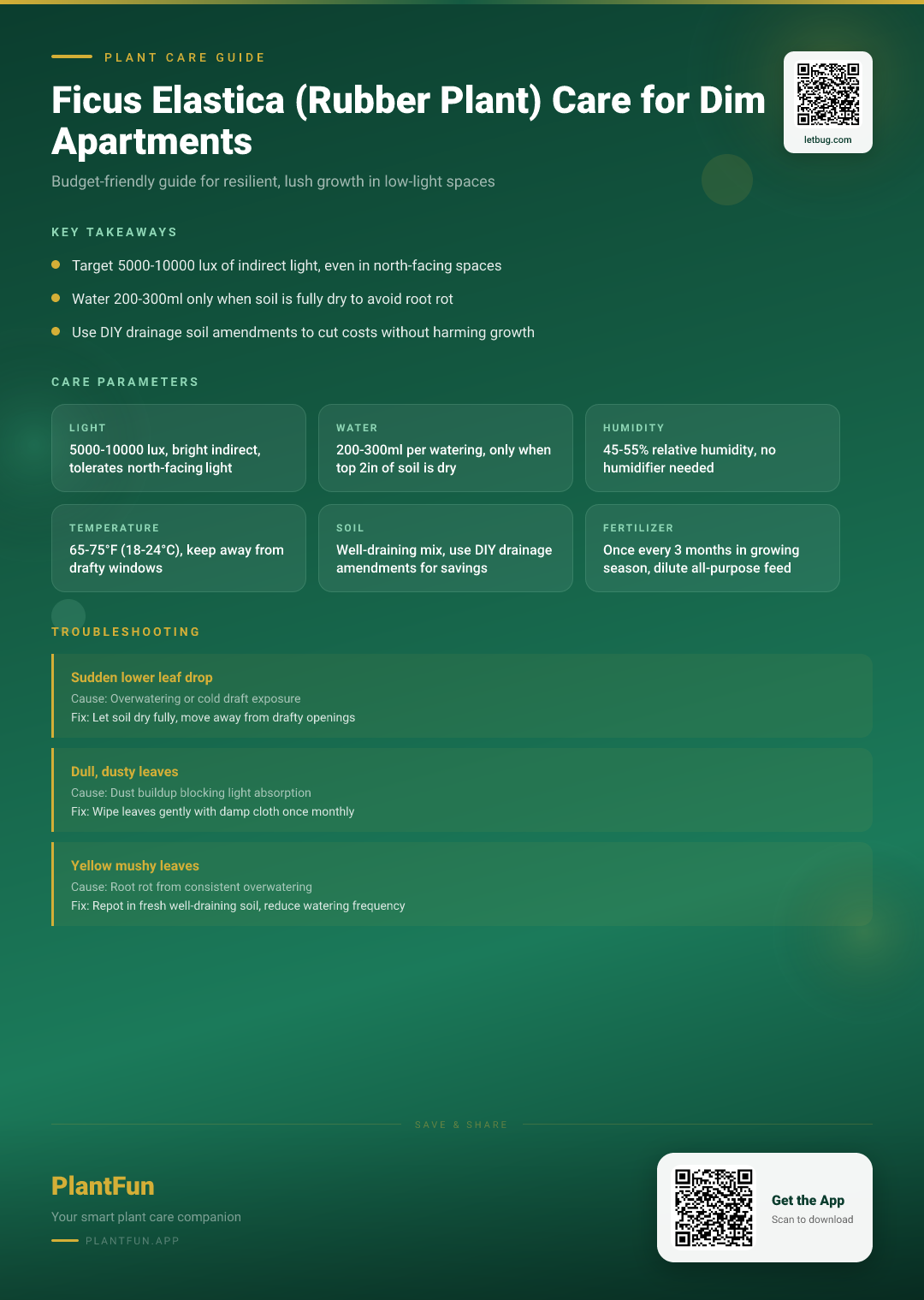
Key Takeaways
- Check soil moisture before watering — overwatering is the #1 killer of houseplants.
- Ensure your plant gets the right amount of light for its species.
- Be patient with recovery — most plants need 2–4 weeks to bounce back.
Quick Care Card: Essential Thresholds for Ficus Elastica
| Feature | Requirement |
|---|---|
| Light | 5,000–10,000 Lux (Bright, indirect) |
| Watering | 200–300ml when top 2 inches of soil are dry |
| Humidity | 45–55% ambient room level |
| Temperature | 65–75°F (18–24°C) |
| Soil | Well-draining, peat-based mix |
| Fertilizer | Balanced 10-10-10 during growth phase |
| Toxicity | Toxic to cats and dogs (ASPCA, 2026) |
TL;DR: The Minimalist Strategy for Apartment Resilience
To keep a Ficus elastica thriving in a dim apartment, stop over-complicating your routine. Success hinges on three non-negotiables: maximizing natural light exposure by placing the plant within 3 feet of a window, strictly watering only when the top two inches of soil are bone-dry, and avoiding temperature fluctuations from drafty heaters or AC units. Forget expensive grow lights; if you position your plant correctly, it will adapt to your space (NC State Extension, 2026).
Why Rubber Plants Struggle in Typical Apartments (And How to Fix It)
When I first brought home my Ficus elastica, I placed it in a dark corner, thinking it would be as tough as a snake plant. Within a month, the lower leaves dropped, and the stem looked spindly. I realized that my apartment’s light levels were far below the tropical canopy conditions these plants crave.
Many rubber plants struggle because owners treat them as “low-light” plants, when in reality, they are “dim-tolerant” but “light-loving.” If your plant is losing leaves, it is almost certainly signaling a lack of photosynthetic energy to support its foliage. My fix? I moved it to the brightest spot I had—a north-facing window ledge—and stopped the “watering-on-a-schedule” habit.
Light Requirements: Maximizing 5,000-10,000 Lux in North-Facing Spaces
Even in a north-facing apartment, you can hit the sweet spot of 5,000 to 10,000 lux. Use a free light meter app on your phone to measure the intensity exactly where the foliage sits. If you are consistently below 5,000 lux, rotate your pot weekly to ensure even growth. Avoid direct mid-day sun if you are in a high-heat climate, as this can scorch the waxy leaves, but for most apartment dwellers, the most intense light available is the goal (NC State Extension, 2026).
Watering Protocols: Precise 200-300ml Intervals Based on Soil Moisture
I never water my rubber plant by a calendar. Instead, I use the finger test: if the soil is damp to the touch at two inches deep, I leave it alone. When it is dry, I add 200–300ml of room-temperature water. This prevents the root rot that stems from the soil staying perpetually waterlogged, a common issue in indoor pots with poor airflow (PlantwisePlus Knowledge Bank, 2022).
The Humidity Factor: Maintaining 45-55% Without a Humidifier
Rubber plants prefer moderate humidity. You don’t need a clunky machine; simply grouping your plant with other foliage helps create a microclimate. If the tips turn brown, your air is likely too dry. Keep it away from heating vents, which sap moisture instantly.
Temperature Management: Keeping 65-75°F (18-24°C) Away from Drafty Windows
Ficus elastica is sensitive to sudden drops. In an apartment, this means keeping the plant away from drafty windows during winter or direct airflow from AC units in summer. Consistency is the secret to retaining foliage.
Seasonal Care Calendar: Adjusting for Reduced Winter Metabolism
- Spring/Summer: Increase water slightly as the plant enters its active growth phase.
- Autumn/Winter: Scale back. If the plant isn’t growing new leaves, it isn’t using as much water. Overwatering during this time is the fastest way to invite disease (Esser, 1981).
Common Mistakes: Avoiding the Overwatering-Root Rot Cycle
- Mistake: Watering on a set schedule (e.g., every Monday).
- What happens: Roots suffocate and decay due to lack of oxygen.
- Instead: Water only when the top 2 inches of soil feel dry.
- Mistake: Using dense, garden-variety soil.
- What happens: Water pools at the bottom, creating a swamp.
- Instead: Amend potting soil with 30% perlite for drainage.
Budget-Friendly Soil Amendments: DIY Drainage Hacks
If you can’t afford expensive potting mixes, buy a standard indoor mix and add 30% coarse perlite or even small aquarium gravel to the bottom of the pot. This promotes the aeration necessary to prevent root pathogens (PlantwisePlus Knowledge Bank, 2022).
FAQ: Why is my rubber plant dropping lower leaves suddenly?
It’s a symptom of low light or overwatering. The plant sheds “expensive” foliage it can no longer support via photosynthesis (NC State Extension, 2026).
FAQ: How do I clean dust off my rubber plant leaves at home?
Use a damp microfiber cloth to gently wipe the top and bottom of the leaves. This allows the plant to absorb more light.
FAQ: Can I keep my rubber plant in the bedroom without much light?
Only if you place it directly on the windowsill. If the bedroom is dim, the plant will eventually lose its vigor and drop leaves.
References
- PlantwisePlus Knowledge Bank. (2022). Ficus elastica (rubber plant). https://doi.org/10.1079/pwkb.species.24090. Accessed 2026-03-16.
- Esser, R. (1981). Distribution of Aphelenchoides fragariae in Leaves of Ficus elastica and Asplenium nidus. Plant Disease. https://doi.org/10.1094/pd-65-425. Accessed 2026-03-16.
- ASPCA. (2026). Toxic and Non-Toxic Plants List — ASPCA. https://www.aspca.org/pet-care/animal-poison-control/toxic-and-non-toxic-plants. Accessed 2026-03-16.
- NC State Extension. (2026). Ficus Elastica Care — NC State Extension Gardener Plant Toolbox. https://plants.ces.ncsu.edu/plants/elastica-care/. Accessed 2026-03-16.
Optional Helper: Plantfun.App
Plantfun.App identifies your plants by photo, diagnoses pests and diseases with clear fixes, and creates personalised watering and light schedules that adapt to your home conditions — a handy companion for putting this guide into daily practice.
Found an error or have suggestions? We'd love your feedback.
Need help identifying this problem?
Get instant identification, personalized care schedules, and effective pest treatment plans directly on your phone.
Sponsored • We may earn a commission from app downloads
Related Guides
Ficus Elastica Care for Dim City Apartments: The Budget-Friendly Guide to Resilient Growth
Transform your dim apartment into a thriving jungle. Follow this 5-step Rubber Plant care plan to achieve vibrant, glossy growth without expensive specialized gear.
Care GuideFicus Elastica in Small Apartments: The Essential Rubber Plant Care Guide for Resilient Growth
Transform your Ficus elastica into a resilient centerpiece. Master these 4 exact care thresholds and a simple seasonal routine to ensure lush, consistent growth.
Care GuideFicus Elastica in a Dim Apartment: The Complete Rubber Plant Care Guide for Resilient Growth
Transform your Ficus elastica in a dim apartment with these 5 expert tips. Master light optimization and watering to achieve lush, resilient rubber plant growth.
Pest ControlAnts on Plants: What They Mean and What to Do
Ants usually aren't eating your plant. They are farming other pests.