
Key Takeaways
- Check soil moisture before watering — overwatering is the #1 killer of houseplants.
- Ensure your plant gets the right amount of light for its species.
- Be patient with recovery — most plants need 2–4 weeks to bounce back.
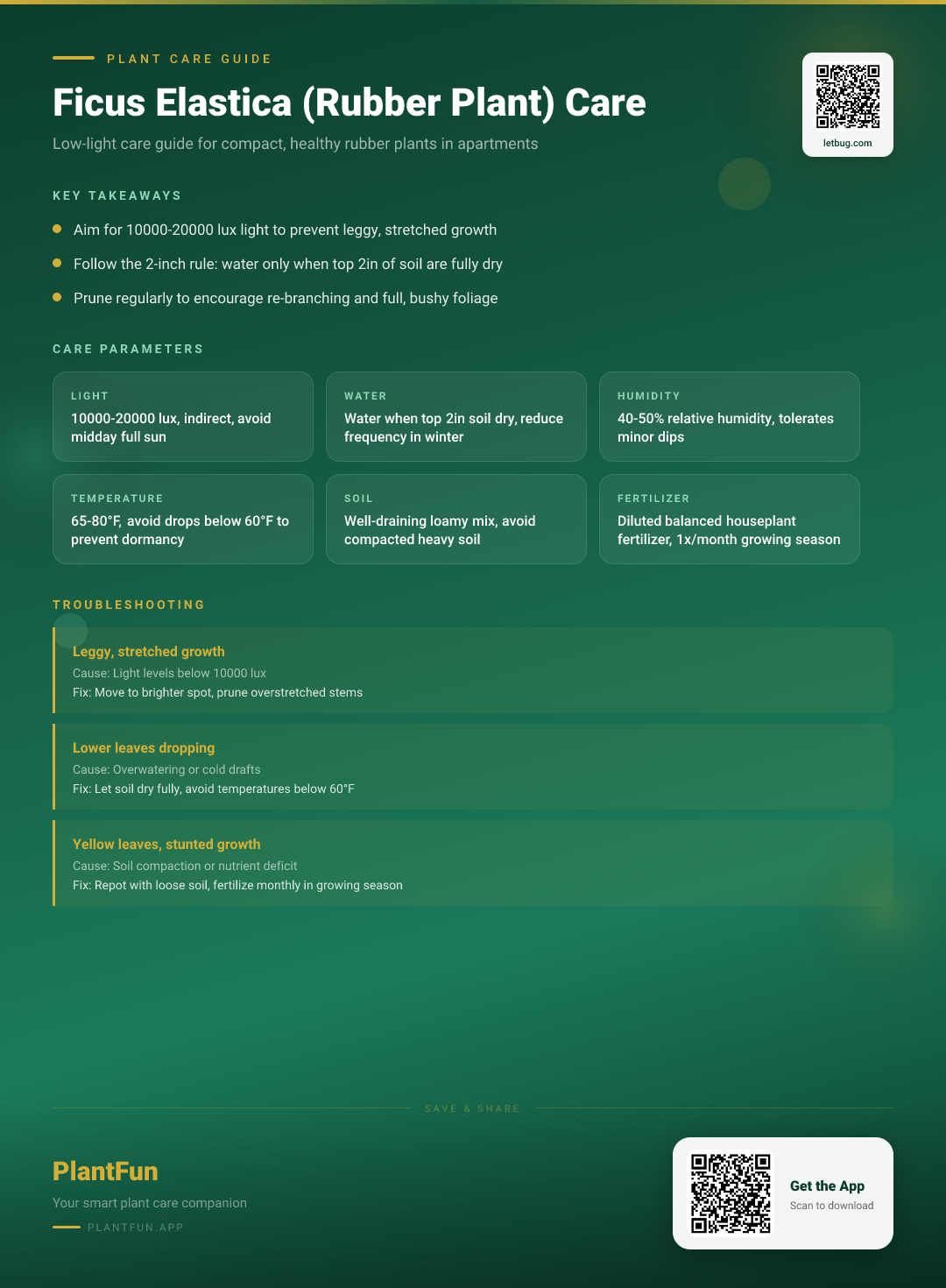
Quick Care Card: Essential Thresholds for Apartment Ficus
| Feature | Requirement |
|---|---|
| Light | 10,000–20,000 lux (Bright, indirect) |
| Watering | When top 2 inches of soil are dry |
| Humidity | 40–50% (Standard home levels) |
| Temperature | 65–80°F (18–27°C) |
| Soil | Well-draining, peat-based mix |
| Fertilizer | Balanced liquid feed, monthly in summer |
| Toxicity | Toxic to cats and dogs (ASPCA, 2026) |
TL;DR: The Reality of Rubber Plants in Dimmer Spaces
If you are housing a Ficus elastica in an apartment, it likely wants more light than it is receiving. Rubber plants are not true low-light plants; they thrive in bright, filtered light (NC State Extension, 2026). When light is insufficient, the plant undergoes etiolation—stretching to find a better light source. You can counteract this by rotating the pot weekly, pruning to encourage branching, and strictly monitoring your watering schedule to avoid root rot in cooler, dim corners.
My Experience: The “Leggy” Trap
When I first started my indoor gardening journey, I placed a beautiful Ficus elastica in the corner of a dimly lit studio apartment. Within three months, the plant had doubled in height but lost half its leaves, looking more like a rubbery stick than a lush tropical tree. I learned the hard way that a rubber plant in an apartment is a balancing act of light exposure and intentional pruning. I had to move the plant within three feet of a south-facing window and implement a pruning regimen to regain that bushy, compact silhouette I originally purchased.
Why Your Rubber Plant is Stretching: Diagnosing Light Deficits
Etiolation occurs when the plant lacks sufficient light energy to maintain its structural integrity. According to the NC State Extension (2026), these plants perform best in bright, indirect light. When they are placed in a “dark corner,” the internodes (the stem space between leaves) elongate as the plant desperate reaches for a light source. If your plant is leaning heavily toward a window, it is signaling that its photosynthetic needs are not being met.
Measuring Your Light: Target 10,000–20,000 Lux for Compact Growth
To stop the stretching, you must measure your light. Professional indoor gardeners use a light meter to check the lux (lumen per square meter). You should aim for 10,000 to 20,000 lux. You can use free light-meter apps on your smartphone to check the intensity at the leaf surface. If your apartment consistently registers below 5,000 lux, you will likely need to supplement with a full-spectrum LED grow light for at least 8 hours a day to prevent the plant from shedding its lower foliage.
The 2-Inch Rule: Watering Strategies for Apartment Humidity (40-50%)
In an apartment, air circulation is often poorer than in a greenhouse, which keeps soil moist longer. Before adding water, use the “2-inch rule”: stick your index finger into the soil up to the second knuckle. If the soil is still damp, do not water. Overwatering is the most common killer of Ficus (PlantwisePlus Knowledge Bank, 2022). Aim for a well-draining soil mix; if the water sits on top of the soil for more than a few seconds, your mix is too dense.
Temperature Management: Maintaining 65-80°F to Prevent Dormancy
Rubber plants prefer consistent temperatures between 65°F and 80°F (NC State Extension, 2026). In an apartment, proximity to drafty windows or heating vents can cause major stress. If the temperature drops below 60°F for extended periods, the plant will enter a semi-dormant state where it consumes less water, increasing the risk of root rot if you stick to your summer watering routine.
Format B: The Rescue Plan for Leggy or Dropping Ficus Elastica
Yellowing or Dropping Leaves
Symptom: Lower leaves yellow and fall off unexpectedly.
Likely cause: Overwatering or dramatic changes in environment.
Fix:
- Assess moisture: If the soil is soggy, repot into fresh, dry, free-draining soil.
- Trim away dead roots, which appear dark and mushy rather than firm and white.
Excessive Stretching
Symptom: Long, bare stems with large gaps between leaf nodes.
Likely cause: Insufficient light.
Fix:
- Pruning: Cut the apical meristem (the top growth point) to trigger lateral bud growth.
- Relocate: Move the plant to the brightest spot available or add a grow light.
Why is my rubber plant losing lower leaves? (Voice Search FAQ)
This is almost always a sign of the plant adjusting to light levels or moisture stress. If the leaves yellow before dropping, you are likely overwatering. If the leaves are healthy but green when they drop, the plant may be light-starved and prioritizing new growth at the expense of older, shaded leaves.
How often should I water my rubber plant in the winter? (Voice Search FAQ)
In winter, the plant’s growth slows. You might find you only need to water every 2 to 3 weeks. Always defer to the soil moisture rather than a calendar. If your apartment is heated and dry, check the soil more frequently, as evaporation may happen faster than you think.
Can I use fertilizer to force growth in a dark corner? (Voice Search FAQ)
Absolutely not. Fertilizing a plant that isn’t actively photosynthesizing efficiently will lead to salt buildup in the soil and potential root burn. Only fertilize during the active growing season (spring and summer) and only if the plant is receiving sufficient light to support that new growth.
Step-by-Step Pruning: How to Re-branch Your Plant
- Identify a healthy node (where a leaf meets the stem).
- Using sanitized shears, make a clean 45-degree cut just above the node.
- The plant will secrete a milky white latex sap; wipe this away with a damp cloth.
- Within 3–6 weeks, two or more new stems will typically emerge from near the cut.
Common Apartment Mistakes: Soil Compaction and Drainage
- Mistake: Using standard garden soil.
- What happens: The soil compacts, suffocating roots.
- Instead: Use an airy mix containing orchid bark and perlite.
- Mistake: Ignoring pot drainage.
- What happens: Water pools at the bottom, leading to pathogens (Esser, 1981).
- Instead: Ensure your decorative pot has a nursery liner with drainage holes.
Seasonal Adjustments: Managing Growth Cycles in Artificial Heat
During winter, central heating often drops indoor humidity to 20%. While Ficus elastica is tolerant, it appreciates a weekly misting or a proximity to a humidifier. Remember that artificial heat increases transpiration, so keep the plant away from direct airflow from vents to prevent leaf-edge browning.
References
- PlantwisePlus Knowledge Bank. (2022). Ficus elastica (rubber plant). https://doi.org/10.1079/pwkb.species.24090. Accessed 2026-03-09.
- Esser, R. (1981). Distribution of Aphelenchoides fragariae in Leaves of Ficus elastica and Asplenium nidus. Plant Disease. https://doi.org/10.1094/pd-65-425. Accessed 2026-03-09.
- ASPCA. (2026). Toxic and Non-Toxic Plants List — ASPCA. https://www.aspca.org/pet-care/animal-poison-control/toxic-and-non-toxic-plants. Accessed 2026-03-09.
- NC State Extension. (2026). Ficus Elastica — NC State Extension Gardener Plant Toolbox. https://plants.ces.ncsu.edu/plants/ficus-elastica/. Accessed 2026-03-09.
Optional Helper: Plantfun.App
Plantfun.App identifies your plants by photo, diagnoses pests and diseases with clear fixes, and creates personalised watering and light schedules that adapt to your home conditions — a handy companion for putting this guide into daily practice.
Found an error or have suggestions? We'd love your feedback.
Need help identifying this problem?
Get instant identification, personalized care schedules, and effective pest treatment plans directly on your phone.
Sponsored • We may earn a commission from app downloads
Related Guides
Ficus Elastica in a Dim Apartment: The Complete Rubber Plant Care Guide for Resilient Growth
Transform your Ficus elastica in a dim apartment with these 5 expert tips. Master light optimization and watering to achieve lush, resilient rubber plant growth.
Care GuideFicus Elastica in Small Apartments: The Essential Rubber Plant Care Guide for Resilient Growth
Transform your Ficus elastica into a resilient centerpiece. Master these 4 exact care thresholds and a simple seasonal routine to ensure lush, consistent growth.
Care GuideThe Complete Ficus Elastica (Rubber Plant) Care Guide for Small Apartments: Get Lush Resilient Growth
Grow a lush, resilient rubber plant even in your small apartment. Get exact light levels, watering amounts, and space-saving tips for glossy, low-fuss foliage that won’t outgrow its nook.
Pest ControlAnts on Plants: What They Mean and What to Do
Ants usually aren't eating your plant. They are farming other pests.