
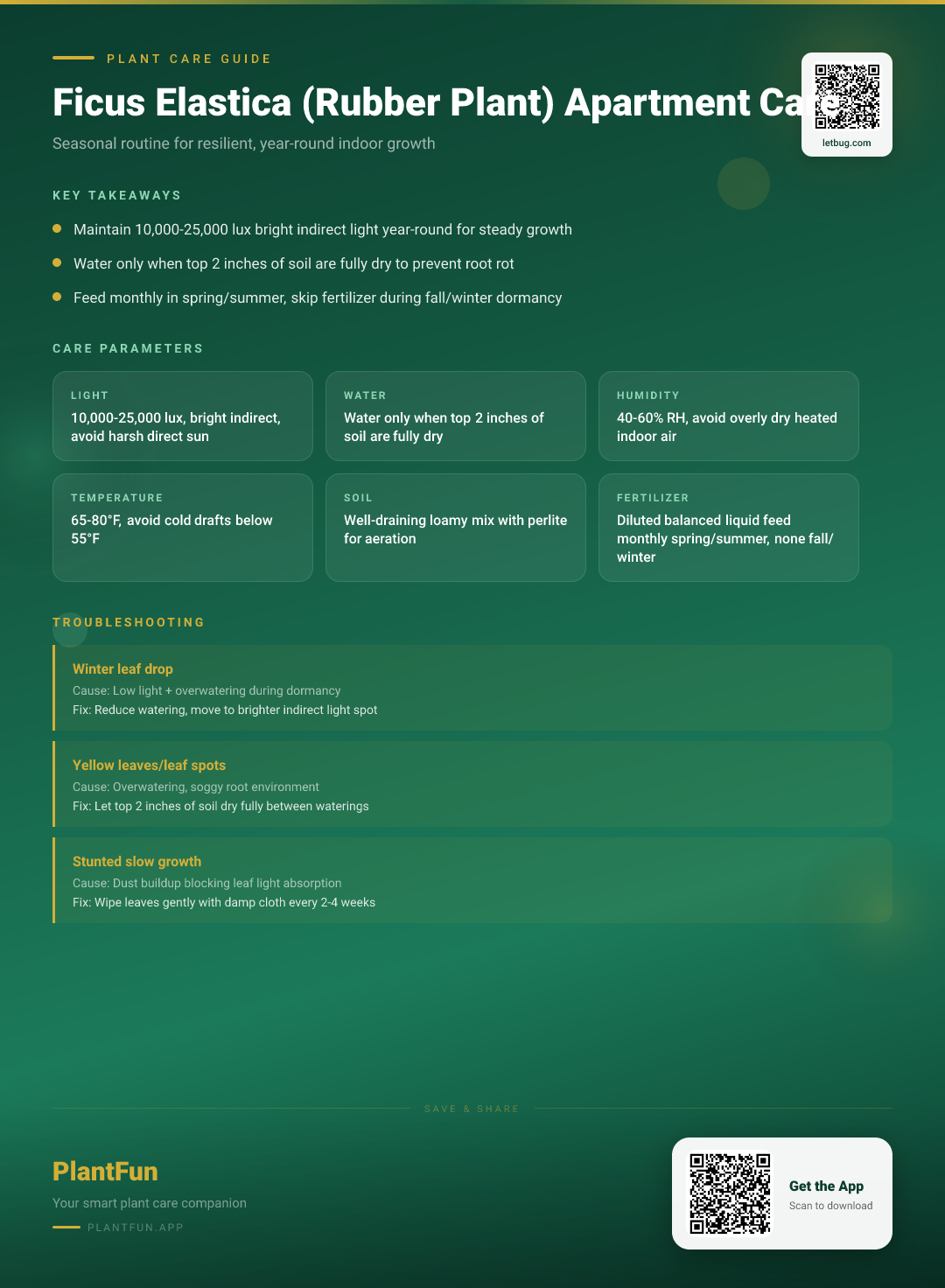
Key Takeaways
- Check soil moisture before watering — overwatering is the #1 killer of houseplants.
- Ensure your plant gets the right amount of light for its species.
- Be patient with recovery — most plants need 2–4 weeks to bounce back.
Quick Care Card: Essential Thresholds for Ficus Elastica
| Feature | Requirement |
|---|---|
| Light | 10,000–25,000 Lux (Bright, indirect) |
| Water | Allow top 2 inches of soil to dry out |
| Humidity | 40%–60% (Moderate) |
| Temperature | 65°F–80°F (18°C–27°C) |
| Soil | Well-draining, peat-based mix |
| Fertilizer | Balanced liquid 10-10-10 (Monthly in summer) |
| Toxicity | Toxic to cats and dogs (ASPCA, 2026) |
TL;DR: The 30-Second Rubber Plant Apartment Strategy
To keep your Ficus elastica healthy, prioritize light and drainage. Place your plant in your brightest window, water only when the top two inches of soil are dry to the touch, and reduce all maintenance during the darker winter months. Avoid over-handling and keep it away from cold drafts to prevent leaf drop.
Understanding Your Apartment’s Microclimate
When I first started keeping Ficus elastica in my small urban apartment, I made the mistake of treating it like a low-light plant. I tucked it in a corner away from the window, and within weeks, it lost its lower leaves. I learned the hard way that these plants aren’t just decorative; they are sensitive to the specific light and airflow patterns of your living space. Success relies on balancing your plant’s needs against the limitations of indoor life.
Light Requirements: Maintaining 10,000–25,000 Lux Year-Round
Rubber plants thrive in bright, filtered light. According to NC State Extension (2026), these plants perform best when they receive ample indirect sunlight. In an apartment, I recommend using a simple light meter app to ensure your plant is receiving at least 10,000 lux. If you notice the internodes (the stem space between leaves) stretching out, your plant is begging for more light—a process known as etiolation.
Watering Mastery: Why the Top 2 Inches of Soil Matter
Overwatering is the primary killer of indoor Ficus. My rule is simple: stick your index finger into the soil up to the second knuckle. If the soil feels moist, walk away. If it is dry, water thoroughly until you see liquid exiting the drainage holes. Consistent moisture is good, but soggy roots lead to decay (PlantwisePlus Knowledge Bank, 2022).
Humidity & Temperature: Keeping Your Ficus Between 65-80°F
Your Ficus elastica prefers temperatures between 65-80°F. If your apartment fluctuates wildly—especially near radiators or drafty windows—your plant will show stress. While they tolerate average home humidity, they appreciate a gentle misting during dry winters or the use of a humidity tray to prevent the edges of the leaves from browning.
Spring & Summer: The Growth Phase Feeding Routine
During the active growth phase, your plant is hungry. I apply a balanced 10-10-10 liquid fertilizer once a month. This fuels the development of those iconic, glossy leaves. Ensure the soil is slightly damp before applying fertilizer to prevent root burn.
Autumn & Winter: Navigating Low Light and Dormancy
As daylight hours shorten, your plant enters a period of dormancy. I stop fertilizing entirely during the winter and reduce watering frequency by roughly 30%. The plant’s metabolism slows down, and forcing it to grow through low-light months only weakens the structure.
Can I keep my Rubber Plant in a room with only one window?
Yes, but placement is everything. Keep the plant within 2-3 feet of that window. If the room is north-facing, ensure the window isn’t obscured by trees or buildings.
Why is my Rubber Plant dropping leaves in the winter?
This is often a reaction to environmental shifts, such as moving the plant, sudden drafts, or a drastic change in light. According to Esser (1981), specific pathogens can sometimes affect leaves, but usually, it is a response to lack of light or cold stress.
How do I know if my apartment air is too dry for my plant?
Look at the leaf tips. If they start curling or turning crispy brown while the rest of the leaf is healthy, your humidity is likely falling below 30%.
Common Apartment Mistakes: Overwatering and Dust Accumulation
- Mistake: Leaving the plant in a decorative pot without drainage. What happens: Root rot. Instead: Keep the plant in a nursery liner inside the decorative pot.
- Mistake: Ignoring dust. What happens: Photosynthesis is inhibited. Instead: Wipe leaves with a damp cloth monthly.
Troubleshooting Guide: Identifying Leaf Spot and Pests
Yellowing Lower Leaves
Symptom: The bottom-most leaves turn yellow and drop off.
Likely cause: Overwatering or light deficiency.
Fix:
- Check soil moisture levels immediately.
- Move the plant closer to your primary light source.
Crispy Leaf Edges
Symptom: The edges of the leaves become brown and brittle.
Likely cause: Low humidity or salt buildup from tap water.
Fix:
- Increase humidity with a room humidifier.
- Use filtered or distilled water for a few cycles.
Drooping Leaves
Symptom: The entire plant looks sad and lacks turgor pressure.
Likely cause: Underwatering or root damage.
Fix:
- Perform a thorough soaking.
- Inspect roots for decay if the plant doesn’t recover within 48 hours.
References and Botanical Resources
- PlantwisePlus Knowledge Bank. (2022). Ficus elastica (rubber plant). https://doi.org/10.1079/pwkb.species.24090. Accessed 2026-03-19.
- Esser, R. (1981). Distribution of Aphelenchoides fragariae in Leaves of Ficus elastica and Asplenium nidus. Plant Disease. https://doi.org/10.1094/pd-65-425. Accessed 2026-03-19.
- ASPCA. (2026). Toxic and Non-Toxic Plants List — ASPCA. https://www.aspca.org/pet-care/animal-poison-control/toxic-and-non-toxic-plants. Accessed 2026-03-19.
- NC State Extension. (2026). Ficus Elastica Care — NC State Extension Gardener Plant Toolbox. https://plants.ces.ncsu.edu/plants/ficus-elastica/. Accessed 2026-03-19.
Optional Helper: Plantfun.App
Plantfun.App identifies your plants by photo, diagnoses pests and diseases with clear fixes, and creates personalised watering and light schedules that adapt to your home conditions — a handy companion for putting this guide into daily practice.
Found an error or have suggestions? We'd love your feedback.
Need help identifying this problem?
Get instant identification, personalized care schedules, and effective pest treatment plans directly on your phone.
Sponsored • We may earn a commission from app downloads
Related Guides
Ficus Elastica in Small Apartments: The Essential Rubber Plant Care Guide for Resilient Growth
Transform your Ficus elastica into a resilient centerpiece. Master these 4 exact care thresholds and a simple seasonal routine to ensure lush, consistent growth.
Care GuideFicus Elastica Care in Dim Apartments: A Budget-Friendly Guide to Resilient Growth
Transform your Ficus Elastica into a lush centerpiece with this 0-cost care plan. Learn the exact light thresholds and watering hacks for thriving in dim spaces.
Care GuideThe Complete Ficus Elastica (Rubber Plant) Care Checklist for Resilient Growth in Typical Apartments
Stop dealing with droopy, yellowing rubber plant leaves. Get exact light, water, and humidity thresholds plus a mistake-proof checklist to keep your Ficus elastica thriving year-round in your apartment.
Pest ControlAnts on Plants: What They Mean and What to Do
Ants usually aren't eating your plant. They are farming other pests.