
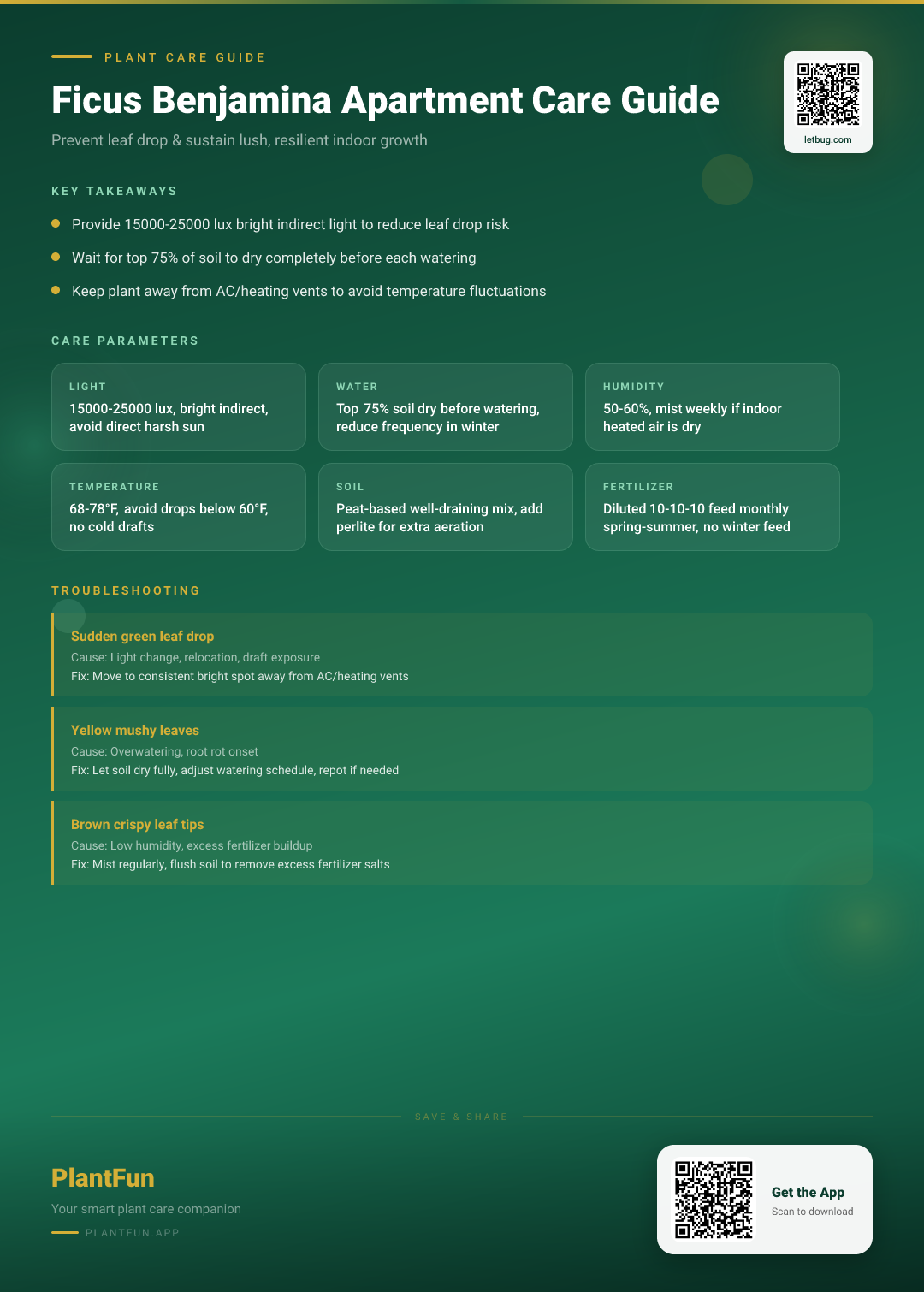
Key Takeaways
- Check soil moisture before watering — overwatering is the #1 killer of houseplants.
- Ensure your plant gets the right amount of light for its species.
- Be patient with recovery — most plants need 2–4 weeks to bounce back.
Quick Care Card: Essential Metrics for Success
| Metric | Requirement |
|---|---|
| Light | 15,000–25,000 Lux (Bright, indirect) |
| Watering | When top 2 inches of soil are dry |
| Humidity | 50%–60% |
| Temperature | 68°F–78°F (Avoid drafts) |
| Soil | Well-draining, peat-based mix |
| Fertilizer | Balanced liquid feed, monthly (Spring/Summer) |
| Toxicity | Toxic to cats and dogs (ASPCA, 2026) |
TL;DR: The Apartment Reality of Ficus Benjamina
Your Ficus Benjamina (Weeping Fig) isn’t inherently “dramatic”; it is highly sensitive to environmental flux. In an apartment, the primary causes of leaf drop are inconsistent light levels and proximity to HVAC vents. To stop the shedding, stabilize its environment: provide consistent bright, indirect light, avoid moving the plant once it acclimates, and ensure your watering cycle matches the drying rate of your specific pot size (NC State Extension, 2026).
Why Your Ficus Drops Leaves (And How to Stop It)
When I first brought my Ficus home, I moved it from the sunny living room to a darker bedroom corner to “test” its tolerance. Within three days, the floor was covered in green leaves. I learned the hard way that the Ficus benjamina is a creature of habit. The plant reacts to changes in light or temperature by shedding leaves to rebalance its energy expenditure. To stop the leaf drop, you must provide a stable environment and allow the plant to “settle in” for 4-6 weeks without rotating or relocating it.
Light Requirements: Achieving 15,000-25,000 Lux Indoors
Unlike many low-light apartment plants, the Ficus requires high-intensity light. For lush growth, aim for 15,000 to 25,000 lux (NC State Extension, 2026). If you don’t own a light meter, you can use a free mobile app, but remember that placement is key. Place your tree within 3 feet of a south or west-facing window. If your apartment lacks natural light, a full-spectrum LED grow light positioned 18 inches above the canopy can maintain these levels throughout the darker winter months.
Watering Mastery: Avoiding Root Rot in Apartment Containers
Watering correctly is the biggest hurdle for apartment gardeners. Overwatering leads to root decay, which manifests as yellowing leaves (Bolton, 1984).
The Quick Test: Before you reach for the watering can, push your index finger 2 inches into the soil. If you feel moisture, wait another two days. The goal is to keep the soil consistently damp but never waterlogged. According to research on root health, proper drainage is non-negotiable to prevent pathogens from destroying the root system (Bolton, 1984).
Environmental Controls: Maintaining 50-60% Humidity and 68-78°F Temperatures
Apartment air is notoriously dry, especially in winter. I find that a small humidifier placed near the base of the plant works wonders. Aim for 50-60% relative humidity. Furthermore, keep your Ficus in the “sweet spot” of 68°F to 78°F. Ensure it stays away from cold drafts from windows or hot, dry air blowing directly from heating units, as these fluctuations are primary triggers for stress (NC State Extension, 2026).
The 3-Step Stabilization Protocol for New Apartment Additions
- Acclimation (Days 1-14): Find the brightest spot that doesn’t receive direct scorching sun. Do not repot immediately.
- Hydration Check: Use a moisture meter or the finger test daily. Adjust watering to the plant’s current consumption rate, not a calendar schedule.
- Observation: If minor shedding occurs, stay the course. New leaves will adjust to the new light levels within a month.
Seasonal Care Adjustments: Managing Winter Radiator Heat
Winter in an apartment often means dry, forced-air heat. This is lethal for Ficus. During winter months, increase your misting or run a humidifier to counteract the drying effect of radiators. Reduce your fertilization to zero, as the plant enters a period of slower growth during lower-light winter cycles.
Why is my Ficus Benjamina losing green leaves? (Voice Search FAQ)
This is usually a sign of environmental shock. If the leaves are green and healthy-looking when they fall, it is likely that the plant was recently moved, exposed to a temperature draft, or is suffering from irregular watering patterns.
How often should I water my indoor Ficus in a small apartment? (Voice Search FAQ)
There is no fixed schedule. Instead, monitor the top 2 inches of soil. In small, crowded apartment pots, evaporation happens faster near the surface. If the soil is dry to the touch, it is time to water.
Can I keep my Ficus near an air conditioning vent? (Voice Search FAQ)
No. Direct airflow from air conditioning vents causes rapid moisture loss and temperature shock. Always keep your Ficus at least 5 feet away from any forced-air ventilation or heating ducts to ensure the tree maintains its foliage.
Common Mistakes to Avoid: Over-potting and Fertilizer Burn
- Mistake: Using a pot that is too large. What happens: Excess soil holds too much water, leading to root rot (Bolton, 1984). Instead: Use a pot only 2 inches wider than the root ball.
- Mistake: Heavy fertilization. What happens: Salt buildup in the soil, leading to scorched leaf edges. Instead: Use a balanced, water-soluble fertilizer diluted to half-strength during the growing season.
References and Botanical Resources
- Bolton, A. (1984). Root Rot of Ficus benjamina. Plant Disease. https://doi.org/10.1094/pd-69-816. Accessed 2026-03-13.
- Bolton, A. (1984). Root Rot of Ficus benjamina. Plant Disease. https://doi.org/10.1094/pd-68-816. Accessed 2026-03-13.
- ASPCA. (2026). Toxic and Non-Toxic Plants List — ASPCA. https://www.aspca.org/pet-care/animal-poison-control/toxic-and-non-toxic-plants. Accessed 2026-03-13.
- NC State Extension. (2026). Ficus Benjamina — NC State Extension Gardener Plant Toolbox. https://plants.ces.ncsu.edu/plants/benjamina-care/. Accessed 2026-03-13.
Optional Helper: Plantfun.App
Plantfun.App identifies your plants by photo, diagnoses pests and diseases with clear fixes, and creates personalised watering and light schedules that adapt to your home conditions — a handy companion for putting this guide into daily practice.
Found an error or have suggestions? We'd love your feedback.
Need help identifying this problem?
Get instant identification, personalized care schedules, and effective pest treatment plans directly on your phone.
Sponsored • We may earn a commission from app downloads
Related Guides
The Complete Ficus Benjamina Care Checklist for Resilient Growth in Typical Apartments
Stop losing Ficus Benjamina leaves to apartment stress. Get 4 actionable seasonal care routines, measurable light/water thresholds, and a free printable checklist to boost steady, resilient growth year-round.
Care GuideFicus Benjamina in Small Urban Apartments: The Only Resilient Growth Checklist You’ll Ever Need
Stop losing leaves on your Ficus Benjamina. Grab our 8-step apartment-specific checklist with exact light, water, and humidity thresholds to keep your tree lush and resilient year-round.
Care GuideThe Complete Ficus Benjamina Care Checklist for Resilient Growth in Urban Apartments
Stop losing your ficus to apartment stress. Get 12 actionable checklist items, exact light/water thresholds, and simple fixes to grow a resilient, full Ficus Benjamina.
Pest ControlAnts on Plants: What They Mean and What to Do
Ants usually aren't eating your plant. They are farming other pests.