
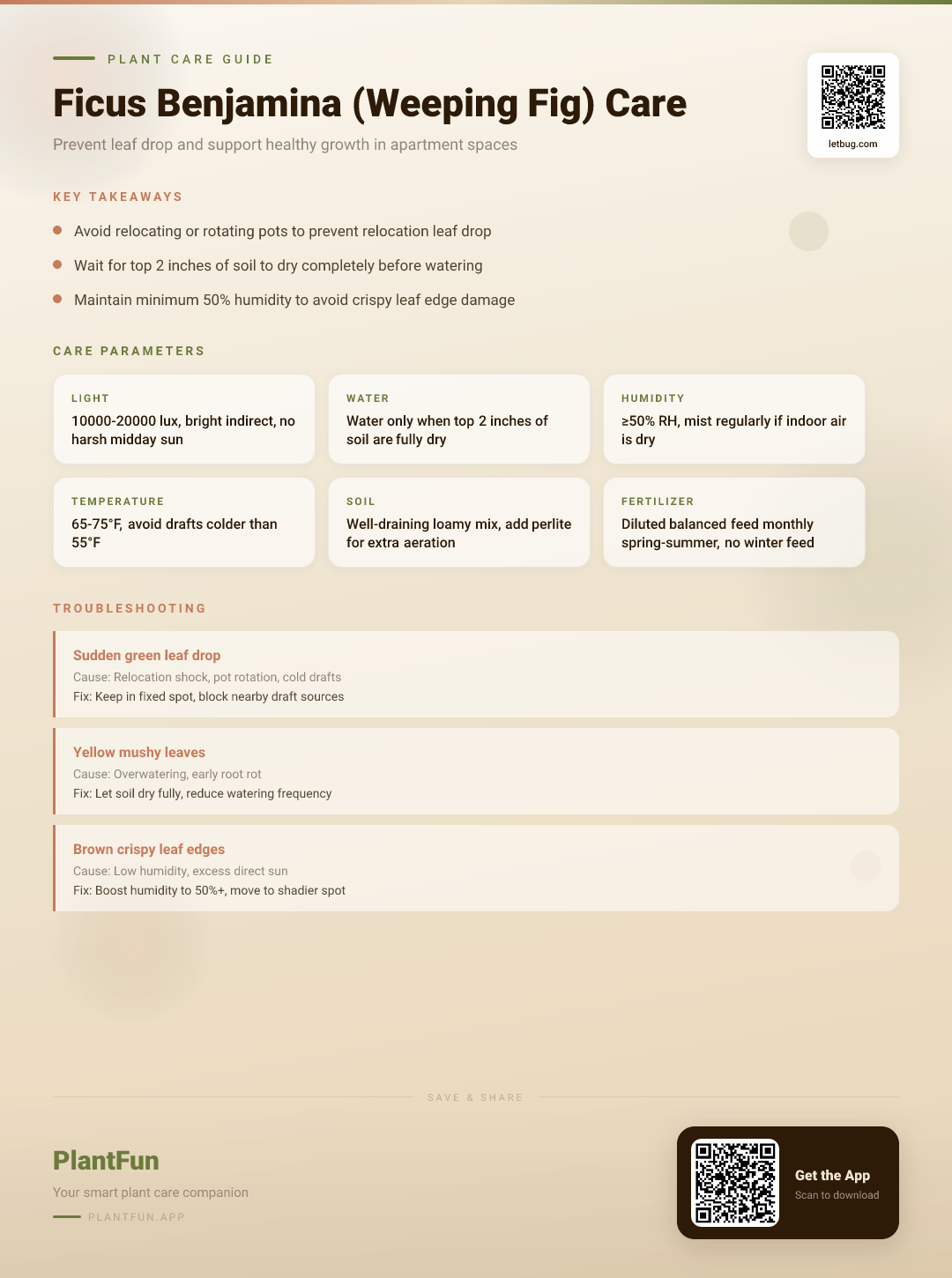
Key Takeaways
- Check soil moisture before watering — overwatering is the #1 killer of houseplants.
- Ensure your plant gets the right amount of light for its species.
- Be patient with recovery — most plants need 2–4 weeks to bounce back.
Quick Care Card: Essential Thresholds for Success
| Feature | Requirement |
|---|---|
| Light | 10,000–20,000 Lux (Bright, indirect) |
| Water | Allow top 2 inches of soil to dry out |
| Humidity | 50% or higher |
| Temperature | 65°F–80°F (18°C–27°C) |
| Soil | Well-draining, peat-based potting mix |
| Fertilizer | Balanced liquid feed during growing season |
| Toxicity | Toxic to cats and dogs (ASPCA, 2026) |
TL;DR: The Ficus Benjamina Survival Protocol
If your Ficus is shedding leaves, it is signaling stress, usually from an abrupt change in light or moisture. To stop the leaf drop, move your plant to a stable, bright spot (avoiding direct hot rays), maintain humidity above 50%, and water only when the top 2 inches of soil are dry. Do not rotate the pot. Consistency is the primary cure for the Weeping Fig.
Why Apartment Living Challenges the Weeping Fig
When I first brought a Ficus Benjamina into my apartment years ago, I made the mistake of placing it in a “decorative” corner away from windows. Within three weeks, the floor was covered in yellowing, fallen leaves. I learned the hard way that the Weeping Fig is a creature of habit. In an apartment, the main enemies are artificial climate fluctuations, specifically the dry air from central heating and the low light intensity in typical living rooms.
Understanding the 10,000-20,000 Lux Requirement
Ficus Benjamina demands high light levels to maintain its foliage. In many apartments, the light level drops below 5,000 lux, which triggers the plant to shed leaves it can no longer support through photosynthesis (NC State Extension, 2026). If you don’t have a light meter, imagine the light intensity required to comfortably read a book without strain—that is the baseline your Ficus needs. Place your tree within 3 feet of a south or east-facing window.
The 50% Humidity Rule: Why Your Apartment Air is Too Dry
Most indoor apartments hover between 20-30% humidity, especially during winter months when heaters are running. This is arid for a plant native to tropical and subtropical climates. Dry air causes the stomata (tiny pores on leaves) to close, inducing stress and leaf drop. Use a humidifier to maintain a constant 50% relative humidity.
Watering Mastery: Avoiding the 2-inch Top-Soil Trap
Overwatering is the fastest way to kill a Ficus. According to Bolton (1984), excess moisture in the root zone is a primary catalyst for root rot.
- The Quick Test: Before watering, stick your index finger 2 inches into the soil. If it feels damp, wait. Only if it feels dry to that depth should you water.
- Drainage: Always use a pot with drainage holes. If water sits at the bottom, pathogens will thrive (Bolton, 1984).
Step-by-Step: Managing Ficus Benjamina ‘Relocation Shock’
- Placement: Choose one spot and keep it there. Moving a Ficus disrupts its light orientation.
- Monitoring: For the first 14 days, check soil moisture every 2 days.
- Pruning: If the plant is heavily stressed, remove only dead or crispy branches to encourage energy redirection.
- Acclimatization: If you recently moved the plant from a greenhouse, expect a 10-15% leaf drop as it adapts to the new light levels.
Seasonal Care Calendar: From Central Heating to Summer Growth
- Spring/Summer: This is the primary growth phase. Increase water slightly and apply a balanced houseplant fertilizer every 4-6 weeks (NC State Extension, 2026).
- Autumn/Winter: Growth slows down. Reduce watering and halt fertilization. Ensure the plant is not in the path of a forced-air vent or a drafty doorway.
Common Mistakes: Stop Rotating Your Pot Today
- Mistake: Rotating the pot to “get even light.”
- What happens: The plant spends energy adjusting its leaf orientation to the changing light direction, causing leaves to drop.
- Instead: Choose one orientation and leave it. If you must clean the leaves, return the pot to the exact same degree mark on your floor.
Voice Search FAQ: Why is my Ficus dropping green leaves?
If your Ficus is dropping green leaves, it is almost always a sign of overwatering or a sudden cold draft. Check the soil drainage immediately; if it is waterlogged, the roots are suffocating (Bolton, 1984).
Voice Search FAQ: How often should I water my Ficus in an apartment?
There is no set day of the week. Instead, follow the 2-inch rule. In a typical apartment with average airflow, this often equates to every 7-10 days, but always test the soil moisture first.
Voice Search FAQ: Can I fertilize my Ficus in the winter?
It is best to wait. Fertilizer triggers growth; in the winter, lower light levels mean the plant cannot support new, rapid growth. Wait for the natural increase in day length in late March.
Advanced Care: Pruning for a Fuller, Resilient Crown
Pruning is not just for aesthetics; it helps air circulate through the inner canopy. Use clean, sharp shears to snip back stems just above a leaf node. This stimulates the plant to push out two new branches, creating a bushier, more structurally sound indoor tree.
References: Botanical Data and Horticultural Best Practices
- ASPCA. (2026). Toxic and Non-Toxic Plants List — ASPCA. https://www.aspca.org/pet-care/animal-poison-control/toxic-and-non-toxic-plants. Accessed 2026-03-13.
- Bolton, A. (1984). Root Rot of Ficus benjamina. Plant Disease. https://doi.org/10.1094/pd-69-816. Accessed 2026-03-13.
- Bolton, A. (1984). Root Rot of Ficus benjamina. Plant Disease. https://doi.org/10.1094/pd-68-816. Accessed 2026-03-13.
- NC State Extension. (2026). Ficus Benjamina — NC State Extension Gardener Plant Toolbox. https://plants.ces.ncsu.edu/plants/benjamina-care/. Accessed 2026-03-13.
Optional Helper: Plantfun.App
Plantfun.App identifies your plants by photo, diagnoses pests and diseases with clear fixes, and creates personalised watering and light schedules that adapt to your home conditions — a handy companion for putting this guide into daily practice.
Found an error or have suggestions? We'd love your feedback.
Need help identifying this problem?
Get instant identification, personalized care schedules, and effective pest treatment plans directly on your phone.
Sponsored • We may earn a commission from app downloads
Related Guides
The Complete Ficus Benjamina Care Checklist for Resilient Growth in Urban Apartments
Stop losing your ficus to apartment stress. Get 12 actionable checklist items, exact light/water thresholds, and simple fixes to grow a resilient, full Ficus Benjamina.
Care GuideThe Complete Ficus Benjamina Care Checklist for Resilient Growth in Typical Apartments
Stop losing Ficus Benjamina leaves to apartment stress. Get 4 actionable seasonal care routines, measurable light/water thresholds, and a free printable checklist to boost steady, resilient growth year-round.
Care GuideThe Complete Ficus Benjamina Care Checklist for Resilient Growth in Small Apartments
Stop losing your Ficus Benjamina to tricky apartment growing conditions. Get 8 budget-friendly checklist items, exact care thresholds, and a seasonal guide to keep it lush and drop-free all year.
Pest ControlAnts on Plants: What They Mean and What to Do
Ants usually aren't eating your plant. They are farming other pests.