
Key Takeaways
- Check soil moisture before watering — overwatering is the #1 killer of houseplants.
- Ensure your plant gets the right amount of light for its species.
- Be patient with recovery — most plants need 2–4 weeks to bounce back.
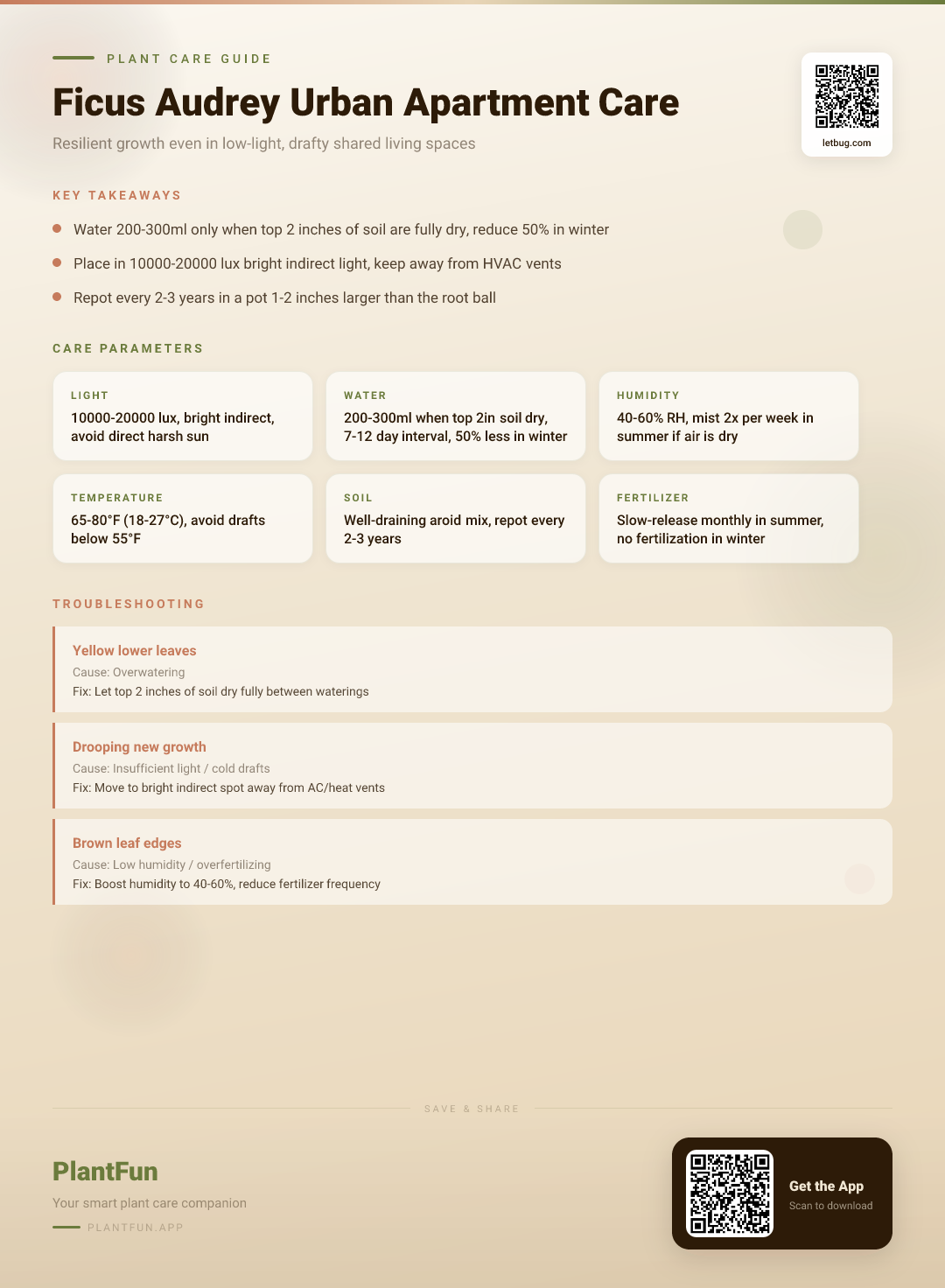
Quick Care Card: At-a-glance printable cheat sheet with all measurable care thresholds for Ficus Audrey in urban apartments for easy reference
| Care Parameter | Exact Urban Apartment Threshold |
|---|---|
| Light | 10,000-20,000 lux bright indirect light, no unfiltered midday sun |
| Water | 200-300ml only when top 2 inches of soil are fully dry (7-12 days, season-dependent) |
| Humidity | 40-60% relative humidity |
| Temperature | 65-80°F (18-27°C), avoid swings of more than 5°F |
| Soil | Well-draining aroid mix (3 parts coco coir, 2 parts perlite, 1 part orchid bark) |
| Fertilizer | Diluted 10-10-10 NPK slow-release, once monthly spring/summer, none winter |
| Toxicity | Toxic to cats, dogs, and humans if ingested (ASPCA, 2026) |
Why Ficus Audrey Struggles in Typical Apartments
Standard Ficus Audrey care guides are written for ideal home conditions, not the unique stressors of small urban apartments. The three most common unaddressed pain points are:
- Shared HVAC drafts that cause sudden temperature swings, which Ficus Audrey has very low tolerance for
- Limited southern light blocked by adjacent buildings, which fails to meet Ficus Audrey light requirements for steady growth
- Irregular renter watering schedules (from travel, busy work weeks, or forgetfulness) that lead to either root rot or chronic underwatering
Myth vs Reality: Myth: Ficus Audrey needs full direct sun to grow. Reality: In urban apartments, unfiltered direct sun through double-paned glass will scorch leaves; bright indirect light is far better for resilient growth (NC State Extension, 2026). This guide is tailored exclusively to these apartment-specific challenges, so you don’t waste time testing generic advice that doesn’t work for your space.
Step 1: Diagnose Your Ficus Audrey’s Current Health
Catch stress early before it leads to permanent leaf drop or root death with these three easy-to-spot early warning signs:
Yellow lower leaves
Symptom: Pale, mushy yellow leaves falling exclusively from the bottom of the plant
Likely cause: Overwatering and early-stage root rot
Fix:
- Stop watering immediately
- Tip the pot slightly to drain any standing water from the saucer
- Check roots after 3 days; trim any brown, mushy roots and repot in fresh dry soil if needed (Ficus Audrey yellow leaves fix)
Drooping new growth
Symptom: Soft, curling new leaves that droop even immediately after watering
Likely cause: Insufficient light or exposure to cold drafts
Fix:
- Move the plant 1-2 feet closer to a bright window
- Check for nearby AC vents or exterior doors that may be blowing cold air, and relocate if needed
Brown leaf edges
Symptom: Crispy, light brown edges on fully grown, mature leaves
Likely cause: Low humidity or fertilizer salt buildup
Fix:
- Fill a pebble tray under the pot to raise local humidity
- Flush soil with 3x the pot volume of water to remove excess salt if you have fertilized in the last 30 days
Step 2: Light Adjustment for Apartment Placement
Ficus Audrey needs 10,000-20,000 lux of bright indirect light to support steady, resilient growth (NC State Extension, 2026). Quick test: Hold your hand 1 foot from your chosen spot at noon on a sunny day. If you cast a faint, soft-edged shadow, the light level is perfect. Follow these placement tips for every window orientation:
- South-facing window: Place 3-5 feet back from the glass, with a sheer curtain to filter harsh midday sun to avoid leaf scorch
- East-facing window: Place 1-2 feet from the glass; gentle morning sun requires no filtering and is ideal for Ficus Audrey apartment placement
- West-facing window: Place 2-4 feet back from the glass, and add a thin curtain if late afternoon sun hits the plant directly for more than 1 hour per day
- North-facing window: Place within 1 foot of the glass, and add a full-spectrum grow light 12 inches above the plant for 10 hours per day if you measure light below 10,000 lux
Step 3: Watering Schedule Built for Irregular Renter Routines
How often to water Ficus Audrey depends on season and light levels, but the rule of thumb for apartment renters is simple: Water 200-300ml only when the top 2 inches of soil are fully dry (NC State Extension, 2026). This translates to every 7-10 days in spring and summer, and every 10-12 days in fall and winter for most apartments. Quick test: Stick your index finger 2 inches deep into the soil. If no moisture sticks to your skin, it’s time to water. For renters who travel frequently: Use a terracotta self-watering spike set to release 50ml of water per day for up to 2 weeks. Avoid overfilling spikes, as this is a common cause of root rot. This schedule is designed for Ficus Audrey root rot prevention, even if you occasionally forget to water for a few extra days.
Step 4: Humidity & Temperature Tweaks for Shared HVAC
Ficus Audrey humidity needs fall between 40-60% relative humidity, and it prefers a steady temperature range of 65-80°F (18-27°C) (Banik et al., 2020). Shared HVAC systems often drop humidity to 20-30% in winter and cause sudden temperature swings of 10°F or more, which trigger leaf drop. Use these low-effort renter-friendly fixes:
- Place a 1-inch deep pebble tray under the pot, filled with water just below the top of the pebbles (make sure the pot is not sitting directly in standing water)
- Group your Ficus Audrey with 2-3 other plants to raise local humidity by 10-15% naturally
- Run a small desktop humidifier near the plant for 2 hours per day in winter if your hygrometer reads below 40% RH
- Keep the plant at least 3 feet away from AC vents, radiators, and exterior doors to avoid draft exposure, as Ficus Audrey draft tolerance is extremely low
Step 5: Soil & Repotting Rules for Small Spaces
Ficus Audrey grows best in a well-draining aroid soil mix: 3 parts coco coir, 2 parts perlite, and 1 part orchid bark. This mix drains fast enough to prevent root rot, even if you accidentally overwater once. To save valuable apartment shelf space and support faster growth, follow these repotting rules:
- Only repot every 2-3 years, when you see roots growing out of the drainage holes at the bottom of the pot
- Choose a pot only 1-2 inches larger than the current root ball; oversized pots hold excess moisture that causes root rot
- Ficus Audrey prefers being slightly root bound, which actually encourages faster new growth (NC State Extension, 2026). This is the easiest trick for how to make Ficus Audrey grow faster without extra fertilizer.
Seasonal Care Calendar for Apartments
Adjust your care routine with these month-by-month tweaks tailored to urban apartment HVAC and light changes:
- Winter (December-February): Reduce watering by 50%, only water when the top 3 inches of soil are dry. Move the plant at least 2 feet away from drafty exterior windows, and skip all fertilizer (core Ficus Audrey winter care rule).
- Spring (March-May): Resume regular watering, add your first dose of diluted slow-release fertilizer, and prune any dead or yellowed leaves to encourage new growth.
- Summer (June-August): Mist leaves 2x per week to raise humidity, add slow-release fertilizer once per month, and check soil moisture every 5 days to adjust for Ficus Audrey summer watering needs.
- Fall (September-November): Gradually reduce watering frequency, stop all fertilizer by mid-October, and move the plant away from AC vents if you switch your HVAC to heat.
Common Apartment Care Mistakes to Avoid
These 5 frequent mistakes are the top reasons Ficus Audrey fails to thrive in small apartments:
- Mistake: Placing your plant directly next to AC or heat vents What happens: Sudden temperature swings of 10°F or more cause massive, sudden leaf drop (the most common answer to “why is my Ficus Audrey dropping leaves” for apartment renters) Instead: Keep your plant at least 3 feet away from all HVAC vents and exterior entry doors
- Mistake: Overfertilizing to speed up growth What happens: Salt buildup in the soil burns roots, leading to brown leaf edges and stunted growth Instead: Use diluted 10-10-10 NPK slow-release fertilizer only once per month in spring and summer
- Mistake: Repotting your Ficus Audrey every year What happens: Disturbing the root system causes transplant shock, and oversized pots take up unnecessary shelf space Instead: Repot only every 2-3 years, when roots grow out of the drainage holes
- Mistake: Moving your plant frequently to different spots around your apartment What happens: Ficus Audrey takes 2-3 weeks to acclimate to new light and temperature conditions; frequent moves cause chronic stress and leaf drop Instead: Pick one permanent spot that meets light requirements, and only move it if you discover draft exposure or insufficient light
- Mistake: Ignoring pest signs that spread from shared apartment spaces What happens: Thrips and spider mites spread easily from shared hallways, neighbor’s plants, and package deliveries, and can infest your entire plant collection quickly (Hassan, 2020) Instead: Wipe leaves with a damp cloth once per week, and check leaf undersides for tiny black or brown spots at every watering
FAQ: Voice-Search Optimized Answers
Can I put my Ficus Audrey in a north-facing apartment window?
Yes, as long as it is placed within 1 foot of the window. If you measure light levels below 10,000 lux, add a full-spectrum grow light 12 inches above the plant set to run for 10 hours per day. For Ficus Audrey care for beginners, an east-facing window is the most low-effort choice if you have one available.
Why is my Ficus Audrey dropping leaves after I moved into a new apartment?
Sudden changes in light, temperature, or humidity are the most common cause. First, check if the plant is near an HVAC vent or exterior door that is exposing it to drafts, as Ficus Audrey draft tolerance is very low. Give the plant 2-3 weeks to acclimate to its new spot before making any other care changes; leaf drop should stop once it adjusts.
How often to water Ficus Audrey in the winter?
Cut your regular watering amount by 50% in winter, and only water when the top 3 inches of soil are completely dry. For most urban apartments, this translates to every 12-18 days, depending on your indoor heat levels.
Is Ficus Audrey safe for my cat?
No, Ficus Audrey is toxic to cats, dogs, and humans if ingested, as its sap contains calcium oxalate crystals that cause mouth pain, vomiting, and diarrhea (ASPCA, 2026). Keep the plant on a high shelf or stand out of reach of pets and small children.
Printable Resilient Growth Checklist
Tape this fillable checklist near your Ficus Audrey to track care tasks and catch stress early: ☐ Weekly: Check top 2 inches of soil for moisture, wipe leaves with a damp cloth to remove dust and check for pests ☐ Bi-weekly: Check humidity levels with a hygrometer, refill pebble tray if humidity is below 40% RH ☐ Monthly (spring/summer only): Add diluted slow-release fertilizer, check for roots growing out of drainage holes ☐ Seasonal: Adjust watering schedule for winter/summer, move plant away from drafts when switching HVAC settings ☐ Stress check: Inspect for yellow lower leaves, drooping new growth, and brown leaf edges every time you water
References
- NC State Extension. (2026). Ficus Audrey — NC State Extension Gardener Plant Toolbox. https://plants.ces.ncsu.edu/plants/audrey-care/. Accessed 2026-03-04.
- Banik, B.; Debbarma, S.; Majumdar, K. (2020). A new distributional record of Ficus altissima Blume (Moraceae) in Tripura: an occasionally confused fig species with Ficus benghalensis L. Plant Science Today. https://doi.org/10.14719/pst.2020.7.4.896. Accessed 2026-03-04.
- Hassan, M. (2020). ECOLOGICAL STUDIES ON THRIPS, GYNAIKOTHRIPS FICORUM (MARCHAL) (THYSANOPTERA: PHLOETHRIPIDAE) INFESTING FICUS TREES, FICUS BENJAMINA. Menoufia Journal of Plant Protection. https://doi.org/10.21608/mjapam.2020.171261. Accessed 2026-03-04.
- ASPCA. (2026). Toxic and Non-Toxic Plants List — ASPCA. https://www.aspca.org/pet-care/animal-poison-control/toxic-and-non-toxic-plants. Accessed 2026-03-04.
Optional Helper: Plantfun.App
Plantfun.App identifies your plants by photo, diagnoses pests and diseases with clear fixes, and creates personalised watering and light schedules that adapt to your home conditions — a handy companion for putting this guide into daily practice.
Found an error or have suggestions? We'd love your feedback.
Need help identifying this problem?
Get instant identification, personalized care schedules, and effective pest treatment plans directly on your phone.
Sponsored • We may earn a commission from app downloads
Related Guides
The Complete Ficus Audrey Care Checklist for Thriving Growth in East-Facing Urban Apartments
Stop losing Ficus Audrey leaves to tricky apartment growing conditions. Get our 10-step printable checklist, exact light, water, and humidity specs for resilient, lush growth all year.
Care GuideThe Complete Ficus Audrey Care Checklist for Resilient Growth in Typical Urban Apartments
Stop dealing with Ficus Audrey leaf drop and stunted growth. Grab our apartment-specific seasonal care checklist with exact light, water, and humidity parameters to keep your tree thriving year-round.
Care GuideThe Complete Ficus Audrey Care Checklist for East-Facing Apartments: Grow Resilient Lush Foliage
Stop losing leaves on your Ficus Audrey. Get exact light lux levels, watering amounts, and a mistake-proof 8-step checklist for resilient growth in your standard east-facing apartment.
Pest ControlAnts on Plants: What They Mean and What to Do
Ants usually aren't eating your plant. They are farming other pests.