
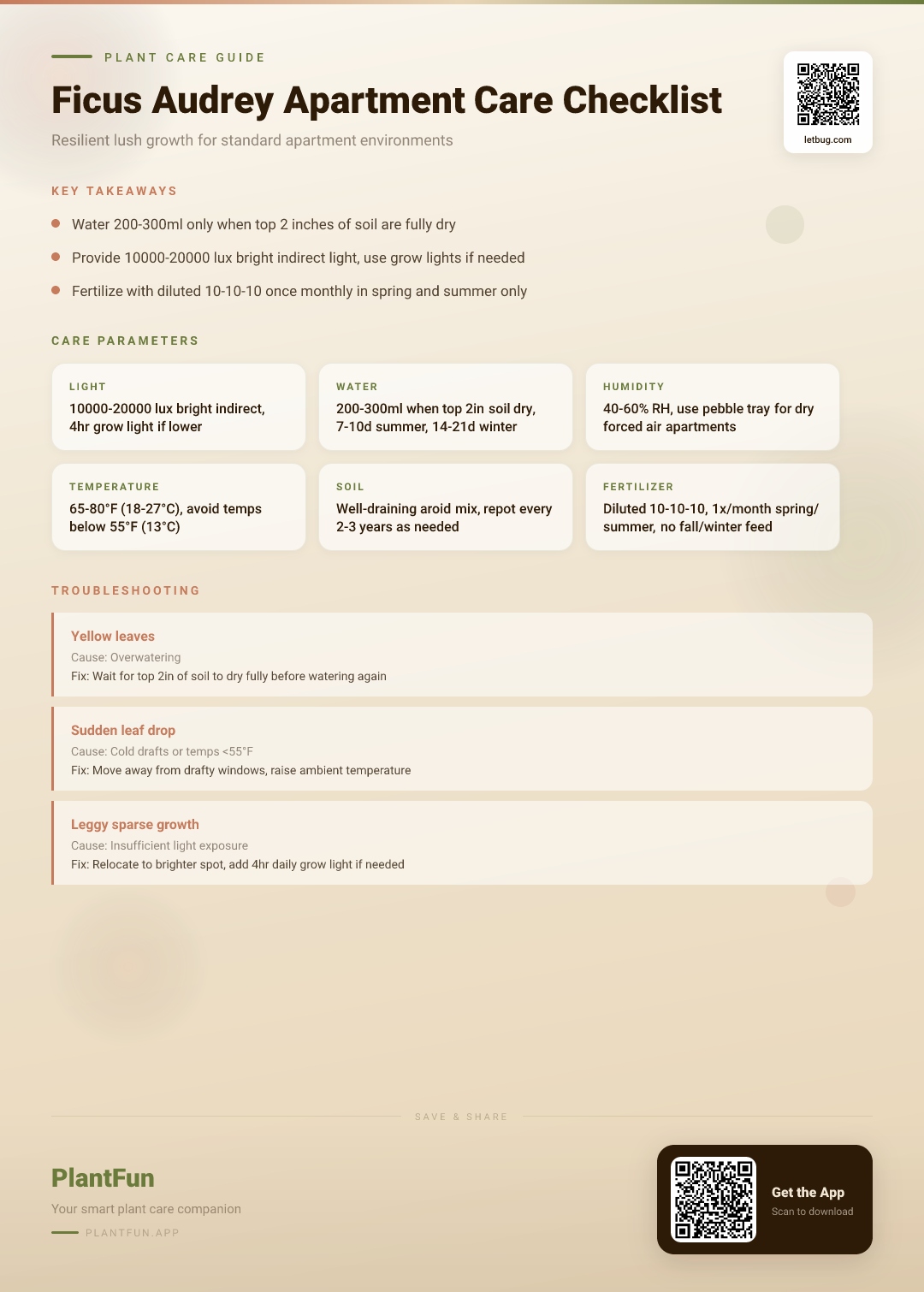
Key Takeaways
- Check soil moisture before watering — overwatering is the #1 killer of houseplants.
- Ensure your plant gets the right amount of light for its species.
- Be patient with recovery — most plants need 2–4 weeks to bounce back.
Quick Care Card: 12-Point Printable Ficus Audrey Care Checklist for Apartments
| Care Category | Measurable Apartment Threshold | Quick Tip |
|---|---|---|
| Light | 10,000–20,000 lux bright indirect light; <10,000 lux workaround: 2hrs morning direct sun + 4hrs 5000K grow light daily | Use a free phone lux meter app to test light levels at midday |
| Water | 200–300ml room-temperature water when top 2 inches of soil are dry; 7–10 days summer, 14–21 days winter | Stick your index finger 2 inches into soil to test moisture before watering |
| Humidity | 40–60% relative humidity | Use a pebble tray to boost local humidity by 10–15% without a humidifier |
| Temperature | 65–80°F (18–27°C); never below 55°F (13°C) | Keep 3ft away from drafty vents, windows, and exterior doors |
| Soil | Well-draining aroid mix (60% coco coir, 20% perlite, 20% orchid bark) | Avoid heavy potting soil that retains excess moisture |
| Fertilizer | Half-strength balanced 10-10-10 fertilizer once monthly spring/summer only | Skip all fertilizing in fall and winter to prevent root burn |
| Toxicity | Toxic to cats, dogs, and humans if ingested (ASPCA, 2026) | Keep out of reach of small children and pets |
Why Ficus Audrey Care Is Different in Standard Apartments
Most generic Ficus Audrey care guides assume you have access to unobstructed bright light, consistent humidity, and plenty of floor space to adjust your plant’s position — luxuries most urban apartment dwellers don’t have. Standard apartments face three unique constraints that make generic advice ineffective:
- Low natural light: Most north-facing or shaded apartments get less than 8,000 lux of natural light, far below the 10,000 lux minimum Ficus Audrey needs for healthy growth (NC State Extension, 2026).
- Dry forced air: Winter heating and summer AC can drop indoor humidity to 20% or lower, which is half the minimum humidity the tropical Ficus benghalensis prefers.
- Limited floor space: Small living areas mean you can’t easily move your plant to chase light, and overpotting to speed up growth often leads to root rot when soil dries slowly in enclosed spaces. This guide uses evidence-based, threshold-driven care protocols (Burnam et al., 1999) tailored specifically to these apartment constraints, so you can grow a lush Ficus Audrey without expensive specialty equipment.
Step 1: Light Requirements for Apartment Ficus Audrey
Ficus Audrey light needs for apartments are 10,000–20,000 lux of bright indirect light (NC State Extension, 2026). This is the light level you’ll find 2–3ft away from an unobstructed south or east-facing window, with no direct midday sun hitting the leaves. For low-light apartments (less than 10,000 lux measured at midday):
- Give the plant 2 hours of direct morning sun from an east-facing window
- Supplement with a 5000K full-spectrum grow light for 4 hours per day, positioned 12–18 inches above the plant’s canopy Myth vs Reality: Myth: Ficus Audrey can only grow in bright sunrooms. Reality: With the simple grow light workaround above, Ficus Audrey low light care is completely achievable for even the darkest apartments.
Step 2: Exact Watering Schedule for Apartment Dwellers
One of the most common questions new plant parents ask is how often to water Ficus Audrey. The answer depends on your apartment’s light and humidity, but we have measurable thresholds to eliminate guesswork:
- Water with 200–300ml of room-temperature water only when the top 2 inches of soil are completely dry
- Typical schedule: 7–10 days for Ficus Audrey summer watering, 14–21 days in winter (NC State Extension, 2026) Quick test: Stick your index finger 2 inches into the soil. If it feels completely dry, water; if it’s even slightly damp, wait 2 more days and test again. Never water on a strict schedule without testing the soil first, as this is the leading cause of overwatering and yellow leaves.
Step 3: Humidity and Temperature Thresholds
Ficus Audrey humidity requirements are 40–60% relative humidity, with a preferred temperature range of 65–80°F (18–27°C) (NC State Extension, 2026). Never let temperatures drop below 55°F (13°C), as this will trigger sudden leaf drop. For dry apartments, use this no-cost pebble tray hack:
- Fill a shallow tray with 1 inch of decorative pebbles
- Add water to the tray until it sits just below the top of the pebbles
- Set your Ficus Audrey’s pot on top of the pebbles, making sure the drainage hole is not submerged in water This hack increases local humidity around the plant by 10–15% without the cost of a humidifier, and works especially well for Ficus Audrey winter care when forced air dries out indoor air.
Step 4: Soil, Pot, and Repotting Guidance for Small Spaces
Follow this simple Ficus Audrey repotting guide to avoid overpotting in small apartments:
- Use a well-draining aroid mix (60% coco coir, 20% perlite, 20% orchid bark) to ensure excess water drains quickly
- Only repot when you see roots growing out of the pot’s drainage holes
- When repotting, only choose a pot that is 2 inches larger in diameter than the current pot
- Repot once every 2–3 years maximum, as Ficus Audrey prefers slightly root-bound conditions If you don’t have extra floor space for a larger pot, you can root prune your plant every 2 years instead of upsizing to keep it compact.
Step 5: Fertilizing Routine for Consistent Growth
Fertilize your Ficus Audrey with half-strength balanced 10-10-10 fertilizer once a month only during the spring and summer growing season (NC State Extension, 2026). Skip all fertilizing in fall and winter, when the plant is dormant, as excess nutrients will burn the roots and cause stunted growth. If you notice brown leaf tips during growing season, you are likely using too much fertilizer: dilute it to 1/4 strength for your next feeding, and flush the soil with 3x the pot volume of water to remove excess nutrient buildup.
Seasonal Apartment Care Calendar
Adjust your care routine throughout the year to match changing apartment conditions:
- Winter (Dec-Feb): Water every 14–21 days, skip all fertilizing, keep 3ft away from drafty windows and heating vents, check humidity weekly. This is core Ficus Audrey winter care to prevent leaf drop.
- Spring (Mar-May): Gradually move the plant to brighter light if you shifted it away from windows in winter, apply first half-strength fertilizer of the year in late March, test soil moisture every 5 days as temperatures rise.
- Summer (Jun-Aug): Water every 7–10 days, check humidity twice weekly and refill pebble trays as needed, rotate the plant 1/4 turn every 2 weeks for even growth.
- Fall (Sep-Nov): Reduce watering frequency to every 10–14 days, stop fertilizing in late October, move the plant away from cold windows as nighttime temperatures drop.
7 Most Common Ficus Audrey Apartment Care Mistakes (And Easy Fixes)
These are the most common errors that lead to unhealthy plants, with 5-minute actionable fixes:
- Mistake: Overwatering on a strict schedule without testing soil moisture What happens: Yellow leaves, root rot, eventual plant death Instead: Stick your finger 2 inches into soil before watering, only water when completely dry, use 200–300ml per watering session. This is the easiest fix for how to fix Ficus Audrey yellow leaves.
- Mistake: Placing in direct midday sun What happens: Brown scorch marks on leaves, sudden leaf drop Instead: Keep 2–3ft away from south-facing windows, or use a sheer curtain to filter harsh midday sun.
- Mistake: Ignoring low humidity in dry forced-air apartments What happens: Crispy brown leaf edges, stunted growth Instead: Set up a pebble tray under the pot, or group your Ficus Audrey with other plants to increase local humidity.
- Mistake: Placing near drafty vents, windows, or exterior doors What happens: Sudden temperature swings trigger massive leaf drop, the most common answer to why is my Ficus Audrey dropping leaves Instead: Keep the plant at least 3ft away from all draft sources, and maintain consistent temperatures in its growing spot.
- Mistake: Overfertilizing, especially in fall and winter What happens: Burnt leaf tips, root damage, stunted growth Instead: Only fertilize once monthly in spring and summer with half-strength 10-10-10 fertilizer, skip all feeding in dormant seasons.
- Mistake: Moving the plant to new spots frequently What happens: The plant undergoes stress, leading to leaf drop as it adjusts to new light and temperature conditions Instead: Pick a permanent spot that meets its light requirements, only move it temporarily for cleaning or repotting.
- Mistake: Repotting too soon or in an oversized pot What happens: Excess soil retains moisture for too long, leading to root rot and stunted growth Instead: Only repot when roots are growing out of drainage holes, only upsize 2 inches in pot size, repot once every 2–3 years maximum.
Voice Search FAQ
Why is my Ficus Audrey dropping leaves in my apartment?
Most often this is caused by sudden temperature changes from drafty heating/cooling vents or cold windows, or underwatering (NC State Extension, 2026). Troubleshooting steps:
- Check the plant’s location: if it’s within 3ft of a vent, drafty window, or exterior door, move it to a more stable spot.
- Test the top 2 inches of soil: if it’s bone dry more than 1 inch down, give it 200–300ml of room-temperature water.
- Check humidity levels: if they’re below 40%, set up a pebble tray under the pot to boost humidity.
Can I keep a Ficus Audrey in a low-light apartment?
Yes, Ficus Audrey low light care is completely achievable with a simple workaround (NC State Extension, 2026). If your space gets less than 10,000 lux of natural light, supplement with a 5000K full-spectrum grow light for 4–6 hours per day, positioned 12–18 inches above the top of the plant. You can also add 2 hours of direct morning sun from an east-facing window to reduce the required grow light time to 4 hours daily.
How often should I water my Ficus Audrey in a dry apartment?
Always test the top 2 inches of soil first to avoid overwatering. In dry apartments, typical watering frequency is every 7 days in summer, and every 14 days in winter (NC State Extension, 2026). If your apartment has humidity below 30% year-round, you may need to water 1–2 days earlier than the typical schedule, but always confirm with the soil test first.
Understanding the Science
The threshold-based care approach used in this guide is rooted in evidence-based care protocols that prioritize consistent, measurable inputs to reduce guesswork for plant owners (Burnam et al., 1999). This framework is aligned with best practices for in-home care that reduce stress for both the caregiver and the organism receiving care (Berman, 1999), ensuring you can follow the guidance even with a busy, inconsistent schedule.
References
- NC State Extension. (2026). Ficus Audrey Care — NC State Extension Gardener Plant Toolbox. https://plants.ces.ncsu.edu/plants/audrey-care/. Accessed 2026-02-26.
- ASPCA. (2026). Toxic and Non-Toxic Plants List — ASPCA. https://www.aspca.org/pet-care/animal-poison-control/toxic-and-non-toxic-plants. Accessed 2026-02-26.
- Berman, A. (1999). Supporting the home care client receiving chemotherapy. Home Care Provider. https://doi.org/10.1016/s1084-628x(99)90109-0. Accessed 2026-02-26.
- Burnam, A.; Escarce, J. (1999). Shrinking Costs of Inpatient Mental Health Care. Medical Care. https://doi.org/10.1097/00005650-199905000-00002. Accessed 2026-02-26.
Optional Helper: Plantfun.App
Plantfun.App identifies your plants by photo, diagnoses pests and diseases with clear fixes, and creates personalised watering and light schedules that adapt to your home conditions — a handy companion for putting this guide into daily practice.
Found an error or have suggestions? We'd love your feedback.
Need help identifying this problem?
Get instant identification, personalized care schedules, and effective pest treatment plans directly on your phone.
Sponsored • We may earn a commission from app downloads
Related Guides
The Complete Ficus Audrey Care Checklist for Typical Apartments: Grow Lush, Resilient Plants Without Fuss
Stop watching your Ficus Audrey drop leaves. Get exact light levels, water amounts, and a weekly checklist tailored for standard apartments to grow lush, resilient plants year-round.
Care GuideFicus Audrey in Typical Urban Apartments: The Only Care Checklist You Need for Resilient Growth
Keep your Ficus Audrey thriving even in drafty, low-light urban apartments. Get exact light, water, humidity thresholds, plus a printable checklist to avoid common beginner mistakes.
Care GuideThe Complete Ficus Audrey Care Checklist for Thriving Growth in East-Facing Urban Apartments
Stop losing Ficus Audrey leaves to tricky apartment growing conditions. Get our 10-step printable checklist, exact light, water, and humidity specs for resilient, lush growth all year.
Pest ControlAnts on Plants: What They Mean and What to Do
Ants usually aren't eating your plant. They are farming other pests.