
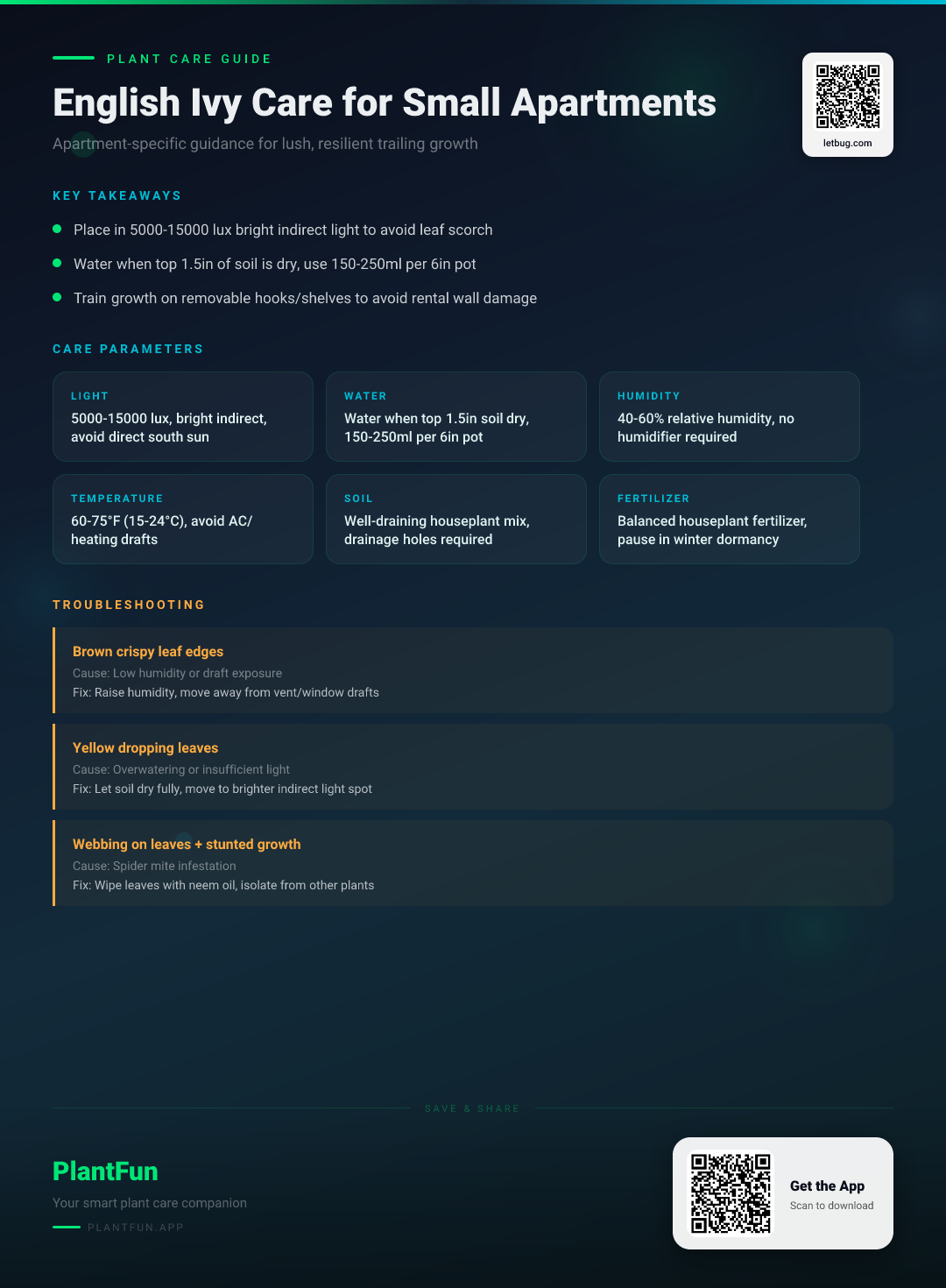
Key Takeaways
- Check soil moisture before watering — overwatering is the #1 killer of houseplants.
- Ensure your plant gets the right amount of light for its species.
- Be patient with recovery — most plants need 2–4 weeks to bounce back.
Quick Care Card: At-a-glance Measurable Parameters for Apartment-Grown English Ivy
| Parameter | Apartment-Specific Threshold |
|---|---|
| Light | 5,000–15,000 lux bright indirect light (faint midday hand shadow) |
| Water | 150–250ml per 6-inch pot, only when top 1.5 inches of soil are dry |
| Humidity | 40–60% relative humidity |
| Temperature | 60–75°F (15–24°C), no sudden swings |
| Soil | 2 parts general potting mix + 1 part perlite + 1 part orchid bark |
| Fertilizer | 10-10-10 NPK diluted to half strength, every 4–6 weeks spring to fall |
| Toxicity | Toxic to cats, dogs, and humans if ingested (ASPCA, 2026) |
Why English Ivy Struggles in Typical Apartments
Standard 500–1,000 sq ft North American apartments have three universal stressors that trip up even experienced plant parents trying to master English ivy care for apartments: forced air heating and cooling that dries air to below 30% relative humidity, limited natural light in interior rooms and north-facing units, and drafty window sills or vent proximity that creates sudden temperature swings. Unlike outdoor-grown ivy, indoor Hedera helix has no buffer for these stressors, which is why so many people report English ivy turning brown or dropping leaves even when following generic care advice (NC State Extension, 2026). If you’ve ever wondered can English ivy grow in apartments, the answer is yes — you just need apartment-specific parameters to eliminate guesswork.
Important safety note: English ivy is toxic to cats, dogs, and humans if ingested, so keep hanging or shelf-placed ivy out of reach of curious pets and small children (ASPCA, 2026).
Step 1: Correct Light Placement for Small Apartments
English ivy light requirements indoors fall between 5,000 and 15,000 lux of bright indirect light, a range proven to preserve variegation and prevent leaf scorch in peer-reviewed research (Kim et al., 2012). The best spots for small apartments are:
- 1–2 feet back from east-facing windows (gentle morning sun, no harsh afternoon heat)
- 3–4 feet back from unobstructed south-facing windows, covered with a sheer curtain to filter direct sun
- North-facing windowsills for low-light tolerant varieties (note that English ivy low light care supports survival at 2,000 lux, but growth will be slower with less trailing length)
Quick test: Hold your hand at plant height at midday. A faint, blurry shadow means you’re in the ideal lux range. A sharp, dark shadow means light is too intense and will scorch leaves, while no shadow means you need to move the plant to a brighter spot or add a grow light. If you need help picking an affordable option, see our roundup of the best compact grow lights for apartments under $50 (https://letbug.com/best-compact-apartment-grow-lights-under-50).
Step 2: Exact Watering Routine for Apartment Conditions
Wondering how often to water English ivy? The answer depends on your heating and cooling cycles, but the rule is simple: only water when the top 1.5 inches of soil are completely dry (stick your index finger into the soil — if it’s dry past your first knuckle, it’s time to water). For a standard 6-inch pot, use 150–250ml of room-temperature water, poured slowly until it drains out the bottom of the pot. Dump any excess water from the saucer after 10 minutes to prevent root rot (NC State Extension, 2026). Adjust for seasons: check soil every 7–10 days in summer when AC is running, and every 2–3 weeks in winter when the plant is dormant.
Step 3: Humidity & Temperature Adjustments
English ivy humidity needs sit at 40–60% relative humidity, and ideal temperatures are 60–75°F (15–24°C) (NC State Extension, 2026). Forced air heating in winter and AC in summer often drop humidity to 20–30% in apartments, which causes brown crispy leaf edges. You don’t need an expensive humidifier to fix this: try these cheap, space-saving hacks:
- Place a 1-inch deep tray of pebbles and water under the pot (make sure the pot is not sitting directly in standing water)
- Group your ivy with other humidity-loving houseplants to create a microclimate. If you’re looking for compatible plants, check out our guide to the best low-maintenance tropical houseplants for apartments (https://letbug.com/best-tropical-apartment-houseplants)
- Mist the leaves 2–3 times a week with room-temperature filtered water
Keep your ivy at least 3 feet away from heating vents, AC units, and drafty old windows to avoid sudden temperature swings that cause leaf drop.
Step 4: Soil & Potting Rules for Small Spaces
English ivy needs well-draining soil to avoid root rot in the slower airflow of apartments. Use a mix of 2 parts general-purpose potting mix, 1 part perlite, and 1 part orchid bark to create air pockets around roots. Always use a pot with a drainage hole — if you prefer a decorative cache pot, add a 1-inch layer of pebbles at the bottom to catch excess drainage water.
For small apartments, opt for space-saving pot options that support trailing English ivy care: hanging macramé planters above windows, floating shelf planters, or wall-mounted planters that keep floor and counter space clear.
Step 5: Fertilizing Schedule for Year-Round Resilient Growth
Wondering how to make English ivy grow faster? Stick to a consistent, gentle fertilizing schedule instead of overfeeding. Use a balanced 10-10-10 NPK houseplant fertilizer, diluted to half the manufacturer’s recommended strength. Apply every 4–6 weeks from March to September during the active growing season. Pause all fertilizing completely from October to February during winter dormancy, as extra nutrients will cause salt buildup in soil that burns root tips (NC State Extension, 2026). This rule is a core part of English ivy winter care that most generic guides skip.
Step 6: Pruning & Training Tips for Apartment Layouts
Prune your ivy 2–3 times a year to prevent overcrowding in small spaces: trim back leggy vines and any growth that is blocking walkways, touching walls, or getting in the way of other plants. Cut ¼ inch above a leaf node to encourage bushier, fuller growth instead of sparse, stringy vines.
For rental apartments, use removable adhesive command hooks to train trailing vines along shelf edges, window frames, or accent walls without drilling holes or damaging paint. Avoid attaching vines directly to painted drywall, as the aerial roots can lift paint over time.
Step 7: Pest Prevention for Shared Apartment Spaces
Shared building HVAC systems spread common ivy pests like spider mites and aphids easily between units. Check the undersides of leaves every 2 weeks for tiny red dots (spider mites) or sticky clear residue (aphids). If you spot an infestation:
- Wipe all leaves with a 50/50 mix of room-temperature water and isopropyl alcohol
- Spray the entire plant with diluted neem oil, following label instructions
- Isolate the plant for 2 weeks to prevent spread to your other plants or neighboring units
For more non-toxic pest treatment tips, read our step-by-step guide to natural pest control for indoor plants (https://letbug.com/natural-indoor-plant-pest-control).
Step 8: Cleaning Routine for Healthy Leaves
Apartment dust builds up on ivy leaves quickly, blocking light absorption and slowing growth. Wipe both sides of leaves with a damp microfiber cloth every 2 weeks, no special cleaning products required. For larger ivy plants, you can also give them a quick rinse in your bathroom sink with lukewarm water, then let them drain completely before returning them to their spot.
7 Most Common Apartment English Ivy Mistakes (And Fast Fixes)
- Mistake: Overwatering on a fixed schedule, regardless of soil moisture What happens: Root rot, yellow leaves, and English ivy dropping leaves Instead: Only water when the top 1.5 inches of soil are dry, and dump excess water from the saucer after 10 minutes
- Mistake: Placing ivy in a dark corner with less than 2,000 lux of light What happens: Leggy, sparse growth, lost variegation, and stunted trailing length Instead: Move to a spot with at least 5,000 lux of bright indirect light, or add a compact grow light for dark rooms
- Mistake: Ignoring early signs of pest infestations What happens: Pests spread to all your houseplants, and ivy can die within 2–3 weeks Instead: Check under leaves biweekly, and treat immediately with alcohol and neem oil at the first sign of pests
- Mistake: Exposing ivy to consistent humidity below 30% What happens: Brown crispy leaf edges and English ivy turning brown Instead: Use a pebble tray, group with other plants, or mist 2–3 times a week to raise humidity
- Mistake: Placing ivy near heating vents, AC units, or drafty windows What happens: Sudden, widespread leaf drop and wilting Instead: Move the plant at least 3 feet away from sources of temperature swings
- Mistake: Potting ivy in a pot with no drainage hole and heavy potting soil What happens: Soggy soil and root rot Instead: Repot into a drainage hole pot with a well-draining perlite-amended soil mix
- Mistake: Fertilizing at full strength in winter What happens: Salt buildup in soil, burnt leaf tips, and stunted growth Instead: Dilute fertilizer to half strength in growing season, and pause all applications in winter
Seasonal Apartment Care Calendar
| Season | Adjustments for Apartment Conditions |
|---|---|
| Spring (March–May) | Fertilize every 4 weeks to support growth spurts, check soil moisture twice a week, prune leggy growth to encourage trailing |
| Summer (June–August) | Follow English ivy summer watering guidelines: check soil every 7 days, mist daily if AC runs constantly, move away from unobstructed south-facing windows to avoid scorch |
| Fall (September–November) | Reduce watering frequency, stop fertilizing after mid-October, trim back overgrown vines before winter |
| Winter (December–February) | Follow English ivy winter care rules: water only when top 2 inches of soil are dry, keep 3+ feet away from heating vents, avoid misting if your apartment is colder than 60°F to prevent fungal growth |
For more seasonal care tips, check out our complete winter houseplant care guide for apartments (https://letbug.com/winter-houseplant-care-guide-for-apartments).
Voice Search Optimized FAQ
Why is my English Ivy dropping leaves in my apartment?
The most common causes are sudden temperature swings from drafts near vents or windows, overwatering, or extremely low humidity below 30% (NC State Extension, 2026). First check your plant’s placement to rule out draft exposure, then test soil moisture to confirm you are not overwatering.
Can I keep English Ivy in my dark apartment bedroom?
English ivy low light care supports survival at light levels as low as 2,000 lux (about the light 3 feet back from a north-facing window), but it will grow slower and may lose variegation (Kim et al., 2012). Add a low-wattage grow light if you want faster trailing growth. Note that ivy is toxic to pets, so keep it out of reach if your cat or dog sleeps in your bedroom (ASPCA, 2026).
How often should I water my English Ivy in the winter?
In winter, when forced air heating dries air but the plant is dormant, water only when the top 2 inches of soil are completely dry. For a standard 6-inch pot, this is usually every 2–3 weeks. Overwatering in winter is the top cause of English ivy turning brown.
Printable Care Checklist Download
Grab our free, no-email-required one-page PDF checklist of all 8 care steps, measurable thresholds, and common mistake fixes to post near your ivy for quick, no-fuss reference. The checklist is formatted to fit on a standard 8.5x11 inch sheet of paper, so you can tape it to the back of a shelf or inside a cabinet near your plant.
References
- NC State Extension. (2026). English Ivy — NC State Extension Gardener Plant Toolbox. https://plants.ces.ncsu.edu/plants/english-ivy/. Accessed 2026-03-07.
- Kim, J.; Kang, S.; Pak, C. (2012). Changes in Leaf Variegation and Coloration of English Ivy and Polka Dot Plant under Various Indoor Light Intensities. HortTechnology. https://doi.org/10.21273/horttech.22.1.49. Accessed 2026-03-07.
- Polito, V.; Chang, Y. (1984). Quantitative nuclear cytology of english ivy (Hedera helix L.). Plant Science Letters. https://doi.org/10.1016/s0304-4211(84)80017-6. Accessed 2026-03-07.
- ASPCA. (2026). Toxic and Non-Toxic Plants List — ASPCA. https://www.aspca.org/pet-care/animal-poison-control/toxic-and-non-toxic-plants. Accessed 2026-03-07.
Optional Helper: Plantfun.App
Plantfun.App identifies your plants by photo, diagnoses pests and diseases with clear fixes, and creates personalised watering and light schedules that adapt to your home conditions — a handy companion for putting this guide into daily practice.
Found an error or have suggestions? We'd love your feedback.
Need help identifying this problem?
Get instant identification, personalized care schedules, and effective pest treatment plans directly on your phone.
Sponsored • We may earn a commission from app downloads
Related Guides
The Complete English Ivy Care Guide for Typical Apartments: Tips for Lush, Resilient Growth
Stop struggling with brown, crispy English Ivy leaves. Get exact light levels, watering amounts, and apartment-specific care hacks that encourage lush, resilient growth year-round.
Care GuideEnglish Ivy Care Checklist: Grow Resilient, Lush Vines in Your Typical Urban Apartment
Stop struggling with crispy, yellowing English ivy in your apartment. Get 8 actionable checklist steps, exact light/water thresholds, and symptom fixes for resilient, trailing vines.
Care GuideEnglish Ivy in Small Urban Apartments: The Budget Care Checklist for Resilient Growth
Grow lush, resilient English Ivy in your small urban apartment without spending a fortune. Get exact light, water, and humidity thresholds plus a free printable weekly care checklist you can use today.
Pest ControlAnts on Plants: What They Mean and What to Do
Ants usually aren't eating your plant. They are farming other pests.