
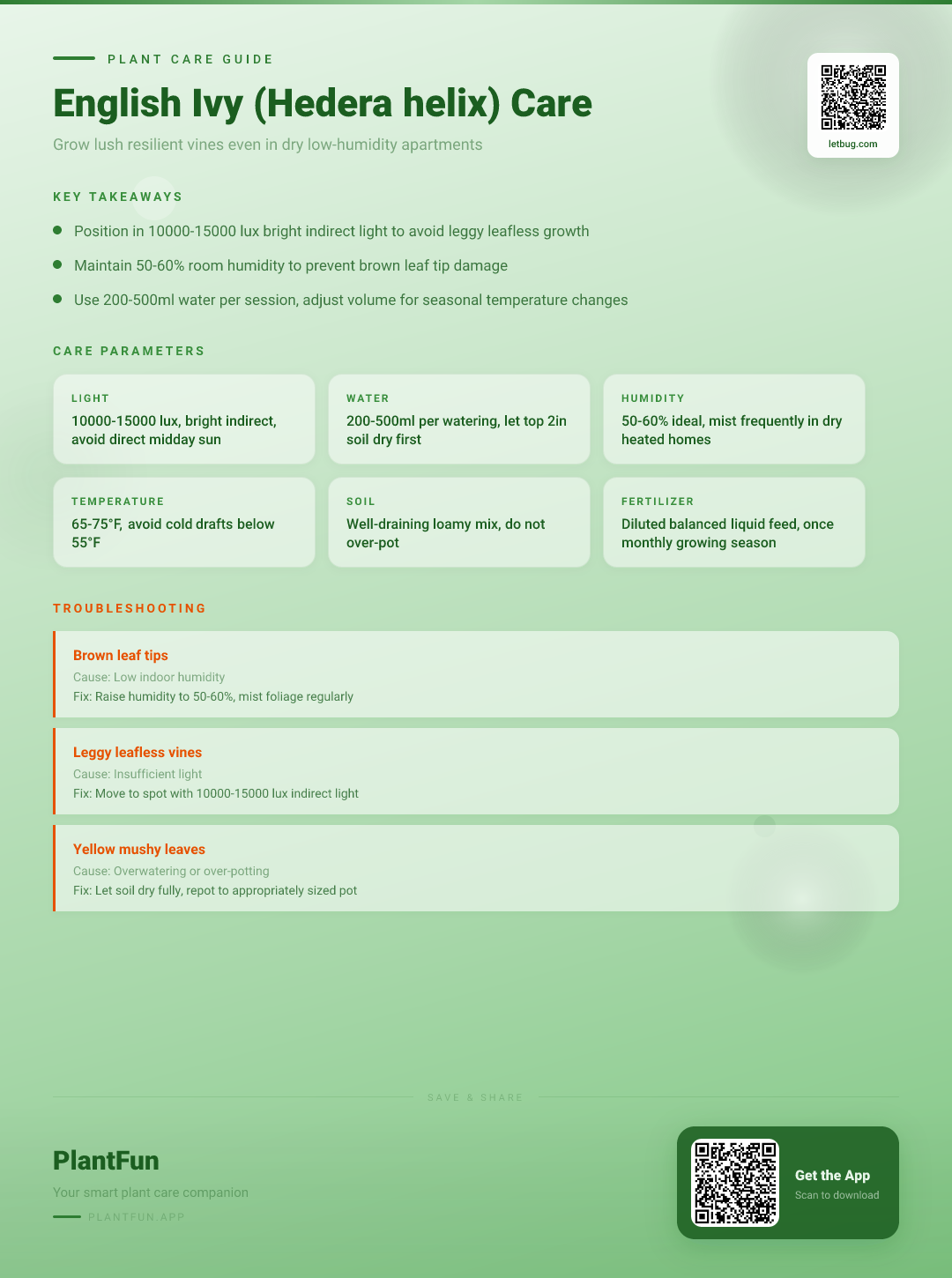
Key Takeaways
- Check soil moisture before watering — overwatering is the #1 killer of houseplants.
- Ensure your plant gets the right amount of light for its species.
- Be patient with recovery — most plants need 2–4 weeks to bounce back.
Quick Care Card: Essential thresholds for English Ivy
| Requirement | Threshold |
|---|---|
| Light | 10,000–15,000 lux (bright, indirect) |
| Water | Allow top 1 inch to dry between waterings |
| Humidity | 50–60% constant |
| Temperature | 65–75°F (18–24°C) |
| Soil | Well-draining, peat-based potting mix |
| Fertilizer | Balanced liquid feed, monthly in summer |
| Toxicity | Toxic to cats and dogs (ASPCA, 2026) |
TL;DR: The golden rule of apartment-grown Ivy
To keep Hedera helix thriving in an apartment, prioritize consistent moisture and high ambient humidity. Avoid the “radiator trap” by keeping plants away from direct heat vents, and ensure they receive at least 10,000 lux of light. When I first started growing ivy, I lost three plants to dry indoor air before realizing that misting does nothing—you need a physical humidity tray or a dedicated room humidifier to stabilize the micro-climate (NC State Extension, 2026).
The Humidity Trap: Why your apartment is sabotaging your Ivy
When I first got my English Ivy, I made the mistake of placing it directly above a radiator. Within a week, the leaves were crisp, brown, and shedding. Apartments are often “deserts” with humidity levels dropping below 30% in winter. English Ivy, which naturally thrives in woodland environments, cannot transpire efficiently in these conditions. When the air is too dry, the plant loses water faster than its roots can pull it up, leading to the dreaded crispy brown tips (NC State Extension, 2026).
Step 1: Diagnosing leaf crisping vs. root rot (The Moisture Check)
Before you change your care routine, you must perform the “knuckle test.” Stick your finger two inches into the soil.
- If it feels soggy/mushy: You have root rot. Reduce watering immediately and check for drainage holes.
- If it feels bone-dry/dusty: You have a hydration deficit. Increase frequency, but never let it sit in standing water.
Step 2: Optimal lighting strategy (10,000–15,000 lux)
Light intensity is the primary driver of variegation and structural health. A study in HortTechnology confirms that indoor light intensities significantly alter leaf coloration and vigor (Kim, Kang, & Pak, 2012). If your ivy is stretching (etiolation), it is starving for light. Aim for a spot near an east-facing window where it gets gentle morning sun.
Step 3: Mastering the 50-60% humidity threshold in living rooms
Since misting only provides a temporary spike, I use a pebble tray. Fill a tray with pebbles and water, then set your pot above the water line. The evaporating water creates a localized humid micro-climate around the leaves. This is the single most effective way to prevent leaf browning on indoor plants in climate-controlled apartments.
Step 4: Watering schedule: When to use 200ml vs 500ml
- Summer/Growth Phase: Use 500ml for a standard 6-inch pot. Ensure water runs out the drainage holes to flush out salt buildup.
- Winter/Dormancy: Use 200ml. The plant is not actively growing, so excess water will stay trapped in the soil, inviting root rot.
Seasonal Calendar: Adjusting for winter radiator heat (65-75°F range)
Winter is the most dangerous time for Hedera helix. As central heating kicks in, keep your ivy at least 5 feet away from HVAC vents. If your apartment hits the 75°F range, increase your watering frequency by 20% to compensate for higher transpiration rates.
Troubleshooting Guide
Leaf Crisping at the Tips
Symptom: Brown, crunchy margins on otherwise green leaves.
Likely cause: Low ambient humidity or erratic watering cycles.
Fix:
- Move the plant away from heat sources.
- Install a small humidifier nearby or use a pebble tray.
Yellowing Leaves
Symptom: Lower leaves turning yellow and dropping.
Likely cause: Overwatering or poor soil aeration.
Fix:
- Check the drainage holes for blockage.
- Allow the soil to dry out significantly before the next soak.
Etiolated (Leggy) Vines
Symptom: Long stems with large gaps between leaves.
Likely cause: Insufficient light intensity.
Fix:
- Move the plant to a brighter location (closer to a window).
- Consider a grow light if natural light is insufficient.
Frequently Asked Questions
- Can I put my English Ivy on a high bookshelf? Yes, but watch for heat buildup near the ceiling. Hot air rises and will dry out your ivy faster than at eye level.
- Is English Ivy safe for my cat? No, the ASPCA lists English Ivy as toxic to both cats and dogs, causing vomiting and drooling (ASPCA, 2026). Always keep it out of reach.
- How do I know if my apartment has enough light? If you cannot comfortably read a book in the spot you’ve chosen for your ivy, it is likely too dark for long-term health.
Common Mistakes: Avoiding the ‘over-potting’ trap
- Mistake: Using a pot that is too large for the root ball.
- What happens: The extra soil holds too much water, preventing oxygen from reaching the roots.
- Instead: Only repot into a container 1-2 inches larger in diameter than the current one.
References
- ASPCA. (2026). Toxic and Non-Toxic Plants List — ASPCA. https://www.aspca.org/pet-care/animal-poison-control/toxic-and-non-toxic-plants. Accessed 2026-03-13.
- Kim, J., Kang, S., & Pak, C. (2012). Changes in Leaf Variegation and Coloration of English Ivy and Polka Dot Plant under Various Indoor Light Intensities. HortTechnology. https://doi.org/10.21273/horttech.22.1.49. Accessed 2026-03-13.
- NC State Extension. (2026). English Ivy — NC State Extension Gardener Plant Toolbox. https://plants.ces.ncsu.edu/plants/ivy-care/. Accessed 2026-03-13.
- Polito, V., & Chang, Y. (1984). Quantitative nuclear cytology of english ivy (Hedera helix L.). Plant Science Letters. https://doi.org/10.1016/s0304-4211(84)80017-6. Accessed 2026-03-13.
Optional Helper: Plantfun.App
Plantfun.App identifies your plants by photo, diagnoses pests and diseases with clear fixes, and creates personalised watering and light schedules that adapt to your home conditions — a handy companion for putting this guide into daily practice.
Found an error or have suggestions? We'd love your feedback.
Need help identifying this problem?
Get instant identification, personalized care schedules, and effective pest treatment plans directly on your phone.
Sponsored • We may earn a commission from app downloads
Related Guides
English Ivy in Apartment Living: The Complete Care Guide for Year-Round Resilient Growth
Transform your apartment into a lush sanctuary. Master English Ivy care with our 4-season routine, light-lux requirements, and proven tips for pest-free growth.
Care GuideEnglish Ivy in a Low-Light Apartment: The Complete Care Guide for Resilient Growth
Revive your English Ivy with expert light and moisture strategies. Discover the 3-step watering rule and exact lux levels for lush, trailing vines in apartments.
Care GuideEnglish Ivy in Apartment Living: The Resilient Growth Guide for Beginners and Pros
Transform your English Ivy into a lush apartment feature with these 4 simple care rules. Master light, soil, and humidity for resilient, pest-free trailing vines.
Pest ControlAnts on Plants: What They Mean and What to Do
Ants usually aren't eating your plant. They are farming other pests.