
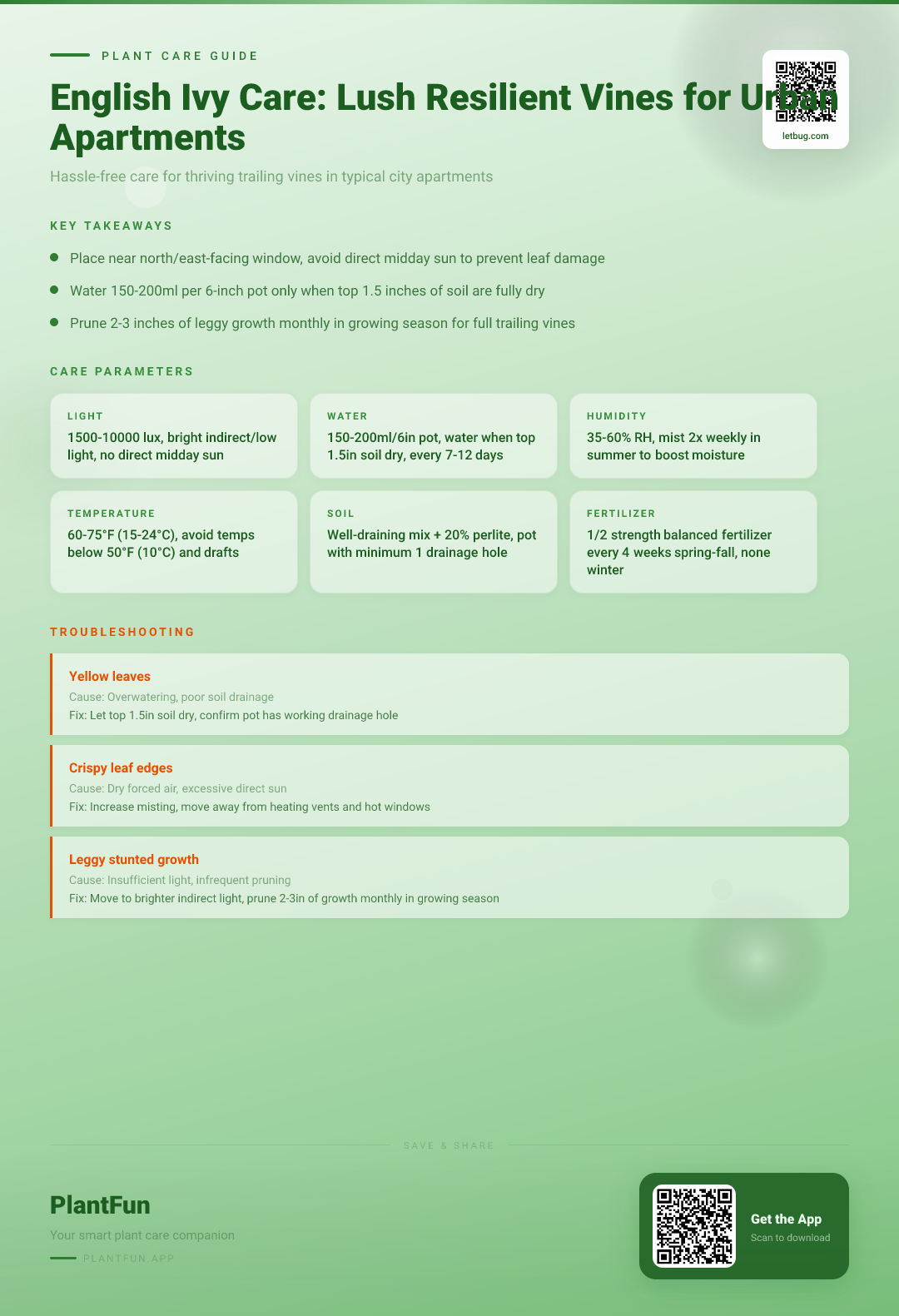
Key Takeaways
- Check soil moisture before watering — overwatering is the #1 killer of houseplants.
- Ensure your plant gets the right amount of light for its species.
- Be patient with recovery — most plants need 2–4 weeks to bounce back.
Quick Care Card: At-a-glance printable checklist of all key care thresholds for apartment English ivy, no fluff
| Care Factor | Exact Apartment Threshold |
|---|---|
| Light | 1,500-10,000 lux (bright indirect to low light), 1-3ft from north/east-facing window |
| Water | 150-200ml per 6-inch pot when top 1.5 inches of soil are dry, every 7-12 days |
| Humidity | 35-60% relative humidity (matches average apartment humidity) |
| Temperature | 60-75°F (15-24°C), never below 50°F (10°C) |
| Soil | 80% general potting mix + 20% perlite, pot with minimum 1 drainage hole |
| Fertilizer | 1/2 strength balanced 10-10-10 fertilizer every 4 weeks, spring through fall only |
| Toxicity | Toxic to cats, dogs, and humans if ingested (ASPCA, 2026) |
Why English Ivy Struggles in Typical Apartments
Many beginner plant owners hear that English ivy is a “hardy” outdoor plant, then are surprised when it dies within weeks indoors. The disconnect comes from generic care advice that doesn’t account for the unique stressors of urban apartments: low light levels, dry forced air, frequent temperature swings, and stagnant airflow (NC State Extension, 2026). Myth vs Reality: Myth: English ivy can’t survive in apartments. Reality: It thrives when care is adjusted to match average apartment conditions, including 35-40% humidity and partial north/east light. This guide cuts through generic advice to give measurable thresholds so you never have to guess at care. If you’re new to houseplant care, check out our beginner’s guide to indoor plant care for foundational tips.
Step 1: Light Requirements for Apartment Ivy
English ivy tolerates a wide range of light levels, from 1,500 lux (dim low light) up to 10,000 lux (bright indirect light) (NC State Extension, 2026). The best placement for apartment dwellers is 1-3 feet away from a north or east-facing window, where it gets soft morning sun and no harsh midday direct sun that burns leaves. Quick test: Hold your hand in the plant’s planned spot at midday. If you cast a sharp, dark shadow, the light is too strong; if you cast no shadow at all, the light is too low for fast trailing growth. For English ivy low light care, it will survive in 1,500 lux (like a dim bedroom with a north window) but will grow slower and have smaller leaves. If you need help measuring light levels, use our free lux measurement guide to get accurate readings.
Step 2: Watering Schedule for Average Apartment Humidity
The #1 question we get is how often to water English ivy in apartments. For a standard 6-inch pot in 35-40% average apartment humidity, water 150-200ml only when the top 1.5 inches of soil are completely dry (NC State Extension, 2026). This works out to every 7-9 days in summer, and every 10-12 days in winter. Quick test: Stick your index finger 1.5 inches into the soil. If it feels completely dry with no moisture at all, it’s time to water; if it’s even slightly damp, wait 2-3 days and check again. Overwatering is the leading cause of death for indoor ivy, so never water on a fixed schedule without checking the soil first. If you notice mushy yellow leaves, you may have early root rot; see our complete root rot fix guide to save your plant.
Step 3: Humidity & Temperature Guidelines
English ivy humidity requirements fall between 35-60% relative humidity, which perfectly matches the average 35-40% humidity of most urban apartments (NC State Extension, 2026). If your apartment runs drier than 35% (common in winter with forced heating), mist the leaves 1-2 times per week to raise local humidity around the plant. Keep temperatures between 60-75°F (15-24°C), and never let the plant sit near drafty windows where temperatures drop below 50°F (10°C) in winter, as this will cause leaf drop.
Step 4: Soil & Potting Rules for Low-airflow Apartments
Stagnant apartment air means soil dries much slower than it does outdoors, so drainage is non-negotiable to prevent root rot. Use a well-draining potting mix made of 80% general purpose houseplant mix and 20% perlite to improve airflow around the roots. Always use a pot with at least 1 drainage hole, and never let standing water sit in the pot saucer for more than 30 minutes after watering.
Step 5: Pruning & Fertilizing for Trailing Growth
To get lush, full trailing vines, follow these simple steps: First, prune 2-3 inches of leggy growth off the end of each stem monthly during the growing season (spring through fall) (NC State Extension, 2026). How to prune English ivy indoors: Use clean, sharp scissors and cut just above a leaf node (the small bump where a leaf attaches to the stem) to trigger new bushy growth. These cuttings can be propagated in water to make new ivy plants. Second, fertilize once every 4 weeks with 1/2 strength balanced 10-10-10 houseplant fertilizer, only from March through September. Never fertilize in winter, when the plant is dormant. For more English ivy trailing growth tips, prune stems that grow straight up to encourage trailing habit.
Symptom-to-Action Troubleshooting Cheat Sheet
Yellow Leaves
Symptom: Soft, mushy yellow lower leaves, often with damp soil at the base of the plant.
Likely cause: Overwatering leading to early root rot, the most common issue for apartment English ivy.
Fix:
- Stop watering immediately, and pour off any standing water in the pot saucer
- If soil remains soggy after 3 days, repot into fresh, dry 20% perlite potting mix, trimming any black, mushy roots with clean scissors
Crispy Brown Edges
Symptom: Dry, brown leaf edges that curl inward, with dry topsoil.
Likely cause: Low humidity, underwatering, or placement near forced air heating/cooling vents.
Fix:
- Give your ivy 150-200ml of water if the top 1.5 inches of soil are completely dry
- Move the plant at least 3 feet away from any heating/cooling vents, and mist leaves 2x weekly if humidity is below 35%
Stunted or Leggy Growth
Symptom: Long, bare stems with large gaps between leaves, or no new growth for 2+ months in spring/summer.
Likely cause: Insufficient light, or skipped pruning leading to sparse growth.
Fix:
- Move the plant to within 3 feet of a north or east-facing window to hit the 1,500-10,000 lux light threshold
- Prune 2-3 inches off the end of each leggy stem just above a leaf node to trigger new bushy growth
Spider Mite Infestation
Symptom: Tiny white or brown specks on leaf undersides, fine webbing between stems, and yellow speckled leaf surfaces.
Likely cause: Stagnant, dry apartment air which creates ideal breeding conditions for spider mites.
Fix:
- Wipe all leaf surfaces with a damp cloth, then spray with diluted neem oil solution once a week for 3 weeks
- Increase airflow near the plant with a small desktop fan on low speed, and mist 2x weekly to raise humidity above 40%
Seasonal Care Adjustment Calendar for Apartments
Winter Care Tweaks (December-February, Northern Hemisphere)
- Reduce watering by 50%: only water when top 2 inches of soil are dry, ~every 10-12 days for a 6-inch pot (English ivy winter care priority is avoiding overwatering)
- Stop all fertilization completely, as the plant is dormant
- Move at least 3 feet away from heating vents, and 1 foot away from drafty windows where temps drop below 50°F
Summer Care Tweaks (June-August, Northern Hemisphere)
- Increase misting to 2x weekly if humidity drops below 35%
- Move 6 inches back from east-facing window glass if you notice sunburned brown spots on leaves
- Check soil moisture every 5 days, as English ivy summer watering may be needed every 7 days instead of 10 in hot weather
Common Apartment Ivy Care Mistakes to Avoid
- Mistake: Overwatering on a fixed schedule instead of checking soil moisture What happens: Soggy soil leads to root rot, the #1 cause of death for indoor English ivy Instead: Only water when the top 1.5 inches of soil are completely dry, using the finger test every 7 days to check
- Mistake: Placing your ivy directly next to forced air heating or cooling vents What happens: Dry moving air strips moisture from leaves in 24-48 hours, leading to widespread crispy edges Instead: Keep all ivy plants at least 3 feet away from vents, and add a small humidifier nearby if your apartment runs very dry
- Mistake: Using full-strength fertilizer or fertilizing in winter What happens: Excess fertilizer burns root tips, leading to stunted growth and brown leaf edges Instead: Use 1/2 strength balanced fertilizer only every 4 weeks from March through September, and skip all fertilization in winter
- Mistake: Skipping pruning for months at a time What happens: Ivy grows long, leggy bare stems with few leaves, and won’t produce the lush trailing growth most owners want Instead: Trim 2-3 inches off the end of each long stem monthly during the growing season to encourage bushy new foliage
FAQ (Voice Search Optimized)
Can I keep my English ivy in a dark apartment bedroom?
Yes, English ivy tolerates low light as low as 1,500 lux, which is typical of dim north-facing apartment bedrooms (NC State Extension, 2026). Note that growth will be slower and less trailing than in brighter indirect light, and you’ll need to water less often to avoid overwatering in low light conditions, so it is a yes to the question of can English ivy survive in apartments with low light.
Why is my English ivy getting crispy edges all of a sudden?
Sudden crispy edges are almost always caused by a drop in humidity or placement near a heating/cooling vent. First, check if the plant is within 3 feet of a vent, then check if the top 1.5 inches of soil are dry (underwatering is another common trigger). If humidity is below 35%, mist 2x weekly to bring it up to the minimum 35% threshold for ivy health.
How often do I need to water my English ivy in winter?
In winter, you’ll need to water your English ivy 50% less often than in summer, typically every 10-12 days for a 6-inch pot (NC State Extension, 2026). Only water when the top 2 inches of soil are completely dry, as lower light and cooler temperatures mean soil dries much slower in winter months.
Next Steps for New Ivy Owners
Use this 30-day action plan to acclimate a new English ivy to your apartment without stress:
- Days 1-7: Place your new ivy 2 feet away from a north or east-facing window, don’t water or fertilize for the first 7 days to let it acclimate to your apartment’s conditions. Check for pests on leaf undersides daily.
- Days 8-14: Do the finger test to check soil moisture, water with 150ml if the top 1.5 inches are dry. Prune any leggy or damaged stems to encourage new growth.
- Days 15-30: Check soil moisture every 7 days, adjust placement if you see signs of too much/too little light. If your apartment humidity is below 35%, start misting 1x weekly. After 30 days, if you see new growth, you can start fertilizing at 1/2 strength if it’s spring or summer.
References
- ASPCA. (2026). Toxic and Non-Toxic Plants List — ASPCA. https://www.aspca.org/pet-care/animal-poison-control/toxic-and-non-toxic-plants. Accessed 2026-02-24.
- NC State Extension. (2026). English Ivy Care — NC State Extension Gardener Plant Toolbox. https://plants.ces.ncsu.edu/plants/english-ivy/. Accessed 2026-02-24.
- Bourgeault, I.; Oandasan, I.; McMurchy, D. (2023). Team Primary Care: Training for Transformation in Canada. International Journal of Integrated Care. https://doi.org/10.5334/ijic.icic23307. Accessed 2026-02-24.
- Ivy, D. (2010). Prostacyclin in the intensive care setting. Pediatric Critical Care Medicine. https://doi.org/10.1097/pcc.0b013e3181d10845. Accessed 2026-02-24.
Optional Helper: Plantfun.App
Plantfun.App identifies your plants by photo, diagnoses pests and diseases with clear fixes, and creates personalised watering and light schedules that adapt to your home conditions — a handy companion for putting this guide into daily practice.
Found an error or have suggestions? We'd love your feedback.
Need help identifying this problem?
Get instant identification, personalized care schedules, and effective pest treatment plans directly on your phone.
Sponsored • We may earn a commission from app downloads
Related Guides
The Complete English Ivy Care Guide for Apartments: Resilient, Lush Growth Year-Round
Grow lush, full English Ivy in your apartment without guesswork. Get exact light levels, watering amounts, and a seasonal care calendar to avoid leggy growth and crispy leaves.
Care GuideEnglish Ivy in Small Urban Apartments: The Budget Care Checklist for Resilient Growth
Grow lush, resilient English Ivy in your small urban apartment without spending a fortune. Get exact light, water, and humidity thresholds plus a free printable weekly care checklist you can use today.
Care GuideEnglish Ivy in Typical Dry Apartments: The Complete Resilient Growth Care Checklist
Stop struggling with browning, leggy English Ivy in your apartment. Get a printable care checklist with exact light, water, and humidity thresholds for lush, resilient trailing growth all year.
Pest ControlAnts on Plants: What They Mean and What to Do
Ants usually aren't eating your plant. They are farming other pests.