
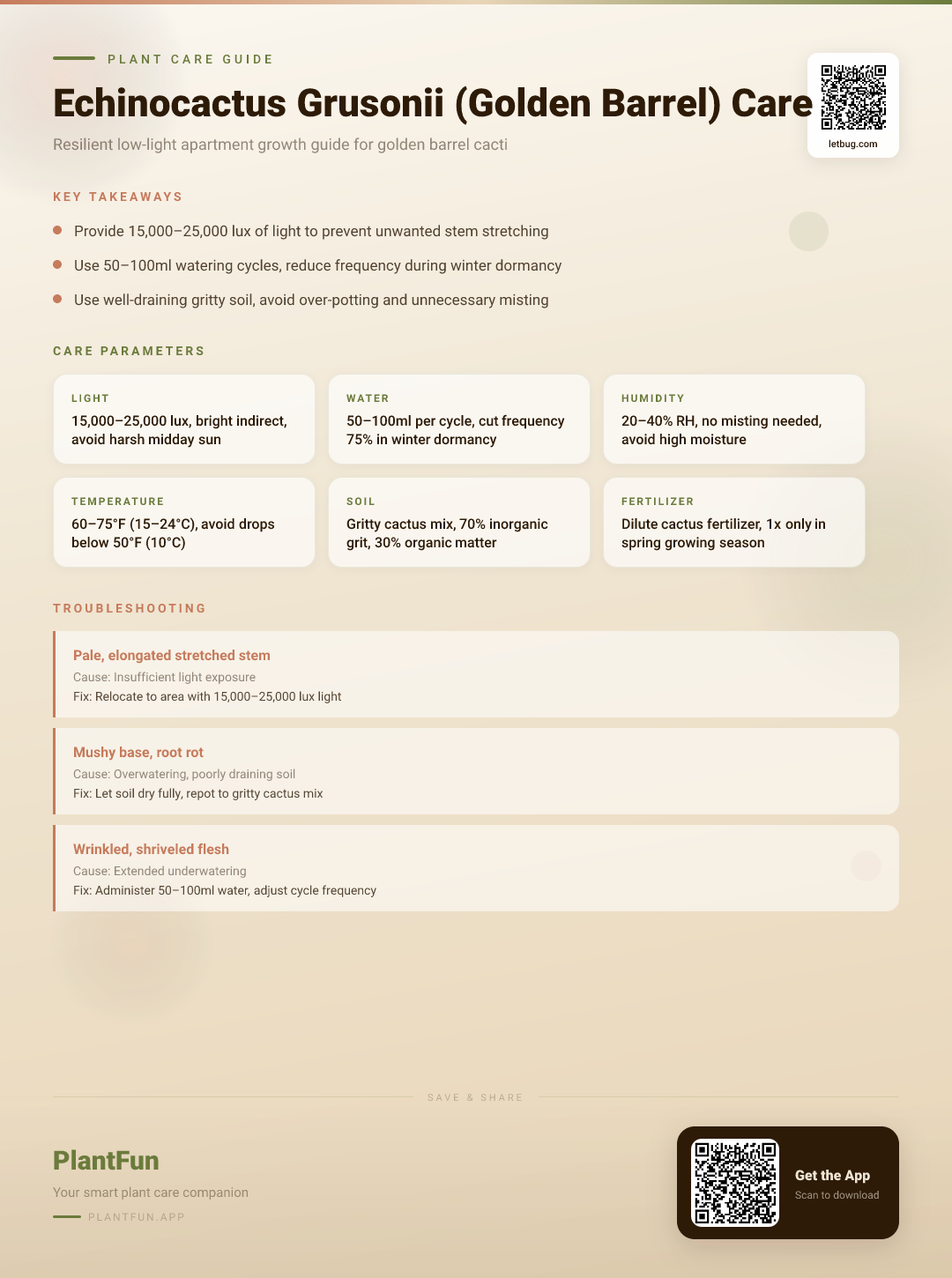
Key Takeaways
- Check soil moisture before watering — overwatering is the #1 killer of houseplants.
- Ensure your plant gets the right amount of light for its species.
- Be patient with recovery — most plants need 2–4 weeks to bounce back.
Quick Care Card: Essential Data Points for Golden Barrel Growth
| Feature | Requirement |
|---|---|
| Light | 15,000–25,000 Lux (Bright, direct preferred) |
| Watering | 50–100ml per cycle; allow full desiccation |
| Humidity | Low (30–40%) |
| Temperature | 60–75°F (15–24°C) |
| Soil | 60% Inorganic grit, 40% succulent potting mix |
| Fertilizer | Low-nitrogen, diluted liquid (Summer only) |
| Toxicity | Non-toxic (but physically hazardous) (ASPCA, 2026) |
TL;DR: The Reality of Keeping Echinocactus Grusonii Indoors
To successfully grow the Echinocactus grusonii in an apartment, you must abandon the idea of ‘growth’ and embrace ‘maintenance.’ Golden Barrels are high-light specialists that struggle in dim interiors. By restricting water to 50–100ml cycles and providing maximum possible window exposure, you prevent etiolation (stretching). In my experience, these plants do best when kept dormant and structural, rather than encouraged to grow rapidly in sub-optimal light.
Why Your Apartment Needs a Different Growth Strategy
When I first brought home my Echinocactus grusonii, I made the mistake of placing it in a corner and watering it like my pothos. It quickly etiolated, turning from a compact, lime-green globe into a pale, elongated column. In an apartment, your goal is to simulate a ‘slow-growth’ environment. According to the NC State Extension (2026), this species naturally thrives in high-light, arid conditions. Recreating this indoors means prioritizing light exposure and limiting moisture to keep the plant’s metabolic rate low, effectively preserving its genetic structure and form (Arab Journal of Biotechnology, 1999).
The Light Threshold: Maximizing 15,000–25,000 Lux in Limited Spaces
Light is the engine for chlorophyll production. Without sufficient photon flux, the plant will prioritize height over girth, causing the classic ‘stretching’ look. I strongly advise using a light meter app or a dedicated sensor to ensure your plant receives at least 15,000–25,000 lux. If your apartment window provides less, the plant will eventually suffer.
Watering Mastery: Using 50–100ml Cycles for Dormancy and Growth
Over-watering is the primary cause of indoor cactus failure. I use a measured 50–100ml water cycle. Do not saturate the entire pot; apply water directly to the base of the root ball and allow the soil to completely desiccate. Use a wooden chopstick: if it comes out damp, wait another week.
Soil Science: Creating an Inexpensive, Well-Draining Grit Mixture
Standard potting soil is too moisture-retentive for Echinocactus grusonii. I mix my own substrate to ensure rapid drainage:
- 40% High-quality succulent/cactus potting mix
- 40% Pumice or perlite (for aeration)
- 20% Horticultural sand (coarse, not fine)
Temperature Control: Why 60–75°F (15–24°C) is the Apartment Sweet Spot
While these plants are resilient, they prefer consistency. Keeping the ambient temperature between 60–75°F (15–24°C) prevents the plant from entering heat-induced stress or cold-induced dormancy. Ensure it is away from HVAC vents, as forced air can desiccate the epidermis too quickly.
Seasonal Maintenance: Adjusting Care from Winter Dormancy to Summer Solstice
- Winter: Reduce watering to a bare minimum. The reduced light intensity means the plant cannot process large volumes of water (Chaicharoenaudomrung et al., 2014).
- Summer: Increase water slightly if the plant is in a bright window, but always monitor for rot.
Troubleshooting Guide
Pale/Stretching Growth
Symptom: The top of the cactus is reaching toward the light source and losing its green, rounded shape.
Likely cause: Insufficient light triggering etiolation.
Fix:
- Move the plant to your brightest available window.
- Consider supplementing with a full-spectrum grow light if natural light is insufficient.
Mushy or Soft Base
Symptom: The base of the plant feels soft or discolored (brown/black).
Likely cause: Over-watering leading to fungal rot.
Fix:
- Stop watering immediately.
- Inspect the roots; if they are black/mushy, prune the dead tissue and repot in dry grit.
Frequently Asked Questions
- Can I put my Golden Barrel in the bathroom? No, the humidity levels in bathrooms can lead to fungal issues and prevent the necessary drying cycle this cactus requires.
- How often do I really need to water my cactus in a dim room? In dim conditions, I only water once every 4–6 weeks, and only if the soil is bone-dry throughout the entire pot.
- Is the Golden Barrel cactus toxic to my cats? No, according to the ASPCA (2026), the Echinocactus grusonii is non-toxic, though its spines present a physical risk to curious pets.
Common Mistakes: Avoiding the Over-Potting and Misting Trap
- Mistake: Misting your cactus.
- What happens: Water trapped in the spines creates an environment for mold.
- Instead: Keep the plant dry and provide airflow.
- Mistake: Over-potting (using a pot too big).
- What happens: Excess soil holds too much water.
- Instead: Use a pot that is only 1–2 inches wider than the root ball.
References
- Arab Journal of Biotechnology. (1999). In vitro micropropagation and molecular genetic analysis of cactus (Echinocactus grusonii) variants using SDS-PAGE and RAPD fingerprinting. https://doi.org/10.21608/arjb.1999.429998. Accessed 2026-03-14.
- ASPCA. (2026). Toxic and Non-Toxic Plants List — ASPCA. https://www.aspca.org/pet-care/animal-poison-control/toxic-and-non-toxic-plants. Accessed 2026-03-14.
- Chaicharoenaudomrung, N.; Oonsivilai, A.; Oonsivilai, R. (2014). Chlorophylls Contents in Echinocactus grusonii Extract. Advanced Materials Research. https://doi.org/10.4028/www.scientific.net/amr.931-932.1507. Accessed 2026-03-14.
- NC State Extension. (2026). Echinocactus Grusonii — NC State Extension Gardener Plant Toolbox. https://plants.ces.ncsu.edu/plants/echinocactus-grusonii/. Accessed 2026-03-14.
Optional Helper: Plantfun.App
Plantfun.App identifies your plants by photo, diagnoses pests and diseases with clear fixes, and creates personalised watering and light schedules that adapt to your home conditions — a handy companion for putting this guide into daily practice.
Found an error or have suggestions? We'd love your feedback.
Need help identifying this problem?
Get instant identification, personalized care schedules, and effective pest treatment plans directly on your phone.
Sponsored • We may earn a commission from app downloads
Related Guides
Golden Barrel Cactus in a Studio Apartment: The Ultimate Low-Maintenance Care Guide
Master your Golden Barrel Cactus care with this simple, 5-step apartment guide. Learn exact light, soil, and watering cycles to ensure long-term resilience.
Care GuideGolden Barrel Cactus in a Low-Light Apartment: Why Your Plant Stretches and How to Stop It
Rescue your stretching Golden Barrel Cactus with our 4-step light correction plan. Learn exactly how to adjust your home environment for healthy, stout growth.
Care GuideGolden Barrel Cactus in a South-Facing Apartment: The Only Care Guide You’ll Ever Need
Master Golden Barrel cactus care with our precise 3-step watering schedule and light mapping. Keep your desert jewel thriving with 20,000+ lux and expert tips.
Pest ControlAnts on Plants: What They Mean and What to Do
Ants usually aren't eating your plant. They are farming other pests.