
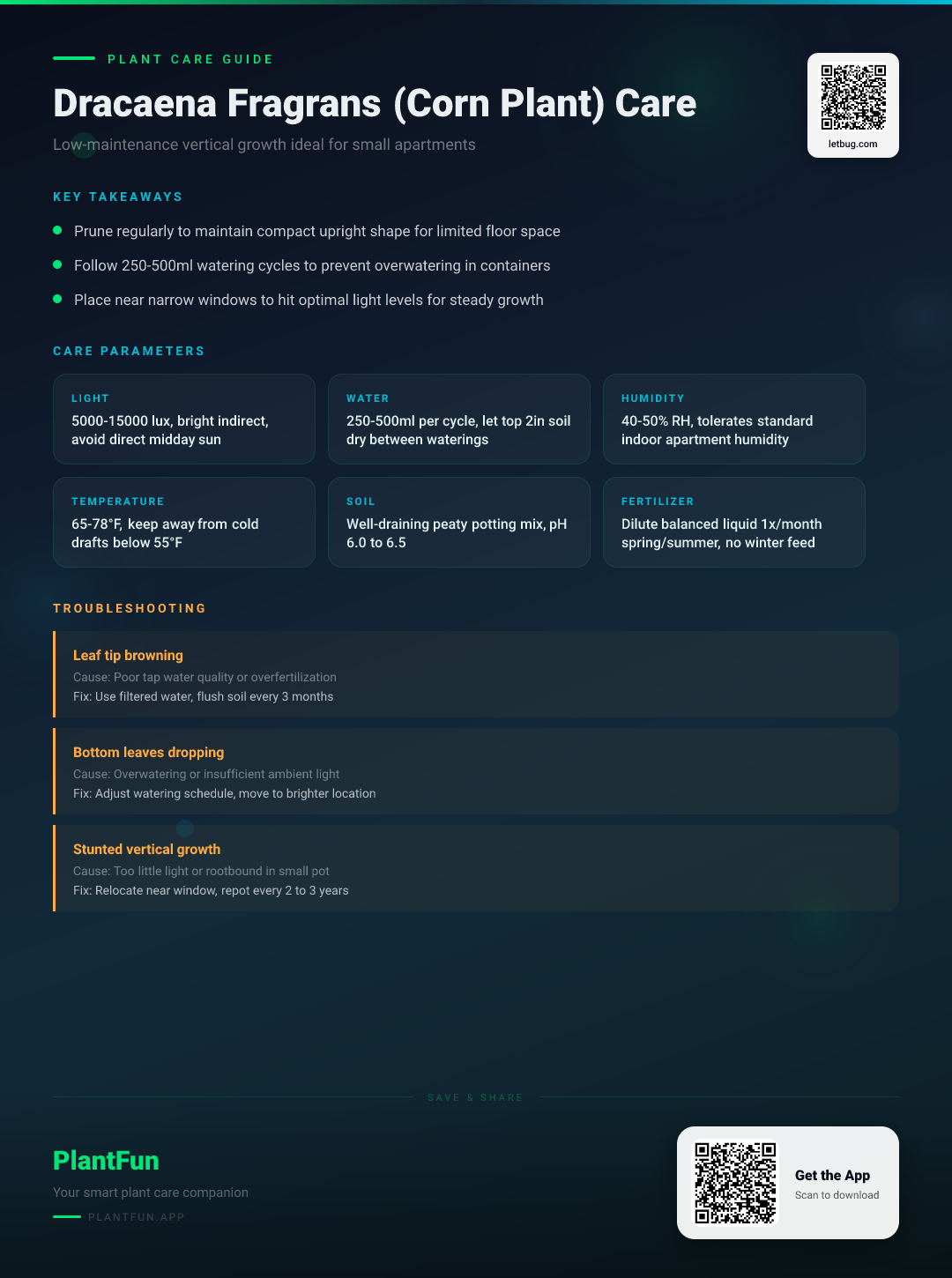
Key Takeaways
- Check soil moisture before watering — overwatering is the #1 killer of houseplants.
- Ensure your plant gets the right amount of light for its species.
- Be patient with recovery — most plants need 2–4 weeks to bounce back.
Quick Care Card: The Essential Metrics for Apartment Dracaenas
| Feature | Requirement |
|---|---|
| Light | 5,000–15,000 lux (bright, indirect) |
| Water | 250–500ml per cycle; allow top 2” to dry |
| Humidity | 40–50% RH |
| Temperature | 65–78°F (18–26°C) |
| Soil | Well-draining, peat-based mix |
| Fertilizer | Balanced 10-10-10, monthly (spring/summer) |
| Toxicity | Toxic to cats and dogs (ASPCA, 2026) |
TL;DR: Why the Corn Plant is the Perfect Apartment Architect
If you live in a small space, Dracaena fragrans is your best friend. Unlike sprawling philodendrons, the corn plant grows vertically, acting as a living pillar that occupies minimal floor area while adding massive architectural impact. It is surprisingly resilient, and by maintaining specific light levels (5,000–15,000 lux) and strictly following a 250–500ml watering rotation, you can prevent common apartment pitfalls like leaf drop or brown tips. It is the ultimate solution for adding height to rooms with low square footage.
My Experience: Learning the Vertical Lesson
When I first brought home my Dracaena fragrans, I tucked it into a dark corner, thinking it would be fine since it’s a “tough” plant. Within weeks, the bottom leaves turned yellow and dropped. I realized then that while they are adaptable, they aren’t magic. Once I moved it closer to my window and started measuring my water—rather than guessing—it stopped shedding leaves and began shooting up, providing the elegant, tree-like structure I wanted for my studio.
Understanding Your Micro-Climate: Light and Airflow in Urban Spaces
Apartment living often involves inconsistent light and stagnant air. Dracaena fragrans thrives when it has access to ambient light and enough airflow to prevent moisture buildup in the soil (PlantwisePlus Knowledge Bank, 2022). Do not place these in drafty hallways or directly against heaters, as this can cause metabolic stress.
Light Requirements: How to achieve 5,000-15,000 lux near narrow windows
These plants prefer bright, indirect light (NC State Extension, 2026). If you have narrow windows, place the pot on a stand to ensure the foliage catches the light without the trunk blocking the window path. If you notice the growth slowing, move it closer to the glass, ensuring no direct afternoon sun hits the leaves, which can scorch them.
Watering Protocols: Precise schedules for container-grown Dracaenas (250-500ml cycles)
Overwatering is the #1 killer of container-grown Dracaenas. In a small apartment, the soil dries unevenly. I recommend a simple test: poke your finger 2 inches into the soil. If it’s damp, wait. When you do water, use 250–500ml, ensuring water runs out the drainage holes. Never let the pot sit in a saucer of water, as this invites root rot.
Small-Space Optimization: Strategic pruning for a compact, upright aesthetic
To keep your plant vertical and lean, you can prune the top growth. If the plant gets too “leggy” or touches the ceiling, cut the main stem back by a few inches using a sterilized blade. New shoots will emerge near the cut, often creating a fuller, more architectural canopy without increasing the plant’s footprint.
Temperature & Humidity: Keeping your plant comfortable at 65-78°F and 40-50% RH
Most apartment heating systems drop the air humidity significantly. To counteract this, group your plant with other foliage to create a micro-climate or use a pebble tray. Keep temperatures between 65–78°F to mimic the conditions described in botanical research (Gilman, 2007).
Common Mistakes to Avoid
- Mistake: Using tap water with high fluoride content. What happens: Brown, crusty leaf tips develop. Instead: Use distilled or filtered water to keep the foliage pristine.
- Mistake: Crowding the pot against a wall. What happens: Poor air circulation leads to fungal growth. Instead: Maintain at least 4 inches of clearance between the foliage and wall.
FAQ: Why is my Dracaena fragrans dropping bottom leaves in my bedroom?
If you are losing only the lowest, oldest leaves, it is a natural part of the aging process. If the drop is rapid or affects younger leaves, check your water—you are likely overdoing it.
FAQ: Can I keep my Dracaena in a low-light apartment corner?
“Can I put my plant in the corner?” is a question I hear often. The answer is no. While it may survive for a while, it will struggle to maintain its structural integrity and likely begin dropping leaves to conserve energy (NC State Extension, 2026).
Seasonal Calendar: Adjusting your care routine for central heating and AC
- Winter: Watch for dry air. Increase humidity levels and reduce water frequency as the plant’s metabolism slows down in lower light.
- Summer: Increase hydration cycles to account for AC evaporation and faster growth rates. Check for pests like spider mites that thrive in dry, recycled air.
References
- ASPCA. (2026). Toxic and Non-Toxic Plants List — ASPCA. https://www.aspca.org/pet-care/animal-poison-control/toxic-and-non-toxic-plants. Accessed 2026-03-18.
- Gilman, E. (2007). Dracaena fragrans ‘Massangeana’ Corn Plant, Fragrant Dracaena. EDIS. https://doi.org/10.32473/edis-fp184-1999. Accessed 2026-03-18.
- NC State Extension. (2026). Dracaena Fragrans — NC State Extension Gardener Plant Toolbox. https://plants.ces.ncsu.edu/plants/dracaena-fragrans/. Accessed 2026-03-18.
- PlantwisePlus Knowledge Bank. (2022). Dracaena fragrans (corn plant). https://doi.org/10.1079/pwkb.species.19898. Accessed 2026-03-18.
Optional Helper: Plantfun.App
Plantfun.App identifies your plants by photo, diagnoses pests and diseases with clear fixes, and creates personalised watering and light schedules that adapt to your home conditions — a handy companion for putting this guide into daily practice.
Found an error or have suggestions? We'd love your feedback.
Need help identifying this problem?
Get instant identification, personalized care schedules, and effective pest treatment plans directly on your phone.
Sponsored • We may earn a commission from app downloads
Related Guides
Dracaena Fragrans in a Dim Apartment: The Complete Care Guide for Resilient Growth
Revive your Dracaena in a low-light apartment with these 4 science-backed care steps. Learn exact watering frequencies and light thresholds for lush, green growth.
Care GuideThe Complete Dracaena Fragrans Care Checklist for Typical Urban Apartments to Boost Resilient Lush Year-Round Growth
Keep your Dracaena fragrans thriving in your apartment with this seasonal care checklist, complete with exact light, water, and humidity thresholds for lush, resilient growth all year.
Care GuideDracaena Fragrans in a Low-Light Apartment: The Complete Seasonal Care Guide for Success
Master your Dracaena fragrans care with our seasonal calendar. Discover the exact light levels, water thresholds, and 3 pro-tips for thriving in apartments.
ToolThe Complete Dracaena Care Checklist for East-Facing Apartments: Seasonal Tips for Resilient Growth
Keep your Dracaena thriving in small east-facing apartments with this science-backed seasonal checklist, complete with exact light, water, and humidity thresholds for year-round resilient growth, no fancy equipment required.