
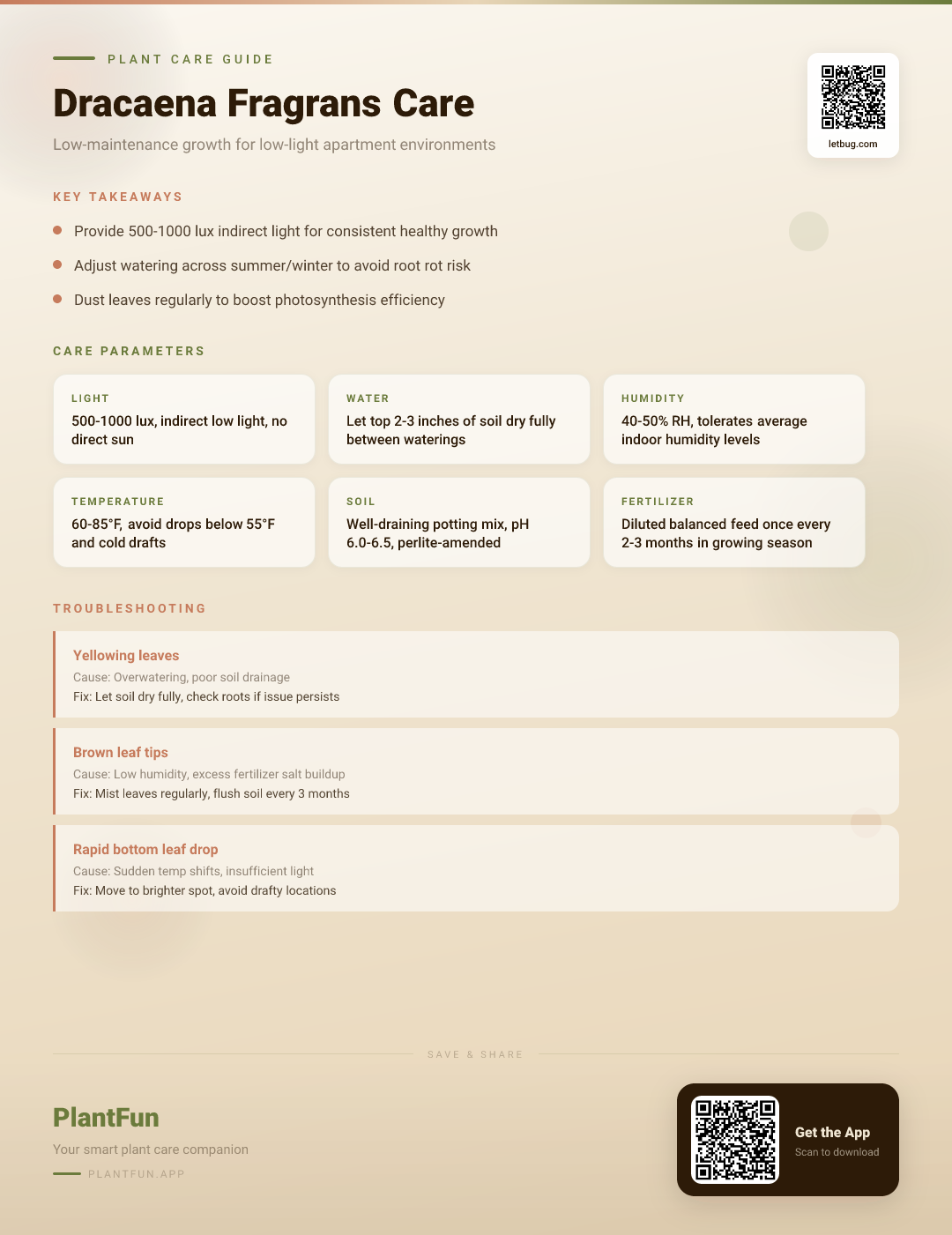
Key Takeaways
- Check soil moisture before watering — overwatering is the #1 killer of houseplants.
- Ensure your plant gets the right amount of light for its species.
- Be patient with recovery — most plants need 2–4 weeks to bounce back.
TL;DR: The Corn Plant (Dracaena fragrans) is a resilient staple for low-light apartments, but it isn’t “dark-thriving.” It requires 500-1000 lux of light and a “soak-and-dry” watering method. If your plant struggles, it is almost always due to overwatering or lack of airflow. Keep temperatures above 65°F (18°C) and wipe leaves monthly to maintain photosynthesis efficiency. Note: This plant is toxic to pets (ASPCA, 2026).
Quick Care Card: Essential Data for Dracaena Success
| Feature | Requirement |
|---|---|
| Light | Low to medium indirect (500-1000 lux) |
| Water | Allow top 2-3 inches to dry out completely |
| Humidity | Average household (40-50%) |
| Temperature | 65°F to 80°F (18°C - 27°C) |
| Soil | Well-draining, peat-based mix |
| Fertilizer | Balanced liquid feed, monthly in growing season |
| Toxicity | Toxic to cats and dogs (ASPCA, 2026) |
Why Your Dracaena Struggles in Typical Apartments
When I first brought home my massive Dracaena fragrans, I made the mistake of placing it in a hallway with zero windows. Within weeks, the lower leaves began to yellow and drop. The reality is that while these plants are labeled as “low light,” this is a relative term. In their native African habitats, they receive filtered light under tree canopies. In our apartments, a dark corner is often a death sentence. The plant enters a state of metabolic slowdown where it cannot sustain its foliage mass, leading to accelerated leaf drop as it sacrifices older growth to conserve energy (PlantwisePlus, 2022).
Understanding Your Light: What 500-1000 Lux Actually Looks Like
Many apartment dwellers confuse “low light” with “no light.” A room with a single north-facing window typically provides 500-1000 lux. If you can comfortably read a book without a lamp, you are likely in the right zone. If you have to squint, your Dracaena is starving. I recommend using a simple light meter app or assessing the distance from the window: keeping your plant within 3-5 feet of an east-facing window is usually the sweet spot for consistent, non-scorching growth (Gilman, 2007).
Step-by-Step Watering Routine: Preventing Root Rot at 65°F+
Overwatering is the primary cause of decline in indoor Dracaena plants. Because your apartment air flow may be stagnant, soil moisture lingers longer than it would outdoors.
- The Finger Test: Insert your index finger 2 inches into the soil. If you feel even a hint of dampness, wait two more days.
- The Pour: Use room-temperature water. Pour slowly until it drains from the bottom holes.
- The Purge: After 15 minutes, empty the saucer. Never let the pot sit in standing water, as this creates an anaerobic environment that kills roots (NC State Extension, 2026).
Seasonal Care Calendar: Adjusting for Summer vs Winter
- Summer Growth Phase: During warmer months, metabolic activity increases. Water once every 10-14 days. Fertilize at half-strength once a month.
- Winter Dormancy: When temperatures dip toward 65°F, growth slows. Extend watering to every 3-4 weeks. Stop all fertilizer to prevent salt buildup in the soil, which causes leaf tip burn.
The 4 Measurable Care Thresholds for Resilient Growth
- Light: Maintain 500+ lux; rotate the pot 90 degrees every month to ensure even growth.
- Drainage: Use pots with drainage holes and a porous substrate (perlite/peat mix) to ensure oxygen reaches the root zone (NC State Extension, 2026).
- Temperature: Avoid placing the plant near air conditioning vents or drafty winter windows; keep it strictly above 65°F.
- Cleanliness: Dust-free leaves are critical for plants in low-light conditions to maximize available photons.
Common Mistakes: Identifying Yellowing and Tip Brownness
[Leaf Tip Burn]
Symptom: Dry, crispy brown edges on older leaves.
Likely cause: Mineral buildup from tap water or fluctuating humidity.
Fix:
- Use filtered or distilled water.
- Increase ambient humidity with a pebble tray.
[Yellowing Lower Leaves]
Symptom: Older leaves at the base turn pale yellow and drop.
Likely cause: Overwatering or improper soil drainage.
Fix:
- Check the soil moisture; wait for it to dry out deeper.
- Ensure the pot has proper drainage holes.
FAQ: Can I keep my Dracaena in a dark corner of my bedroom?
While it will survive temporarily, it will not thrive. If you must place it there, consider installing a full-spectrum LED grow bulb in a nearby desk lamp to provide the minimum 500 lux required for healthy cellular function (PlantwisePlus, 2022).
FAQ: Why is my Dracaena dropping bottom leaves so fast?
If you see a sudden mass-drop of yellow leaves, it is almost always a signal that the root system is suffocating. Check for a swampy smell in the soil, which indicates root rot. If the soil is wet, repotting into fresh, dry soil is your only chance to save the plant.
FAQ: How do I know when it is time to repot my plant?
Watch for roots circling the bottom of the pot or growing out of the drainage holes. I generally repot my Dracaena once every two years, moving up only one pot size (e.g., from an 8-inch to a 10-inch pot) to avoid creating a massive volume of wet soil that the roots cannot occupy quickly enough.
Advanced Maintenance: Dusting Leaves for Better Photosynthesis
In a low-light apartment, every photon counts. Dust acts as a physical barrier to light. I take a damp microfibre cloth and gently wipe the tops and undersides of the leaves every time I water. This simple habit keeps the stomata clear and ensures the plant remains as efficient as possible (Gilman, 2007).
References and Botanical Resources
- Gilman, E. (2007). Dracaena fragrans ‘Massangeana’ Corn Plant, Fragrant Dracaena. EDIS. https://doi.org/10.32473/edis-fp184-1999. Accessed 2026-03-17.
- PlantwisePlus Knowledge Bank. (2022). Dracaena fragrans (corn plant). PlantwisePlus Knowledge Bank. https://doi.org/10.1079/pwkb.species.19898. Accessed 2026-03-17.
- ASPCA. (2026). Toxic and Non-Toxic Plants List — ASPCA. https://www.aspca.org/pet-care/animal-poison-control/toxic-and-non-toxic-plants. Accessed 2026-03-17.
- NC State Extension. (2026). Dracaena Fragrans — NC State Extension Gardener Plant Toolbox. https://plants.ces.ncsu.edu/plants/dracaena-fragrans/. Accessed 2026-03-17.
Optional Helper: Plantfun.App
Plantfun.App identifies your plants by photo, diagnoses pests and diseases with clear fixes, and creates personalised watering and light schedules that adapt to your home conditions — a handy companion for putting this guide into daily practice.
Found an error or have suggestions? We'd love your feedback.
Need help identifying this problem?
Get instant identification, personalized care schedules, and effective pest treatment plans directly on your phone.
Sponsored • We may earn a commission from app downloads
Related Guides
The Complete Dracaena Care Checklist for Resilient Growth in Typical Budget Apartments
Get a free printable Dracaena care checklist with exact light, water, and soil parameters to keep your plant thriving in a typical apartment without spending extra on fancy care supplies.
Care GuideDracaena Fragrans in a Typical Apartment: The Only Care Guide You’ll Ever Need
Master your Dracaena fragrans with this seasonal guide. Get exact light levels, water volumes, and a 12-month care schedule to keep your indoor plant thriving.
Care GuideThe Budget-Friendly Dracaena Care Checklist for Resilient Growth in Small East-Facing Apartments
Skip overpriced plant supplies and get your dracaena thriving in your small east-facing apartment. Follow this free, science-backed checklist for lush, resilient growth with minimal effort.
ToolThe Complete Dracaena Care Checklist for East-Facing Apartments: Seasonal Tips for Resilient Growth
Keep your Dracaena thriving in small east-facing apartments with this science-backed seasonal checklist, complete with exact light, water, and humidity thresholds for year-round resilient growth, no fancy equipment required.