
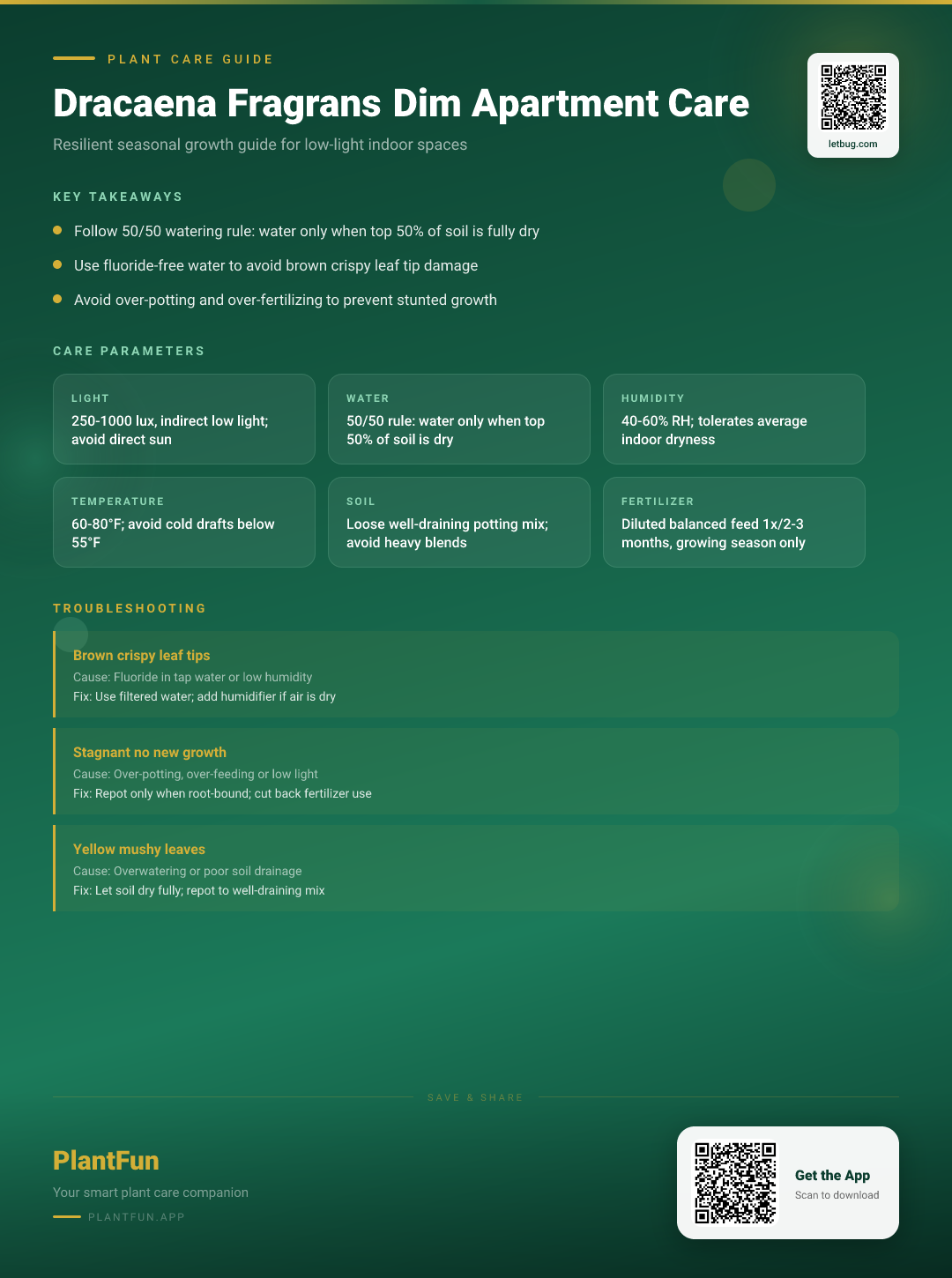
Key Takeaways
- Check soil moisture before watering — overwatering is the #1 killer of houseplants.
- Ensure your plant gets the right amount of light for its species.
- Be patient with recovery — most plants need 2–4 weeks to bounce back.
TL;DR: Dracaena fragrans thrives in dim apartments when you honor the seasonal shift. Reduce watering by 50% during winter, use filtered water to prevent fluoride-induced browning, and ensure your soil remains well-draining. Keep it away from heating vents to maintain local humidity and avoid over-potting, which often leads to root rot in low-light environments.
Quick Care Card: Essential Thresholds for Your Dracaena
| Feature | Requirement |
|---|---|
| Light | Bright, indirect light preferred; tolerates low light (100–300 lux) |
| Water | Allow top 2–3 inches of soil to dry before watering |
| Humidity | Moderate (40–60%); misting or pebble trays recommended |
| Temperature | 65°F–75°F (18°C–24°C) |
| Soil | Well-draining, peat-based potting mix |
| Fertilizer | Balanced 10-10-10, diluted, monthly in growing season |
| Toxicity | Toxic to cats and dogs (ASPCA, 2026) |
My Experience: The “Summer Routine” Trap
When I first brought home my Dracaena fragrans, I treated it like a high-energy tropical. I watered it on a strict calendar schedule regardless of the season. By February, I was staring at yellowing leaves and a soggy soil line. I had failed to realize that in my dim apartment, the plant wasn’t “drinking” at the same rate during the short, dark winter days. Once I shifted to a “check-the-soil” approach rather than a calendar approach, the plant stabilized. The secret isn’t a perfect schedule; it’s learning to read the moisture levels of your specific indoor climate.
Why Dracaena Fragrans Struggles in Low-Light Apartments
Many of us love the structural elegance of the Corn Plant, but apartments often lack the intense light these species enjoy in their native African habitats. According to the NC State Extension (2026), these plants are adaptable, but low light slows their metabolic rate. When metabolism slows, the plant uses less water. If you keep watering as if it is mid-July, the roots will sit in stagnant, cold moisture, which is the primary cause of root decay and foliage decline.
Understanding the Lux Requirements: How to Measure Your Apartment Light
To gauge your lighting, look for “bright, indirect” light. If you can read a book comfortably without turning on a lamp, you are in the 200-500 lux range, which is sufficient for maintenance (Gilman, 2007). Avoid direct sunlight, as it can scorch the foliage, leading to unsightly bleached patches.
The 50/50 Rule: When to Water (and When to Hold Back)
To avoid the common mistake of overwatering, I follow the 50/50 rule: during the active growth phase (spring/summer), I wait until the top 2 inches of soil are dry. During the dormant phase (autumn/winter), I wait until the top 4 inches of soil are dry. Always test this by sticking your finger directly into the soil—if you feel any dampness, wait another three days.
Step-by-Step: Calibrating Care for the Four Seasons
- Spring: As growth resumes, increase watering to keep soil consistently moist but never waterlogged.
- Summer: Apply a balanced, water-soluble fertilizer at half-strength once a month (PlantwisePlus Knowledge Bank, 2022).
- Autumn: Gradually decrease watering frequency as natural daylight hours decline.
- Winter: Ensure the plant is not sitting in a draft. Maintain slightly drier soil to prevent root issues during low-light months.
Can I keep my Dracaena in a room without windows?
Technically, no plant can survive in a room with zero natural light. If you are placing your Dracaena in a bedroom with minimal light, you must supplement with a full-spectrum LED grow light for 8–10 hours daily. Without this, the plant will eventually exhaust its stored energy.
Why are the tips of my Dracaena leaves turning brown and crispy?
This is typically a sign of fluoride sensitivity or low humidity. Dracaena are notoriously sensitive to tap water chemicals. Try switching to distilled or rainwater. If the browning continues, increase ambient humidity using a room humidifier or a pebble tray (NC State Extension, 2026).
How do I know if my apartment is too dry for this plant?
If your leaves begin to curl inward or the margins become papery, your humidity is likely below 30%. In modern, air-conditioned or radiator-heated apartments, this is common. Placing your plant away from direct airflow is your first line of defense.
Managing Fluoride Sensitivity in Apartment Tap Water
Dracaena roots absorb fluoride from tap water, which accumulates in leaf tips, causing necrosis (browning). If you notice this, flush your soil with filtered water and switch to a non-fluoridated water source permanently.
Common Mistakes: The Perils of Over-Potting and Over-Feeding
- Mistake: Using a pot much larger than the root ball. What happens: Excess soil holds too much water, leading to root rot. Instead: Only increase pot size by 1–2 inches.
- Mistake: Fertilizing in winter. What happens: Pushing growth when the plant wants to rest causes weak, spindly stems. Instead: Only feed during active growth months.
Troubleshooting: What to do when your plant stops growing
Yellowing lower leaves
Symptom: The bottom leaves turn yellow and drop off.
Likely cause: Natural aging or overwatering.
Fix:
- Inspect soil moisture levels.
- If soil is dry, ensure you are providing enough light for the plant to sustain its foliage.
Soft, mushy stems
Symptom: The trunk feels squishy at the base.
Likely cause: Advanced root rot from standing water.
Fix:
- Remove the plant from the pot immediately.
- Trim away blackened, slimy roots with sterilized shears and repot in fresh, dry, fast-draining soil.
Dracaena leaf drop prevention
Symptom: Sudden, significant leaf loss.
Likely cause: Sudden environmental shift (drafts or temperature shock).
Fix:
- Move the plant to a spot with stable temperatures (no heating vents nearby).
- Ensure it isn’t being exposed to cold window drafts in winter.
References
- Gilman, E. (2007). Dracaena fragrans ‘Massangeana’ Corn Plant, Fragrant Dracaena. https://doi.org/10.32473/edis-fp184-1999. Accessed 2026-03-11.
- PlantwisePlus Knowledge Bank. (2022). Dracaena fragrans (corn plant). https://doi.org/10.1079/pwkb.species.19898. Accessed 2026-03-11.
- ASPCA. (2026). Toxic and Non-Toxic Plants List — ASPCA. https://www.aspca.org/pet-care/animal-poison-control/toxic-and-non-toxic-plants. Accessed 2026-03-11.
- NC State Extension. (2026). Dracaena Fragrans — NC State Extension Gardener Plant Toolbox. https://plants.ces.ncsu.edu/plants/dracaena-fragrans/. Accessed 2026-03-11.
Optional Helper: Plantfun.App
Plantfun.App identifies your plants by photo, diagnoses pests and diseases with clear fixes, and creates personalised watering and light schedules that adapt to your home conditions — a handy companion for putting this guide into daily practice.
Found an error or have suggestions? We'd love your feedback.
Need help identifying this problem?
Get instant identification, personalized care schedules, and effective pest treatment plans directly on your phone.
Sponsored • We may earn a commission from app downloads
Related Guides
Dracaena Fragrans in a Dim Apartment: The Complete Care Guide for Resilient Growth
Revive your Dracaena in a low-light apartment with these 4 science-backed care steps. Learn exact watering frequencies and light thresholds for lush, green growth.
Care GuideThe Complete Dracaena Fragrans Care Guide for Urban Apartments: Resilient Growth Made Easy
Keep your Dracaena fragrans thriving in a typical apartment. Get exact light levels, watering amounts, and a 4-season care checklist for lush, resilient growth year-round.
Care GuideTradescantia Zebrina in a Low-Light Apartment: The Complete Care Guide for Resilient Growth
Transform your leggy Tradescantia Zebrina into a lush, vibrant centerpiece. Follow our expert seasonal checklist to master light, water, and pruning for apartments.
ToolThe Complete Dracaena Care Checklist for East-Facing Apartments: Seasonal Tips for Resilient Growth
Keep your Dracaena thriving in small east-facing apartments with this science-backed seasonal checklist, complete with exact light, water, and humidity thresholds for year-round resilient growth, no fancy equipment required.