
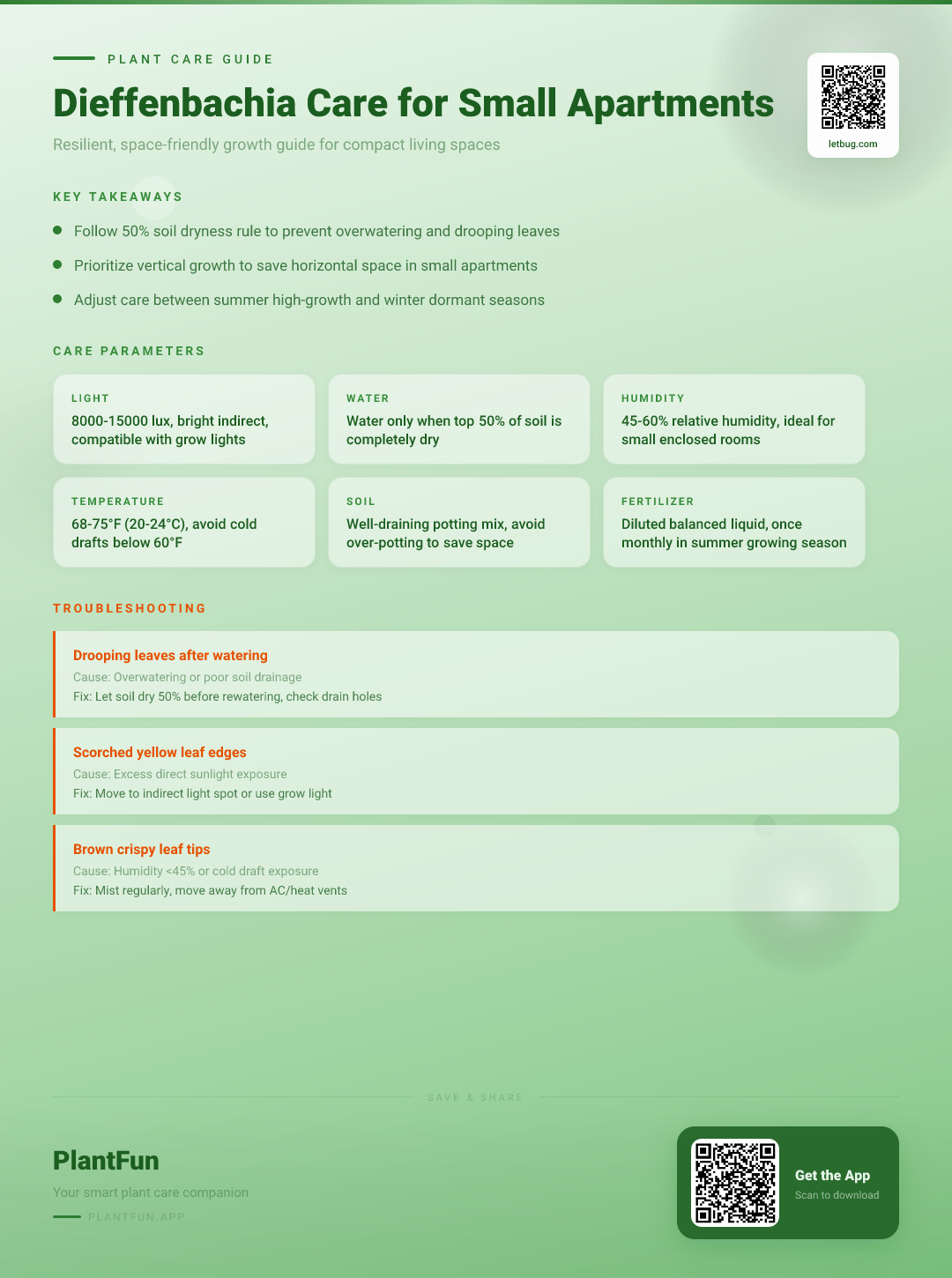
Key Takeaways
- Check soil moisture before watering — overwatering is the #1 killer of houseplants.
- Ensure your plant gets the right amount of light for its species.
- Be patient with recovery — most plants need 2–4 weeks to bounce back.
TL;DR: The Apartment Grower’s Cheat Sheet
Dieffenbachia thrives in small apartments when you balance indirect, bright light with a strict 50% soil dryness watering rule. Place your plant away from drafts, maintain consistent humidity between 45-60%, and avoid oversized pots that lead to root rot. Keep them out of reach of pets, as they are toxic (ASPCA, 2026).
Quick Care Card: Essential Thresholds for Your Apartment Dieffenbachia
| Feature | Requirement |
|---|---|
| Light | 8,000–15,000 lux (bright, indirect) |
| Watering | When top 50% of soil is dry |
| Humidity | 45% – 60% |
| Temperature | 68°F – 75°F (20°C – 24°C) |
| Soil | Well-draining, peat-based mix |
| Fertilizer | Balanced liquid 10-10-10 (monthly in summer) |
| Toxicity | Toxic to cats and dogs (ASPCA, 2026) |
Why Dieffenbachia Thrives in Compact Spaces: Adapting Your Layout
When I first got my Dieffenbachia, I treated it like a floor filler in the corner. I made the mistake of placing it too far from a window, which caused it to grow long, spindly stems reaching for the light—what we call “legginess.” In a small apartment, you don’t have square footage for lanky growth. By keeping these plants in a vertical, structural focal point, you can control their growth habit. They are excellent for apartment living because they grow upward rather than spreading aggressively outward, provided you give them the right light orientation.
Light Requirements: Balancing 8,000-15,000 Lux Without a Greenhouse
Dieffenbachia are understory plants. They crave bright, indirect light. In an apartment, this typically means a spot within 3 to 5 feet of an east-facing window. If you don’t have a light meter, use the “hand shadow” test: your hand should cast a soft, fuzzy shadow when held near the foliage. If the shadow is sharp and dark, the light is too intense; if no shadow exists, it is too dim.
Watering Mastery: The 50% Soil Dryness Rule for Typical Apartments
Many beginners ask, “How often to water Dieffenbachia?” The answer isn’t a calendar; it’s a sensory check. I never water based on a schedule. Instead, I use the finger test: insert your finger into the soil until it reaches the second knuckle. If the soil feels dry, it is time to hydrate. Overwatering is the primary cause of yellowing leaves (NC State Extension, 2026). Ensure your pot has drainage holes, as excess water retention is lethal to the root system.
Humidity & Air Quality: Managing 45-60% Levels in Small Rooms
Apartments are notorious for dry air, especially when heaters kick in. Dieffenbachia suffers when humidity drops below 40%. I use a small humidity tray—a saucer filled with pebbles and water—placed beneath the pot to create a micro-climate. Avoid placing your plant directly in the path of AC vents or heaters, as sudden temperature fluctuations stress the plant.
Temperature Control: Why 68-75°F (20-24°C) is Your Dieffenbachia’s Sweet Spot
These plants prefer stable environments (Ajay & Fatmi, 2024). In an apartment, try to avoid extreme temperature swings. If your room drops below 60°F at night, move the plant away from the window glass, which can get much colder than the rest of the room.
Step-by-Step: Managing Leaf Growth for Vertical, Not Horizontal, Space
- Pruning: Remove the lowest, oldest leaves as the plant grows to maintain the “cane” look.
- Rotation: Turn the pot 90 degrees every week to ensure even light exposure, which prevents lopsided growth.
- Cleaning: Wipe leaves with a damp cloth every two weeks to remove dust, which increases photosynthesis efficiency.
- Support: If your Dieffenbachia starts leaning, install a small moss pole to encourage upward, vertical growth.
Voice FAQ: Why is my Dieffenbachia drooping even though I watered it?
This is a classic sign of root stress. While drooping often signals thirst, it also indicates root rot from overwatering. Check the roots; if they are mushy or brown, you have been keeping the soil too moist (NC State Extension, 2026). If the roots are firm and white, the plant might be experiencing a sudden temperature shift.
Voice FAQ: Can I keep my Dieffenbachia in a windowless room with a grow light?
Yes, but you must ensure the light intensity matches the 8,000–15,000 lux requirement. A full-spectrum LED grow light placed 12–18 inches above the foliage for 10–12 hours a day will mimic the necessary conditions to prevent the plant from becoming leggy.
Seasonal Calendar: How to Shift Care from High-Growth Summer to Dormant Winter
- Summer: High growth requires weekly fertilizer and more frequent water checks.
- Winter: Growth slows. Reduce watering frequency to allow the top 75% of soil to dry out and stop fertilizing entirely.
Common Mistakes: Avoiding the ‘Over-Potting’ Trap in Tiny Living Spaces
- Mistake: Moving your plant into a pot much larger than the current root ball.
- What happens: The extra soil retains too much moisture, leading to root rot.
- Instead: Repot only when roots become crowded, and only move up one pot size (1-2 inches in diameter).
References
- Ajay, P.; Fatmi, U. (2024). Performance of Different Dieffenbachia (Dieffenbachia seguine) Varieties under Prayagraj Agro-climatic Conditions. International Journal of Plant & Soil Science. https://doi.org/10.9734/ijpss/2024/v36i74815. Accessed 2026-03-09.
- Chase, A. (1982). Dasheen Mosaic Virus Infection of Dieffenbachia Cultivars. Plant Disease. https://doi.org/10.1094/pd-66-891. Accessed 2026-03-09.
- ASPCA. (2026). Toxic and Non-Toxic Plants List — ASPCA. https://www.aspca.org/pet-care/animal-poison-control/toxic-and-non-toxic-plants. Accessed 2026-03-09.
- NC State Extension. (2026). Dieffenbachia — NC State Extension Gardener Plant Toolbox. https://plants.ces.ncsu.edu/plants/dieffenbachia-care/. Accessed 2026-03-09.
Optional Helper: Plantfun.App
Plantfun.App identifies your plants by photo, diagnoses pests and diseases with clear fixes, and creates personalised watering and light schedules that adapt to your home conditions — a handy companion for putting this guide into daily practice.
Found an error or have suggestions? We'd love your feedback.
Need help identifying this problem?
Get instant identification, personalized care schedules, and effective pest treatment plans directly on your phone.
Sponsored • We may earn a commission from app downloads
Related Guides
The Complete Budget Dieffenbachia Care Checklist for Lush Resilient Growth in Typical Apartments
Grow lush, full Dieffenbachia in your apartment without buying expensive specialty supplies. Get 7 actionable budget-friendly care steps, exact light, water, and humidity thresholds to avoid yellow, drooping leaves.
Care GuideDieffenbachia Care in Small Apartments: A Space-Optimized Guide for Resilient, Lush Growth
Master your Dieffenbachia care in small apartments. Learn the exact 15,000 lux threshold, precise watering schedules, and 4 space-saving hacks for lush growth.
Care GuideDieffenbachia Care in Small Apartments: How to Thrive in Limited Light and Space
Master your indoor jungle. Learn the 4 exact light and water thresholds needed to keep your Dieffenbachia lush and pest-free in a compact apartment today.
Pest ControlAnts on Plants: What They Mean and What to Do
Ants usually aren't eating your plant. They are farming other pests.