
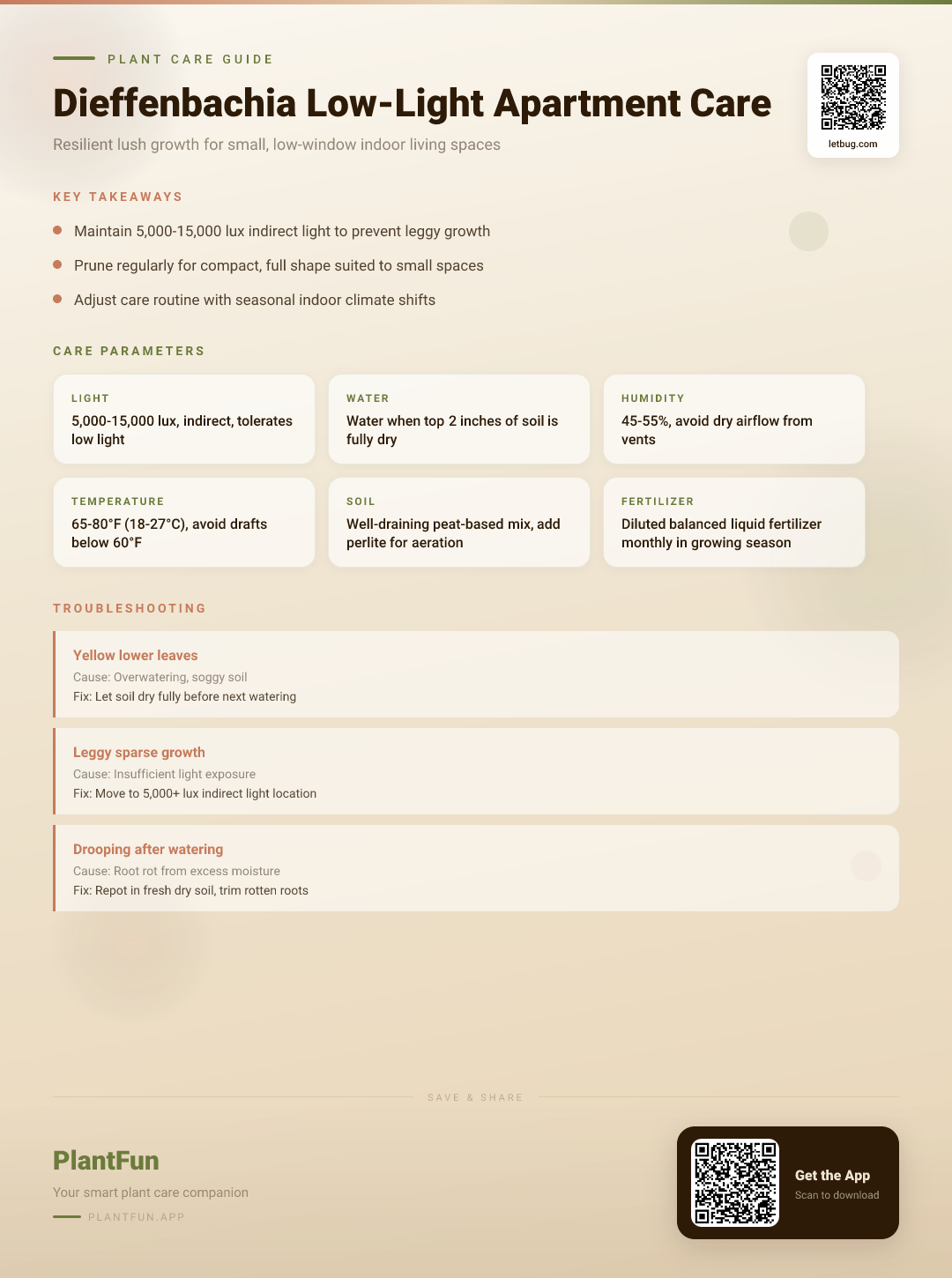
Key Takeaways
- Check soil moisture before watering — overwatering is the #1 killer of houseplants.
- Ensure your plant gets the right amount of light for its species.
- Be patient with recovery — most plants need 2–4 weeks to bounce back.
Quick Care Card: Essential Thresholds for Apartment Success
| Feature | Requirement |
|---|---|
| Light | 5,000–15,000 lux (bright, indirect) |
| Water | Allow top 2 inches of soil to dry out |
| Humidity | 45%–55% |
| Temperature | 65°F–80°F (18°C–27°C) |
| Soil | Well-draining, peat-based mix |
| Fertilizer | Balanced liquid feed monthly (Spring/Summer) |
| Toxicity | Toxic to cats and dogs (ASPCA, 2026) |
TL;DR: The Reality of Dieffenbachia in Small Spaces
Dieffenbachia (Dumb Cane) is a resilient foliage plant that thrives in apartment settings if you mimic its natural understory habitat. In small spaces, focus on preventing “legginess” by rotating the plant weekly to balance light intake and avoiding overwatering, which is the primary cause of decline. Provide moderate indirect light and consistent humidity to maintain its characteristic vibrant variegation.
Why Your Apartment Environment Challenges the Dieffenbachia
When I first got my Dieffenbachia, I made the mistake of placing it in a dark hallway, expecting it to perform like a snake plant. It didn’t take long for the lower leaves to yellow and drop. Apartments often have limited windows, leading to “etiolation”—a state where the plant stretches aggressively to find light, resulting in weak, thin stems (NC State Extension, 2026). Managing this requires a shift in how we perceive “low light.” While they tolerate lower conditions better than some tropicals, they still require enough energy to sustain their broad leaves.
Light Requirements: Balancing 5,000-15,000 Lux Without Window Space
Dieffenbachia is not a shade plant; it is a “bright indirect” lover. I suggest placing your plant within 3-5 feet of a window. If you lack window real estate, you can supplement with full-spectrum LED bulbs. Aim for roughly 5,000 to 15,000 lux to keep the plant’s metabolism steady (Ajay & Fatmi, 2024).
Pro-tip: If you notice your Dieffenbachia leaning, it’s starving for light. Rotate the pot 90 degrees every time you water to encourage balanced, upward growth rather than a lopsided, stretching habit.
Precision Watering: Calculating ML and Frequency for Indoor Containers
“How often to water Dieffenbachia?” is the most common question I receive. Instead of a calendar, use your finger. If the top 2 inches of the soil feel dry, it is time to irrigate. For a 6-inch pot, I typically find that 200–300ml of water is sufficient. Ensure your container has drainage holes; sitting in stagnant water will cause root rot, a silent killer in low-light apartments (NC State Extension, 2026). Check out our essential guide on container drainage to ensure your setup is optimized.
Humidity & Airflow: Maintaining 45-55% Levels in Typical Living Areas
Low humidity in winter can lead to crispy brown leaf edges. To mimic a tropical environment, try grouping plants together to create a microclimate or using a pebble tray. Keep humidity between 45% and 55% to support healthy leaf development. Good airflow is equally critical to prevent fungal issues, so ensure your plant isn’t tucked into a corner with absolutely zero breeze.
Temperature Control: Why 65-80°F (18-27°C) is Critical for Leaf Health
Dieffenbachias hate drafts. Whether it is an AC vent or a radiator, avoid placing your plant directly in the line of temperature fluctuations. Keeping temperatures steady between 65°F and 80°F (18°C–27°C) helps the plant maintain its structural integrity (Ajay & Fatmi, 2024).
Seasonal Care Calendar: Adapting to Indoor Climate Shifts
- Spring/Summer: Growth phase. Increase watering frequency and start a monthly fertilization routine with a balanced 10-10-10 liquid fertilizer.
- Fall/Winter: Dormancy phase. Reduce water significantly as light levels drop. Stop fertilizing until the days lengthen again.
Common Mistakes to Avoid: Stop Common Leaf Browning and Droop
- Mistake: Watering on a strict schedule (e.g., “every Monday”).
- What happens: Root rot and eventual collapse.
- Instead: Water only when the soil feels dry two inches deep.
- Mistake: Ignoring dust on leaves.
- What happens: Reduced photosynthesis, leading to slow growth.
- Instead: Gently wipe leaves with a damp cloth bi-weekly.
FAQ: Why is my Dieffenbachia drooping even though I watered it?
Drooping often suggests either extreme thirst or root rot. If the soil is soggy, the roots are damaged and cannot uptake water (NC State Extension, 2026). If the soil is bone-dry, the plant is wilting from dehydration. Always verify with the “finger test” before adding more water.
FAQ: Can I keep my Dieffenbachia in a dark corner away from the window?
While it will survive for a short time, it will not thrive. It will eventually lose its variegation and become thin. If your apartment has limited light, I recommend investing in high-quality grow lights to maintain its health.
Advanced Care Technique: Pruning for Fullness and Small-Space Shaping
If your plant becomes “leggy,” don’t be afraid to prune. Cutting the top cane will encourage the plant to push out new growth lower down, resulting in a bushier shape. Always use sterilized shears to prevent the spread of pathogens, as Dieffenbachia can be susceptible to viral infections if wounded incorrectly (Chase, 1982).
Troubleshooting Guide: Identifying Nutrient Deficiencies vs. Overwatering
Yellowing Lower Leaves
Symptom: The oldest leaves near the base turn yellow and drop.
Likely cause: Natural aging or overwatering.
Fix:
- Check the soil moisture.
- If the soil is wet, pause watering and check for root health.
Brown Leaf Edges
Symptom: Tips of the leaves become dry and brown.
Likely cause: Low humidity or high salt buildup from water.
Fix:
- Use a humidifier near the plant.
- Flush the soil with distilled water to remove excess minerals.
Stunted Growth and Small Leaves
Symptom: Plant stops producing large, vibrant leaves.
Likely cause: Insufficient light or root-bound pot.
Fix:
- Move to a brighter location (5,000+ lux).
- Repot into a container only 1-2 inches larger.
References
- Ajay, P.; Fatmi, U. (2024). Performance of Different Dieffenbachia (Dieffenbachia seguine) Varieties under Prayagraj Agro-climatic Conditions. International Journal of Plant & Soil Science. https://doi.org/10.9734/ijpss/2024/v36i74815. Accessed 2026-03-18.
- Chase, A. (1982). Dasheen Mosaic Virus Infection of Dieffenbachia Cultivars. Plant Disease. https://doi.org/10.1094/pd-66-891. Accessed 2026-03-18.
- ASPCA. (2026). Toxic and Non-Toxic Plants List — ASPCA. https://www.aspca.org/pet-care/animal-poison-control/toxic-and-non-toxic-plants. Accessed 2026-03-18.
- NC State Extension. (2026). Dieffenbachia — NC State Extension Gardener Plant Toolbox. https://plants.ces.ncsu.edu/plants/dieffenbachia-care/. Accessed 2026-03-18.
Optional Helper: Plantfun.App
Plantfun.App identifies your plants by photo, diagnoses pests and diseases with clear fixes, and creates personalised watering and light schedules that adapt to your home conditions — a handy companion for putting this guide into daily practice.
Found an error or have suggestions? We'd love your feedback.
Need help identifying this problem?
Get instant identification, personalized care schedules, and effective pest treatment plans directly on your phone.
Sponsored • We may earn a commission from app downloads
Related Guides
The Complete Dieffenbachia Care Checklist for Resilient Growth in Typical Urban Apartments
Grow lush, full Dieffenbachia even in dry, variable urban apartment conditions. Get a free seasonal checklist, exact light/humidity thresholds, and 3 easy fixes for common yellow leaf issues.
Care GuideDieffenbachia Care in Small Apartments: How to Thrive in Limited Light and Space
Master your indoor jungle. Learn the 4 exact light and water thresholds needed to keep your Dieffenbachia lush and pest-free in a compact apartment today.
Care GuideDieffenbachia Care in Low-Humidity Apartments: The Complete Seasonal Guide for Lush Growth
Transform your Dieffenbachia with our seasonal care guide. Discover exact humidity levels, watering cycles, and apartment-friendly tips for year-round success.
Pest ControlAnts on Plants: What They Mean and What to Do
Ants usually aren't eating your plant. They are farming other pests.