
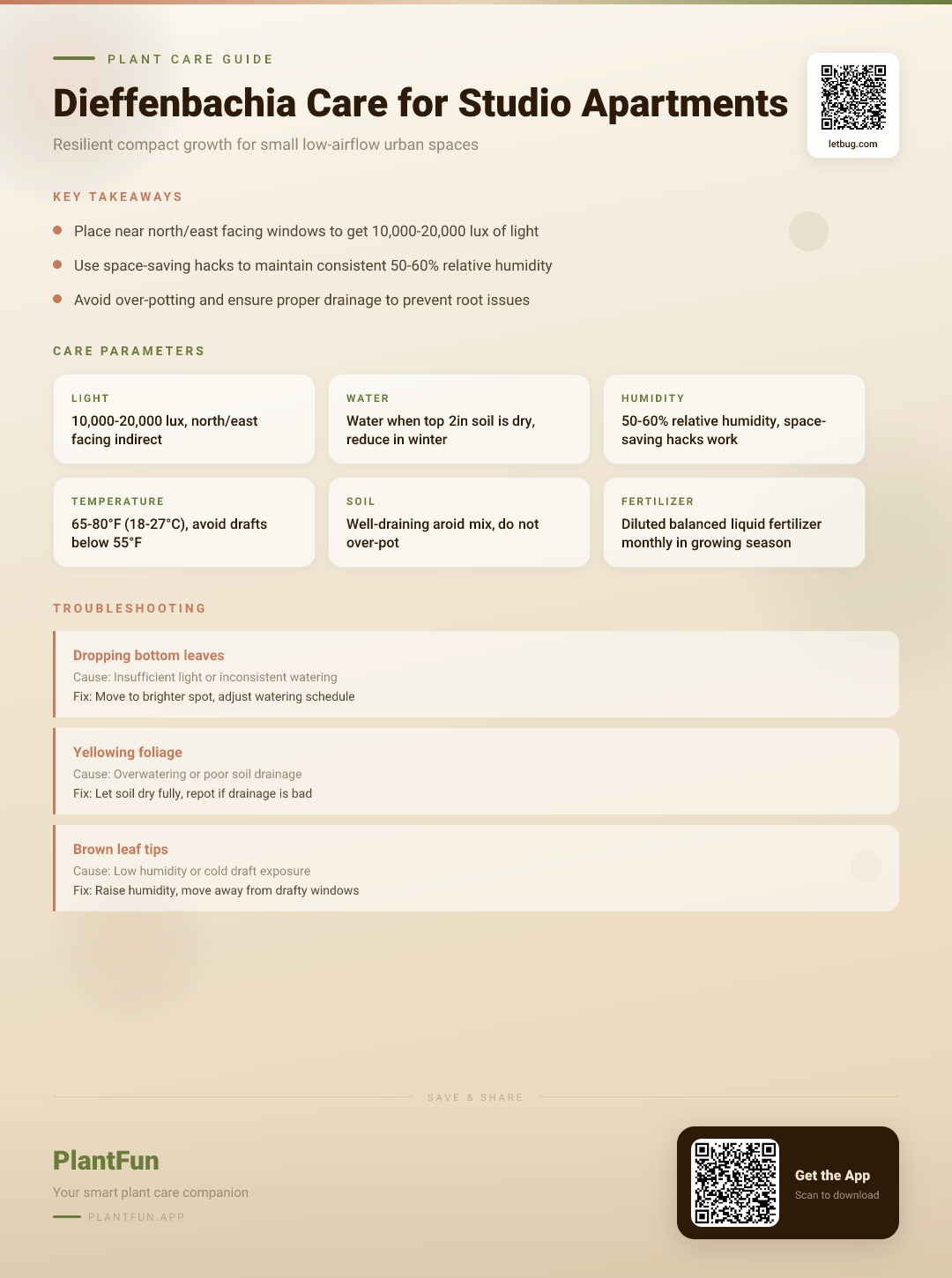
Key Takeaways
- Check soil moisture before watering — overwatering is the #1 killer of houseplants.
- Ensure your plant gets the right amount of light for its species.
- Be patient with recovery — most plants need 2–4 weeks to bounce back.
TL;DR: The 30-second summary for busy apartment dwellers
To thrive in a studio, your Dieffenbachia needs bright, indirect light (10,000–20,000 lux) and consistent moisture without waterlogging. Water when the top 2 inches of soil feel dry. Maintain 50–60% humidity to keep foliage lush. Keep the plant away from pets as it is toxic (ASPCA, 2026). If it leans toward the light, rotate it weekly to prevent asymmetrical growth.
Quick Care Card: Measuring your success
| Feature | Requirement |
|---|---|
| Light | Bright, indirect (10,000–20,000 lux) |
| Water | When top 2 inches of soil are dry |
| Humidity | 50–60% constant |
| Temperature | 65–80°F (18–27°C) |
| Soil | Well-draining, peat-based mix |
| Fertilizer | Balanced liquid 20-20-20, monthly in summer |
| Toxicity | Toxic to cats and dogs (ASPCA, 2026) |
Why Dieffenbachia Struggles in Studio Apartments
When I first started collecting plants in my tiny 400-square-foot studio, I brought home a beautiful Dieffenbachia. I made the mistake of shoving it in a corner near the bathroom. Within a month, it was dropping leaves.
Dieffenbachias (Dumb Cane) originate from the tropical understory where they enjoy high humidity and filtered sunlight (NC State Extension, 2026). In an apartment, the primary enemies are stagnant air and extreme light variance. Unlike a greenhouse, a studio apartment has “static” light. If you don’t supplement with rotation or proper placement, the plant will prioritize height over leaf density, leading to the dreaded “leggy” look.
Mastering Light: Achieving 10,000-20,000 lux
Dieffenbachia light requirements are often misunderstood. They don’t want direct, scorching sun, but they crave intensity. In an urban setting, a north or east-facing window is your best friend.
Aim for 10,000 to 20,000 lux. If you aren’t sure if your spot is bright enough, use the “hand shadow” test: if you hold your hand a foot above the soil and see a crisp, distinct shadow, you have sufficient light. If the shadow is blurry, you need to move the plant closer to the window or supplement with a full-spectrum grow lamp.
Hydration Strategy
Many owners ask, “how often to water Dieffenbachia?” The answer isn’t a calendar date, but a physical assessment. Because airflow in apartments can be restricted, the soil stays wetter for longer.
- Use the “knuckle test”: Stick your finger 2 inches into the soil. If it is dry, water thoroughly until it drains from the bottom.
- In 65-80°F (18-27°C) environments, metabolic rates are high. During summer, you may water every 7-10 days (Ajay & Fatmi, 2024).
- Always dump the excess water from the saucer; sitting water causes root rot.
Humidity Hacks
Dieffenbachia humidity needs are modest but essential. In winter, apartment heating zaps the air down to 20-30%. To achieve the required 50-60% without massive humidifiers:
- Group plants: This creates a microclimate where transpirational moisture is trapped between leaves.
- The pebble tray: Place your pot on a tray of wet gravel, ensuring the pot sits above the water line.
Seasonal Care Calendar
- Spring/Summer: Peak growth period. Fertilize monthly and keep the plant hydrated. This is when your indoor Dieffenbachia plant growth will be most aggressive.
- Autumn/Winter: Light levels drop significantly. Reduce watering frequency by 30% and pause all fertilization. Dieffenbachia winter care focuses on avoiding temperature fluctuations near windows.
Troubleshooting
Yellowing lower leaves
Symptom: The bottom leaves turn yellow and eventually drop off.
Likely cause: Overwatering or poor drainage leading to root stress.
Fix:
- Check the drainage holes for blockages.
- Reduce watering frequency by 2-3 days.
- Inspect roots; if they are mushy/brown, trim and repot in fresh, airy soil.
Drooping foliage
Symptom: The whole plant looks wilted despite damp soil.
Likely cause: Root rot or severe cold shock.
Fix:
- Move away from drafty vents or windows.
- Check soil moisture; if it is waterlogged, repot in a pot with better drainage.
Leggy growth
Symptom: Long, bare stems with leaves only at the top.
Likely cause: Insufficient light or lack of rotation.
Fix:
- Move closer to a light source.
- Rotate the pot 90 degrees every time you water.
Voice FAQ
How do I prune my Dieffenbachia to keep it from hitting the ceiling? Simply cut the top of the main stem using sterile shears. This encourages “branching” from lower nodes. The sap is caustic, so wear gloves (Peterson et al., 2009).
Can I keep my Dieffenbachia near a drafty apartment window? No. They prefer stable temperatures. Drafts in winter will cause cell collapse in the leaves, appearing as brown, papery patches.
Why is my Dieffenbachia drooping? It is usually a sign of “why is my Dieffenbachia drooping” due to uneven moisture. Ensure your pot size is appropriate—too much soil leads to wet, anaerobic conditions.
Common Mistakes to Avoid
- Mistake: Over-potting. What happens: The plant sits in too much soil that stays wet, causing root rot. Instead: Use a pot only 1-2 inches larger than the root ball.
- Mistake: Using dense, heavy garden soil. What happens: Compaction prevents oxygen from reaching roots. Instead: Use a mix of peat moss, perlite, and potting soil.
References
- Ajay, P.; Fatmi, U. (2024). Performance of Different Dieffenbachia (Dieffenbachia seguine) Varieties under Prayagraj Agro-climatic Conditions. International Journal of Plant & Soil Science. https://doi.org/10.9734/ijpss/2024/v36i74815. Accessed 2026-03-12.
- Peterson, K.; Beymer, J.; Rudloff, E. (2009). Airway obstruction in a dog after Dieffenbachia ingestion. Journal of Veterinary Emergency and Critical Care. https://doi.org/10.1111/j.1476-4431.2009.00486.x. Accessed 2026-03-12.
- ASPCA. (2026). Toxic and Non-Toxic Plants List — ASPCA. https://www.aspca.org/pet-care/animal-poison-control/toxic-and-non-toxic-plants. Accessed 2026-03-12.
- NC State Extension. (2026). Dieffenbachia Care — NC State Extension Gardener Plant Toolbox. https://plants.ces.ncsu.edu/plants/dieffenbachia-care/. Accessed 2026-03-12.
Optional Helper: Plantfun.App
Plantfun.App identifies your plants by photo, diagnoses pests and diseases with clear fixes, and creates personalised watering and light schedules that adapt to your home conditions — a handy companion for putting this guide into daily practice.
Found an error or have suggestions? We'd love your feedback.
Need help identifying this problem?
Get instant identification, personalized care schedules, and effective pest treatment plans directly on your phone.
Sponsored • We may earn a commission from app downloads
Related Guides
The Complete Dieffenbachia Care Guide for Typical Apartments: Grow Lush, Resilient Plants Easily
Stop dealing with yellow, drooping Dieffenbachia leaves in your apartment. Get exact light levels, watering amounts, and a weekly checklist to grow lush, resilient plants with minimal effort.
Care GuideDieffenbachia Care Checklist for Typical Apartments: 7 Steps for Lush, Resilient Growth
Grow lush, hard-to-kill Dieffenbachia even in dry, low-light urban apartments. Get 7 actionable checklist steps, exact care thresholds, and fixes for common yellow leaf issues fast.
Care GuideThe Complete Budget Dieffenbachia Care Checklist for Lush Resilient Growth in Typical Apartments
Grow lush, full Dieffenbachia in your apartment without buying expensive specialty supplies. Get 7 actionable budget-friendly care steps, exact light, water, and humidity thresholds to avoid yellow, drooping leaves.
Pest ControlAnts on Plants: What They Mean and What to Do
Ants usually aren't eating your plant. They are farming other pests.