
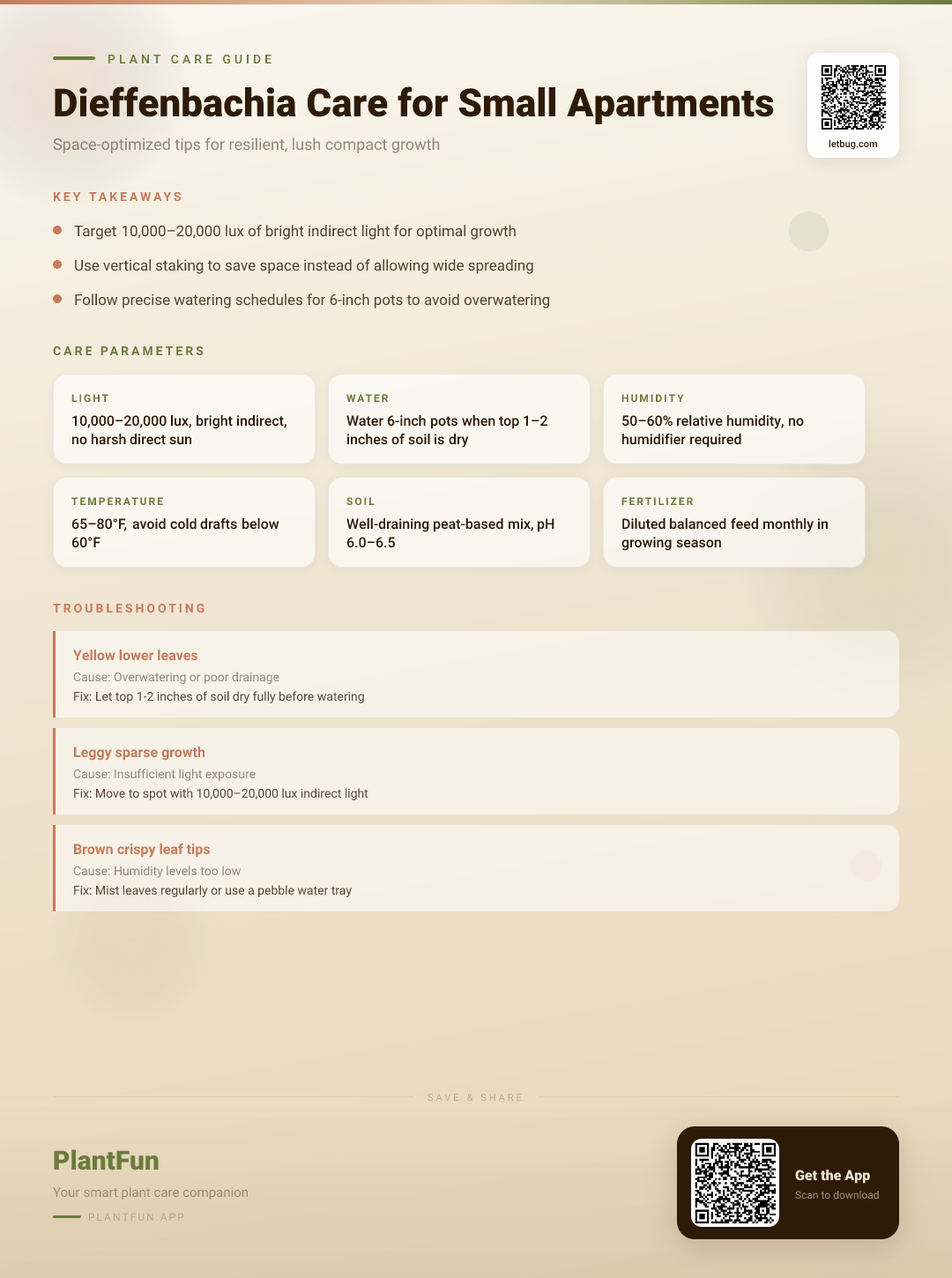
Key Takeaways
- Check soil moisture before watering — overwatering is the #1 killer of houseplants.
- Ensure your plant gets the right amount of light for its species.
- Be patient with recovery — most plants need 2–4 weeks to bounce back.
Quick Care Card: Essential Parameters
| Feature | Requirement |
|---|---|
| Light | 10,000–20,000 lux (bright, indirect) |
| Watering | Allow top 2 inches to dry out |
| Humidity | 50–60% constant |
| Temperature | 65–80°F (18–27°C) |
| Soil | Well-draining, airy aroid mix |
| Fertilizer | Balanced liquid feed, monthly (Apr–Sept) |
| Toxicity | Toxic to cats and dogs (ASPCA, 2026) |
TL;DR: The Apartment Grower’s Snapshot
To keep a Dieffenbachia happy in a small footprint, prioritize vertical growth. Maintain light levels between 10,000 and 20,000 lux, water only when the top 2 inches of soil feel dry to the touch, and avoid cold drafts. Because these plants contain calcium oxalate crystals, keep them out of reach of pets to prevent respiratory or oral irritation (Peterson et al., 2009).
Understanding the Dieffenbachia: Why It Thrives in Small Footprints
When I first started my indoor plant journey in a cramped studio, I assumed the Dieffenbachia was a sprawling monster. I made the mistake of placing it in a dark corner, leading to lanky, weak stems. In reality, Dieffenbachia is an ideal urban companion because its growth is phototropic—it will follow the light, making it easy to steer with a simple rotation schedule. Research into variety performance confirms that with appropriate environmental control, even cultivars in smaller containers can maintain structural integrity and leaf color (Ajay & Fatmi, 2024).
Light Optimization: Achieving 10,000–20,000 Lux in Limited Windows
Most apartment windows don’t offer full sun, but Dieffenbachia actually prefers the diffused light of an east or north-facing window. To hit the ideal 10,000–20,000 lux, place your plant within 3 feet of a window. If your apartment is perpetually dim, a simple LED grow bulb on a timer can supplement natural light without taking up extra shelf space.
Precision Watering: Calculating Hydration Needs for 6-inch Pots
Knowing how often to water Dieffenbachia is the difference between a lush plant and root rot. In a 6-inch pot, I use the “two-inch test”: insert your index finger into the soil. If it feels moist at the second knuckle, wait. Over-watering is the fastest way to kill this plant. In the winter, frequency should drop significantly as growth slows.
Humidity & Airflow: Maintaining 50–60% Humidity Without a Humidifier
Dieffenbachias hate the dry air produced by apartment radiators. You don’t need a bulky humidifier; a pebble tray filled with water and river stones placed beneath the pot increases local humidity. Ensure there is enough space for air to circulate; stagnant air encourages fungal gnats.
Temperature Control: Why 65–80°F Is Vital for Your Living Space
These plants are tropical natives. If your apartment drops below 60°F at night, the plant will go into shock. Keep it away from AC vents and exterior doors to ensure a steady 65–80°F environment.
Seasonal Care Calendar: Transitioning from Summer Growth to Winter Dormancy
- Spring/Summer: Increase light and water; fertilize once a month.
- Autumn/Winter: Reduce water by 30%. The plant’s metabolism slows down, so avoid feeding entirely from November to February.
Space-Saving Hack: Why Vertical Staking Beats Wide Spreading
If your plant is leaning, don’t let it take over your floor space. Use a moss pole or a simple bamboo stake to train the central stem upward. This forces the plant to allocate energy to vertical growth rather than outward leaf expansion.
Troubleshooting: Why Are My Dieffenbachia Leaves Turning Yellow?
Overwatering Stress
Symptom: Lower leaves yellowing and becoming mushy.
Likely cause: Waterlogged roots resulting in decay.
Fix:
- Remove the plant from the pot and inspect roots.
- Trim away black, slimy roots and repot in fresh, fast-draining mix.
Light Deficiency
Symptom: Yellowing starting at the base of the plant while the top remains green.
Likely cause: Lack of sufficient light reaching lower foliage.
Fix:
- Move the plant 1 foot closer to your window.
- Prune the bottom-most yellow leaves to encourage energy flow to new growth.
Voice Search FAQ: How do I prune a leggy Dieffenbachia in a small room?
Pruning is key for apartment maintenance. Use clean, sterile shears to cut the main stem back to a desired height—just above a leaf node. The plant will branch out from the cut site, creating a bushier, more compact silhouette.
Voice Search FAQ: Can I keep my Dieffenbachia on my desk near a computer monitor?
Yes, provided there is a nearby window. Keep it at least 12 inches away from the monitor itself; the heat from electronics can dry out the leaves, leading to brown tips.
Common Mistakes to Avoid in Tight Living Quarters
- Mistake: Planting in a pot without drainage. What happens: Water collects at the bottom, causing rot. Instead: Always use a nursery liner inside your decorative pot.
- Mistake: Crowding the plant against a wall. What happens: Poor air circulation invites pests. Instead: Keep at least 4 inches of clearance on all sides.
References and Botanical Best Practices
- Ajay, P.; Fatmi, U. (2024). Performance of Different Dieffenbachia (Dieffenbachia seguine) Varieties under Prayagraj Agro-climatic Conditions. International Journal of Plant & Soil Science. https://doi.org/10.9734/ijpss/2024/v36i74815. Accessed 2026-03-09.
- Peterson, K.; Beymer, J.; Rudloff, E. (2009). Airway obstruction in a dog after Dieffenbachia ingestion. Journal of Veterinary Emergency and Critical Care. https://doi.org/10.1111/j.1476-4431.2009.00486.x. Accessed 2026-03-09.
- ASPCA. (2026). Toxic and Non-Toxic Plants List — ASPCA. https://www.aspca.org/pet-care/animal-poison-control/toxic-and-non-toxic-plants. Accessed 2026-03-09.
Optional Helper: Plantfun.App
Plantfun.App identifies your plants by photo, diagnoses pests and diseases with clear fixes, and creates personalised watering and light schedules that adapt to your home conditions — a handy companion for putting this guide into daily practice.
Found an error or have suggestions? We'd love your feedback.
Need help identifying this problem?
Get instant identification, personalized care schedules, and effective pest treatment plans directly on your phone.
Sponsored • We may earn a commission from app downloads
Related Guides
Dieffenbachia in Small Apartments: The Only Care Guide You’ll Ever Need for Resilient Growth
Master Dieffenbachia care in small spaces with our precise guide. Learn exact lux needs and watering routines that stop drooping leaves for a thriving plant.
Care GuideDieffenbachia Care in Low-Humidity Apartments: The Complete Seasonal Guide for Lush Growth
Transform your Dieffenbachia with our seasonal care guide. Discover exact humidity levels, watering cycles, and apartment-friendly tips for year-round success.
Care GuideThe Complete Budget Dieffenbachia Care Checklist for Lush Resilient Growth in Typical Apartments
Grow lush, full Dieffenbachia in your apartment without buying expensive specialty supplies. Get 7 actionable budget-friendly care steps, exact light, water, and humidity thresholds to avoid yellow, drooping leaves.
Pest ControlAnts on Plants: What They Mean and What to Do
Ants usually aren't eating your plant. They are farming other pests.