
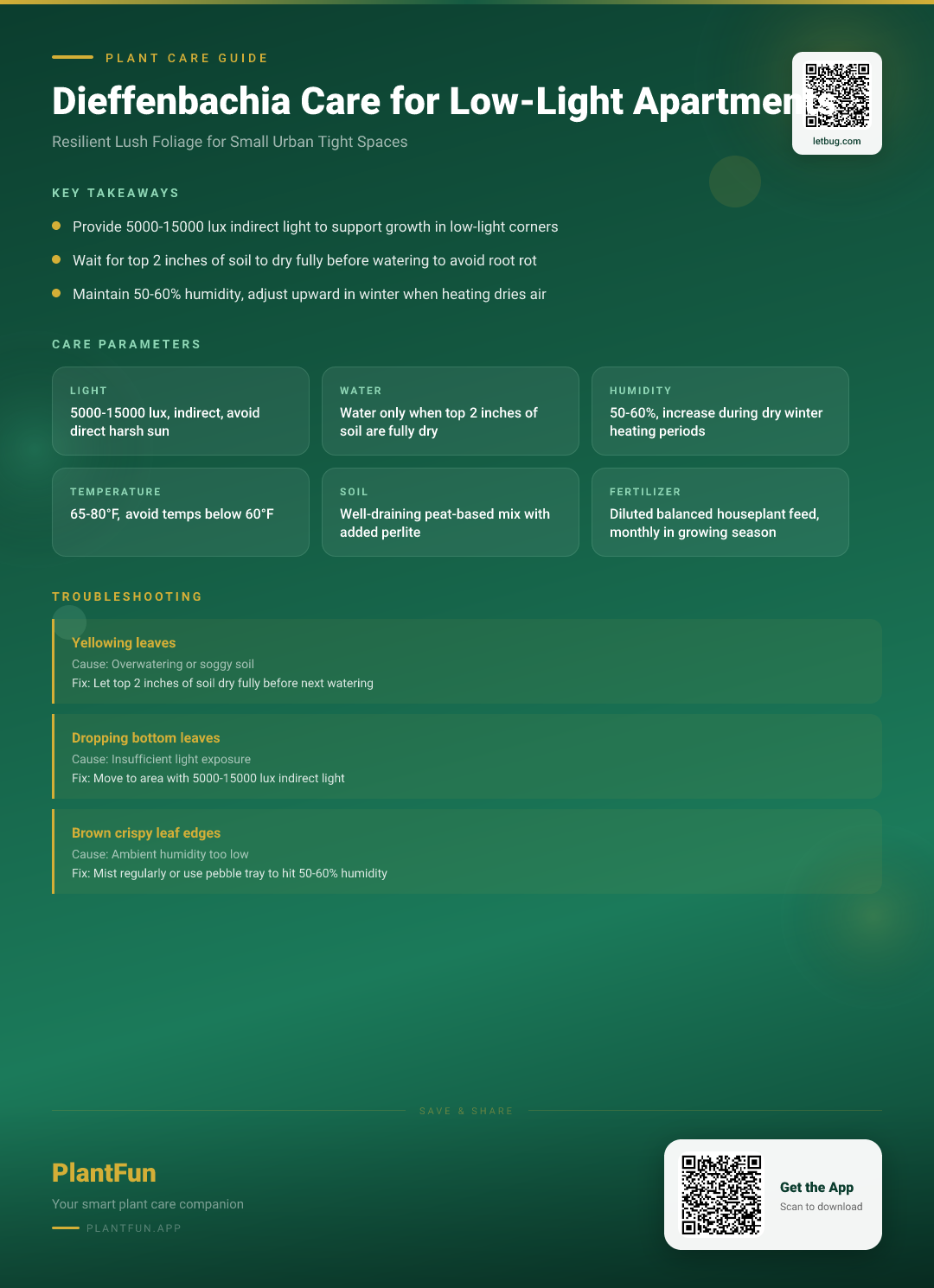
Key Takeaways
- Check soil moisture before watering — overwatering is the #1 killer of houseplants.
- Ensure your plant gets the right amount of light for its species.
- Be patient with recovery — most plants need 2–4 weeks to bounce back.
Quick Care Card: Essential Data
| Feature | Requirement |
|---|---|
| Light | 5,000–15,000 lux (bright, indirect) |
| Water | Allow top 2 inches to dry completely |
| Temp | 65–80°F (18–27°C) |
| Humidity | 50–60% |
| Soil | Well-draining, peat-based mix |
| Fertilizer | Balanced liquid feed, monthly in summer |
| Toxicity | Toxic to pets and humans (ASPCA, 2026) |
TL;DR: The Apartment-Dweller’s Cheat Sheet
Keep your Dieffenbachia happy by placing it in a spot that receives bright, filtered light—avoid direct, scorching sun. Water only when the top two inches of soil feel dry to the touch, and maintain at least 50% humidity to prevent crispy leaf tips. Because this plant contains calcium oxalate crystals, keep it away from pets and curious toddlers (ASPCA, 2026).
Understanding Your Dieffenbachia: Natural Habitat vs. The Living Room Corner
When I first brought home my first Dieffenbachia, I treated it like a rugged succulent, placing it in a dark hallway. I quickly realized my mistake: these plants originate from the tropical understories of the Americas. They are evolved for dappled light and consistent warmth. In an apartment, you aren’t just decorating; you are simulating the forest floor. By understanding these nuances, you can stop fighting the plant and start facilitating its natural, vigorous growth.
Why Light Quality Matters More Than Quantity for Indoor Dieffenbachia
It is a myth that Dieffenbachia can thrive in total darkness. While they tolerate lower light better than many tropicals, they require 5,000 to 15,000 lux to maintain their vibrant variegation (Ajay & Fatmi, 2024). In a small apartment, this usually means placing the pot within 3 feet of a north or east-facing window. If your leaves start turning solid green, they are “reaching” for more light.
Step-by-Step Watering Protocol: Avoiding Root Rot in Small Containers
Overwatering is the number one killer of apartment-bound Dieffenbachia. Since indoor airflow is often restricted, water takes longer to evaporate.
- The Finger Test: Insert your index finger 2 inches into the soil. If you feel any moisture, wait.
- Drainage Check: Ensure your pot has drainage holes. If you use a decorative cachepot, empty it of standing water 15 minutes after watering.
- Volume Control: Use approximately 250ml of lukewarm water for a 6-inch pot, adjusting based on the plant’s size and the ambient humidity (Ajay & Fatmi, 2024).
Maximizing Vertical Growth: Strategies for Limited Floor Space
If floor space is tight, utilize a plant stand to raise the plant, which often increases the light exposure on lower leaves. If the plant becomes too tall and “leggy,” you can perform a top-cutting. Taking a cutting and propagating it in water is an excellent way to refresh your collection without needing new, expensive plants.
Seasonal Adjustments: Managing Humidity in Winter Apartment Air
Winter radiator heat turns apartments into deserts. I keep a humidity tray filled with pebbles and water beneath my Dieffenbachia to maintain local moisture levels. Aim for 50–60% relative humidity, especially during the heating season, to prevent the foliage from curling.
Common Mistakes: Leaf Yellowing and Why It’s Usually a Watering Issue
- Mistake: Watering on a strict calendar schedule.
- What happens: The soil stays perpetually soggy, leading to root asphyxiation.
- Instead: Water based on soil moisture levels, which fluctuate based on your apartment’s unique heating and cooling cycles.
FAQ
Why is my Dieffenbachia dropping its bottom leaves so quickly? It is natural for the lowest, oldest leaves to shed as the plant matures. However, if multiple leaves yellow simultaneously, it is almost certainly a sign of overwatering (Ajay & Fatmi, 2024).
Can I keep my Dieffenbachia in a dark corner of my bedroom? While it will survive for a short time, it will eventually lose its variegation and become stunted. It is better to rotate it to a brighter spot every few days.
How do I know if my apartment air is too dry for my plant? Look for brown, crispy tips on the edges of the leaves. This is your plant’s way of saying the ambient humidity is below 40%.
Troubleshooting Guide: Quick Fixes for Common Dieffenbachia Stresses
Yellowing Leaves
Symptom: Lower leaves turn yellow and mushy.
Likely cause: Overwatering or poor drainage.
Fix:
- Check the soil moisture immediately.
- Repot into a more porous well-draining soil mix if the soil feels heavy or muddy.
Brown, Crispy Leaf Tips
Symptom: Tips become dry and brown while the rest of the leaf is healthy.
Likely cause: Low humidity or inconsistent watering.
Fix:
- Increase local humidity using a pebble tray.
- Establish a more consistent watering schedule that doesn’t let the plant dry out completely.
Drooping Foliage
Symptom: Entire stems lose their turgidity and sag.
Likely cause: Severe thirst.
Fix:
- Perform a thorough deep watering until liquid runs from the drainage holes.
- Keep the plant out of direct drafts from windows or air vents.
References
- Ajay, P.; Fatmi, U. (2024). Performance of Different Dieffenbachia (Dieffenbachia seguine) Varieties under Prayagraj Agro-climatic Conditions. International Journal of Plant & Soil Science. https://doi.org/10.9734/ijpss/2024/v36i74815. Accessed 2026-03-12.
- Peterson, K.; Beymer, J.; Rudloff, E. (2009). Airway obstruction in a dog after Dieffenbachia ingestion. Journal of Veterinary Emergency and Critical Care. https://doi.org/10.1111/j.1476-4431.2009.00486.x. Accessed 2026-03-12.
- ASPCA. (2026). Toxic and Non-Toxic Plants List — ASPCA. https://www.aspca.org/pet-care/animal-poison-control/toxic-and-non-toxic-plants. Accessed 2026-03-12.
Optional Helper: Plantfun.App
Plantfun.App identifies your plants by photo, diagnoses pests and diseases with clear fixes, and creates personalised watering and light schedules that adapt to your home conditions — a handy companion for putting this guide into daily practice.
Found an error or have suggestions? We'd love your feedback.
Need help identifying this problem?
Get instant identification, personalized care schedules, and effective pest treatment plans directly on your phone.
Sponsored • We may earn a commission from app downloads
Related Guides
Dieffenbachia in Small Apartments: The Complete Care Guide for Resilient, Upright Growth
Stop your Dieffenbachia from becoming leggy. Discover 5 space-saving care steps, exact light thresholds, and a watering schedule that ensures compact, lush leaves.
Care GuideThe Complete Budget Dieffenbachia Care Checklist for Lush Resilient Growth in Typical Apartments
Grow lush, full Dieffenbachia in your apartment without buying expensive specialty supplies. Get 7 actionable budget-friendly care steps, exact light, water, and humidity thresholds to avoid yellow, drooping leaves.
Care GuideThe Complete Dieffenbachia Care Checklist for Resilient Growth in Typical City Apartments
Grow a lush, full Dieffenbachia even in a standard city apartment. Get a 9-step actionable checklist, measurable care thresholds, and quick fixes for common leaf issues to keep your plant thriving year-round.
Pest ControlAnts on Plants: What They Mean and What to Do
Ants usually aren't eating your plant. They are farming other pests.