
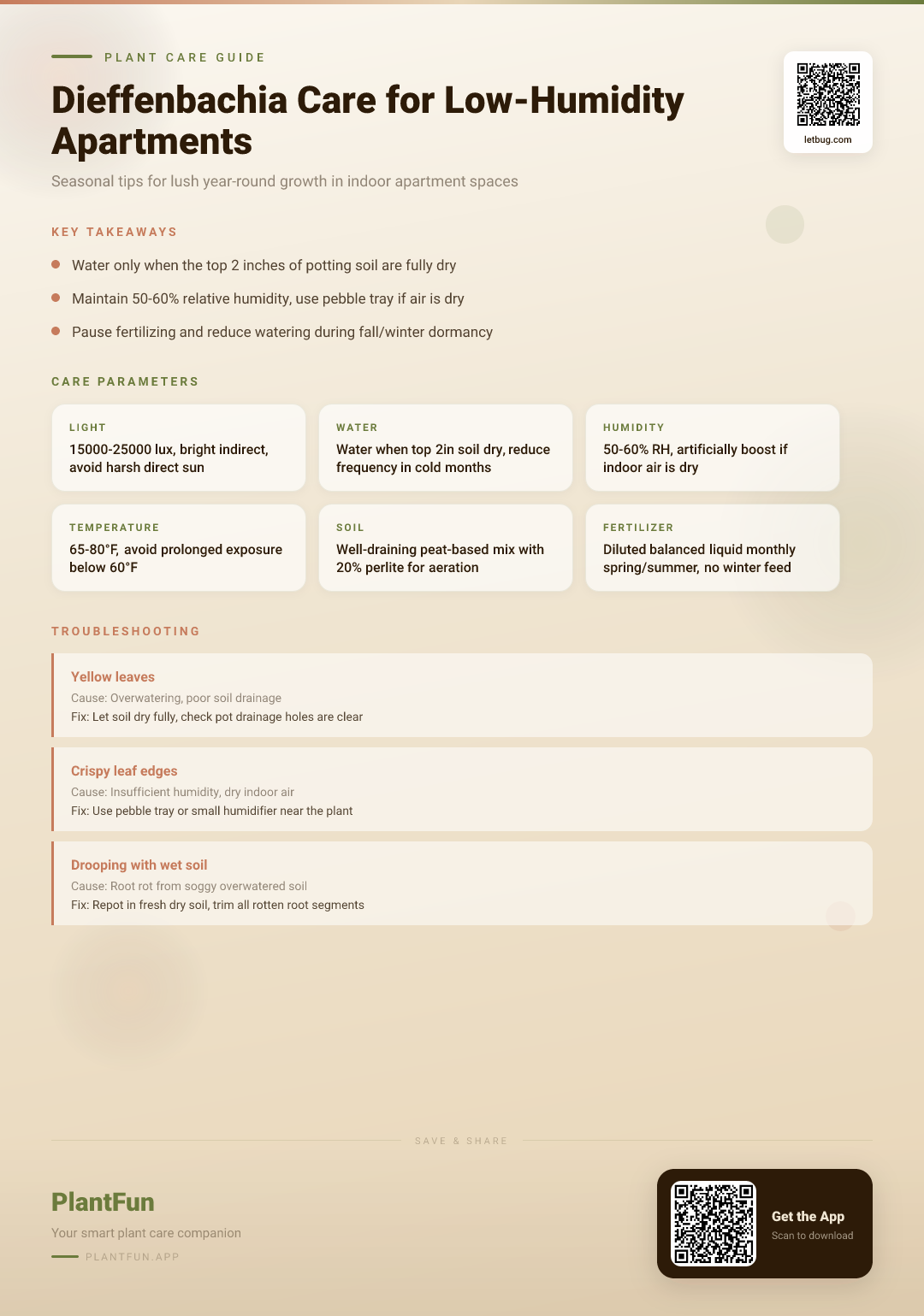
Key Takeaways
- Check soil moisture before watering — overwatering is the #1 killer of houseplants.
- Ensure your plant gets the right amount of light for its species.
- Be patient with recovery — most plants need 2–4 weeks to bounce back.
Quick Care Card: Essential Thresholds
| Feature | Requirement |
|---|---|
| Light | 15,000–25,000 lux (bright, indirect) |
| Water | When top 2 inches of soil are dry |
| Humidity | 50–60% relative humidity |
| Temperature | 65–80°F (18–27°C) |
| Soil | Well-draining, peat-based mix |
| Fertilizer | Balanced 20-20-20 (monthly in summer) |
| Toxicity | Toxic to cats and dogs (ASPCA, 2026) |
TL;DR: The Dieffenbachia Apartment Manifesto
Dieffenbachias (Dumb Cane) thrive in apartments by mimicking their native rainforest floor. To succeed, prioritize bright, indirect light—aim for 15,000–25,000 lux—and maintain humidity above 50%. Watering should only occur when the top 2 inches of soil feel dry. Because these plants contain calcium oxalate crystals, keep them out of reach of pets and small children (ASPCA, 2026).
Why Dieffenbachias Struggle in Modern Apartments (The Dry-Air Problem)
When I first brought home my first Dieffenbachia, I treated it like a pothos, ignoring the dry, recycled air of my high-rise apartment. Within weeks, the tips turned crispy and brown. Apartment living often subjects plants to forced-air heating and air conditioning, which can plummet indoor humidity below 30%. Unlike hardier foliage, Dieffenbachia requires higher transpiration support (Ajay & Fatmi, 2024). When the air is too dry, the plant loses water through its leaves faster than its roots can supply it, leading to systemic stress.
Step-by-Step Care: Mastering Light, Soil, and Fertilizer Precision
- Light Positioning: Place your plant within 3 feet of a window with sheer curtains. If your leaves are stretching toward the light (etiolation), your light levels are likely below 15,000 lux.
- Soil Composition: Use a mix consisting of 50% high-quality peat moss, 25% perlite for aeration, and 25% pine bark. This ensures the roots have access to both oxygen and moisture.
- Fertilization: During the active growing season, use a balanced liquid fertilizer diluted to half-strength. Do not fertilize during winter dormancy.
- Watering Technique: Stick your finger 2 inches into the soil. If it feels damp, wait. If it is dry, irrigate until water flows through the drainage holes. Never let the plant sit in standing water.
Seasonal Routine: Spring & Summer Growth Cycles vs. Fall & Winter Dormancy
In the spring and summer, your Dieffenbachia will enter a growth phase. Increase your watering frequency to match the ambient temperature; usually, this means checking soil moisture twice a week. As autumn approaches and temperatures drop below 65°F, growth slows significantly. Reduce your water intake by 30-40% to prevent root rot—a common killer of indoor plants during the darker, colder months.
How to Artificially Boost Humidity in a Typical Living Room
If your apartment humidity drops below 40%, follow these steps:
- Grouping: Cluster your Dieffenbachia with other tropical plants to create a microclimate where moisture is trapped.
- Ultrasonic Humidifiers: Position a humidifier within 5 feet of the plant to keep local humidity steady at 55%.
- Strategic Placement: Avoid placing the plant directly in the line of HVAC vents or radiators.
Troubleshooting Guide: Why are my Dieffenbachia leaves turning yellow or crispy?
Yellowing Lower Leaves
Symptom: The oldest, bottom leaves are yellowing and drooping.
Likely cause: Overwatering leading to root oxygen deprivation.
Fix:
- Check the drainage holes for blockages.
- Withhold water until the top 3 inches of soil are dry.
Crispy Leaf Margins
Symptom: Edges of the leaves are turning brown and brittle.
Likely cause: Low humidity or mineral buildup from tap water.
Fix:
- Increase ambient humidity using a humidifier.
- Switch to filtered or distilled water to avoid fluoride sensitivity.
Sudden Leaf Drop
Symptom: Green leaves are falling off unexpectedly.
Likely cause: Temperature shock or cold drafts.
Fix:
- Move the plant away from drafty doors or windows.
- Ensure temperatures remain consistently above 65°F (18°C).
Voice Search FAQ
Why is my Dieffenbachia drooping even though the soil is wet? Drooping in wet soil is a classic sign of root rot. The roots are suffocating and cannot transport water to the leaves. Remove the plant from its pot, trim back any mushy, black roots, and repot in fresh, dry soil.
How do I know when my Dieffenbachia needs more light? If the plant loses its variegation (the colorful patterns on the leaves turn solid green) or the stems start to lean significantly toward the nearest light source, it needs more intensity (Ajay & Fatmi, 2024).
Can I use a pebble tray to fix dry air for my plant? While popular, pebble trays provide negligible humidity increase in large, air-conditioned apartments. They are better suited for localized, very small spaces; an ultrasonic humidifier is much more effective.
Common Mistakes: Overwatering and Light Shock Explained
- Mistake: Watering on a set calendar day.
- What happens: The plant receives water when it doesn’t need it, leading to root death.
- Instead: Water based on the 2-inch soil finger test.
- Mistake: Moving a plant suddenly from a dark corner to direct, mid-day sun.
- What happens: Light shock occurs, causing white, bleached spots on the leaves (sunburn).
- Instead: Gradually acclimate the plant to brighter light over 2 weeks.
References
- ASPCA. (2026). Toxic and Non-Toxic Plants List — ASPCA. https://www.aspca.org/pet-care/animal-poison-control/toxic-and-non-toxic-plants. Accessed 2026-03-11.
- Ajay, P.; Fatmi, U. (2024). Performance of Different Dieffenbachia (Dieffenbachia seguine) Varieties under Prayagraj Agro-climatic Conditions. International Journal of Plant & Soil Science. https://doi.org/10.9734/ijpss/2024/v36i74815. Accessed 2026-03-11.
- Peterson, K.; Beymer, J.; Rudloff, E. (2009). Airway obstruction in a dog after Dieffenbachia ingestion. Journal of Veterinary Emergency and Critical Care. https://doi.org/10.1111/j.1476-4431.2009.00486.x. Accessed 2026-03-11.
Optional Helper: Plantfun.App
Plantfun.App identifies your plants by photo, diagnoses pests and diseases with clear fixes, and creates personalised watering and light schedules that adapt to your home conditions — a handy companion for putting this guide into daily practice.
Found an error or have suggestions? We'd love your feedback.
Need help identifying this problem?
Get instant identification, personalized care schedules, and effective pest treatment plans directly on your phone.
Sponsored • We may earn a commission from app downloads
Related Guides
The Complete Dieffenbachia Care Guide for Typical Apartments: Grow Lush, Resilient Plants Easily
Stop dealing with yellow, drooping Dieffenbachia leaves in your apartment. Get exact light levels, watering amounts, and a weekly checklist to grow lush, resilient plants with minimal effort.
Care GuideDieffenbachia Care in Small Apartments: How to Thrive in Limited Light and Space
Master your indoor jungle. Learn the 4 exact light and water thresholds needed to keep your Dieffenbachia lush and pest-free in a compact apartment today.
Care GuideDieffenbachia in a Typical Apartment: The Essential Guide to Resilient, Lush Leaf Growth
Transform your struggling Dieffenbachia into a vibrant centerpiece. Get precise watering schedules, light levels, and 4 proven fixes for common apartment issues.
Pest ControlAnts on Plants: What They Mean and What to Do
Ants usually aren't eating your plant. They are farming other pests.