
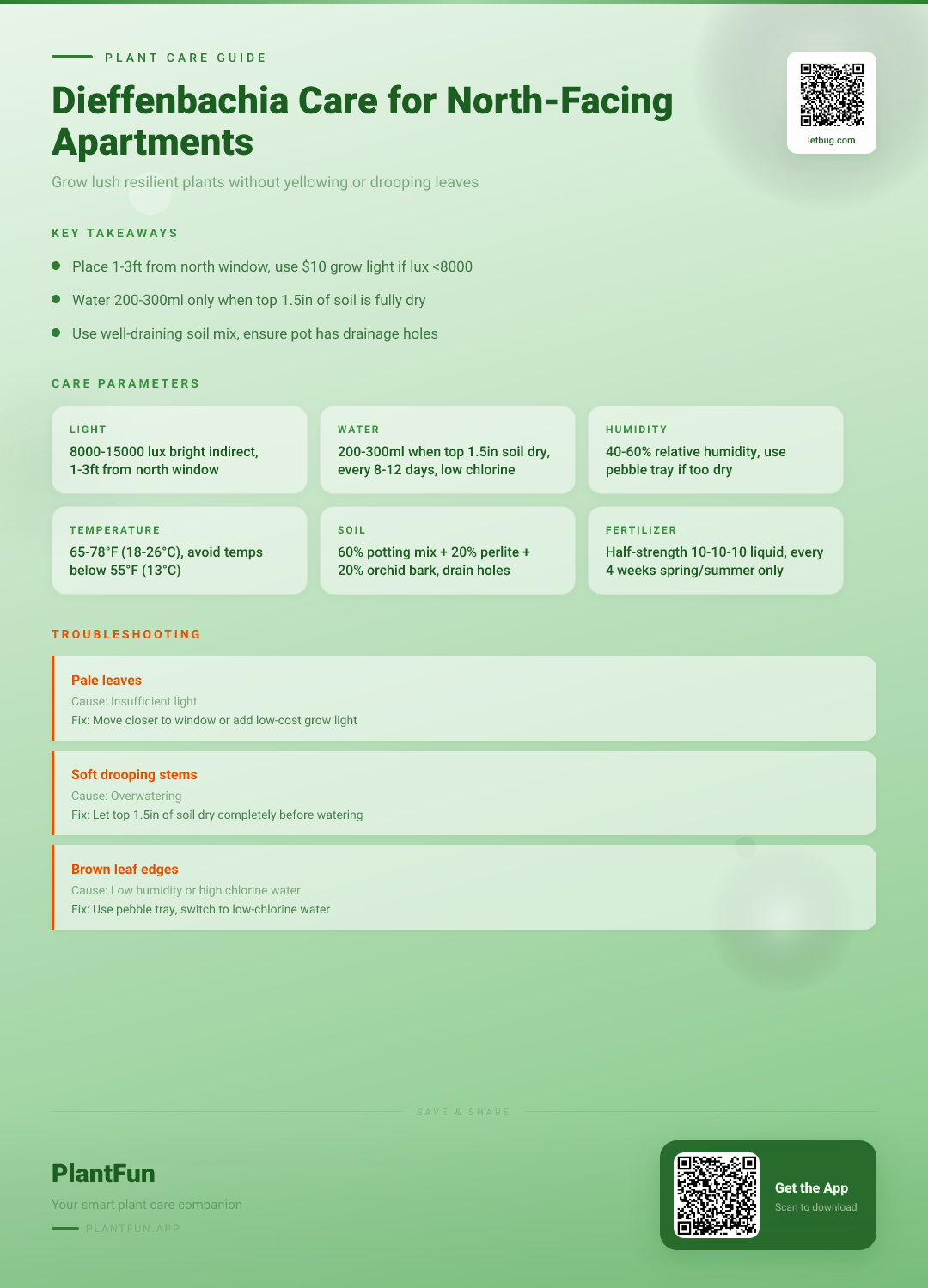
Key Takeaways
- Check soil moisture before watering — overwatering is the #1 killer of houseplants.
- Ensure your plant gets the right amount of light for its species.
- Be patient with recovery — most plants need 2–4 weeks to bounce back.
Quick Care Card: Printable at-a-glance table with all measurable care thresholds for Dieffenbachia in north-facing apartments for easy reference
| Care Factor | Threshold for North-Facing Apartments |
|---|---|
| Light | 8,000–15,000 lux, placed 1–3 feet from north window, no direct midday sun |
| Water | 200–300 ml when top 1.5 inches of soil are dry (every 8–12 days on average) |
| Humidity | 40–60% relative humidity, no humidifier required with low-effort hacks |
| Temperature | 65–78°F (18–26°C), never expose to temperatures below 55°F (13°C) |
| Soil | 60% general potting mix + 20% perlite + 20% orchid bark for fast drainage |
| Fertilizer | Half-strength balanced 10-10-10 liquid fertilizer, once every 4 weeks spring/summer only |
| Toxicity | Toxic to cats, dogs, and humans if ingested (ASPCA, 2026) |
Why Standard North-Facing Apartment Conditions Are Perfect (And Tricky) For Dieffenbachia
Dieffenbachia are native to tropical Central and South American understories, where they grow in dappled, low-intensity sunlight and consistent warm, humid conditions — a profile that aligns almost perfectly with the average north-facing 1-bedroom apartment (Ajay & Fatmi, 2024).
Myth vs Reality
Myth: Dieffenbachia need bright south-facing light to grow well. Reality: The soft, consistent indirect light from north-facing windows actually matches their native habitat better than harsh direct sun, which will scorch their leaves (NC State Extension, 2026).
The only tricky parts of north-facing apartment conditions are rare light dips below 8,000 lux in mid-winter, cold drafts from window AC or heating vents, and humidity drops below 40% during heating season — all easy to fix with no fancy equipment. For more low-light plant tips, check out our guide to growing tropical plants in dim apartments.
Diagnosis First: How to Spot 3 Early Dieffenbachia Stress Signals Before They Worsen
Catch these early warning signs 2–3 weeks before permanent damage occurs:
- Pale new leaves: New growth is a lighter, washed-out green than mature leaves, with faded variegation (if applicable). This signals light levels are too low.
- Soft drooping stems: Stems bend easily at the base, and leaves hang limp even if you watered recently. This is the first sign of early root rot from overwatering.
- Crispy brown leaf edges: Light brown, dry edges on mature leaves with no yellow halo. This signals low humidity or excess chlorine in tap water.
Light Requirements for North-Facing Placement
Dieffenbachia need 8,000–15,000 lux of bright indirect light to thrive (NC State Extension, 2026). For north-facing apartments, place your plant 1–3 feet away from the living room window: this position avoids the 1–2 hours of weak early morning sun that north windows get in summer, while capturing maximum consistent indirect light.
Use a free phone lux meter app to test light levels. If you measure less than 7,000 lux for 3+ consecutive days in mid-winter, a $10 clip-on LED grow light run for 8 hours a day is all you need to fill the gap. See our guide to budget grow lights for apartments for affordable recommendations.
Exact Watering Schedule For 35-45% Apartment Humidity
For the average 35–45% indoor humidity of most apartments, water your Dieffenbachia with 200–300 ml of water only when the top 1.5 inches of soil are completely dry (stick your finger past the first knuckle to test) (Ajay & Fatmi, 2024). This works out to every 8–12 days on average, with small seasonal adjustments:
- Summer: Water every 7–9 days (Dieffenbachia summer watering) as higher temperatures speed up evaporation
- Winter: Water every 12–16 days (Dieffenbachia winter care) as growth slows and soil dries slower
Avoid high-chlorine tap water by letting it sit out for 24 hours before use, or use filtered/rainwater. Overwatering is the #1 cause of Dieffenbachia yellow leaves, so always err on the side of underwatering.
Soil & Potting Requirements to Prevent Root Rot
Dieffenbachia root rot prevention relies on fast-draining soil and properly sized pots:
- Use a mix of 60% general potting mix + 20% perlite + 20% orchid bark to ensure excess water drains quickly (NC State Extension, 2026)
- Always use a pot with mandatory drainage holes; if you use a decorative cache pot, empty any standing water from the bottom 30 minutes after watering
- Choose a pot no more than 2 inches larger than the current root ball: extra soil holds excess moisture that causes root rot. Only repot when roots grow out of the drainage holes.
For more tips on avoiding root rot, see our step-by-step guide to root rot prevention for houseplants.
Humidity & Temperature Thresholds for Resilient Growth
Dieffenbachia humidity needs fall between 40–60% relative humidity, and they prefer temperatures of 65–78°F (18–26°C) (Ajay & Fatmi, 2024). Never expose them to temperatures below 55°F (13°C), as this will cause sudden leaf drop.
No humidifier is required to hit the minimum 40% humidity: try these easy hacks:
- Use a pebble tray: fill a tray with pebbles, add water to just below the top of the pebbles, and set your pot on top. Evaporation increases local humidity by 5–10%
- Group your Dieffenbachia with other houseplants to share moisture released through leaf transpiration
- Keep plants at least 2 feet away from heating/AC vents and drafty window seals
Fertilizing Routine for Lush, Full Foliage
Dilute a balanced 10-10-10 liquid fertilizer to half strength, and apply once every 4 weeks only in spring and summer (NC State Extension, 2026). Skip fertilizing entirely in fall and winter, when the plant is dormant and will not absorb extra nutrients. Over-fertilizing causes brown leaf tips; if you see this, flush the soil with 3x the pot volume of water to remove excess salt buildup.
Seasonal Care Calendar for Apartment Dieffenbachia (Northern Hemisphere)
| Month Range | Watering Frequency | Light Adjustments | Fertilizer |
|---|---|---|---|
| Jan–Feb (Winter) | Every 12–16 days | Add grow light if lux levels drop below 7,000 | None |
| Mar–Apr (Early Spring) | Every 10–12 days | Wipe leaves with a damp cloth to remove dust for better light absorption | First application when new growth appears |
| May–Aug (Summer) | Every 7–9 days | Ensure no direct early morning sun hits leaves, avoid AC drafts | Apply every 4 weeks |
| Sep–Oct (Early Fall) | Every 10–12 days | Move 6 inches closer to window as daylight hours shorten | Stop applications |
| Nov–Dec (Late Fall) | Every 12–16 days | Check for cold drafts from window seals | None |
5 Common Mistakes That Kill Dieffenbachia in North-Facing Apartments
- Mistake: Overwatering on a fixed schedule regardless of soil moisture. What happens: Root rot, yellow mushy leaves, drooping stems. Instead: Test the top 1.5 inches of soil every week, only water when completely dry.
- Mistake: Placing in direct sun for more than 2 hours a day. What happens: Sun scorch, brown crispy patches on leaves, faded variegation. Instead: Keep 1–3 feet from the north window, no closer than 1 foot in summer when early morning sun is stronger.
- Mistake: Placing near cold drafts from window AC units, heating vents, or drafty window seals. What happens: Sudden leaf drop, brown edges, stunted growth. Instead: Keep the plant at least 2 feet away from all vents and drafty window edges, use a draft stopper if needed.
- Mistake: Repotting more than once every 2–3 years, or in a pot much larger than the root ball. What happens: Excess soil holds moisture, leading to root rot, stunted growth. Instead: Only repot when roots are growing out of the drainage holes, use a pot 2 inches larger at maximum.
- Mistake: Ignoring early pest signs like tiny white speckles on leaves or webbing on stems. What happens: Spider mites or mealybugs infest the plant, leading to leaf drop and death if untreated. Instead: Wipe leaves with a damp cloth every 2 weeks, treat early infestations with neem oil spray.
Voice Search FAQ
Why is my Dieffenbachia turning yellow?
The most common cause is overwatering, followed by light levels below 8,000 lux, or exposure to cold drafts (NC State Extension, 2026). First test the top 1.5 inches of soil: if it’s damp, hold off on watering until it’s completely dry, and check that the plant is not near a drafty vent or window. If the yellow leaves have brown mushy spots, you may have early root rot.
Can I keep my Dieffenbachia in a dark apartment corner?
Only if you add a basic $10 clip-on grow light set to run 8 hours a day. Dieffenbachia need a minimum of 7,000 lux to survive, and 8,000–15,000 lux to thrive (Ajay & Fatmi, 2024). Dark corners typically have less than 2,000 lux, which will lead to pale, drooping leaves and stunted growth over time.
How often do I need to repot my Dieffenbachia?
Only once every 2–3 years, when you see roots growing out of the drainage holes at the bottom of the pot (NC State Extension, 2026). Dieffenbachia prefer being slightly root-bound, so repotting too often will stress the plant and increase the risk of root rot. Wear gloves when repotting, as Dieffenbachia sap is toxic to cats, dogs, and humans if ingested (ASPCA, 2026).
Final 2-Minute Health Audit Checklist
Do these 5 quick checks right now to confirm your Dieffenbachia is on track:
- Stick your finger 1.5 inches into the soil: is it completely dry? If yes, water 200–300ml; if no, wait 2–3 days and check again.
- Test light levels with a free phone lux meter app: is it between 8,000–15,000 lux? If below 7,000, move closer to the window or add a grow light.
- Inspect the newest 2 leaves: are they a vibrant green with clear variegation (if applicable)? If pale, light is too low.
- Feel the stems: are they firm and upright? If soft and droopy, check for overwatering.
- Check the leaf edges: are they green and smooth? If crispy brown, test humidity or switch to filtered water.
References
- NC State Extension. (2026). Dieffenbachia Care Checklist — NC State Extension Gardener Plant Toolbox. https://plants.ces.ncsu.edu/plants/dieffenbachia-care/. Accessed 2026-02-26.
- Ajay, P.; Fatmi, U. (2024). Performance of Different Dieffenbachia (Dieffenbachia seguine) Varieties under Prayagraj Agro-climatic Conditions. International Journal of Plant & Soil Science. https://doi.org/10.9734/ijpss/2024/v36i74815. Accessed 2026-02-26.
- ASPCA. (2026). Toxic and Non-Toxic Plants List — ASPCA. https://www.aspca.org/pet-care/animal-poison-control/toxic-and-non-toxic-plants. Accessed 2026-02-26.
- Elderly Care. (1985). Checklist for care. Elderly Care. https://doi.org/10.7748/eldc.5.4.6.s8. Accessed 2026-02-26.
Optional Helper: Plantfun.App
Plantfun.App identifies your plants by photo, diagnoses pests and diseases with clear fixes, and creates personalised watering and light schedules that adapt to your home conditions — a handy companion for putting this guide into daily practice.
Found an error or have suggestions? We'd love your feedback.
Need help identifying this problem?
Get instant identification, personalized care schedules, and effective pest treatment plans directly on your phone.
Sponsored • We may earn a commission from app downloads
Related Guides
The Complete Budget Dieffenbachia Care Checklist for Resilient Growth in Typical Apartments
Skip expensive specialty plant products to grow lush, full Dieffenbachia in your typical apartment. Get 7 actionable budget care steps, exact light/water thresholds, and fixes for common issues.
Care GuideThe Complete Budget Dieffenbachia Care Checklist for Lush Resilient Growth in Typical Apartments
Grow lush, full Dieffenbachia in your apartment without buying expensive specialty supplies. Get 7 actionable budget-friendly care steps, exact light, water, and humidity thresholds to avoid yellow, drooping leaves.
Care GuideThe Complete Dieffenbachia Care Checklist for Resilient Growth in Typical Urban Apartments
Grow lush, full Dieffenbachia even in dry, variable urban apartment conditions. Get a free seasonal checklist, exact light/humidity thresholds, and 3 easy fixes for common yellow leaf issues.
Pest ControlAnts on Plants: What They Mean and What to Do
Ants usually aren't eating your plant. They are farming other pests.