
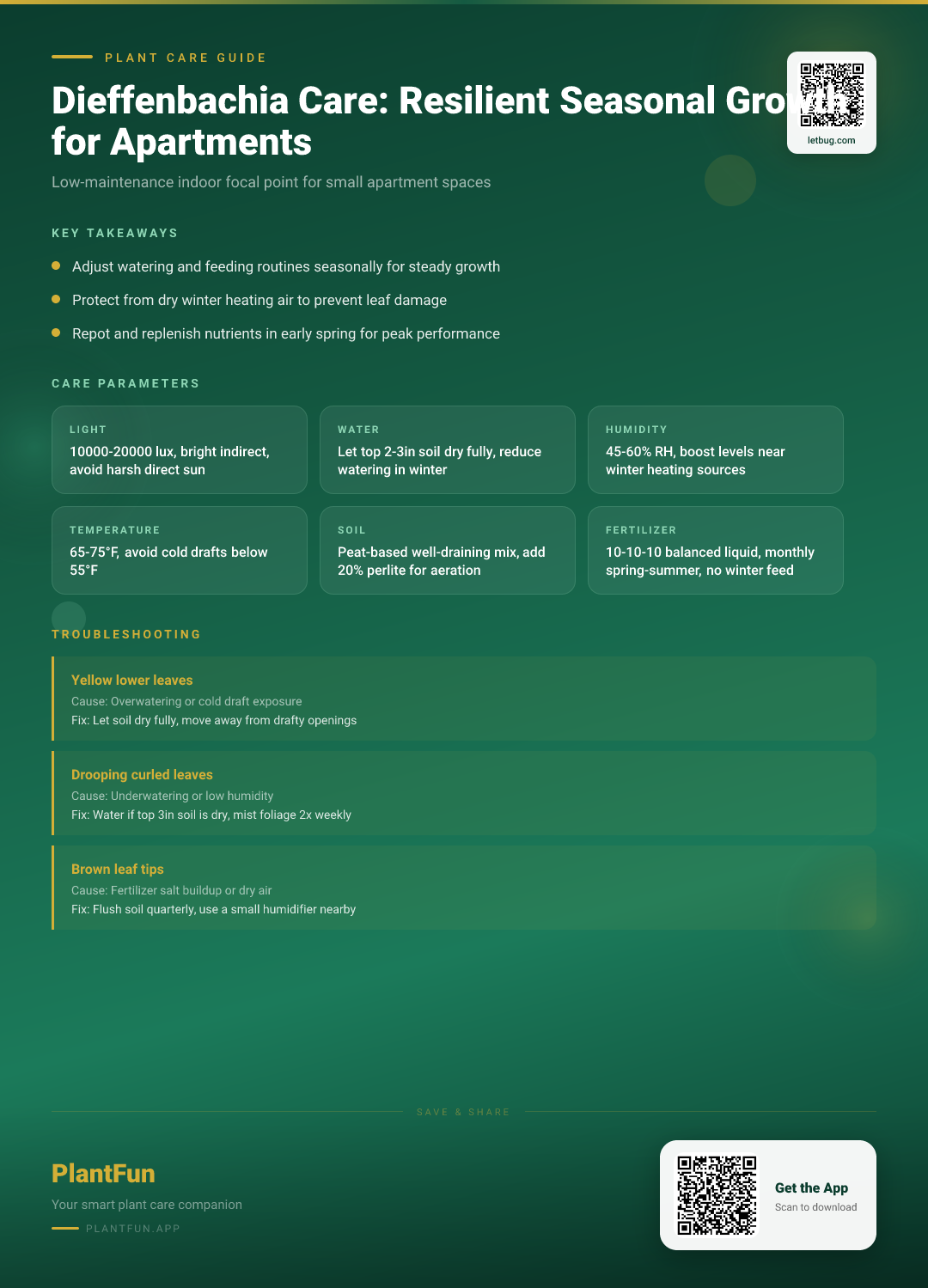
Key Takeaways
- Check soil moisture before watering — overwatering is the #1 killer of houseplants.
- Ensure your plant gets the right amount of light for its species.
- Be patient with recovery — most plants need 2–4 weeks to bounce back.
TL;DR: Success in a Nutshell
To keep your Dieffenbachia (Dumb Cane) flourishing in an apartment, prioritize bright, indirect light (10,000–20,000 lux) and allow the top 2 inches of soil to dry out between waterings. Because these plants are tropical, they thrive in 45–60% humidity and require significantly less water during the darker winter months. Always wear gloves when pruning, as the sap contains calcium oxalate crystals that cause irritation (ASPCA, 2026).
Quick Care Card: Snapshot of Essential Thresholds
| Category | Requirement |
|---|---|
| Light | 10,000–20,000 lux (bright, indirect) |
| Watering | When top 2 inches of soil are dry |
| Humidity | 45–60% (ideal for apartments) |
| Temperature | 65°F–80°F (18°C–27°C) |
| Soil | Well-draining, peat-based mix |
| Fertilizer | Balanced liquid feed monthly (Spring/Summer) |
| Toxicity | Toxic to pets/humans if ingested (ASPCA, 2026) |
My Experience: The Apartment Learning Curve
When I first brought home my Dieffenbachia, I assumed it would tolerate the dim corner of my living room just fine. I made the mistake of overwatering it during a cold snap, thinking the plant needed the same care year-round. Within weeks, the lower leaves turned yellow and dropped. I learned the hard way that Dieffenbachia care in apartments requires a rhythmic, seasonal approach that respects the plant’s metabolic slowing in winter.
Why Your Dieffenbachia Needs a Seasonal Strategy in Small Spaces
Apartment environments are notorious for sudden micro-climate shifts. In summer, your window might be a sun-drenched hotspot; in winter, it can turn into a drafty, dry corridor. According to research on plant performance in varying agro-climatic conditions, these varieties respond directly to light and temperature stability (Ajay & Fatmi, 2024). By adjusting your care, you prevent the stress that causes the plant to drop leaves prematurely.
Understanding the Light-Water Balancing Act (10,000-20,000 lux)
Dieffenbachia require high-quality indirect light. If you can read a book comfortably in the spot where the plant sits, it is likely in the 10,000–20,000 lux range. Avoid harsh, direct afternoon sun, which scorches leaves.
- The Balancing Act: High light speeds up photosynthesis and water consumption. In the summer, you may water every 7 days. In winter, with lower light, this may stretch to every 14–18 days.
Step-by-Step: The Seasonal Watering & Feeding Calendar
- Spring (Awakening): Increase watering frequency as new growth emerges. Apply a diluted 20-20-20 fertilizer every 4 weeks.
- Summer (Peak Growth): Monitor for heat waves. If temps exceed 80°F, check soil moisture every 5 days.
- Autumn (Transition): Taper off fertilizer as natural daylight decreases.
- Winter (Dormancy): Allow the plant to dry out significantly. Stop fertilizing entirely to prevent salt buildup in the soil.
Winterization: Protecting Your Plant from Dry Apartment Air (45-60% humidity)
Central heating is a death knell for tropical plants. I keep my Dieffenbachia away from radiators. If you notice brown, crispy leaf edges, your ambient humidity is likely below 40%. Use a humidifier or group your plants together to create a micro-climate (NC State Extension, 2026).
Spring Awakening: Timing Repotting and Nutrient Loading
Repot only when you see roots emerging from the drainage hole. Use a pot only 1–2 inches wider than the current one to prevent root rot. Fresh potting medium provides necessary aeration.
Common Apartment Mistakes: Why Less is Often More
- Mistake: Watering on a strict weekly schedule.
- What happens: Root suffocation and yellowing leaves.
- Instead: Use the finger test—stick your finger 2 inches into the soil before deciding to water.
- Mistake: Using a pot without drainage.
- What happens: Water pools at the bottom, leading to fungal pathogens.
- Instead: Use a nursery liner inside a decorative pot.
Troubleshooting: What to do when leaves yellow or droop
Yellowing Lower Leaves
Symptom: Older leaves at the bottom turn yellow and drop.
Likely cause: Natural aging or overwatering.
Fix:
- Check the soil moisture; if soggy, stop watering for 10 days.
- If the soil is dry, ensure you are providing consistent hydration.
Brown, Crispy Leaf Tips
Symptom: The tips of the leaves turn brown and brittle.
Likely cause: Low humidity or mineral buildup from tap water.
Fix:
- Increase local humidity using a pebble tray or humidifier.
- Flush the soil with distilled water to remove excess salts.
Wilting Despite Moist Soil
Symptom: The entire plant droops.
Likely cause: Root rot destroying the root system’s ability to uptake water.
Fix:
- Remove the plant from the pot and inspect roots; trim any mushy, black roots.
- Repot in fresh, well-draining soil.
FAQ: Why is my Dieffenbachia dropping its lower leaves in winter?
It is often a response to decreased light. The plant is shedding older foliage it can no longer support metabolically. Move it closer to a light source, but keep it away from cold glass.
FAQ: Can I safely keep my Dieffenbachia in an apartment with pets?
No. The ASPCA classifies Dieffenbachia as toxic to both dogs and cats. Ingestion can cause oral irritation, excessive drooling, and difficulty swallowing (Peterson et al., 2009; ASPCA, 2026). Keep it on a high pedestal.
FAQ: How do I know if my apartment has enough light for this plant?
If the plant is losing variegation and stems are becoming long and “leggy,” it is not receiving enough light. Move it to a brighter, east-facing window.
Science-Backed Soil Mixes for Container Longevity
For optimal growth, I recommend a blend of 50% high-quality potting soil, 25% perlite for aeration, and 25% coco coir or peat moss to retain just enough moisture without waterlogging the roots (NC State Extension, 2026).
References
- Ajay, P.; Fatmi, U. (2024). Performance of Different Dieffenbachia (Dieffenbachia seguine) Varieties under Prayagraj Agro-climatic Conditions. International Journal of Plant & Soil Science. https://doi.org/10.9734/ijpss/2024/v36i74815. Accessed 2026-03-17.
- Peterson, K.; Beymer, J.; Rudloff, E. (2009). Airway obstruction in a dog after Dieffenbachia ingestion. Journal of Veterinary Emergency and Critical Care. https://doi.org/10.1111/j.1476-4431.2009.00486.x. Accessed 2026-03-17.
- ASPCA. (2026). Toxic and Non-Toxic Plants List — ASPCA. https://www.aspca.org/pet-care/animal-poison-control/toxic-and-non-toxic-plants. Accessed 2026-03-17.
- NC State Extension. (2026). Dieffenbachia Care — NC State Extension Gardener Plant Toolbox. https://plants.ces.ncsu.edu/plants/dieffenbachia-care/. Accessed 2026-03-17.
Optional Helper: Plantfun.App
Plantfun.App identifies your plants by photo, diagnoses pests and diseases with clear fixes, and creates personalised watering and light schedules that adapt to your home conditions — a handy companion for putting this guide into daily practice.
Found an error or have suggestions? We'd love your feedback.
Need help identifying this problem?
Get instant identification, personalized care schedules, and effective pest treatment plans directly on your phone.
Sponsored • We may earn a commission from app downloads
Related Guides
Dieffenbachia Care for Apartments: The 5-Step System for Resilient Growth in Low-Light Rooms
Transform your struggling Dieffenbachia into a lush centerpiece. Learn precise light, humidity, and watering metrics tailored to typical apartment environments today.
Care GuideDieffenbachia in Small Apartments: The Complete Care Guide for Resilient, Upright Growth
Stop your Dieffenbachia from becoming leggy. Discover 5 space-saving care steps, exact light thresholds, and a watering schedule that ensures compact, lush leaves.
Care GuideThe Complete Budget Dieffenbachia Care Checklist for Lush Resilient Growth in Typical Apartments
Grow lush, full Dieffenbachia in your apartment without buying expensive specialty supplies. Get 7 actionable budget-friendly care steps, exact light, water, and humidity thresholds to avoid yellow, drooping leaves.
Pest ControlAnts on Plants: What They Mean and What to Do
Ants usually aren't eating your plant. They are farming other pests.