
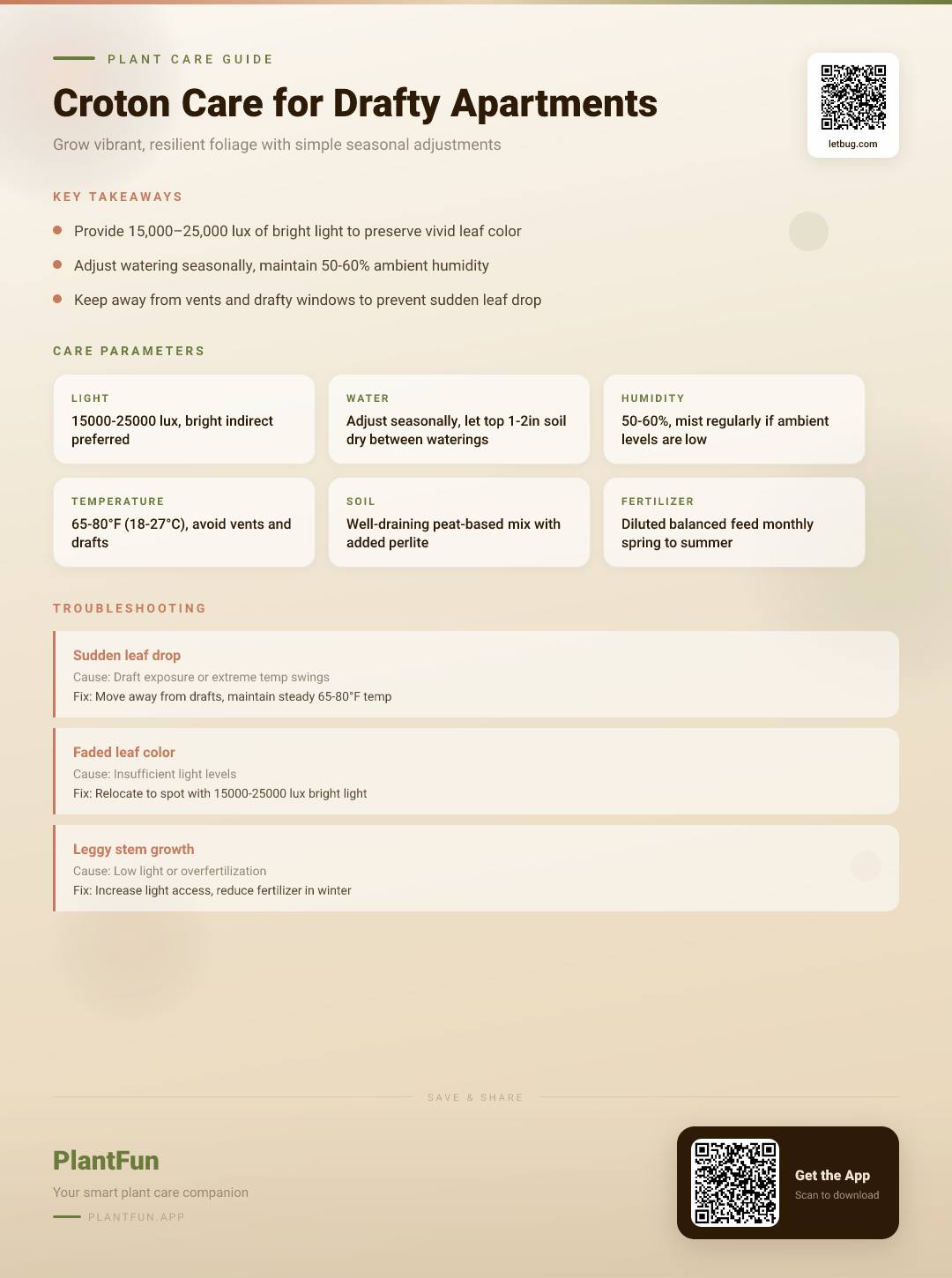
Key Takeaways
- Check soil moisture before watering — overwatering is the #1 killer of houseplants.
- Ensure your plant gets the right amount of light for its species.
- Be patient with recovery — most plants need 2–4 weeks to bounce back.
TL;DR: The 60-Second Croton Survival Protocol
To keep your Codiaeum variegatum thriving, provide 15,000–25,000 lux of light and maintain temperatures between 65–80°F (18–27°C) (Stone, 2010). Avoid cold drafts from windows or HVAC vents, as these are the primary culprits for leaf drop. Water when the top 2 inches of soil feel dry to the touch, and maintain at least 50% humidity to keep those signature colors vivid. Never move your Croton frequently; they are sensitive to environmental shifts.
Quick Care Card: The Croton Baseline
| Category | Requirement |
|---|---|
| Light | 15,000–25,000 lux (Bright, indirect to direct) |
| Water | When top 2 inches of soil are dry |
| Humidity | 50–60% constant |
| Temperature | 65–80°F (18–27°C) |
| Soil | Well-draining, peat-based mix |
| Fertilizer | Balanced liquid feed during growing season |
| Toxicity | Toxic to cats and dogs (ASPCA, 2026) |
Why Crotons Struggle in Modern Apartments: Bridging the Gap Between Tropics and City Living
When I first bought my ‘Petra’ Croton, I placed it near a drafty radiator in my apartment. Within a week, it looked like a shedding autumn tree. I realized that my indoor environment was a poor imitation of its native tropical habitat. Crotons (Codiaeum variegatum) are famously temperamental in climate-controlled spaces because they require high, stable humidity and consistent, intense light (Stone, 2010). Unlike more forgiving houseplants, a Croton will communicate its distress immediately by dropping healthy leaves if its environmental threshold is breached.
The Light Mandate: Providing 15,000–25,000 Lux for Maximum Color
The vibrant yellows, oranges, and reds of a Croton are a direct result of its access to light. If your plant is turning exclusively green, it is starving for photons. I aim for at least 15,000–25,000 lux for optimal pigment development. If you aren’t using a light meter, imagine the intensity of a south-facing window with a sheer curtain. If the plant is in a corner or a north-facing room, you will likely need to supplement with full-spectrum grow lights to prevent color loss.
Seasonal Watering & Hydration: Adjusting for 50-60% Humidity and Evaporation Rates
Apartment air is notoriously dry, especially in winter. I find that placing my Croton on a pebble tray or near a dedicated humidifier helps maintain the 50-60% humidity it craves. Watering frequency should change with the seasons; in the summer, I water weekly, but in the winter, I wait for the soil to dry further down. Always check by inserting your finger 2 inches into the soil—if it’s moist, step away from the watering can. Overwatering is the fastest path to root rot.
Temperature Control: Keeping Your Croton Between 65-80°F (18-27°C) Away from Vents
Temperature stability is non-negotiable. I keep mine away from AC vents and exterior doors. Even a slight drop below 60°F can trigger a stress response, leading to rapid leaf drop. If you live in an older building, ensure your plant isn’t sitting on a cold sill during the winter months.
The Seasonal Routine: Quarterly Checklists for Spring Growth and Winter Dormancy
- Spring: Increase fertilizer frequency to once per month to support new growth. Rotate the pot 90 degrees every week to ensure even foliage development.
- Summer: Monitor for pests like spider mites, which love the dry heat that stressed Crotons often face. Wipe leaves with a damp cloth to clean dust (EL Sayed, 2020).
- Autumn: Prepare the plant for lower light. Move it to your brightest available window if you haven’t already.
- Winter: Reduce watering. Watch for drafts and ensure the plant is not touching cold window glass.
FAQ
- Why is my Croton dropping leaves suddenly despite consistent watering? It is almost certainly a reaction to a draft or a sudden change in temperature. Check if the plant is near a doorway or HVAC vent (Stone, 2010).
- Can I place my Croton directly in front of a drafty apartment window? No. While they need light, direct exposure to cold, chilly air from a drafty window can cause severe thermal shock and leaf loss.
- Is my Croton getting enough light? If the plant is losing its bright variegation and the stems are becoming long and sparse (leggy), it is not receiving sufficient light. Consider supplemental lighting.
Troubleshooting Common Apartment Failures: Leggy Stems and Faded Colors
Leggy or Sparse Stems
Symptom: The distance between leaves increases significantly, making the plant look thin.
Likely cause: The plant is stretching to find a more intense light source.
Fix:
- Move the plant to a spot with higher light intensity.
- Prune the long stems back to encourage lateral growth.
Faded or Green Foliage
Symptom: The vibrant red and yellow patterns are disappearing, leaving only green leaves.
Likely cause: The plant is not hitting the 15,000–25,000 lux requirement (Stone, 2010).
Fix:
- Introduce supplemental LED grow lighting.
- Gradually acclimate the plant to a brighter window position.
Sudden Leaf Drop
Symptom: Healthy-looking leaves fall off at the slightest touch.
Likely cause: Cold drafts or dramatic, sudden temperature fluctuations.
Fix:
- Relocate the plant to a stable environment away from windows and vents.
- Check for signs of root rot caused by stagnant, cold water in the pot.
References
- EL Sayed, N. (2020). Spray Golden Pothos and Croton Plants with Glutathione and Bilirubin to Purify the Indoor Air from Pollutants. Journal of Plant Production. https://doi.org/10.21608/jpp.2020.102766. Accessed 2026-03-15.
- Stone, T. (2010). Indoor gardening. Child Care. https://doi.org/10.12968/chca.2010.7.2.46139. Accessed 2026-03-15.
- ASPCA. (2026). Toxic and Non-Toxic Plants List — ASPCA. https://www.aspca.org/pet-care/animal-poison-control/toxic-and-non-toxic-plants. Accessed 2026-03-15.
Optional Helper: Plantfun.App
Plantfun.App identifies your plants by photo, diagnoses pests and diseases with clear fixes, and creates personalised watering and light schedules that adapt to your home conditions — a handy companion for putting this guide into daily practice.
Found an error or have suggestions? We'd love your feedback.
Need help identifying this problem?
Get instant identification, personalized care schedules, and effective pest treatment plans directly on your phone.
Sponsored • We may earn a commission from app downloads
Related Guides
The Complete Croton Care Checklist for Resilient Growth in Small Budget Apartments
Stop losing croton leaves to bad apartment conditions. Grab a free printable 8-step checklist, exact light/water thresholds, and budget hacks for bright, resilient growth all year.
Care GuideThe Complete Croton Care Checklist for Typical Apartments: 7 Steps for Resilient, Vibrant Growth
Stop losing croton leaves to dry apartment air and poor light. Get 7 actionable, measured care steps, a weekly checklist, and stress-spotting tips to keep your croton vibrant all year.
Care GuideThe Complete Petra Croton Care Checklist for Resilient Growth in Small Urban Apartments
Grow a lush, colorful Petra croton even in a tiny urban apartment. Get exact light levels, watering amounts, and space-saving tips to prevent leaf drop and boost resilient growth.
Pest ControlAnts on Plants: What They Mean and What to Do
Ants usually aren't eating your plant. They are farming other pests.