
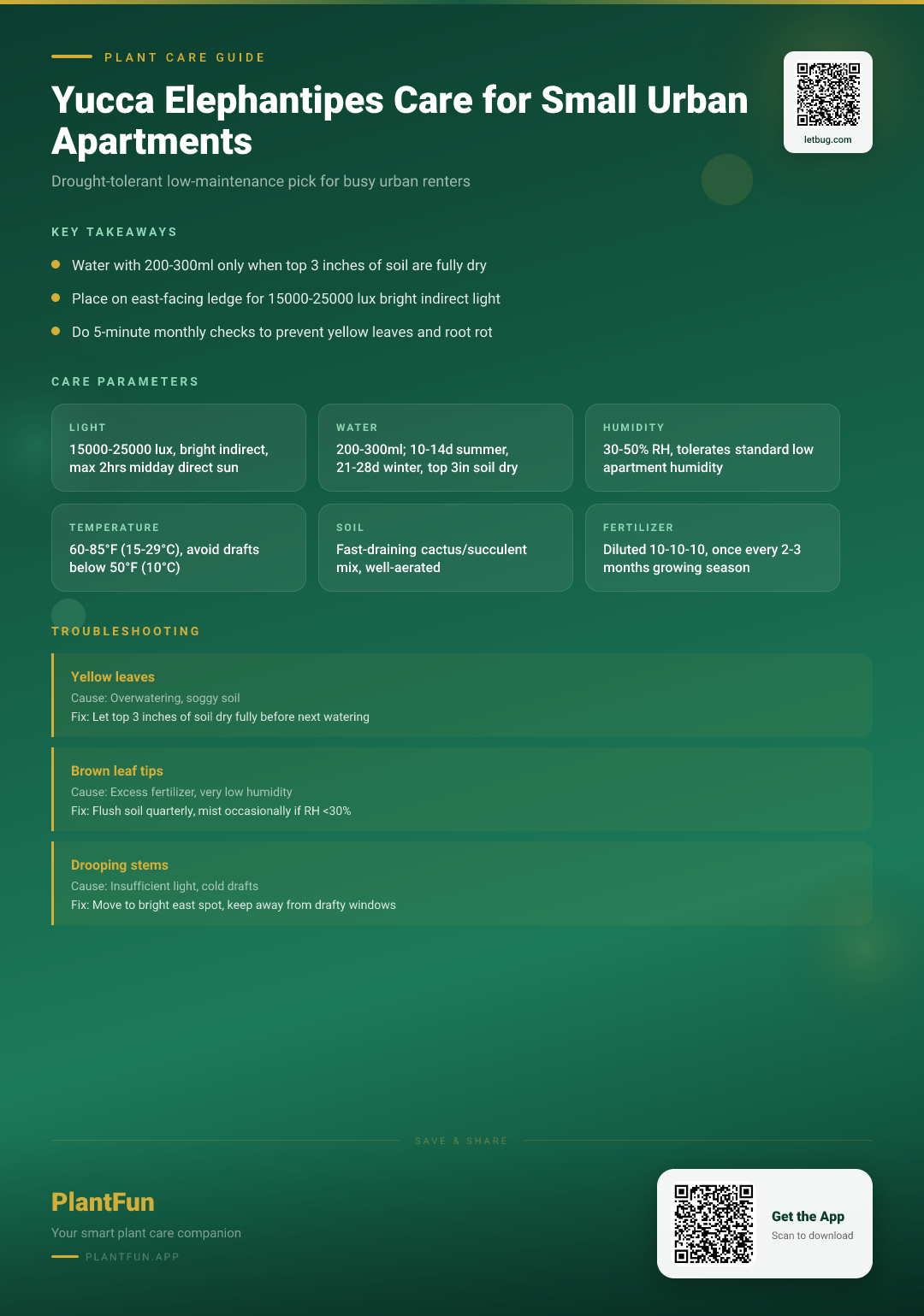
Key Takeaways
- Check soil moisture before watering — overwatering is the #1 killer of houseplants.
- Ensure your plant gets the right amount of light for its species.
- Be patient with recovery — most plants need 2–4 weeks to bounce back.
Quick Care Card
| Care Factor | Measurable Threshold for Small Apartments |
|---|---|
| Light | 15,000-25,000 lux (bright indirect east-facing light, max 2 hours direct midday sun) |
| Water | 200-300ml when top 3 inches of soil are completely dry: 10-14 days summer, 21-28 days winter |
| Humidity | 30-50% relative humidity |
| Temperature | 60-85°F (15-29°C) ideal, minimum 50°F (10°C) |
| Soil | Fast-draining cactus/succulent mix with 20% perlite |
| Fertilizer | Half-strength 10-10-10 succulent fertilizer once every 3 months in spring/summer, no winter feed |
| Toxicity | Toxic to cats, dogs, and horses (ASPCA, 2026) |
Why Yucca Elephantipes Are Perfect for Busy Apartment Renters
Native to arid regions of Mexico and Central America, Yucca elephantipes are uniquely adapted to the common stressors of small urban apartment living (NC State Extension, 2026). Their thick, water-storing stems mean they tolerate missed waterings, low humidity, and inconsistent light far better than most common houseplants, making them ideal for yucca care for beginners with packed work schedules.
Myth vs Reality: Contrary to popular belief, yuccas do not need 6+ hours of full direct sun to thrive indoors. They adapt well to the bright indirect light found in most apartment windows, as long as levels stay above the 15,000 lux minimum (NC State Extension, 2026). Note: According to the ASPCA, this plant is toxic to pets, so place it on high ledges out of reach of cats and dogs (ASPCA, 2026).
Symptom-to-Action Quick Reference Chart
Yellow Lower Leaves
Symptom: Pale, mushy yellow leaves on the lower half of the plant with no brown edges.
Likely cause: Overwatering, the top cause of Yucca elephantipes yellow leaves in apartment settings (NC State Extension, 2026).
Fix:
- Poke 4-5 3-inch deep holes in the soil with a chopstick to improve aeration
- Hold off on watering until the top 3 inches of soil are completely dry (test with your index finger)
- Empty all standing water from the pot saucer immediately
Brown Leaf Tips
Symptom: Dry, crispy brown tips on otherwise green, firm leaves.
Likely cause: Low humidity or fertilizer salt buildup, common in heated winter apartments.
Fix:
- Wipe leaves with a damp microfiber cloth to remove dust and residue
- Mist leaves once weekly (avoid over-misting to prevent fungal spots)
- Flush soil with 500ml of distilled water every 3 months to wash away salt buildup
Drooping Stems
Symptom: Soft, bendable stems that lean away from light, with pale new growth.
Likely cause: Insufficient light or cold draft exposure (NC State Extension, 2026).
Fix:
- Move the plant within 2 feet of an east-facing ledge to hit 15,000-25,000 lux light levels
- Test the temperature near the plant to confirm it stays above 50°F (10°C)
- Rotate the pot ¼ turn every 2 weeks to encourage even, upright growth
Root Rot
Symptom: Foul, mushy smell coming from the soil, entire branches yellow and fall off easily.
Likely cause: Sustained overwatering in heavy, moisture-retentive potting soil.
Fix:
- Remove the plant from its pot and cut away all brown, mushy roots with sterile pruning shears
- Repot in fresh fast-draining cactus mix with 20% added perlite
- Do not water for 2 weeks after repotting to let root wounds heal
Step-by-Step Yucca Care Routine for East-Facing Apartment Ledges
All tasks include exact time estimates to fit busy renter schedules:
Weekly (2 minutes)
- Test soil moisture by sticking your index finger 3 inches deep into the soil
- Wipe dust off 3-4 large leaves with a damp cloth to improve light absorption
- Rotate the pot ¼ turn to prevent lopsided growth
Monthly (5 minutes)
- Test light levels at leaf level with an affordable light meter to confirm 15,000-25,000 lux exposure
- Inspect leaf undersides and joints for signs of mealybugs or spider mites
- Empty any residual water from the pot saucer to prevent root rot
Quarterly (10 minutes, spring and summer only)
- Flush soil with 500ml of distilled water to remove fertilizer salt buildup
- Feed with 200ml of half-strength 10-10-10 succulent fertilizer
- Check for root bound signs (roots growing out of drainage holes) and repot only if necessary
Measurable Light Requirements for Apartment Yuccas
Yucca elephantipes light requirements indoors fall between 15,000-25,000 lux, which is exactly the light level of an unobstructed east-facing window (NC State Extension, 2026). West or south-facing windows will produce over 30,000 lux of midday sun, which can scorch leaves, so hang a sheer curtain to filter light if you only have these exposures.
Quick test: Use a $10-$15 light meter held at leaf level at midday. If readings are under 15,000 lux, add a grow light set to 12 hours a day to support active growth. While yuccas can survive lower light levels for 2-3 months, they will not produce new growth, so 15,000 lux is the minimum for resilient, healthy plants (answers “can yucca grow in low light apartments?”).
Exact Watering Schedule for Low-Humidity Apartments
Understanding the Science
A 2023 study found that Yucca elephantipes have specialized water-storing cells in their stems that hold up to 70% of their weight in water, allowing them to survive 4+ weeks without watering (Indian Journal of Natural Products and Resources, 2023). This is why overwatering is far more dangerous than underwatering for apartment-grown yuccas.
Follow these exact rules for how often to water yucca in apartment settings:
- Use 200-300ml of room-temperature filtered water per application
- Only water when the top 3 inches of soil are completely dry (test with your finger)
- Yucca summer watering schedule: Every 10-14 days when temperatures are above 75°F
- Winter schedule: Every 21-28 days when heating systems dry out soil more slowly
Never water on a fixed weekly schedule, as this is the top cause of root rot. If you notice yellow leaves, hold off on watering for 7-10 days and test soil moisture before watering again.
Humidity and Temperature Thresholds for Apartment Growth
Yucca elephantipes humidity needs are 30-50% relative humidity, which exactly matches the average humidity of most heated and cooled urban apartments (NC State Extension, 2026). You do not need a humidifier for this plant, even in dry winter months.
Ideal temperature range is 60-85°F (15-29°C). Never let the temperature near your yucca drop below 50°F (10°C), as cold damage will cause leaf drop and stem rot. If you have drafty windows, move the plant 1-2 feet away from the glass in winter or hang a thermal curtain between the plant and window to block cold air.
Seasonal Care Calendar for Yuccas in 4-Season Climates
Adjust your care routine to match seasonal apartment conditions:
- Spring (March-May): Increase watering to every 10-14 days, start quarterly fertilizer applications, move the plant back to your east-facing ledge after winter
- Summer (June-August): Filter midday sun with a sheer curtain if using a south/west window, avoid placing the plant near AC vents that cause cold drafts
- Fall (September-November): Reduce watering frequency to every 21 days, stop fertilizer applications, move the plant away from windows if nighttime temperatures drop below 50°F
- Winter (December-February): Water only every 28 days, avoid placing near heating vents that dry out leaf tips, supplement with a grow light if light levels drop below 15,000 lux (core yucca winter care indoors guidance)
Common Apartment Yucca Care Mistakes to Avoid
- Mistake: Watering on a fixed weekly schedule without checking soil moisture What happens: Soggy soil leads to root rot and yellow leaves, the most common cause of yucca death in apartments (NC State Extension, 2026) Instead: Only water when the top 3 inches of soil are completely dry, using 200-300ml of water per application
- Mistake: Placing your yucca 5+ feet away from a window in low light What happens: Stems become leggy and droop, new growth is thin and pale Instead: Keep your yucca within 2 feet of an east-facing window, or use a grow light to maintain 15,000+ lux of light
- Mistake: Repotting your yucca every year or using a pot that is too large What happens: Extra potting soil holds excess moisture, leading to root rot, and yuccas prefer being slightly root bound Instead: Repot only once every 3-4 years, using a pot that is only 1-2 inches wider than the current root ball
- Mistake: Using regular potting soil for your yucca What happens: Regular soil retains moisture for too long, leading to root rot and yellow leaves Instead: Use a fast-draining cactus/succulent mix with 20% perlite added to improve aeration and drainage
Voice Search Optimized FAQ
Can I keep my yucca elephantipes near my apartment’s drafty window?
Only if the temperature near the window never drops below 50°F (10°C). If you have single-pane windows or live in a cold climate, move your yucca 1-2 feet away from the window in winter, or hang a thermal curtain between the plant and the glass to block cold drafts (NC State Extension, 2026). Yuccas can tolerate mild air movement, but sustained cold drafts will cause leaf drop and stem damage.
Why is my yucca getting yellow leaves even if I water it once a week?
Watering once a week is almost always too frequent for apartment yuccas, leading to overwatering and root rot, the #1 cause of Yucca elephantipes yellow leaves (NC State Extension, 2026). Test the soil moisture by sticking your finger 3 inches deep: if it is still damp, hold off on watering for another 7-10 days. If the soil is constantly soggy, you may need to repot in fresh fast-draining soil to save the plant. If you also notice soft stems, this answers “why is my yucca drooping?”: root rot has already set in, so follow the root rot treatment steps outlined earlier.
How do I prune my yucca if it grows too tall for my apartment ceiling?
Yuccas are very resilient and can be pruned easily to control height, making them perfect for small apartment yucca care tips. Use sterile pruning shears to cut the main stem 6-12 inches below the height you want the plant to stay. New growth will sprout from the cut edge within 2-3 months, giving you a bushier, more compact plant (NC State Extension, 2026). You can also root the top portion you cut off to grow a new yucca plant.
5-Minute Monthly Yucca Health Checklist
Print this no-fuss checklist to catch small issues before they escalate, core of yucca care checklist for resilient growth:
- Test light levels at leaf level with a light meter to confirm 15,000-25,000 lux of exposure
- Stick your finger 3 inches deep into soil to check moisture level: water only if completely dry with 200-300ml of water
- Inspect leaf undersides and joints for signs of pests (mealybugs, spider mites)
- Empty any standing water from the pot saucer to prevent root rot
- Wipe 3-4 large leaves with a damp microfiber cloth to remove dust buildup
- Check the temperature near the plant to ensure it stays above 50°F (10°C)
References
- NC State Extension. (2026). The Complete Yucca Elephantipes — NC State Extension Gardener Plant Toolbox. https://plants.ces.ncsu.edu/plants/yucca-elephantipes/. Accessed 2026-03-06.
- Indian Journal of Natural Products and Resources. (2023). Unprecedented extraction and characterisation of Yucca elephantipes silver star plant fibre–An exploratory investigation. Indian Journal of Natural Products and Resources. https://doi.org/10.56042/ijnpr.v14i4.6931. Accessed 2026-03-06.
- Mohamed Abass, M.; Thabet, R.; Abdelfattah, M. (2023). Evaluation of Gelling Agent Alternatives during in Vitro Multiplication of Yucca elephantipes L. Journal of Plant Production. https://doi.org/10.21608/jpp.2023.221576.1254. Accessed 2026-03-06.
- ASPCA. (2026). Toxic and Non-Toxic Plants List — ASPCA. https://www.aspca.org/pet-care/animal-poison-control/toxic-and-non-toxic-plants. Accessed 2026-03-06.
Optional Helper: Plantfun.App
Plantfun.App identifies your plants by photo, diagnoses pests and diseases with clear fixes, and creates personalised watering and light schedules that adapt to your home conditions — a handy companion for putting this guide into daily practice.
Found an error or have suggestions? We'd love your feedback.
Need help identifying this problem?
Get instant identification, personalized care schedules, and effective pest treatment plans directly on your phone.
Sponsored • We may earn a commission from app downloads
Related Guides
The Only Yucca Elephantipes Care Checklist for Resilient Growth in Typical Apartments
Grow a lush, resilient yucca in your typical apartment. Get exact care thresholds, 7 common mistake fixes, and a seasonal checklist to skip growing stress.
Care GuideThe Complete Yucca Elephantipes Care Checklist for Thriving Growth in West-Facing Apartments
Grow a lush, low-fuss Yucca elephantipes in your typical apartment. Get exact light levels, watering volumes, and a seasonal checklist that prevents yellow leaves and boosts healthy annual growth.
Care GuideThe Complete Yucca Elephantipes Care Guide for Typical Apartments: Resilient Year-Round Growth
Get a seasonally adjusted yucca care checklist made just for typical apartment conditions, with exact light, water, and soil specs to keep your plant lush, healthy, and resilient for years.
Pest ControlAnts on Plants: What They Mean and What to Do
Ants usually aren't eating your plant. They are farming other pests.