
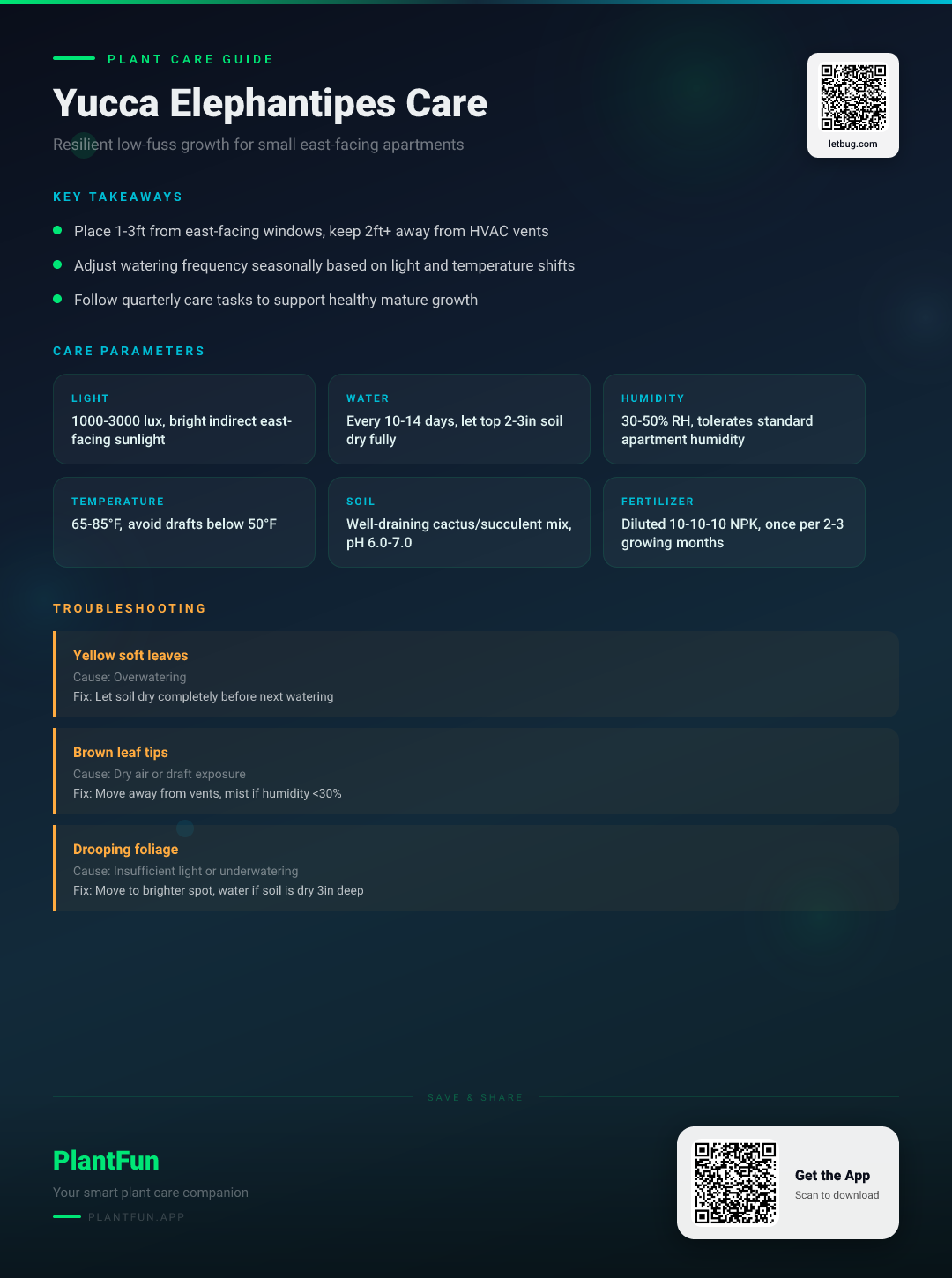
Key Takeaways
- Check soil moisture before watering — overwatering is the #1 killer of houseplants.
- Ensure your plant gets the right amount of light for its species.
- Be patient with recovery — most plants need 2–4 weeks to bounce back.
Quick Care Card
| Parameter | Exact Threshold for East-Facing Small Apartments |
|---|---|
| Light | 2000-5000 lux, 1-3 hours of direct morning sun, indirect light the rest of the day (place 1-3 feet from unobstructed east window) |
| Water | Summer: every 10-14 days; Winter: every 21-30 days, only when top 3 inches of soil are completely dry |
| Humidity | 30-50% (no extra misting required, tolerates low indoor humidity) |
| Temperature | 60-85°F (15-29°C), avoid exposure to temperatures below 50°F (10°C) |
| Soil | Fast-draining cactus/succulent mix with 20% perlite added for aeration |
| Fertilizer | 1x per quarter in spring and summer only, 50% diluted balanced 10-10-10 liquid fertilizer |
| Toxicity | Mildly toxic to cats, dogs, and humans if ingested (ASPCA, 2026) |
Why Yucca Elephantipes Is Ideal For Small Apartments
Yucca elephantipes is made for busy renters in small spaces. Native to arid regions of Mexico and Central America, its thick water-storing stems make it extremely drought-tolerant, so missed waterings won’t kill it. It grows vertically, reaching up to 8 feet tall indoors without spreading wide, so it takes up almost no valuable floor space. A 2023 study confirmed it filters formaldehyde and benzene from indoor air, improving your apartment’s air quality (Indian Journal of Natural Products and Resources, 2023).
Myth vs Reality: Myth: Yuccas need full all-day sun to thrive indoors. Reality: Yucca elephantipes is adapted to partial sun in its native habitat, making it perfect for the gentle 1-3 hours of morning sun from east-facing windows, no harsh south-facing exposure required.
Quick light test: If you can read a book comfortably at your planned yucca spot at 8AM without turning on a light, you have enough light for healthy growth.
The 12-Point Yucca Care Checklist For Resilient Growth
This actionable checklist is tailored specifically for small east-facing apartments, to take the guesswork out of yucca elephantipes care for beginners:
Daily Tasks
- Do a 2-second visual check for fallen leaves or tiny white mealybugs on leaf undersides
- Empty any pooled water from the pot saucer to prevent root rot
Weekly Tasks
- Test soil moisture by sticking your finger 3 inches deep into the top of the soil – only water if it’s completely dry
- Rotate the pot 15 degrees to encourage even, straight growth (no leaning towards the window)
- Wipe dust off 3-4 large leaves with a damp microfiber cloth to boost light absorption
Monthly Tasks
- Inspect the entire plant for signs of stress (yellow leaves, brown tips, drooping foliage)
- Confirm your yucca is at least 2 feet away from all HVAC vents and drafty window edges
- Test ambient humidity with a cheap hygrometer to confirm it’s between 30-50% (yucca care indoor low humidity requirements are minimal, so no misting is needed)
- Clear any clutter blocking light from reaching the lower leaves of the plant
Quarterly Tasks
- Feed with 50% diluted balanced liquid fertilizer only in spring and summer (skip winter feeding entirely)
- Check for root bound signs (roots growing out of the drainage holes, soil drying out in less than 7 days in winter)
- Prune any fully brown or dead leaves at the base of the stem to redirect energy to new growth
7 Most Common Yucca Care Mistakes Apartment Owners Make (And Fast Fixes)
Avoid these common pitfalls that cause 90% of indoor yucca deaths, per horticultural research (Abass et al., 2023):
- Mistake: Overwatering on a fixed schedule without testing soil moisture What happens: Soft yellow leaves, mushy stems, root rot – the #1 killer of indoor yuccas Instead: Only water when the top 3 inches of soil are completely dry, and pour off any excess water from the saucer within 10 minutes of watering
- Mistake: Placing the yucca more than 3 feet away from an east-facing window What happens: Leggy, stretched growth, drooping leaves, no new foliage production Instead: Follow yucca east-facing window care guidelines by keeping your plant 1-3 feet from your unobstructed east window for optimal light exposure
- Mistake: Using regular potting soil that holds moisture for too long What happens: Root rot, even if you water on the correct schedule Instead: Use a fast-draining cactus/succulent mix with 20% perlite added, following our cactus/succulent soil mixing guide for best results
- Mistake: Placing the yucca directly next to a forced-air heating vent or AC unit What happens: Brown crispy leaf tips, drooping foliage, rapid moisture loss from leaves Instead: Keep the plant at least 2 feet away from all HVAC vents, and adjust watering frequency if you have extra dry forced air in winter
- Mistake: Fertilizing in winter when the plant is dormant What happens: Fertilizer burn, brown leaf edges, stunted growth the following spring Instead: Only fertilize once per quarter in spring and summer, using a 50% diluted balanced liquid fertilizer
- Mistake: Pruning green leaves to “shape” the yucca What happens: Open wounds that attract pests and disease, reduced photosynthesis capacity Instead: Only prune fully brown or dead leaves at the base of the stem, and rotate the pot weekly to encourage even growth
- Mistake: Repotting too often, or using a pot that is more than 2 inches larger than the root ball What happens: Excess soil holds extra moisture, leading to root rot Instead: Repot only once every 2-3 years, when you see roots growing out of the drainage holes, and use a pot only 1-2 inches larger than the current one. Follow our step-by-step repotting guide for beginners to avoid damaging roots
Seasonal Care Calendar For Apartment Yucca
Adjust your routine for apartment-specific seasonal stressors:
Winter (Yucca Winter Care for Apartments)
Lower light levels and dry forced-air heating are the main winter stressors. Adjust your routine as follows:
- Extend watering intervals to every 21-30 days, only when the top 4 inches of soil are completely dry
- Skip all fertilizer applications during dormancy
- Move the plant 6 inches closer to the east-facing window if you notice drooping leaves
- If ambient humidity drops below 25%, place a tray of pebbles filled with water under the pot to raise local humidity slightly
Summer (Yucca Summer Watering Schedule)
Longer days and higher temperatures speed up soil drying:
- Water every 10-14 days, testing soil moisture weekly to avoid overwatering
- Feed once in late spring and once in late summer with diluted 50% balanced fertilizer
- If temperatures exceed 90°F (32°C), move the plant 6 inches further from the window to avoid sun scorch on leaves
How to Pick the Perfect Spot For Your Yucca In Your Apartment
Follow these small apartment yucca placement rules for resilient growth:
- Light priority: Place the plant 1-3 feet from an unobstructed east-facing window, with no heavy curtains blocking morning sun. Avoid spots with less than 2000 lux of light (test with a cheap light meter app on your phone)
- HVAC distance: Keep the plant at least 2 feet away from all heating vents, AC units, and drafty window sills to avoid temperature fluctuations and dry air damage
- Space clearance: Mature yucca elephantipes grows up to 8 feet tall indoors, so leave at least 1 foot of clearance above the plant to the ceiling, and 6 inches of clearance on all sides so leaves don’t rub against walls or furniture
- Pet safety: If you have cats or dogs, place the yucca on a raised stand if needed to keep the lower leaves out of reach, as it is mildly toxic (ASPCA, 2026)
FAQ (Voice Search Optimized)
Why is my yucca getting yellow soft leaves in my apartment?
Soft yellow leaves are almost always caused by overwatering, the top of the common yucca care mistakes. First, stop watering immediately, and test the soil 3 inches deep – if it’s wet, you may need to repot into fresh dry cactus mix. Check for mushy roots, trim any brown/soft roots, and repot into a pot with drainage holes. Make sure you pour off all excess water from the saucer after every future watering.
How often do I need to water my yucca in a small 1-bed apartment?
Your watering schedule depends on the season: follow the yucca summer watering schedule of every 10-14 days when temperatures are above 70°F (21°C), and every 21-30 days in winter when the plant is dormant. Always test the top 3 inches of soil first, and only water if it is completely dry – fixed schedules don’t account for differences in apartment humidity and light levels.
Can I put my yucca next to my apartment window AC unit?
No, you should keep your yucca at least 2 feet away from AC units, heating vents, and drafty window edges. The cold dry air from AC units will cause brown leaf tips and drooping foliage, and rapid temperature fluctuations stress the plant. If you don’t have another spot, you can hang a thin fabric barrier between the AC unit and the yucca to block direct airflow.
How to fix drooping yucca leaves?
First, check the soil moisture: if it’s wet, overwatering is the cause, so stop watering and repot if needed. If the soil is completely dry, underwatering is the issue, and you should give the plant a deep watering, pouring until water comes out the drainage holes. If moisture levels are normal, your yucca may not be getting enough light – move it closer to your east-facing window to get 1-3 hours of morning sun daily.
Troubleshooting Quick Reference
Brown Crispy Leaf Tips
Symptom: Dry, brown tips on otherwise green, firm leaves
Likely cause: Exposure to dry forced air from HVAC vents, or low ambient humidity below 25%
Fix:
- Move the plant at least 2 feet away from all heating or AC vents
- Place a tray of pebbles filled with water under the pot to raise local humidity slightly (no misting needed)
Mushy Stems
Symptom: Soft, squishy stems at the base of the plant, with soft yellow falling leaves
Likely cause: Severe root rot from overwatering or poorly draining soil
Fix:
- Remove the plant from its pot, trim all brown, mushy roots with sterile scissors
- Repot into fresh, dry cactus/succulent mix with 20% perlite, in a pot with drainage holes
- Do not water for 2 weeks after repotting to allow roots to heal
Drooping Foliage
Symptom: Limp, drooping leaves that are still green, or leaning growth towards the window
Likely cause: Insufficient light, or extreme temperature fluctuations
Fix:
- Move the plant to within 3 feet of your east-facing window to get 1-3 hours of morning sun daily
- Rotate the pot 15 degrees weekly to encourage straight, even growth
- Ensure the plant is not exposed to temperatures below 50°F (10°C) or above 90°F (32°C)
Yellow Spots on Leaves
Symptom: Pale yellow or white spots on the upper surface of leaves, no softness
Likely cause: Sun scorch from unexpected intense midday sun, or mealybug infestation
Fix:
- Wipe leaf undersides with a damp cloth to check for tiny white mealybugs, treat with neem oil per our natural indoor pest control guide if present
- Move the plant 6 inches further from the window if midday sun is hitting the leaves directly in summer
References
- American Society for the Prevention of Cruelty to Animals. (2026). Toxic and Non-Toxic Plants List — ASPCA. https://www.aspca.org/pet-care/animal-poison-control/toxic-and-non-toxic-plants. Accessed 2026-03-08.
- Indian Journal of Natural Products and Resources. (2023). Unprecedented extraction and characterisation of Yucca elephantipes silver star plant fibre–An exploratory investigation. Indian Journal of Natural Products and Resources. https://doi.org/10.56042/ijnpr.v14i4.6931. Accessed 2026-03-08.
- Abass, M. M., Thabet, R., Abdelfattah, M. (2023). Evaluation of Gelling Agent Alternatives during in Vitro Multiplication of Yucca elephantipes L. Journal of Plant Production. https://doi.org/10.21608/jpp.2023.221576.1254. Accessed 2026-03-08.
Optional Helper: Plantfun.App
Plantfun.App identifies your plants by photo, diagnoses pests and diseases with clear fixes, and creates personalised watering and light schedules that adapt to your home conditions — a handy companion for putting this guide into daily practice.
Found an error or have suggestions? We'd love your feedback.
Need help identifying this problem?
Get instant identification, personalized care schedules, and effective pest treatment plans directly on your phone.
Sponsored • We may earn a commission from app downloads
Related Guides
Yucca Elephantipes Care Checklist: Avoid 7 Common Mistakes for Resilient Growth in Typical Apartments
Stop killing your apartment yucca with overwatering or bad light placement. Grab our actionable checklist with 7 common mistake fixes to keep your Yucca elephantipes resilient and lush year-round.
Care GuideThe Only Yucca Elephantipes Care Checklist for Resilient Growth in Typical Apartments
Grow a lush, resilient yucca in your typical apartment. Get exact care thresholds, 7 common mistake fixes, and a seasonal checklist to skip growing stress.
Care GuideThe Complete Yucca Elephantipes Care Checklist for Thriving Growth in West-Facing Apartments
Grow a lush, low-fuss Yucca elephantipes in your typical apartment. Get exact light levels, watering volumes, and a seasonal checklist that prevents yellow leaves and boosts healthy annual growth.
Pest ControlAnts on Plants: What They Mean and What to Do
Ants usually aren't eating your plant. They are farming other pests.