
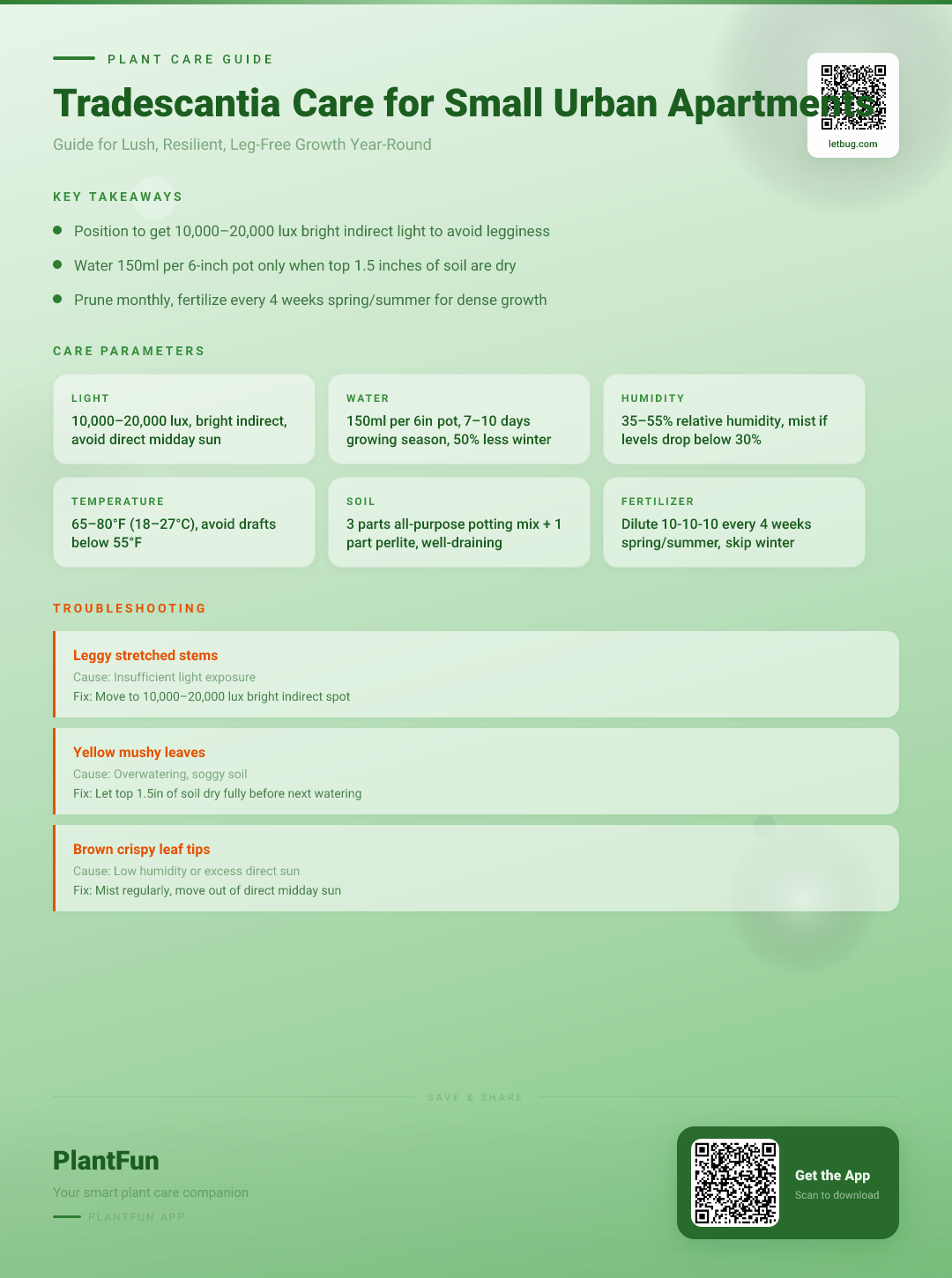
Key Takeaways
- Check soil moisture before watering — overwatering is the #1 killer of houseplants.
- Ensure your plant gets the right amount of light for its species.
- Be patient with recovery — most plants need 2–4 weeks to bounce back.
Quick Care Card
| Category | Exact Parameters for Urban Apartments |
|---|---|
| Light | 10,000–20,000 lux of bright indirect light (NC State Extension, 2026) |
| Water | 150ml per 6-inch pot when top 1.5 inches of soil are dry, 7-10 days in growing season |
| Humidity | 35–55% relative humidity (NC State Extension, 2026) |
| Temperature | 65–80°F (18–27°C), avoid temperatures below 50°F (10°C) |
| Soil | 3 parts all-purpose potting soil + 1 part perlite |
| Fertilizer | Diluted 10-10-10 fertilizer every 4 weeks in spring and summer |
| Toxicity | Mildly toxic to cats, dogs and humans if ingested (ASPCA, 2026) |
Guide Overview
Generic Tradescantia care advice often ignores the unique constraints of small urban apartments: drafty old window sills, inconsistent natural light from nearby tall buildings, and baseline humidity stuck at 30-40% from year-round heating and AC use. These conditions are the top causes of the most common Tradescantia issues you’ve probably dealt with: leggy growth, faded purple or white variegation, and crispy brown tips. This guide cuts through generic recommendations, gives you measurable, no-guess parameters tailored to apartment living, and helps you catch stress signs before your plant starts to decline.
30-Second Pre-Care Diagnosis
Before adjusting your care routine, do this 3-step visual check to spot early stress, no tools required:
- Check stem length: Are new gaps between leaves more than 1 inch longer than older growth gaps? This is early legginess, a sign of insufficient light.
- Check leaf color: Is the signature purple/variegated color on new leaves noticeably paler than older leaves? This is a sign of too little light or nutrient deficiency.
- Check leaf edges: Are the tips of top leaves light brown and crispy? This is a sign of low humidity or draft exposure.
Checklist Step 1: Light Placement
To hit the 10,000–20,000 lux Tradescantia light requirements (NC State Extension, 2026), follow these window-specific placement rules for your apartment:
- North-facing window: Place directly on the sill, no obstruction, as north-facing light never gets intense enough to burn leaves. If your north window is blocked by nearby buildings, add a grow light set to 15,000 lux for 8 hours a day.
- East-facing window: Place 1-2 feet back from the sill, to avoid the 1 hour of harsh direct morning sun that can scorch leaves.
- South-facing window: Place 3-4 feet back from the sill, or behind a sheer curtain, to filter the intense midday sun that will fade variegation.
- West-facing window: Place 2-3 feet back from the sill, to avoid the hot afternoon sun that can burn leaf edges.
Myth vs Reality: Many generic guides say Tradescantia can tolerate low light, but that only applies to green, non-variegated varieties. For purple or variegated Tradescantia, light below 10,000 lux will always lead to legginess and faded color within 2 weeks.
Checklist Step 2: Watering
Follow this exact protocol to avoid overwatering or underwatering, tailored to small apartment pot sizes:
- Do the quick soil test: Stick your index finger 1.5 inches into the soil. Only water if the soil is completely dry at that depth.
- For a standard 6-inch nursery pot, pour exactly 150ml of room temperature water, making sure it drains fully from the bottom of the pot.
- In spring and summer, this will be every 7-10 days, answering the common question of how often to water Tradescantia in growing season. Empty the saucer under the pot 10 minutes after watering to avoid root rot from standing water.
If you struggle with consistent watering, check our guide to small apartment plant care tools for beginners for affordable self-watering solutions that work for compact spaces.
Checklist Step 3: Humidity & Temperature
Tradescantia humidity needs fall between 35–55% (NC State Extension, 2026), which is just above the typical 30-40% baseline in most urban apartments. Follow these fixes for common apartment issues:
- Low humidity fix: Place a tray of pebbles filled with water under the plant pot, or group it with 2-3 other plants to create a microclimate of higher humidity. A $10 desktop humidifier placed 2 feet away will also easily raise humidity to the required range.
- Draft fix: If your window sill is drafty, place a thin foam insulation strip under the pot, or move the plant to a shelf 1 foot away from the window in winter. Never place the plant within 3 feet of an AC vent or heating vent, as the dry, moving air will cause brown leaf tips within 3 days.
- Keep temperatures between 65–80°F (18–27°C) at all times; temperatures below 50°F (10°C) will cause leaf drop.
Checklist Step 4: Soil & Repotting
Use this exact Tradescantia soil mix for apartment containers to ensure proper drainage:
- 3 parts standard all-purpose potting soil + 1 part perlite, mixed thoroughly. This mix drains quickly enough to avoid root rot in small apartment pots that get less natural light to evaporate excess water.
- Repot only when you see roots growing out of the bottom drainage holes, typically every 12-18 months. Go up only one pot size (e.g., from 6-inch to 7-inch pot) to avoid excess soil holding too much water, a common issue for small apartment plants.
Checklist Step 5: Pruning & Fertilizer
Pruning to prevent legginess
Follow this monthly routine for how to prune Tradescantia and keep it full:
- Snip off any stems that are growing longer than 6 inches, cutting just above a leaf node (the small bump on the stem where leaves grow out).
- Remove any stems that are completely green (no variegation/purple color) to encourage more colorful growth.
- You can root the cuttings in water for 1-2 weeks and plant them back into the same pot to make your plant look fuller, perfect for small apartment spaces where you don’t want multiple pots taking up room.
Fertilizer
Use a diluted 10-10-10 liquid fertilizer, mixed to half the strength recommended on the bottle, applied every 4 weeks only in spring and summer. Never fertilize in fall or winter, as the plant is in dormancy and excess nutrients will burn the roots.
Seasonal Care Calendar
Winter Adjustments (Tradescantia winter care)
- Reduce watering by 50%: only 75ml per 6-inch pot when the top 2.5 inches of soil are dry, typically every 14-21 days.
- Stop fertilizing completely, as growth slows in lower light.
- Move plants away from drafty windows if outdoor temperatures drop below 32°F (0°C).
Summer Adjustments (Tradescantia summer watering)
- If temperatures exceed 85°F (29°C), mist the leaves 2 times a week to raise humidity around the plant.
- Check soil moisture 2 times a week, as higher temperatures will dry out soil faster, so you may need to water every 5-7 days instead of 7-10.
- If you place your plant outside on a balcony or fire escape, bring it inside if temperatures exceed 95°F (35°C) to avoid leaf scorch.
Common Apartment-Specific Mistakes to Avoid
- Mistake: Placing Tradescantia directly on a windowsill with a drafty old window in winter What happens: The cold air will cause leaf drop and brown edges within a week Instead: Place the plant on a shelf 1 foot away from the window, or add a foam insulation pad under the pot
- Mistake: Ignoring early leggy growth for more than 2 weeks What happens: The leggy stems will never go back to normal, and the whole plant will become sparse over time Instead: Prune leggy stems as soon as you notice gaps between leaves larger than 1 inch, following the pruning guide above
- Mistake: Overfertilizing in low-light winter months to “boost growth” What happens: Excess salt buildup in the soil will burn the roots and cause brown leaf tips Instead: Stop fertilizing completely from October to February (in the Northern Hemisphere)
- Mistake: Using only all-purpose potting soil with no perlite What happens: The soil will hold too much moisture, leading to root rot in low-light apartment conditions Instead: Always mix in 1 part perlite to 3 parts potting soil for proper drainage
- Mistake: Placing Tradescantia within 3 feet of a heating vent in winter What happens: The dry hot air will drop humidity around the plant to below 20%, causing crispy brown leaves and faded variegation Instead: Keep all plants at least 3 feet away from heating and AC vents, or use a small humidifier nearby
For more common houseplant mistakes to avoid in small spaces, check our guide to small apartment plant care mistakes.
Voice Search FAQ
Why is my Tradescantia losing its purple color?
This is almost always caused by light levels below 10,000 lux, which is common in apartments with blocked north-facing windows. The plant reduces production of the purple pigment anthocyanin when it doesn’t get enough light to support photosynthesis. Move the plant to a brighter window, or add a grow light, and new growth will regain its purple color within 2-3 weeks. This is also a key part of Tradescantia variegation care: variegated varieties need consistent bright indirect light to keep their white/pink markings.
Can I keep my Tradescantia on my apartment fire escape?
Yes, as long as temperatures stay between 50°F (10°C) and 90°F (32°C), and the plant gets bright indirect light (avoid direct midday sun on south-facing fire escapes). Bring it inside if there is heavy rain, as excess water in the pot can cause root rot. Note that Tradescantia is mildly toxic to animals, so if stray cats or neighborhood pets have access to your fire escape, keep the plant out of their reach (ASPCA, 2026).
How often do I water my Tradescantia in winter?
In winter, reduce watering by 50% compared to the growing season: for a 6-inch pot, give 75ml of water only when the top 2.5 inches of soil are completely dry, which will typically be every 14-21 days. Overwatering in winter is the top cause of root rot for Tradescantia in apartments, as lower light and cooler temperatures mean the plant uses much less water.
Why is my Tradescantia leggy?
Leggy growth (long stems with large gaps between leaves) is caused by light levels below 10,000 lux. The plant stretches its stems to try to reach more light. Prune the leggy stems back to 2 inches above the soil line, and move the plant to a brighter location to encourage new, full growth. For more tips on fixing leggy houseplants, check our guide to how to fix leggy indoor plants.
Understanding the Science
Tradescantia’s high light requirement for variegation and purple color is linked to its native habitat as an understory plant in tropical and subtropical regions, where it gets consistent bright filtered light (Šrámek, 1999). Its tolerance for moderate humidity makes it well-suited for apartment living, as long as baseline humidity doesn’t drop below 30% for extended periods. While Tradescantia is generally a low-allergy plant, rare cases of contact dermatitis have been reported for sensitive individuals (Wüthrich & Johansson, 1997), so wear gloves when pruning if you have sensitive skin.
References
- NC State Extension. (2026). The Complete Tradescantia Care — NC State Extension Gardener Plant Toolbox. https://plants.ces.ncsu.edu/plants/tradescantia-care/. Accessed 2026-03-05.
- Šrámek, F. (1999). Vaughan, M.J.: The Complete Book on Cut Flower Care. Biologia plantarum. https://doi.org/10.1023/a:1001770114931. Accessed 2026-03-05.
- Wüthrich, B.; Johansson, S. (1997). Allergy to the ornamental indoor green plant <i>Tradescantia ‘Albifloxia’</i>. Allergy. https://doi.org/10.1111/j.1398-9995.1997.tb02599.x. Accessed 2026-03-05.
- ASPCA. (2026). Toxic and Non-Toxic Plants List — ASPCA. https://www.aspca.org/pet-care/animal-poison-control/toxic-and-non-toxic-plants. Accessed 2026-03-05.
Optional Helper: Plantfun.App
Plantfun.App identifies your plants by photo, diagnoses pests and diseases with clear fixes, and creates personalised watering and light schedules that adapt to your home conditions — a handy companion for putting this guide into daily practice.
Found an error or have suggestions? We'd love your feedback.
Need help identifying this problem?
Get instant identification, personalized care schedules, and effective pest treatment plans directly on your phone.
Sponsored • We may earn a commission from app downloads
Related Guides
Tradescantia Care Checklist for Standard Urban Apartments: Grow Lush, Resilient Trailing Growth
Stop struggling to keep your Tradescantia lush in your urban apartment. Get exact light levels, watering amounts, and a simple checklist for resilient, trailing growth all year long.
Care GuideThe Complete Tradescantia Fluminensis Care Checklist for Lush, Resilient Growth in Standard Apartments
Get your Tradescantia thriving even in low-humidity apartments. Follow our 11-point care checklist with exact light, water, and soil thresholds for full, trailing growth all year.
Care GuideThe Complete Tradescantia Care Checklist for Budget-Friendly Resilient Growth in Small Urban Apartments
Grow lush, trailing Tradescantia in your apartment without spending extra cash. Get exact light, water, and humidity thresholds plus a free printable checklist for resilient, low-fuss growth all year.
Pest ControlAnts on Plants: What They Mean and What to Do
Ants usually aren't eating your plant. They are farming other pests.