
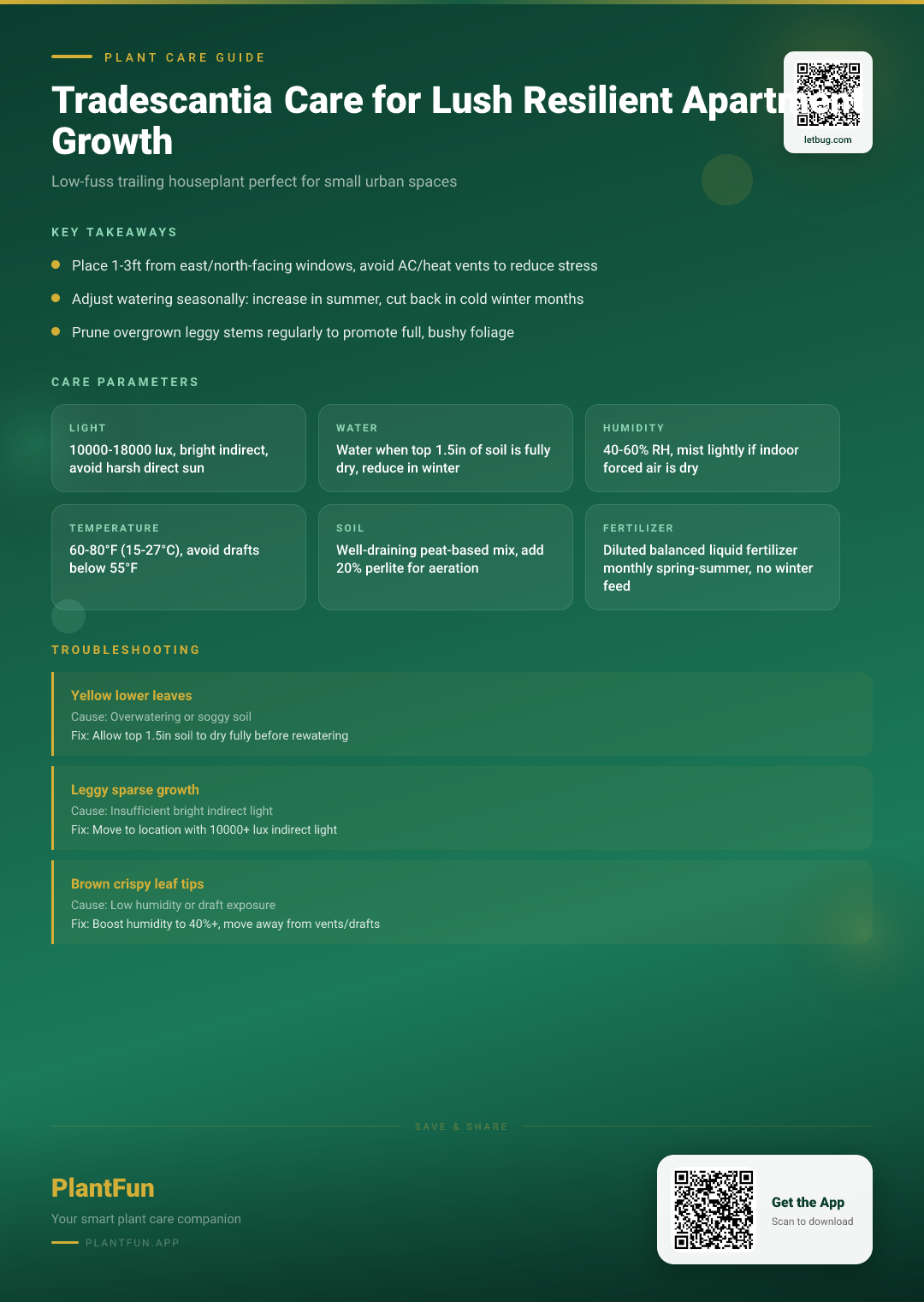
Key Takeaways
- Check soil moisture before watering — overwatering is the #1 killer of houseplants.
- Ensure your plant gets the right amount of light for its species.
- Be patient with recovery — most plants need 2–4 weeks to bounce back.
Quick Care Card
| Care Parameter | Exact Apartment-Specific Threshold |
|---|---|
| Light | 10,000-18,000 lux bright indirect light |
| Water | Water thoroughly only when top 1.5 inches of soil is completely dry |
| Humidity | 40-60% relative humidity |
| Temperature | 60-80°F (15-27°C), avoid swings >10°F in 24 hours |
| Soil | Best soil for Tradescantia in apartments: 60% potting soil + 20% perlite + 20% orchid bark, well-draining |
| Fertilizer | 1/2 strength balanced liquid fertilizer every 4 weeks, March-October only |
| Toxicity | Mildly toxic to cats, dogs, and humans if ingested; may cause skin irritation in sensitive individuals (ASPCA, 2026; Wüthrich & Johansson, 1997) |
Why Tradescantia Thrive (Or Struggle) in Small Urban Apartments
Tradescantia are naturally resilient, fast-growing plants that adapt well to indoor conditions, but the unique constraints of small urban apartments often create hidden stressors that lead to leggy growth, yellow leaves, or root rot (NC State Extension, 2026). Common apartment-specific challenges include limited window light that drops below minimum required levels just 2 feet away from glass, drafty AC and heat vents that cause rapid temperature swings, and forced air systems that cut indoor humidity to 20-30% for months at a time.
Myth vs Reality: A common myth is that Tradescantia can grow in any dark apartment corner. The reality is that all Tradescantia varieties need a minimum of 10,000 lux to maintain full, colorful growth, a threshold most dark apartment corners fail to hit. Quick test: Hold your hand 1 foot above the proposed plant spot at midday on a sunny day. If you can see a faint, soft shadow, light levels are sufficient; if no shadow is visible, the spot is too low light.
Tradescantia trailing care for apartments is simple once you adjust for these constraints, making it an ideal choice for Tradescantia care for beginners who want a fast-growing, low-fuss trailing plant.
Step-by-Step Tradescantia Placement Guide for Apartments
Follow these exact placement rules to maximize growth without rearranging your small space:
- East-facing windows: Place 12-18 inches away from the glass to avoid midday sun scald. This spot delivers 12,000-18,000 lux for 3-4 hours a day, the ideal Tradescantia light levels for apartments.
- North-facing windows: Place 6-12 inches away from the glass, with no direct sun exposure. This spot delivers 10,000-14,000 lux in summer; add a grow light 6 inches above the plant for 12 hours a day in winter if light drops below 8,000 lux. If you’re wondering can Tradescantia grow in low light apartments, this placement works for most varieties as long as you supplement light in winter.
- Draft avoidance: Keep plants at least 3 feet away from AC vents, baseboard heaters, and drafty single-pane window sills, as temperature swings of more than 10°F in 24 hours cause severe stress.
- Trailing growth setup: Mount the plant on a floating shelf 5-6 feet high, or place it on a top shelf, to give trailing stems 2-3 feet of room to grow without being knocked over in tight spaces.
Seasonal Care Calendar for Apartment Tradescantia
This checklist is aligned with typical apartment heating and cooling cycles to eliminate guesswork:
- Late Winter (Jan-Feb, heating running full time): Mist leaves 2x a week to boost humidity, water only when top 2 inches of soil is dry, skip fertilizer, prune leggy stems back by 1/3 to encourage bushier growth. This is a key part of Tradescantia winter care for heated apartments.
- Spring (Mar-May, heating turned off): Water when top 1.5 inches of soil is dry, apply 1/2 strength balanced fertilizer every 4 weeks, rotate the plant 1/4 turn every 2 weeks for even growth, repot if roots are growing out of the drainage holes.
- Summer (Jun-Aug, AC running regularly): Mist leaves 1x a week to counteract AC-driven dry air, water when top 1 inch of soil is dry (AC dries soil 2x faster than still warm air), move plants away from cold AC drafts, pinch back stem tips every 4 weeks to promote full growth. This adjusted schedule solves most Tradescantia summer watering issues for apartment dwellers.
- Fall (Sep-Nov, heating turned on late fall): Gradually reduce watering to only when top 2 inches of soil is dry, stop fertilizing after October, trim back extra-long trailing stems to reduce energy demand during low winter light.
Exact Measurable Care Thresholds
These non-negotiable parameters are backed by horticultural research to prevent common Tradescantia issues:
- Light: 10,000-18,000 lux bright indirect light (NC State Extension, 2026). Levels below 8,000 lux cause leggy growth and faded variegation; levels above 20,000 lux cause leaf scald. Test levels with a free light meter app held at leaf level at midday.
- Humidity: 40-60% relative humidity (Šrámek, 1999). Forced air systems drop most apartment humidity to 20-30%, so use a pebble tray or small humidifier if levels are below 40% to meet Tradescantia humidity requirements.
- Water: Only water when the top 1.5 inches of potting mix is completely dry (NC State Extension, 2026). Stick your index finger into the soil up to the second knuckle to test; if it feels dry, water thoroughly until excess water drains out the bottom of the pot. This is the most reliable rule for how often to water Tradescantia, no matter your apartment conditions.
- Temperature: 60-80°F (15-27°C) (NC State Extension, 2026). Avoid temperature swings larger than 10°F in a 24-hour period, which are common near vents and drafty windows.
Common Apartment-Specific Tradescantia Mistakes to Avoid
- Mistake: Placing your Tradescantia directly on a drafty window sill or within 2 feet of an AC/heat vent. What happens: Rapid temperature fluctuations cause leaf drop, brown tips, and stunted growth. Instead: Keep plants at least 3 feet away from vents and 6 inches away from single-pane window glass in winter.
- Mistake: Overfertilizing in winter when apartment heating keeps the plant warm, but light levels are low. What happens: Salt build-up in soil burns root tips, leading to yellow leaves and mushy stems. Instead: Stop all fertilization from October to March, even if your apartment stays warm year-round.
- Mistake: Underwatering during summer when AC is running constantly, as you assume lower temperatures mean slower water use. What happens: AC pulls moisture out of soil and air faster than warm summer air, leading to crispy leaf edges and wilted stems. Instead: Check soil moisture twice a week during AC season, and water when the top 1 inch of soil is dry.
- Mistake: Putting your Tradescantia on a low coffee table in a north-facing apartment, assuming it gets enough light. What happens: Light levels drop below 8,000 lux at low heights, leading to leggy growth and faded variegation. Instead: Place the plant on a high shelf 5-6 feet high within 12 inches of the north-facing window to maximize light exposure.
- Mistake: Using a heavy, moisture-retentive potting mix designed for outdoor plants for your apartment Tradescantia. What happens: Poor ventilation in apartments slows soil drying, leading to root rot before you notice symptoms. Instead: Use a well-draining aroid mix with 20% perlite to speed up excess water drainage.
FAQ: Why is my Tradescantia getting leggy even though I put it near my apartment window?
Leggy Tradescantia is almost always caused by light levels below 10,000 lux, even if the spot feels bright to you (NC State Extension, 2026). Most apartment windows only deliver sufficient light within 18 inches of the glass, so if your plant is 2+ feet away, it’s not getting enough light. Try moving it 6-12 inches closer to the window, or add a small grow light 6 inches above the plant for 12 hours a day. Prune back leggy stems by 1/3 to encourage bushier new growth. For step-by-step trimming instructions, read our guide on how to prune Tradescantia for full growth.
FAQ: Can I keep my Tradescantia on my apartment balcony during the summer?
Yes, but only if your balcony gets partial shade, with no direct midday sun (which can reach 30,000+ lux and scald leaves). Keep it in a spot that gets only morning sun, and bring it back indoors if nighttime temperatures drop below 60°F (15°C) or if there are heavy rainstorms that can oversaturate the soil. Also, make sure to check for aphids or spider mites before bringing it back inside your apartment to avoid spreading pests to other plants. For more tips on moving houseplants outdoors, check our summer houseplant care guide.
FAQ: How often should I water my Tradescantia if I only have one north-facing apartment window?
North-facing windows get lower light, so soil dries much slower than in brighter spots. On average, you’ll water once every 10-14 days in spring and summer, and once every 2-3 weeks in fall and winter, but always test the soil first instead of following a fixed schedule (NC State Extension, 2026). Stick your finger 1.5 inches into the soil, and only water if it’s completely dry. If you notice yellow leaves, you’re probably overwatering, so cut back on frequency. For more tips on watering low-light houseplants, read our low-light houseplant watering guide.
Troubleshooting Quick Reference
Yellow Leaves
Symptom: Lower leaves turn pale yellow and fall off gradually, or whole stems turn yellow and mushy.
Likely cause: Overwatering leading to root rot, or under-fertilizing during active growing season, two of the most common Tradescantia yellow leaves causes.
Fix:
- If soil is soggy, repot into fresh, well-draining soil and cut off any mushy brown roots with sterile scissors.
- If soil is dry and leaves are pale yellow, apply 1/2 strength balanced liquid fertilizer once a month during spring and summer.
Brown Leaf Tips
Symptom: Edges of leaves turn crispy brown, while the rest of the leaf stays green and plump.
Likely cause: Humidity below 40% from forced air heating or AC, or salt build-up from overfertilizing.
Fix:
- Place the pot on a pebble tray filled with water, or run a small humidifier near the plant to boost humidity to 40-60%.
- Flush the soil with distilled water 2-3 times every 3 months to remove excess salt build-up.
Leggy Stems
Symptom: Long, thin stems with large gaps between leaves, and smaller than average new growth.
Likely cause: Light levels below 10,000 lux, or lack of regular pruning to encourage bushier growth.
Fix:
- Move the plant to within 18 inches of an east or north-facing window, or add a grow light 6 inches above the plant for 12 hours a day.
- Prune back leggy stems by 1/3, pinching off the top 1/2 inch of new growth every 4 weeks to encourage branching.
Faded Variegation
Symptom: Bright pink, purple, or white variegated leaves turn solid green over time.
Likely cause: Light levels below 12,000 lux, as the plant produces more chlorophyll to compensate for low light.
Fix:
- Move the plant 6-12 inches closer to a bright east-facing window to increase light exposure to 12,000-18,000 lux.
- Avoid pruning off all variegated stems, as this can lead to the plant producing only green growth permanently.
Free Printable Seasonal Checklist Download
Grab our free 1-page printable Tradescantia care checklist PDF, formatted to hang near your plant for quick, at-a-glance reference. The checklist includes all seasonal care steps, measurable thresholds, and troubleshooting tips from this guide. Download the free Tradescantia care checklist here.
References
- NC State Extension. (2026). The Complete Tradescantia Care — NC State Extension Gardener Plant Toolbox. https://plants.ces.ncsu.edu/plants/tradescantia-care/. Accessed 2026-03-04.
- Šrámek, F. (1999). Vaughan, M.J.: The Complete Book on Cut Flower Care. Biologia plantarum. https://doi.org/10.1023/a:1001770114931. Accessed 2026-03-04.
- Wüthrich, B.; Johansson, S. (1997). Allergy to the ornamental indoor green plant <i>Tradescantia ‘Albifloxia’</i>. Allergy. https://doi.org/10.1111/j.1398-9995.1997.tb02599.x. Accessed 2026-03-04.
- ASPCA. (2026). Toxic and Non-Toxic Plants List — ASPCA. https://www.aspca.org/pet-care/animal-poison-control/toxic-and-non-toxic-plants. Accessed 2026-03-04.
Optional Helper: Plantfun.App
Plantfun.App identifies your plants by photo, diagnoses pests and diseases with clear fixes, and creates personalised watering and light schedules that adapt to your home conditions — a handy companion for putting this guide into daily practice.
Found an error or have suggestions? We'd love your feedback.
Need help identifying this problem?
Get instant identification, personalized care schedules, and effective pest treatment plans directly on your phone.
Sponsored • We may earn a commission from app downloads
Related Guides
Tradescantia Care Checklist for Standard Urban Apartments: Grow Lush, Resilient Trailing Growth
Stop struggling to keep your Tradescantia lush in your urban apartment. Get exact light levels, watering amounts, and a simple checklist for resilient, trailing growth all year long.
Care GuideThe Complete Tradescantia Fluminensis Care Checklist for Lush, Resilient Growth in Standard Apartments
Get your Tradescantia thriving even in low-humidity apartments. Follow our 11-point care checklist with exact light, water, and soil thresholds for full, trailing growth all year.
Care GuideThe Complete Tradescantia Zebrina Care Checklist for Thriving Growth in Typical Urban Apartments
Get a free printable Tradescantia zebrina care checklist with exact light, water, and humidity thresholds to keep your wandering dude lush and trailing even in small urban apartments.
Pest ControlAnts on Plants: What They Mean and What to Do
Ants usually aren't eating your plant. They are farming other pests.