
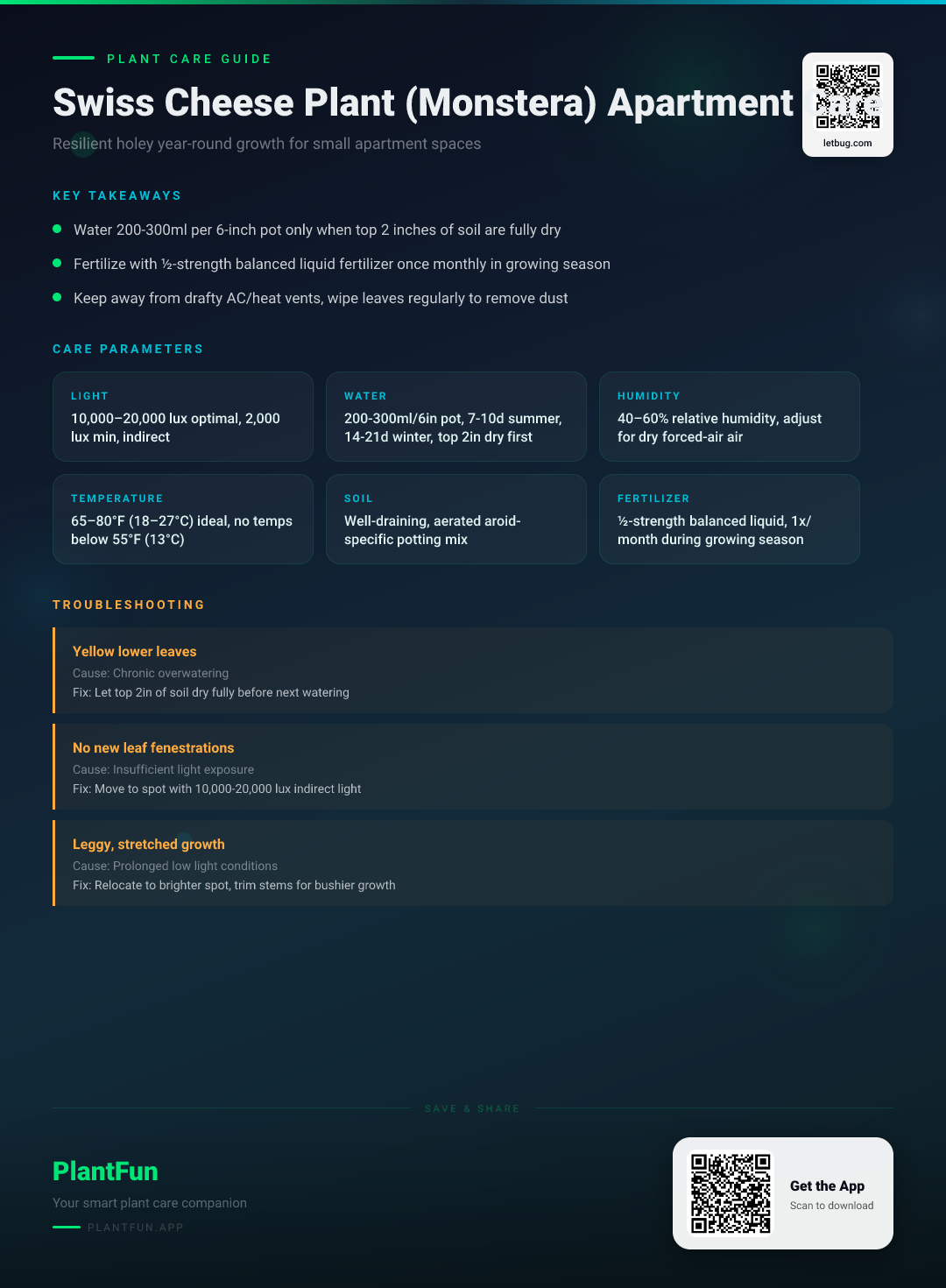
Key Takeaways
- Check soil moisture before watering — overwatering is the #1 killer of houseplants.
- Ensure your plant gets the right amount of light for its species.
- Be patient with recovery — most plants need 2–4 weeks to bounce back.
Quick Care Card
| Parameter | Measurable Threshold |
|---|---|
| Light | 10,000–20,000 lux optimal, 2,000 lux minimum |
| Water | 200–300 ml per 6-inch pot, when top 2 inches of soil are dry |
| Humidity | 40–60% relative humidity |
| Temperature | 65–80°F (18–27°C) ideal, never below 55°F (13°C) |
| Soil | Well-draining aroid mix (1 part potting soil, 1 part perlite, 1 part orchid bark) |
| Fertilizer | ½-strength balanced liquid fertilizer, 1x monthly in growing season |
| Toxicity | Toxic to cats, dogs, and horses if ingested (ASPCA, 2026) |
Guide Context
Generic Swiss cheese plant care guides often assume spacious, sun-filled suburban homes, but small urban apartments come with unique constraints: low natural light, dry forced air, limited floor space, and fluctuating temperatures from AC and heating units. This diagnosis-first framework starts with identifying early stress signs in your plant before adjusting care, so you don’t waste time fixing problems that don’t exist. All advice uses measurable, testable parameters to eliminate guesswork for monstera care for beginners and intermediate plant parents alike.
Myth vs Reality
Myth: Monsteras need full direct sun to grow holes. Reality: Direct sun will scorch their leaves; they only need bright indirect light (10,000–20,000 lux) to produce fenestrations (their signature holes), which is achievable even in small apartments with north-facing windows if you use a low-wattage grow light (NC State Extension, 2026).
Initial Health Diagnosis
Answer these 3 quick questions to spot stress before it becomes irreversible:
- Do you have any soft, fully yellow lower leaves on your plant?
- Have new leaves grown in the last 6 months with no fenestrations?
- Is new growth stretched out with more than 6 inches between leaf nodes?
If you answered yes to any of these, your monstera is signaling it needs adjusted care to thrive in your apartment.
Step-by-Step Core Care Checklist
Follow these steps once per month to keep your plant healthy:
- Test light levels at your plant’s leaf height using a free phone lux meter app to confirm it meets the 2,000 lux minimum requirement.
- Stick your index finger 2 inches deep into the soil to check moisture levels before watering.
- Test relative humidity near your plant with an inexpensive hygrometer to ensure it stays between 40–60%.
- Wipe both sides of all leaves with a damp microfiber cloth to remove dust buildup.
- Check for root growth coming out of drainage holes to confirm it is not root bound.
Light Requirement Breakdown
Monstera light requirements lux are very specific for consistent fenestration growth: 10,000–20,000 lux of bright indirect light is optimal, with a hard minimum of 2,000 lux to prevent leggy growth (NC State Extension, 2026).
How to test and place in your apartment
- Use a free lux meter app on your phone, held at the same height as your plant’s top leaves, to test light levels at different times of day.
- Best placement spots: 3 feet away from an east-facing window, 5 feet away from a south or west-facing window (out of direct sun), or 1 foot under a low-wattage grow light set to 12 hours per day for north-facing apartments.
- Rotate your plant 15 degrees weekly to ensure even growth on all sides.
Exact Watering Guidance
For a standard 6-inch potted monstera, water 200–300 ml only when the top 2 inches of soil are completely dry. Timing will vary by season: 7–10 days in summer, 14–21 days in winter (NC State Extension, 2026).
Overwatering prevention for poorly ventilated apartments
Monstera overwatering signs include soft, mushy yellow leaves and a sour smell coming from the soil. To avoid this:
- Always use a pot with drainage holes, and empty any standing water from the saucer within 15 minutes of watering.
- If you use a decorative pot without drainage, reduce your watering amount by 50% to prevent trapped moisture.
- Skip watering for 2–3 extra days if your apartment is particularly humid or cool after heavy rain.
If you’re looking for more guidance on seasonal watering, our monstera summer watering guide breaks down adjustments for hot, humid months.
Humidity & Temperature Parameters
Monstera humidity requirements sit between 40–60% relative humidity, with ideal temperatures of 65–80°F (18–27°C), and never below 55°F (13°C) (NC State Extension, 2026).
Understanding the Science
Research on foliage plant health confirms that consistent relative humidity between 40–60% reduces leaf browning and stress in tropical aroids like Monstera deliciosa (Šrámek, 1999).
Easy apartment hacks for dry forced air
- Group your monstera with other houseplants to raise surrounding humidity by 5–10% through transpiration.
- Place a pebble tray filled with water under your plant’s pot (make sure the pot is not sitting directly in the water).
- Mist your plant’s leaves 2x per week if humidity drops below 40% during winter heating months.
Swiss cheese plant brown tips are almost always caused by low humidity or exposure to drafty vents, so test your humidity first if you see this symptom.
Soil, Fertilizer & Support Tips
- Soil: Use a well-draining aroid mix: 1 part regular potting soil, 1 part perlite, 1 part orchid bark. This prevents root rot even in poorly ventilated apartments.
- Fertilizer: Apply ½-strength balanced liquid fertilizer once per month only during the growing season (March–October). Skip fertilizing in winter when growth slows.
- Space-saving support: For small apartment monstera care, use a slim 2-foot moss pole attached to the edge of your pot instead of a bulky freestanding pole. This takes up no extra floor space and encourages your monstera to grow upward instead of outward.
Following these tips will help you figure out how to make monstera grow faster in apartment conditions.
12-Month Seasonal Care Calendar
This calendar is tailored specifically to apartment living, with adjustments for heating, AC, and seasonal light shifts:
- January–February (Winter): Follow monstera winter care apartment rules: water every 14–21 days, skip fertilizer, move plant at least 3 feet away from heat vents, and place in the brightest spot available.
- March: Start checking for new growth, resume monthly ½-strength fertilizer once new leaves unfurl.
- April–June (Spring): Water every 7–10 days, rotate 15 degrees weekly for even growth, and check for root bound conditions if growth is rapid.
- July–August (Summer): Move plant 3 feet away from AC vents, add extra humidity if AC runs constantly, and wipe leaves weekly to remove dust from open windows.
- September–October (Fall): Gradually reduce watering frequency, stop fertilizing at the end of October, and move plant away from drafty windows as temperatures drop.
- November–December: Move to the brightest spot in your apartment, avoid placing near exterior doors that open frequently, and reduce watering to 14–21 day intervals.
Apartment-Specific Mistakes to Avoid
- Mistake: Placing your monstera near drafty AC or heat vents. What happens: Rapid temperature fluctuations and dry air cause brown leaf tips and stunted growth. Instead: Keep your plant at least 3 feet away from all heating and cooling vents.
- Mistake: Overpotting your monstera in a much larger pot to avoid repotting often. What happens: Extra soil holds excess moisture, increasing overwatering risk, and takes up valuable floor space in small apartments. Instead: Only pot up to a container 1 inch larger than your current pot every 2–3 years.
- Mistake: Ignoring leaf dust buildup from stale apartment air. What happens: Dust blocks light absorption, slowing growth and preventing fenestration development. Instead: Wipe leaves with a damp cloth once per month to remove dust.
- Mistake: Placing your monstera in a dark corner far from windows to save space. What happens: Light levels drop below the 2,000 lux minimum, causing leggy growth and no new fenestrations. Instead: Test light levels with a phone app, and add a small grow light if your only available spot is low light.
Voice Search FAQ
Why is my monstera not growing holes?
Your monstera is either too young (plants under 3 years old rarely produce fenestrations) or not getting enough light (below 10,000 lux of bright indirect light daily). Mature plants will produce holes consistently once they receive optimal light levels (NC State Extension, 2026).
Can I keep a monstera in a studio apartment?
Absolutely! Choose a compact trailing Monstera deliciosa variety, prune back excess growth annually, and use a slim wall-mounted moss pole to save floor space. Place it in a bright spot away from foot traffic, and it will thrive even in 300–500 square foot studios.
How often do I water my monstera in the winter?
In winter, water a 6-inch potted monstera every 14–21 days, only when the top 2 inches of soil are completely dry. Reduced light and slower winter growth mean your plant uses far less water, so overwatering is very common during this season.
Troubleshooting Quick Reference
Yellow Lower Leaves
Symptom: Soft, mushy yellow leaves at the base of the plant, no browning on edges.
Likely cause: Overwatering from poor drainage or watering too frequently.
Fix:
- Allow the top 3 inches of soil to dry completely before your next watering
- Empty the saucer of any standing water within 15 minutes of watering
Brown Leaf Tips
Symptom: Crispy brown edges on mature leaves, rest of the leaf is vibrant green.
Likely cause: Low humidity (below 40%) or exposure to drafty heat/AC vents.
Fix:
- Move your plant 3+ feet away from all heating and cooling vents
- Add a pebble tray under the pot to increase surrounding humidity by 5–10%
Leggy Growth
Symptom: New growth has more than 6 inches between leaf nodes, leaves are smaller than older growth.
Likely cause: Insufficient light (below 2,000 lux) for extended periods.
Fix:
- Move your plant to a spot with 10,000–20,000 lux of indirect light, or add a grow light set to 12 hours per day
- Prune back stretched stems to encourage bushier, more compact growth
No New Growth
Symptom: No new unfurled leaves for 3+ months during spring and summer.
Likely cause: Nutrient deficiency, insufficient light, or a root bound pot.
Fix:
- Apply ½-strength balanced liquid fertilizer once per month during the growing season
- Check if roots are growing out of drainage holes, and repot to a 1-inch larger pot if needed
Minor Pest Infestation
Symptom: Small brown or yellow spots on leaves, tiny webbing or bugs on leaf undersides.
Likely cause: Spider mites or mealybugs brought in from new plants or stale apartment air.
Fix:
- Wipe all leaf surfaces with a diluted neem oil solution weekly for 3 weeks
- Isolate from other houseplants until the infestation is completely gone
References
- NC State Extension. (2026). The Complete Swiss — NC State Extension Gardener Plant Toolbox. https://plants.ces.ncsu.edu/plants/swiss-cheese/. Accessed 2026-03-03.
- Šrámek, F. (1999). Vaughan, M.J.: The Complete Book on Cut Flower Care. Biologia plantarum. https://doi.org/10.1023/a:1001770114931. Accessed 2026-03-03.
- George, F. (2007). Adherence to recommended standards of diabetes care by Swiss primary care physicians. Swiss Medical Weekly. https://doi.org/10.4414/smw.2007.11592. Accessed 2026-03-03.
- ASPCA. (2026). Toxic and Non-Toxic Plants List — ASPCA. https://www.aspca.org/pet-care/animal-poison-control/toxic-and-non-toxic-plants. Accessed 2026-03-03.
Optional Helper: Plantfun.App
Plantfun.App identifies your plants by photo, diagnoses pests and diseases with clear fixes, and creates personalised watering and light schedules that adapt to your home conditions — a handy companion for putting this guide into daily practice.
Found an error or have suggestions? We'd love your feedback.
Need help identifying this problem?
Get instant identification, personalized care schedules, and effective pest treatment plans directly on your phone.
Sponsored • We may earn a commission from app downloads
Related Guides
The Complete Monstera Deliciosa Care Checklist for Resilient Growth in Typical Apartments
Grow a lush, holey Monstera without fancy expensive gear. Grab our free printable checklist with exact light, water, and soil specs for resilient growth in your typical apartment.
Care GuideThe Complete Monstera Deliciosa Care Guide for Typical Apartments: Resilient Growth Checklist
Grow a lush, fenestrated Monstera deliciosa in your typical apartment with zero guesswork. Get exact light levels, watering volumes, and a 12-step checklist to avoid yellow leaves and stunted growth.
Care GuideThe Complete Monstera Deliciosa Care Checklist for Small Apartments: Resilient Growth Tips That Work
Grow a lush, fenestrated Monstera even in a tiny apartment. Get exact light, water, and space-saving tips to support resilient growth without cluttering your space.
ToolMonstera Deliciosa in East-Facing Apartments: Budget & Pro Tools for Perfect Light & Water
Stop guessing light and water for your east-facing Monstera deliciosa. Get budget and pro tool picks, exact care thresholds, and a seasonal guide to keep leaves lush and full of fenestrations.