
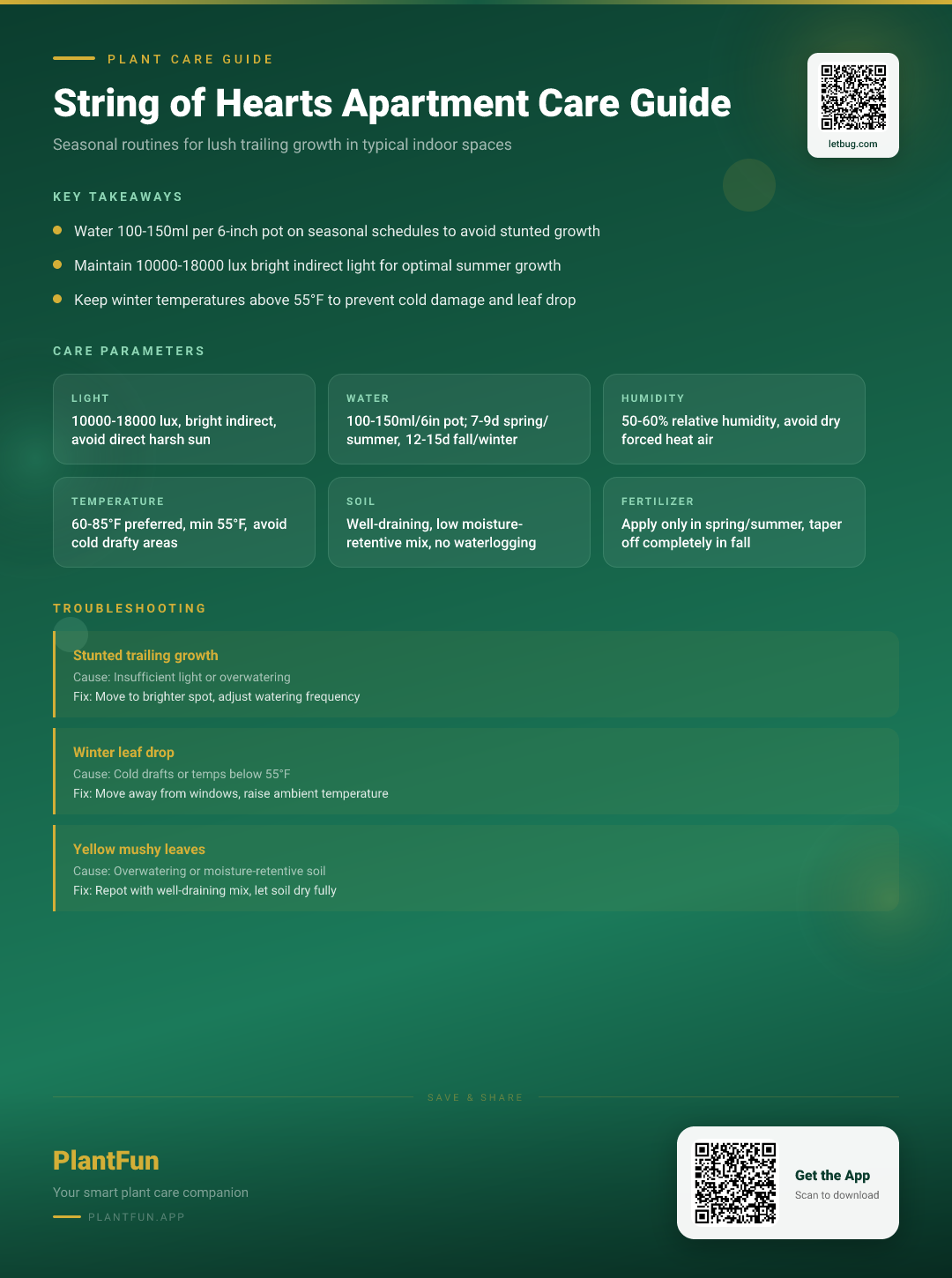
Key Takeaways
- Check soil moisture before watering — overwatering is the #1 killer of houseplants.
- Ensure your plant gets the right amount of light for its species.
- Be patient with recovery — most plants need 2–4 weeks to bounce back.
Quick Care Card: Printable 1-page checklist of all core measurable care thresholds for String of Hearts in typical apartments, categorized by season for at-a-glance reference
| Season | Light (lux) | Water (per 6-inch pot) | Humidity | Temperature | Fertilizer | Toxicity |
|---|---|---|---|---|---|---|
| Spring (Mar-May) | 8,000-12,000 bright indirect | 100-150ml every 7-9 days | 40-50% | 65-75°F (18-24°C) | 1/2 strength cactus fertilizer every 4 weeks | Non-toxic to cats, dogs, humans (ASPCA, 2026) |
| Summer (Jun-Aug) | 10,000-18,000 bright indirect (no midday direct sun) | 120-180ml every 5-7 days | 50-60% | 70-85°F (21-29°C) | 1/2 strength cactus fertilizer every 3 weeks | Non-toxic (ASPCA, 2026) |
| Fall (Sep-Nov) | 7,000-10,000 | 80-120ml every 12-15 days | 40-45% | 60-70°F (15-21°C) | Stop fertilizing after mid-October | Non-toxic (ASPCA, 2026) |
| Winter (Dec-Feb) | 5,000-7,000 (use 10W grow light 8hrs/day if needed) | 50-80ml every 18-22 days | 35-40% | Minimum 55°F (13°C) | None | Non-toxic (ASPCA, 2026) |
Why This Guide Works for Apartment String of Hearts
Generic String of Hearts care guides are built for greenhouse conditions, not the unique constraints of typical apartments: drafty AC/heat vents, forced air that dries foliage, limited bright window access, and extreme temperature swings near exterior doors and windows. These stressors are the leading cause of stunted growth, yellow leaves, and leaf drop for apartment-grown String of Hearts.
Myth vs Reality: Myth: String of Hearts needs 6+ hours of full direct sun daily. Reality: Window glass amplifies sun intensity in apartments, leading to scorched leaves. Bright indirect light is optimal for apartment plants (NC State Extension, 2026). If you’re new to succulent care in small spaces, check our guide to low-maintenance trailing houseplants for apartments for more picks.
Step-by-Step Initial Setup for New String of Hearts
Follow these steps to avoid transplant shock when bringing your String of Hearts home:
- Unbox immediately, inspect undersides of leaves for mealybugs and trim any damaged, yellowed vines.
- Only repot if root-bound (roots growing out of drainage holes): Use a 6-inch terracotta pot with drainage holes, filled with a 70/30 mix of commercial succulent soil and perlite for fast drainage (NC State Extension, 2026). This is the safest method for how to repot String of Hearts in apartment conditions.
- Choose placement: 2-3 feet from a south or east-facing window, at least 5 feet away from AC or forced heat vents to avoid dry air damage.
- First watering: Wait 7 days after repotting to let damaged root hairs heal, then give 100ml of room-temperature filtered water directly to the soil, avoiding wetting the leaves.
- Quick test: Stick your finger 2 inches into the soil – if it is completely dry, you can water; if any moisture remains, wait 2 more days.
For more tips on reducing transplant stress for new plants, see our guide to acclimating store-bought plants to apartment conditions.
Spring Care Routine (March-May)
Spring is the active growth season for String of Hearts, when new vines emerge most rapidly.
- Water: 100-150ml per 6-inch pot every 7-9 days, adjusted for your apartment’s humidity (NC State Extension, 2026). This answers the most common question for new growers: how often to water String of Hearts during peak growth.
- Fertilize: Apply 1/2 strength balanced cactus fertilizer every 4 weeks, always watering lightly before fertilizing to avoid root burn.
- Prune: Trim any yellow or dead vines, and pinch off the top 1/4 inch of growing tips to encourage branching and fuller growth.
- Quick test: Lift the pot – if it feels very light, it is time to water; if it feels heavy, hold off for 2 days.
Summer Care Routine (June-August)
Adjust your routine to account for higher temperatures and longer daylight hours in summer:
- Light: String of Hearts light requirements for apartments are 10,000-18,000 lux of bright indirect light. Use a cheap light meter app to test levels – if readings are over 20,000 lux, hang a sheer curtain to filter midday sun and avoid leaf scorch.
- Humidity: Target 50-60% relative humidity (String of Hearts humidity needs are lower than many tropical houseplants). No expensive humidifier required: place a tray of pebbles and water under the pot, or group your String of Hearts with other plants to raise ambient humidity.
- Water: String of Hearts summer watering calls for 120-180ml per 6-inch pot every 5-7 days, as higher temperatures dry soil faster.
For more low-cost humidity hacks, see our apartment plant humidity guide.
Fall Care Routine (September-November)
Use fall to prep your plant for winter dormancy:
- Water: Reduce frequency to every 12-15 days, giving 80-120ml per 6-inch pot only when the top 3 inches of soil are completely dry.
- Fertilizer: Taper off applications, stopping completely by mid-October to avoid soft new growth that will be damaged by cold winter temperatures.
- Light: Move your plant 1 foot closer to the window if daylight hours drop below 10 hours per day, to maintain a minimum of 7,000 lux of light.
Winter Care Routine (December-February)
String of Hearts winter care focuses on supporting healthy dormancy, which sets the stage for fast growth in spring:
- Temperature: Maintain a minimum of 55°F (13°C), avoid placing the plant within 1 foot of drafty windows or exterior doors (NC State Extension, 2026). Sudden cold drafts are the leading cause of winter leaf drop.
- Water: Reduce to 50-80ml per 6-inch pot every 18-22 days, using room-temperature water to avoid shocking dormant roots. This is a core component of String of Hearts dormancy care.
- Light: If your apartment gets less than 5,000 lux of light daily, use a low-cost 10W grow light placed 1 foot above the plant for 8 hours per day.
Common Apartment-Specific Mistakes to Avoid
- Mistake: Placing within 2 feet of AC or forced heat vents What happens: Dry forced air strips moisture from leaves, leading to shriveling and leaf drop Instead: Keep at least 5 feet away from vents, or use a small draft blocker if you cannot move the plant
- Mistake: Overwatering in low light conditions What happens: Soggy soil causes root rot, leading to soft, yellow leaves and eventual plant death (the top answer for why is my String of Hearts leaves yellow in apartments) Instead: Reduce watering frequency by 30% if your plant gets less than 7,000 lux of light daily
- Mistake: Using overly moisture-retentive regular houseplant soil What happens: Soil stays wet for 2+ weeks, leading to root rot Instead: Use a 70/30 mix of succulent soil and perlite for fast drainage
- Mistake: Placing directly on a drafty window sill in winter What happens: Cold air drafts cause sudden, widespread leaf drop even if the rest of the apartment is warm (the most common String of Hearts leaf drop fix requires adjusting placement first) Instead: Keep at least 1 foot away from exterior windows in winter, or add a layer of bubble wrap to the window glass for insulation
- Mistake: Fertilizing during winter dormancy What happens: Excess fertilizer burns dormant roots, leading to stunted growth the following spring Instead: Skip all fertilizer from mid-October to early March
- Mistake: Watering with cold tap water in winter What happens: Cold water shocks dormant roots, leading to leaf drop Instead: Use room-temperature filtered water, or leave tap water out for 24 hours before using to let chlorine evaporate
- Mistake: Repotting in winter when the plant is dormant What happens: Transplant shock can kill the plant, as roots are not actively growing Instead: Only repot in spring or early summer during active growth
FAQ: Voice Search Optimized
Can I keep my String of Hearts in a low light apartment?
Yes, but growth will be slower. Aim for a minimum of 5,000 lux daily, which you can achieve with a $10 10W grow light placed 1 foot above the plant for 8 hours a day if you do not have bright windows (NC State Extension, 2026). This is a perfect String of Hearts care for beginners hack for dark apartments.
Why is my String of Hearts dropping leaves in winter?
This is almost always caused by cold drafts near exterior windows or overwatering during dormancy. First, move the plant 1 foot away from the window, then check soil moisture – if the top 2 inches are still wet, hold off on watering for 10+ days.
How often should I repot my String of Hearts?
Only repot every 2-3 years, or when you see roots growing out of the drainage holes. String of Hearts prefer to be slightly root-bound, which encourages more trailing growth instead of root growth.
Is String of Hearts safe for my cat and dog?
Yes, the ASPCA classifies String of Hearts as non-toxic to cats, dogs, and humans, making it an ideal pick for pet-friendly apartments (ASPCA, 2026). For more pet-safe houseplant options, see our curated list of non-toxic trailing plants.
Troubleshooting Common Symptoms
Yellow Leaves
Symptom: Soft, mushy yellow leaves, often accompanied by a sour smell from the soil.
Likely cause: Overwatering leading to root rot, especially common in low-light apartments.
Fix:
- Remove the plant from its pot, trim all mushy brown roots with sterile scissors
- Repot in fresh 70/30 succulent/perlite mix, wait 10 days before watering
- Reduce watering frequency by 30% moving forward
Shriveled, Wrinkled Leaves
Symptom: Dry, wrinkled heart-shaped leaves that feel soft to the touch.
Likely cause: Underwatering, or exposure to dry forced air from heating/AC vents.
Fix:
- Give the plant 100ml of room-temperature filtered water directly to the soil
- Move the plant at least 5 feet away from any vents if applicable
- Check soil moisture every 5 days to avoid repeat underwatering
Stunted Growth
Symptom: No new vine growth for 3+ months, even during spring and summer.
Likely cause: Insufficient light, or lack of fertilizer during active growth.
Fix:
- Move the plant to a spot with at least 8,000 lux of bright indirect light, or add a grow light for 8 hours daily
- Apply 1/2 strength cactus fertilizer every 4 weeks during spring and summer
No Trailing Vines
Symptom: The plant grows short, bushy foliage but no long trailing vines.
Likely cause: Lack of light, or not pruning growing tips to encourage branching.
Fix:
- Pinch off the top 1/4 inch of each growing tip every 2 months during active growth
- Ensure the plant gets at least 10,000 lux of light daily to support trailing growth
How to Encourage Trailing Growth for Apartment Displays
Long, lush trailing vines are the top appeal of String of Hearts for shelf and hanging planter displays. Follow these tips for faster growth:
- Prioritize light: 10,000-12,000 lux of bright indirect light daily is the most important factor for fast trailing growth (NC State Extension, 2026). This is the simplest answer for how to make String of Hearts grow faster.
- Prune strategically: Pinch off the top 1/4 inch of growing tips every 2 months during active growth to encourage branching, which leads to fuller, longer vines.
- Guide growth: Use small adhesive hooks on your shelf or wall to train short vines downward as they grow, which reinforces the trailing habit.
- Avoid overpotting: Keep the plant slightly root-bound, as this triggers more vegetative growth instead of root expansion.
- Fertilize regularly: Apply 1/2 strength cactus fertilizer every 3 weeks during summer to support fast, healthy growth. These String of Hearts trailing growth tips work for even the smallest apartment spaces.
References
- NC State Extension. (2026). The Complete String — NC State Extension Gardener Plant Toolbox. https://plants.ces.ncsu.edu/plants/hearts-care/. Accessed 2026-03-06.
- ASPCA. (2026). Toxic and Non-Toxic Plants List — ASPCA. https://www.aspca.org/pet-care/animal-poison-control/toxic-and-non-toxic-plants. Accessed 2026-03-06.
- J.S., . (2003). Chamber Music: Complete String Quintets (Study Score). American String Teacher. https://doi.org/10.1177/000313130305300350. Accessed 2026-03-06.
- Segall, C. (2014). Sergey Ivanovich Taneyev - Sergey Ivanovich Taneyev. Complete String Quartets, vol. 1, <i>String Quartets Nos. 1 and 3</i>. Carpe Diem String Quartet. Naxos 8570437, 2007 (1 CD: 61 minutes). - Sergey Ivanovich Taneyev. Complete String Quartets, vol. 2, <i>String Quartets Nos. 2 and 4</i>. Carpe Diem String Quartet. Naxos 8572421, 2010 (1 CD: 67 minutes). - Sergey Ivanovich Taneyev. Complete String Quartets, vol. 3, <i>String Quartets Nos. 5 and 7</i>. Carpe Diem String Quartet. Naxos 8573010, 2012 (1 CD: 62 minutes). Nineteenth-Century Music Review. https://doi.org/10.1017/s1479409814000470. Accessed 2026-03-06.
Optional Helper: Plantfun.App
Plantfun.App identifies your plants by photo, diagnoses pests and diseases with clear fixes, and creates personalised watering and light schedules that adapt to your home conditions — a handy companion for putting this guide into daily practice.
Found an error or have suggestions? We'd love your feedback.
Need help identifying this problem?
Get instant identification, personalized care schedules, and effective pest treatment plans directly on your phone.
Sponsored • We may earn a commission from app downloads
Related Guides
The Complete String of Hearts Care Checklist for Resilient Growth in Typical Apartments
Grab a foolproof String of Hearts care checklist tailored to typical apartment conditions, with exact light, water, and humidity levels to grow lush, trailing vines without frustrating leaf drop.
Care GuideThe Complete String of Hearts Care Checklist for Thriving Growth in Small City Apartments
Grow lush trailing String of Hearts in your apartment without fancy gear. Grab our free printable care checklist with exact light, water, and humidity thresholds for resilient, low-fuss, year-round growth.
Care GuideThe Complete String of Hearts Care Guide for Typical Apartments: Grow Fuller, Resilient Vines Fast
Stop struggling with leggy, yellowing String of Hearts vines. Get a 10-point apartment-specific checklist, exact light, water, and humidity levels to grow lush, trailing growth year-round.
Pest ControlAnts on Plants: What They Mean and What to Do
Ants usually aren't eating your plant. They are farming other pests.