
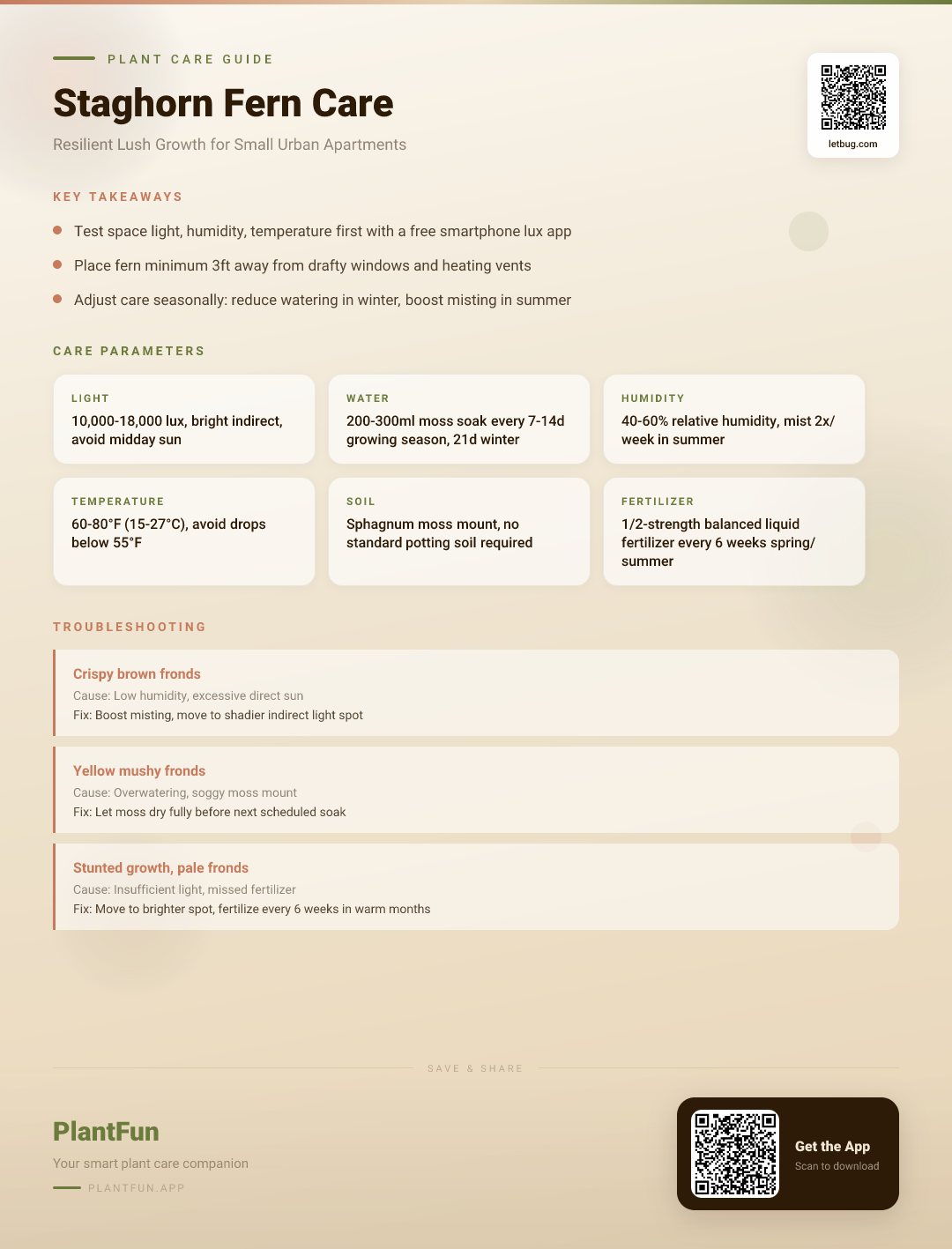
Key Takeaways
- Check soil moisture before watering — overwatering is the #1 killer of houseplants.
- Ensure your plant gets the right amount of light for its species.
- Be patient with recovery — most plants need 2–4 weeks to bounce back.
Quick Care Card
| Parameter | Measurable Value | Apartment-Specific Notes |
|---|---|---|
| Light | 10,000–18,000 lux bright indirect | Avoid midday direct sun that burns fronds |
| Water (Growing Season) | 200–300ml moss mount soak every 7–14 days | Adjust frequency based on your space’s humidity |
| Humidity | 40–60% relative humidity | No greenhouse-level 70%+ humidity required (Hoshizaki, 1975) |
| Temperature | 60–80°F (15–27°C) | Avoid swings larger than 10°F (5°C) |
| Mount Medium | Sphagnum moss on wood plaque | No soil required for epiphytic staghorn ferns |
| Fertilizer | 1/2-strength balanced (10-10-10) liquid every 6 weeks spring/summer | Apply only to moss, not fronds |
| Toxicity | Non-toxic to cats, dogs, and humans | Safe for all apartment households (ASPCA, 2026) |
Why Typical Apartments Are a Tricky Environment for Staghorn Ferns
Generic staghorn fern care guides are written for greenhouse conditions, but small urban apartments have unique constraints that often lead to crispy brown fronds and stunted growth: HVAC systems create extremely dry air (as low as 20% RH in winter), most units have limited bright indirect light exposure, drafty windows and vents create sudden temperature swings, and wall space is often limited for mounting. A common myth is that staghorns need tropical greenhouse humidity to survive, but research shows they adapt well to lower apartment humidity levels if you adjust care to match your space (Hoshizaki, 1975).
Step 1: Diagnose Your Apartment’s Conditions First
Before you buy or adjust care for your staghorn fern, test your space’s unique constraints to avoid guesswork:
- Light test: Download a free smartphone lux app, hold your phone at the height you plan to mount the fern, and take a 10-minute average reading at midday on a sunny day. For more tips on accurate testing, read our step-by-step guide to using a lux meter for houseplants.
- Humidity test: Place an inexpensive analog hygrometer at the mount spot for 24 hours to get your baseline relative humidity.
- Temperature test: Check the same spot over 2 days to note any swings larger than 10°F (5°C) from heating/cooling cycles or drafty openings.
Care Checklist Item 1: Mounting & Placement Rules
Staghorn ferns are epiphytes, meaning they grow on tree trunks in nature, so they need to be mounted rather than potted in soil for optimal growth in apartments:
- Renter-friendly mounting: Use 20lb-capacity heavy-duty command hooks to mount wood plaques without drilling. If you need more options, see our guide to the best renter-friendly plant mounts for small spaces.
- Placement rule 1: Keep the mount at least 3 feet away from drafty windows, heating vents, and AC units to avoid dry air damage.
- Placement rule 2: Do not mount directly on cold exterior walls in winter, as seeping cold air damages the fern’s root system.
Care Checklist Item 2: Light Requirements
Staghorn ferns need consistent bright indirect light to grow well indoors, and the exact measurable threshold is 10,000–18,000 lux (Hamasaki, 1977):
- Acceptable window exposures: East-facing window (2 feet back), south-facing window (5 feet back with a sheer curtain), west-facing window (6 feet back) all meet the lux target.
- Low-light workarounds for north-facing apartments: If your space only gets <8,000 lux of natural light, use a 10W full-spectrum grow light placed 1 foot above the fern, run for 12 hours per day during the growing season. Our roundup of budget grow lights for apartments has picks under $20 that work perfectly for this use case.
Care Checklist Item 3: Watering Routine
Overwatering and underwatering are the top causes of unhealthy staghorn ferns in apartments, so follow these measurable steps:
- Growing season (spring/summer): Submerge the entire moss mount in 200–300ml of room-temperature water for 10 minutes every 7–14 days. Let excess water drain completely before rehanging.
- Moisture test: Stick a wooden skewer 2 inches into the moss. If it comes out completely dry, it’s time to water; if it’s still damp, wait 2–3 more days.
- Overwatering warning signs: Mushy brown shield fronds, white mold on the moss, and a rotting smell from the mount. If you see these, stop watering for 2 weeks and increase air flow around the fern.
Care Checklist Item 4: Humidity & Temperature Rules
Staghorn ferns thrive in 40–60% relative humidity and 60–80°F (15–27°C) temperatures, which is achievable in most apartments without a humidifier:
- No-humidifier humidity hacks: 1) Place a pebble tray filled with water under the mount (make sure the mount does not sit directly in standing water), 2) Group your staghorn with other humidity-loving houseplants to create a microclimate, 3) Mist the brown shield fronds (not the green antler fronds) once every other day. For more tips, see our guide to boosting humidity for plants without a humidifier.
- Temperature rule: If your space regularly drops below 55°F (13°C) or rises above 85°F (29°C), move the fern to a more temperature-stable spot.
Care Checklist Item 5: Feeding & Regular Maintenance
Staghorn ferns are low-feeders, so minimal maintenance is required for resilient growth:
- Feeding: Mix a balanced 10-10-10 liquid fertilizer to 1/2 the recommended strength, and pour directly onto the moss mount every 6 weeks only in spring and summer. Do not apply fertilizer to the fronds, as this can cause burn marks.
- Pruning: Only remove shield fronds that are 100% brown and crispy to the touch. Partially brown or green shield fronds store nutrients for the fern, so cutting them slows growth significantly (Hamasaki, 1977).
Seasonal Care Calendar
Adjust your care routine to match seasonal changes in your apartment:
- Winter adjustments: Reduce watering to once every 21 days, move the mount 1 foot away from cold exterior walls, and stop fertilizing completely until spring.
- Summer adjustments: Increase misting of shield fronds to 2x per week, move the fern 1 foot further back from south/west windows to avoid midday sun burn, and test moss moisture every 5 days to avoid underwatering.
Common Apartment Staghorn Fern Mistakes to Avoid
- Mistake: Mounting on cold exterior walls in winter. What happens: Cold air seeps through the wall, damages the root system, and causes staghorn fern brown edges. Instead: Mount on interior walls, or add a 1/2 inch foam insulation pad behind the mount in winter if exterior wall mounting is your only option.
- Mistake: Soaking green antler fronds directly when watering. What happens: Fronds develop brown spots or rot. Instead: Submerge only the moss mount in water, and avoid getting the antler-shaped fronds wet.
- Mistake: Placing within 3 feet of AC or heating vents. What happens: Dry forced air desiccates fronds, leading to crispy brown edges, which is the top reason people ask why is my staghorn fern turning brown. Instead: Move to a spot at least 3 feet away from all HVAC outlets.
- Mistake: Overwatering in low-humidity apartments to compensate for dry air. What happens: Moss stays soggy, leading to root rot. Instead: Boost local humidity with a pebble tray, and keep your watering schedule consistent.
- Mistake: Pruning partially brown shield fronds. What happens: You remove critical nutrient storage for the fern, slowing growth significantly. Instead: Only prune shield fronds that are 100% brown and crispy to the touch.
Voice Search FAQ
Why is my staghorn fern turning brown at the edges?
Most often this is from exposure to dry forced air from HVAC vents, or placement too close to drafty windows. First confirm your fern is at least 3 feet away from all vents and drafty openings, then test your humidity level to make sure it is above 40% RH. If humidity is low, add a pebble tray under the mount to boost local moisture.
Can I keep a staghorn fern in a low light apartment?
Yes! If you only have north-facing light or less than 10,000 lux of bright indirect light, use a 10W full-spectrum grow light placed 1 foot above the fern, and run it 12 hours per day during the growing season. Staghorns are adaptable to lower light as long as you reduce watering frequency by 25% to avoid overwatering.
How often do I need to water my staghorn fern in winter?
In winter, reduce watering to once every 21 days, as growth slows significantly and the moss takes much longer to dry out. Always test the moss moisture with a skewer before watering to avoid overwatering, which is a common cause of root rot in winter.
References
- ASPCA. (2026). Toxic and Non-Toxic Plants List — ASPCA. https://www.aspca.org/pet-care/animal-poison-control/toxic-and-non-toxic-plants. Accessed 2026-03-05.
- Hoshizaki, B. (1975). A Staghorn Fern (Platycerium) Hybrid. American Fern Journal. https://doi.org/10.2307/1546341. Accessed 2026-03-05.
- Hamasaki, D. (1977). How Fast Does a Staghorn Fern Grow? American Fern Journal. https://doi.org/10.2307/1545969. Accessed 2026-03-05
Optional Helper: Plantfun.App
Plantfun.App identifies your plants by photo, diagnoses pests and diseases with clear fixes, and creates personalised watering and light schedules that adapt to your home conditions — a handy companion for putting this guide into daily practice.
Found an error or have suggestions? We'd love your feedback.
Need help identifying this problem?
Get instant identification, personalized care schedules, and effective pest treatment plans directly on your phone.
Sponsored • We may earn a commission from app downloads
Related Guides
The Budget Staghorn Fern Care Checklist for Resilient Growth in Small Urban Apartments
Grow a lush, resilient staghorn fern in your small apartment without expensive specialty supplies. Get our free science-backed checklist with exact light, water, and humidity targets to skip guesswork.
Care GuideStaghorn Fern Care Checklist for Typical Apartments: 8 Fixes for Resilient Lush Growth
Stop struggling to keep your staghorn fern alive in your apartment. Get 8 actionable care fixes, measurable thresholds, and a free printable checklist for lush, resilient growth.
Care GuideThe Complete Budget Staghorn Fern Care Checklist for Resilient Apartment Growth
Stop wasting money on overpriced fern care products. Grab our free 12-step budget checklist, exact light/humidity thresholds, and easy hacks to grow lush, resilient staghorn ferns in your apartment.
Pest ControlAnts on Plants: What They Mean and What to Do
Ants usually aren't eating your plant. They are farming other pests.