
Key Takeaways
- Check soil moisture before watering — overwatering is the #1 killer of houseplants.
- Ensure your plant gets the right amount of light for its species.
- Be patient with recovery — most plants need 2–4 weeks to bounce back.
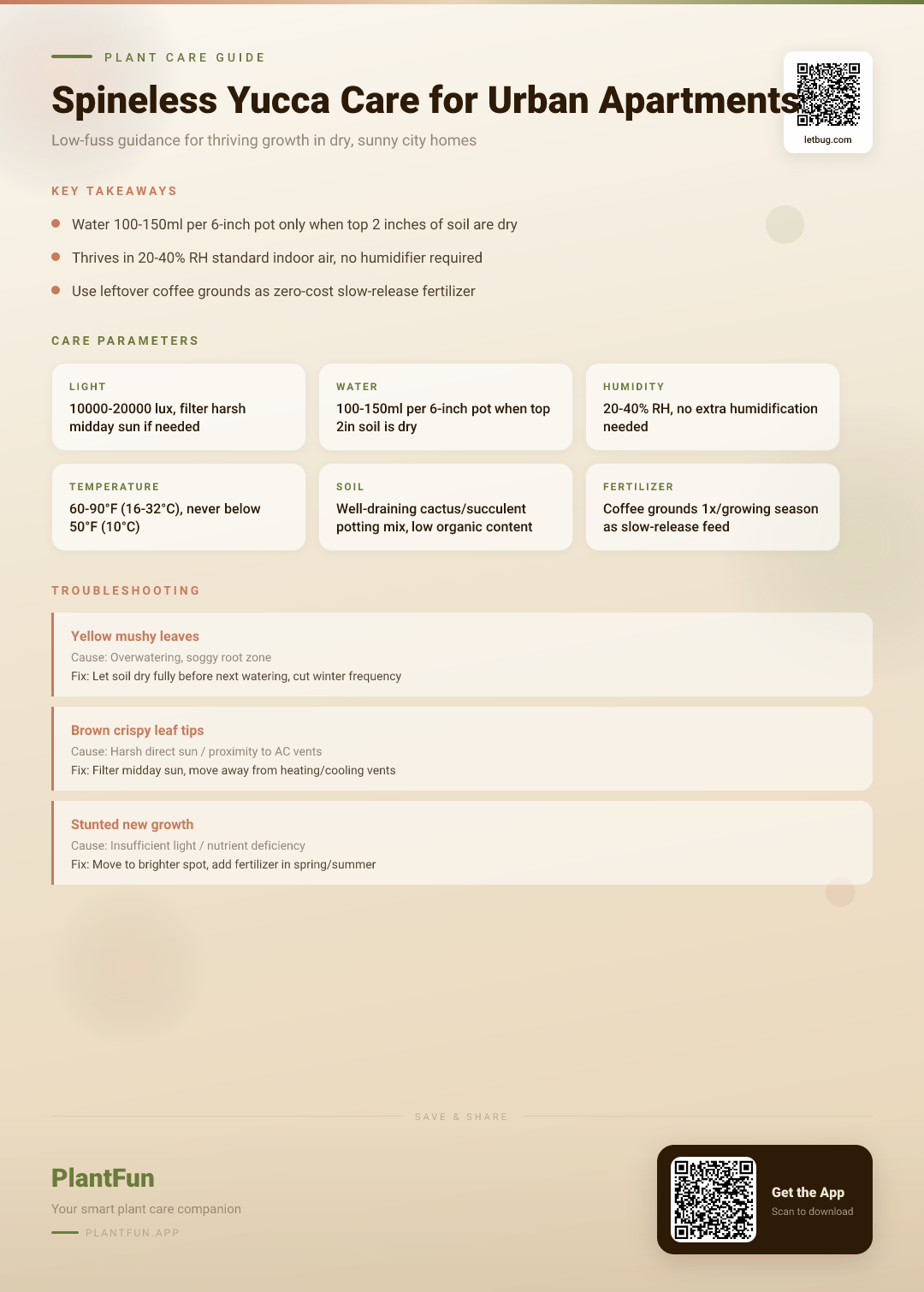
Quick Care Card: At-a-glance cheat sheet for spineless yucca in apartments
| Parameter | Exact Apartment Threshold |
|---|---|
| Light | 10,000–20,000 lux (bright indirect light; tolerates down to 5,000 lux for short periods) |
| Water | 100–150ml per 6-inch pot, only when top 2 inches of soil are completely dry |
| Humidity | 20–40% RH (matches typical apartment forced air, no humidifier needed) |
| Temperature | 60–90°F (16–32°C); never expose to temperatures below 50°F (10°C) |
| Soil | 70% mineral (perlite/pumice) + 30% organic potting mix, or pre-mixed cactus/succulent soil |
| Fertilizer | Twice yearly (spring and mid-summer) with slow-release nitrogen source |
| Toxicity | Toxic to cats, dogs, and horses if ingested (ASPCA, 2026) |
Why Generic Yucca Care Advice Fails for Apartment Dwellers
Most standard spineless yucca care guidance is written for outdoor or custom home growing environments, which do not match the constraints of typical urban rentals. Generic advice ignores the dry forced air that drops humidity to 20% in winter, spotty sunlight blocked by adjacent buildings, fluctuating temperatures from shared HVAC systems, and the inconsistent watering schedules of busy renters.
Myth vs Reality: Many generic guides claim yuccas need 6+ hours of unfiltered full sun daily, but unfiltered midday sun through south-facing apartment windows can reach levels that damage leaves. Spineless yuccas are uniquely adapted to harsh, dry conditions, making them ideal for apartment life—you just need guidance tailored to your space (Abdullah S. Al. Johani, 2019).
Your Free 2-Minute Weekly Yucca Care Checklist
This no-tool routine takes less time than brewing a cup of coffee, and eliminates all guesswork for yucca care for beginners:
- 30-second soil check: Stick your index finger 2 inches deep into the potting mix. If it is completely dry, note to water later that day; if damp, skip watering for the week.
- 30-second leaf scan: Glance over all leaves for yellow spots, brown crispy edges, or drooping growth, which are early signs of stress.
- 30-second placement check: Confirm the plant is at least 1 foot away from AC/heat vents and drafty window sills.
- 30-second dust wipe (as needed): If leaves are coated in dust, wipe them with a damp paper towel to improve light absorption.
Core Measurable Care Thresholds for Apartment Yuccas
These evidence-based parameters are tailored exactly to common apartment conditions, with no fancy equipment required:
- Light: Aim for 10,000–20,000 lux, which is typical of spots 2–3 feet back from a south-facing window, or 1 foot back from an east/west-facing window. Do yuccas need grow lights? No—they can tolerate light levels as low as 5,000 lux for 1–2 months at a time, making them perfect for dimmer apartment layouts (Abdullah S. Al. Johani, 2019).
- Water: Use 100–150ml of room-temperature water per 6-inch pot, only when the top 2 inches of soil are completely dry. Dump any excess water from the saucer within 10 minutes to avoid root rot.
- Humidity: 20–40% RH is ideal, which exactly matches the humidity level of most heated and cooled apartments. Can yucca grow in low humidity apartments? Yes—they evolved to thrive in arid environments, so no humidifier is ever needed (Mejia-Aguilera et al., 2025).
- Temperature: Keep plants between 60–90°F (16–32°C), and never expose them to temperatures below 50°F (10°C). Avoid placing them near drafty exterior windows in winter.
- Soil: The best soil for indoor yucca is a fast-draining mix with 70% mineral content (perlite, pumice, or coarse sand) and 30% organic potting mix, or a pre-made cactus/succulent mix.
Budget Yucca Care Hack Roundup
These low budget yucca care tips cost $5 or less, with zero need for expensive plant products:
- Free slow-release fertilizer: Save dried leftover coffee grounds, and mix 1 tablespoon into the top 1 inch of soil twice a year (spring and mid-summer) for a steady supply of nitrogen.
- Free harsh light filter: Hang an old sheer curtain in front of south-facing windows to filter midday sun that exceeds 25,000 lux. If you don’t have an old curtain, you can pick one up for $3–$5 at a local thrift store.
- Free water source: Use leftover bottled water or collected rainwater instead of buying distilled water for your plant. Tap water works fine too, as long as you flush the soil once every 6 months to remove mineral buildup.
- Free pot upgrade: Repurpose old plastic pots with drainage holes instead of buying expensive decorative planters. Slip the plastic pot into a thrifted cachepot for a polished look, no drilling required.
Seasonal Apartment Yucca Care Calendar
Adjust your routine with these seasonal tweaks tailored to indoor apartment conditions:
- Winter (yucca winter care indoors): Water every 21–30 days, skip fertilizing entirely, and keep plants at least 2 feet away from drafty exterior windows. No extra humidity is needed even when your heater is running constantly.
- Spring: Increase watering to every 14–21 days, add 1 tablespoon of dried coffee grounds to the top of the soil, and move the plant closer to windows if you moved it away for winter cold.
- Summer (yucca summer watering schedule): Water every 7–14 days, check soil moisture twice weekly during heat waves, and use a sheer curtain to filter midday sun. Add a second tablespoon of coffee grounds mid-summer if growth is slow.
- Fall: Reduce watering to every 14–21 days, stop fertilizing, and move plants away from AC vents if you’ve been running cooling all summer.
5 Common Yucca Care Mistakes Apartment Dwellers Make
- Mistake: Watering on a fixed weekly schedule instead of checking soil moisture first. What happens: Overwatering causes root rot, the #1 killer of indoor yuccas. Instead: Only water when the top 2 inches of soil are completely dry to the touch.
- Mistake: Placing yucca within 6 inches of AC or forced heat vents. What happens: Extreme temperature fluctuations cause brown leaf tips and stunted growth. Instead: Keep plants at least 1 foot away from all HVAC vents.
- Mistake: Repotting yucca once per year. What happens: Yuccas prefer root-bound conditions, and frequent repotting shocks the plant and slows growth. Instead: Repot only once every 3–4 years, when roots are visibly growing out of the pot’s drainage holes.
- Mistake: Placing yucca directly against unfiltered south-facing window glass. What happens: Intensified sun through glass exceeds 25,000 lux, causing permanent sunburn on leaves. Instead: Hang a sheer curtain to filter light, or place the plant 2 feet back from the window.
- Mistake: Misting yucca leaves to increase humidity. What happens: Excess moisture on leaves leads to fungal spots, and provides no benefit since yuccas thrive in low humidity. Instead: Skip misting entirely, and focus on proper watering and light placement.
Voice Search Optimized FAQ
How often do I need to water my yucca in my apartment?
Follow the 2-inch dry soil rule: stick your finger 2 inches into the potting mix, and only water when it is completely dry to the touch. For most standard apartments, this translates to every 7–14 days in summer, and every 21–30 days in winter (Abdullah S. Al. Johani, 2019). Use 100–150ml of water per 6-inch pot, and dump any excess water from the saucer within 10 minutes of watering.
Can I put my yucca right next to my south-facing apartment window?
You can, as long as you filter midday sun, which can reach over 25,000 lux—the upper limit for safe yucca exposure (Mejia-Aguilera et al., 2025). Watch for yucca sunburn signs: crispy, light brown or bleached spots on the side of the plant facing the window. If you notice these spots, move the plant 2 feet back from the window or hang a sheer curtain to filter harsh light.
Why is my apartment yucca getting yellow leaves?
There are 3 common causes specific to indoor apartment environments: 1) Overwatering (the most common cause—check if soil is damp 2 inches down), 2) Exposure to cold drafts from windows or AC vents, 3) Sudden extreme light changes from moving the plant from a low-light spot to a bright window suddenly.
Troubleshooting Quick Reference
Brown Leaf Tips
Symptom: Crispy, light brown tips on otherwise healthy green leaves.
Likely cause: Exposure to forced air from heating or cooling vents, or excess mineral buildup from tap water.
Fix:
- Move the plant at least 1 foot away from all HVAC vents
- Flush the soil with 2x the pot volume of water once every 6 months to remove mineral buildup
Yellow Leaves
Symptom: Soft, mushy yellow leaves, often starting from the base of the plant.
Likely cause: Overwatering leading to early root rot.
Fix:
- Stop watering immediately, and let the soil dry completely for 2–3 weeks
- If the issue persists, remove the plant from its pot, trim any mushy black roots, and repot in fresh cactus mix
Drooping Stalks
Symptom: Wobbly, soft drooping yucca stalk that was previously firm.
Likely cause: Severe root rot from chronic overwatering.
Fix:
- Remove the plant from its pot, cut away all mushy roots and any soft sections of the stalk
- Let the cut end of the stalk dry for 3–5 days, then repot in fresh, dry cactus mix, and do not water for 2 weeks
Stunted Growth
Symptom: No new leaf growth for 6+ months, even in spring and summer.
Likely cause: Insufficient light (below 10,000 lux) or being severely root-bound.
Fix:
- Move the plant to a brighter spot near an east or south-facing window, filtering midday sun if needed
- Check if roots are growing out of the drainage holes; if yes, repot to a pot 2 inches larger than the current one
References
- ASPCA. (2026). Toxic and Non-Toxic Plants List — ASPCA. https://www.aspca.org/pet-care/animal-poison-control/toxic-and-non-toxic-plants. Accessed 2026-02-26.
- Abdullah S. Al. Johani. (2019). Optimizing BA and IBA Concentrations for Micro Propagation of Spineless Yucca (Yucca Elephantipes). International Journal of Engineering Research and. https://doi.org/10.17577/ijertv8is010004. Accessed 2026-02-26.
- Mejia-Aguilera, N.; Nunez Sanchez, M.; Flores Magallon, R. (2025). Elaboración de un Cultivo Iniciador a partir de Bacterias Acido Lácticas de un Queso Crema Adicionado con Yucca gigantea (Spineless yucca). Ciencia Latina Revista Científica Multidisciplinar. https://doi.org/10.37811/cl_rcm.v9i4.18939. Accessed 2026-02-26.
Optional Helper: Plantfun.App
Plantfun.App identifies your plants by photo, diagnoses pests and diseases with clear fixes, and creates personalised watering and light schedules that adapt to your home conditions — a handy companion for putting this guide into daily practice.
Found an error or have suggestions? We'd love your feedback.
Need help identifying this problem?
Get instant identification, personalized care schedules, and effective pest treatment plans directly on your phone.
Sponsored • We may earn a commission from app downloads
Related Guides
The Complete Spineless Yucca Care Checklist For Resilient Growth In Typical Apartments
Stop killing your spineless yucca with guesswork. Get a free printable checklist, exact light, water, and soil parameters to support lush, resilient growth in any standard apartment.
Care GuideThe Complete Yucca Elephantipes Care Guide for Typical Apartments: Resilient Year-Round Growth
Get a seasonally adjusted yucca care checklist made just for typical apartment conditions, with exact light, water, and soil specs to keep your plant lush, healthy, and resilient for years.
Care GuideThe Complete Yucca Elephantipes Care Guide for Small Urban Apartments: Resilient Growth Tips That Work
Grow a thriving yucca elephantipes in your small urban apartment with exact light levels, watering amounts, and a 5-minute monthly checklist that prevents yellow leaves and root rot. Follow our science-backed care tips today.
Pest ControlAnts on Plants: What They Mean and What to Do
Ants usually aren't eating your plant. They are farming other pests.