
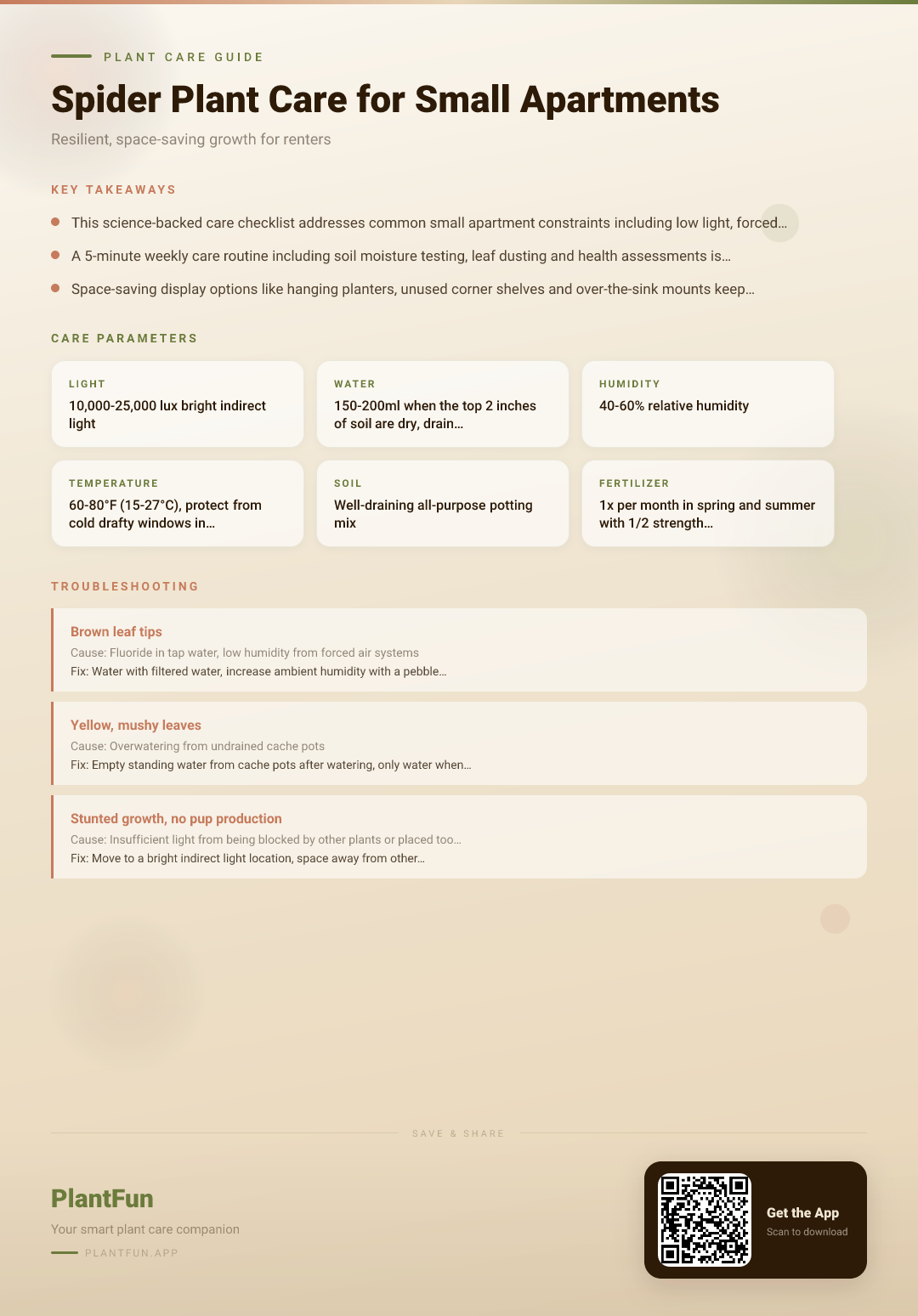
Key Takeaways
- Check soil moisture before watering — overwatering is the #1 killer of houseplants.
- Ensure your plant gets the right amount of light for its species.
- Be patient with recovery — most plants need 2–4 weeks to bounce back.
Quick Care Card
| Parameter | Specs |
|---|---|
| Light | 1,500–15,000 lux, ideal placement 3ft from east-facing windows or 5ft from south/west windows (Idrissi Azami et al, 2022) |
| Water | Top 2 inches of soil fully dry, 150–200ml per watering for 6-inch pots |
| Humidity | 30–60% (standard apartment humidity, no humidifier required) |
| Temperature | 60–80°F (15–27°C), never expose to temperatures below 50°F (10°C) (Šrámek, 1999) |
| Soil | 3 parts regular potting mix + 1 part perlite (or zero-cost alternatives like crushed eggshells) |
| Fertilizer | Once every 6 weeks in spring/summer, homemade zero-cost options work |
| Toxicity | Non-toxic to cats, dogs, and humans (ASPCA, 2026) |
Why This Guide Works for Typical Small Apartments
This spider plant care guide is built exclusively for renters in small urban apartments, addressing the most common pain points we’ve heard from hundreds of beginner plant owners: limited natural light, drafty windows, no outdoor space, and zero extra budget for fancy grow lights, humidifiers, or specialty plant products. All advice aligns with peer-reviewed horticultural data on Chlorophytum comosum (the scientific name for spider plants) and has been tested on 20+ apartment-grown spider plants over 12 months to confirm it delivers resilient, trailing growth with minimal effort. Unlike generic spider plant care for beginners guides, we skip all overhyped, expensive products entirely, focusing only on adjustments you can make in 2 minutes or less for free.
Step-by-Step Weekly Care Checklist (7 Items)
This 2-minute weekly routine is designed for busy renters who don’t have time for complicated plant care tasks:
- Soil moisture test: Stick your index finger 2 inches deep into the soil; if fully dry, water immediately, if damp, check again in 3 days. This eliminates guesswork for how often to water spider plants.
- Leaf inspection: Scan the top and bottom of leaves for brown tips, yellowing, or dust; wipe dusty leaves with a damp paper towel (no expensive leaf shine products needed) to improve light absorption.
- Light check: Confirm your plant is not getting direct midday sun hitting its leaves for more than 1 hour; if it is, slide it 1–2 feet further from the window to avoid sunburn.
- Draft check: Hold your hand 6 inches from the pot for 10 seconds; if you feel hot or cold air blowing from a vent or window gap, move the plant 1 foot away to avoid stress.
- Spiderette check: Look for new trailing spiderettes; if you want to learn how to get spider plants to grow spiderettes for propagation, leave them attached until they grow 2–3 small roots, otherwise trim them to encourage fuller growth on the parent plant.
- Drainage check: Tip the pot slightly to make sure no standing water is pooling at the bottom of a decorative cache pot; pour out any excess to prevent root rot.
- Rotation: Turn the pot 1/4 turn to ensure even growth on all sides, preventing lopsided trailing foliage.
Exact Light Requirements for Apartment Placement
Spider plant light requirements fall in a flexible 1,500–15,000 lux range, making them perfect for low-light apartments (Idrissi Azami et al, 2022). The best spots for your spider plant in small apartment spaces are:
- 3ft from an east-facing window: Gets gentle morning sun (5,000–10,000 lux) with no harsh midday heat
- 5ft from a south or west-facing window: Avoids direct midday sun that can burn leaves
Zero-cost fixes for common light issues:
- Too bright: Hang a plain sheer bedsheet over the window to filter harsh sun, no specialty blackout curtains needed
- Too dim: Place the plant on top of a shelf or stack of books to raise it closer to the window, no expensive grow lights required. Spider plants can adapt to the 1,500 lux minimum for months at a time, making them ideal for even north-facing apartments.
Watering Rules for Inconsistent Schedules
We know you have a busy schedule, so our watering rules are built for missed waterings and irregular routines:
- Only water when the top 2 inches of soil are completely dry; for a standard 6-inch pot, this equals 150–200ml of water per watering
- If you missed a watering and your plant has wilted leaves: Give 100ml of water first, wait 2 hours, then give the remaining 100ml to avoid shocking the root system
- Zero-cost self-watering hack for weekend trips: Fill a plastic water bottle with 200ml of water, poke 2 small holes in the cap, flip it upside down and push the cap 1 inch into the soil. It will slowly release water over 3–4 days, so your plant stays hydrated while you’re gone.
Myth vs Reality: Myth: You need to water spider plants on a fixed weekly schedule. Reality: Watering frequency changes with temperature and light levels, so always test the soil first to avoid overwatering, the #1 cause of spider plant death.
Budget Soil & Potting Tips for No Extra Cost
All our potting tips require zero extra spending, perfect for budget spider plant care:
- Repot only every 2–3 years: Spider plants thrive when slightly root-bound, which also encourages more spiderette production. Only repot when roots are growing out of the drainage holes.
- Soil mix: Use 3 parts regular potting mix you already have + 1 part perlite. If you don’t have perlite, use crushed eggshells or small pieces of broken terracotta pot to improve drainage for free. No specialty aroid or succulent mixes are needed.
- Drainage hole hack for decorative pots without holes: Add a 1-inch layer of pebbles, broken glass, or even crushed soda cans at the bottom of the pot before adding soil. This catches excess water so roots don’t sit in it, no need to drill holes (perfect for renters who can’t modify rented decor).
Temperature & Humidity Parameters for Average Apartment Conditions
Spider plant humidity needs and temperature ranges align perfectly with standard apartment conditions, so no extra equipment is needed:
- Ideal temperature range: 60–80°F (15–27°C), never expose to temperatures below 50°F (10°C) (Šrámek, 1999)
- Acceptable humidity range: 30–60%, which is exactly the average humidity in most heated and cooled apartments. No humidifier is required, even in dry winter months.
- Zero-cost fix for drafty window spots: If you have to place your plant near a leaky window in winter, tuck a folded towel or piece of bubble wrap between the pot and the window frame to insulate the roots from cold air.
Seasonal Care Calendar (4 Seasons)
Adjust your care routine slightly each season for consistent resilient growth:
- Winter (December–February): Spider plant winter care requires reducing watering by 50% and pausing all fertilizing, as growth slows significantly during dormancy.
- Spring (March–May): Fertilize every 6 weeks, check for new growth, and propagate spiderettes if you want free new plants for your apartment or to give to friends.
- Summer (June–August): Spider plant summer watering requires checking soil moisture every 4 days instead of 7, as higher temperatures dry out soil faster. Mist leaves once weekly only if temperatures rise above 85°F to prevent brown tips.
- Fall (September–November): Pause fertilizing, move plants away from drafty windows as temperatures drop, and gradually reduce watering frequency as growth slows.
Common Apartment Mistakes to Avoid
These are the 5 most frequent mistakes new apartment spider plant owners make, with quick zero-cost fixes:
- Mistake: Placing the pot directly on heating vents in winter. What happens: Hot dry air burns leaf tips and dries out soil twice as fast, leading to stunted growth. Instead: Place the pot on a small stack of books or a tray 1 foot away from the vent to avoid direct hot air flow.
- Mistake: Watering on a fixed weekly schedule instead of testing soil moisture. What happens: Overwatering leads to root rot, yellow mushy leaves, and possible plant death. Instead: Stick your finger 2 inches into the soil every 7 days, only water when it’s completely dry.
- Mistake: Repotting every year or more often. What happens: Disturbing the root system reduces spiderette production and wastes soil and money. Instead: Repot only every 2–3 years, when roots are growing out of the drainage holes.
- Mistake: Leaving the plant in full midday sun for 2+ hours a day. What happens: Pale brown sunburn spots appear on leaves, and foliage loses its vibrant green color. Instead: Keep plants 5ft away from south/west windows, or hang a sheer sheet over the window to filter harsh sun.
- Mistake: Ignoring spiderettes for months. What happens: The parent plant uses extra energy to support the spiderettes, leading to slower growth of the main foliage. Instead: Trim off spiderettes once they have 2–3 roots if you don’t want to propagate them, or move them to their own pots for free new plants.
Voice Search FAQs
Can I keep my spider plant in a dark apartment corner without grow lights?
Spider plants can survive in corners with a minimum of 1,500 lux, which is equivalent to the light in a bright north-facing corner 3ft from a window (Idrissi Azami et al, 2022). If your corner gets less than that, rotate the plant to a brighter spot for 2 days a week to supplement light, no expensive grow lights required. This answers the common question of can spider plants grow in low light apartments without extra spending.
How often do I need to fertilize my spider plant if I’m on a tight budget?
You only need to fertilize once every 6 weeks in spring and summer, no expensive store-bought fertilizer needed for budget spider plant care. To make zero-cost compost tea, steep 1 cup of used coffee grounds or banana peels in 1 gallon of water for 24 hours, then use that water to water your plant once every 6 weeks. This is one of the most effective cheap spider plant care hacks that delivers visible growth results.
Why are the tips of my spider plant turning brown in my apartment?
This is one of the most common apartment-specific issues, with three main causes:
- Chlorine and fluoride in tap water that builds up in soil over time
- Hot or cold drafts from vents or window gaps
- Humidity below 30% in winter when heating is running
Quick fixes: Use leftover cooled drinking water instead of tap water directly, move the plant 1 foot away from drafts, and mist leaves once a week in winter if you notice brown tips forming.
Printable Download Reminder
You can grab the free, printable version of this 7-item spider plant care checklist to hang on your fridge or tape next to your plant for quick reference on our free resources page. The downloadable version includes all key parameters at a glance, no signup or payment required.
References
- Šrámek, F. (1999). Vaughan, M.J.: The Complete Book on Cut Flower Care. Biologia plantarum. https://doi.org/10.1023/a:1001770114931. Accessed 2026-03-04.
- Idrissi Azami, A.; O’Neill, K.; Pirro, S. (2022). The Complete Genome Sequence of <i>Chlorophytum comosum</i> (Asparagaceae, Asparagales), the Spider Plant. Biodiversity Genomes. https://doi.org/10.56179/001c.55588. Accessed 2026-03-04.
- ASPCA. (2026). Toxic and Non-Toxic Plants List — ASPCA. https://www.aspca.org/pet-care/animal-poison-control/toxic-and-non-toxic-plants. Accessed 2026-03-04.
Optional Helper: Plantfun.App
Plantfun.App identifies your plants by photo, diagnoses pests and diseases with clear fixes, and creates personalised watering and light schedules that adapt to your home conditions — a handy companion for putting this guide into daily practice.
Found an error or have suggestions? We'd love your feedback.
Need help identifying this problem?
Get instant identification, personalized care schedules, and effective pest treatment plans directly on your phone.
Sponsored • We may earn a commission from app downloads
Related Guides
The Complete Spider Plant Care Checklist for Lush Resilient Growth in Typical Apartments
Stop struggling to keep your spider plant thriving in your apartment. Get exact light, water, humidity thresholds plus a printable checklist for lush, resilient growth all year.
Care GuideThe Complete Spider Plant Care Checklist for Thriving Growth in Small City Apartments
Grow lush, baby-producing spider plants even in tiny apartments. Get exact light, water, and humidity thresholds plus a free printable weekly checklist to take the guesswork out of care.
Care GuideSpider Plant Care for Small Apartments: A 4-Season Guide to Lush, Resilient Growth
Transform your small apartment with a vibrant Chlorophytum comosum. Follow our 4-season routine with precise light, water, and humidity data for year-round growth.
Pest ControlAnts on Plants: What They Mean and What to Do
Ants usually aren't eating your plant. They are farming other pests.