
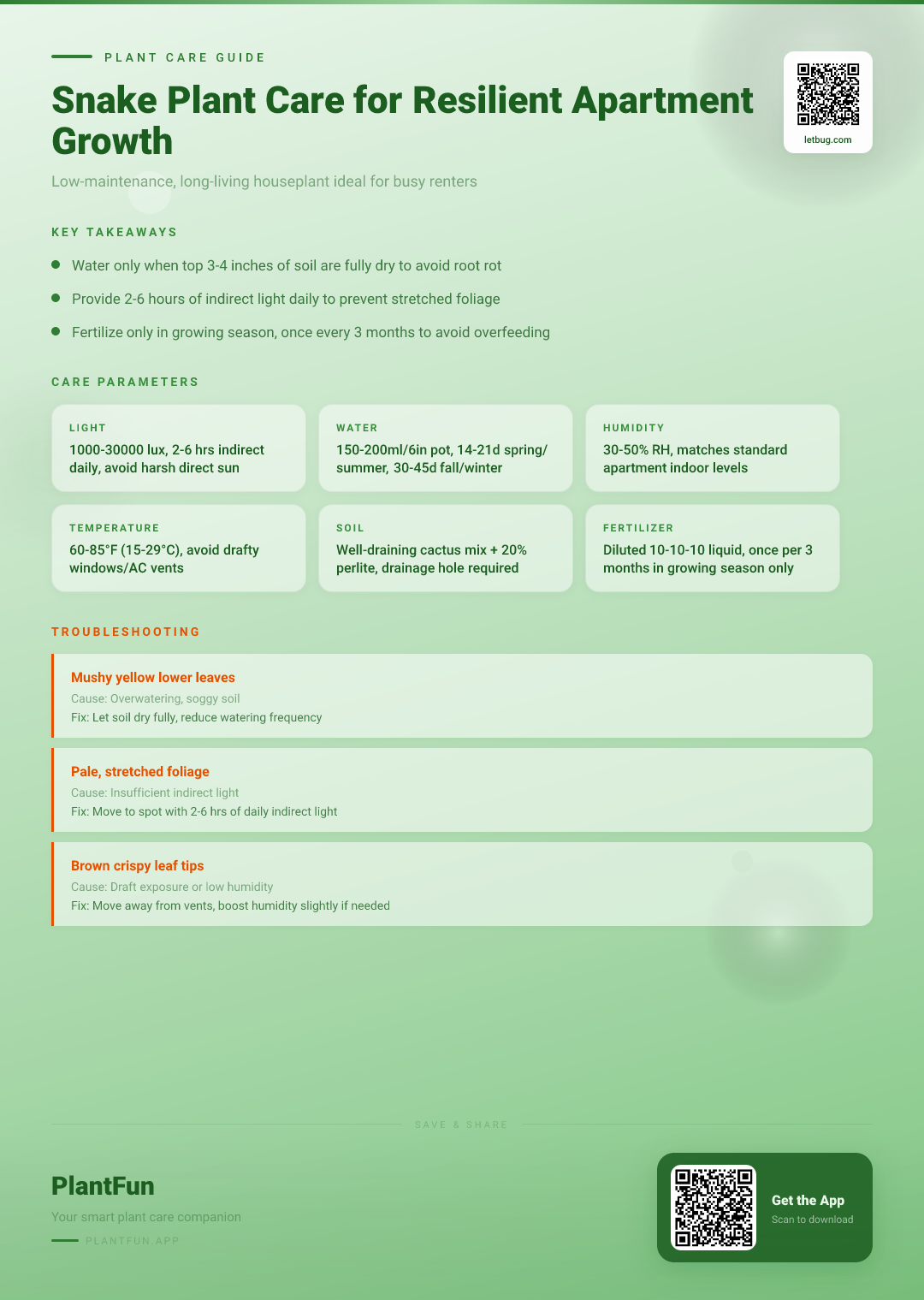
Key Takeaways
- Check soil moisture before watering — overwatering is the #1 killer of houseplants.
- Ensure your plant gets the right amount of light for its species.
- Be patient with recovery — most plants need 2–4 weeks to bounce back.
Quick Care Card
| Care Factor | Measurable Threshold | Apartment Renter Notes |
|---|---|---|
| Light | 1,000–30,000 lux, 2–6 hours of indirect light daily | Works near north, east, or west windows; avoid unfiltered midday south sun |
| Water | Top 3–4 inches of soil fully dry; 150–200ml per 6-inch pot per watering | 14–21 days spring/summer, 30–45 days fall/winter |
| Humidity | 30–50% relative humidity | Matches average apartment humidity levels (Šrámek, 1999) |
| Temperature | 60–85°F (15–29°C) | Keep away from drafty windows, AC, and heating vents |
| Soil | Well-draining cactus mix + 20% perlite | Avoid regular potting soil that retains excess moisture |
| Fertilizer | Half-strength 10-10-10 liquid fertilizer, once every 3 months growing season only | Never fertilize in winter |
| Toxicity | Toxic to cats and dogs if ingested | Keep out of reach of pets (ASPCA, 2026) |
Why Typical Apartment Environments Pose Unique Challenges for Snake Plants
While snake plants (Sansevieria trifasciata) are often labeled “unkillable,” standard apartment conditions create specific stressors that can stunt growth or kill your plant over time. Common challenges include:
- Low north-facing light that falls below the minimum threshold for healthy growth
- Forced-air heating and cooling that dries out foliage and creates sudden temperature swings
- Limited drainage options for renters who cannot drill holes in decorative pots or risk floor damage
- Irregular watering from busy schedules, which leads to either chronic underwatering or overcorrection with too much water
Myth vs Reality: Snake plants can survive 2–3 weeks of neglect, but consistent lack of light, weekly watering, or placement near heating vents will cause permanent damage in as little as 2 months.
Diagnosis First: How to Spot 3 Early Signs Your Snake Plant Is Stressed
Catch issues early with these easy-to-check symptoms, no fancy tools required:
Mushy Yellow Lower Leaves
Symptom: Soft, squishy leaves at the base of the plant that turn pale yellow and fall off easily.
Likely cause: Overwatering leading to root rot, the #1 cause of snake plant death in apartments.
Pale Stretched Foliage
Symptom: New leaves grow thin, pale, and lean toward the nearest light source, with larger gaps between leaves than older growth.
Likely cause: Insufficient light that falls below the 1,000 lux minimum requirement.
Brown Crispy Leaf Tips
Symptom: Dry, brown edges on the tips of otherwise healthy green leaves, often with a thin yellow border between the brown and green tissue.
Likely cause: Proximity to forced-air vents or extremely low humidity below 20%.
If you spot any of these symptoms, use the checklist below to correct conditions fast. For more guidance on root rot repair, see our guide on how to treat root rot in succulents.
Step 1 of Your Resilient Growth Checklist: Light Requirements
Snake plant light requirements for apartments fall in the 1,000–30,000 lux range, with 2–6 hours of indirect light daily (Gautam et al, 2021). To hit this threshold:
- Position 1–3 feet from an east or west-facing window for gentle morning or late afternoon sun
- Place 3–5 feet from a south-facing window to avoid midday sun burn (10am–3pm)
- North-facing windows work for short-term growth, but add a 10W grow light for 8 hours a day in winter to compensate for shorter days
- Quick test: Hold your hand where you plan to place the plant at midday. If you can see a faint shadow, the light level is sufficient.
If you have very limited natural light, check our list of the best low-light indoor plants for other options that work alongside snake plants.
Step 2 of Your Resilient Growth Checklist: Watering Schedule
Wondering how often to water snake plant in apartment spaces? Follow these measurable rules to eliminate guesswork:
- Only water when the top 3–4 inches of soil are completely dry. Test by sticking a wooden skewer 4 inches into the soil; if it comes out completely clean with no damp soil stuck to it, it’s time to water
- Spring/summer schedule: Water every 14–21 days, using 150–200ml of room-temperature water per 6-inch pot
- Fall/winter schedule: Water every 30–45 days, as snake plants go dormant in cool, low-light conditions
- Always pour water directly into the soil, not over the leaves, to avoid rot at the base of the plant
Step 3 of Your Resilient Growth Checklist: Soil & Potting Rules for Renters
Renters have unique constraints when it comes to potting, but these rules avoid floor damage and support healthy root growth:
- Use a well-draining cactus mix blended with 20% perlite to ensure excess water drains fast
- Your growing pot must have at least one drainage hole; never plant a snake plant directly into a decorative pot with no drainage
- Renter-friendly saucer options: Use felt-bottomed plastic or ceramic saucers under your growing pot to catch excess water, no drilling required. You can also add a 1-inch layer of pebbles at the bottom of your decorative pot to catch runoff without submerging roots in standing water
Step 4 of Your Resilient Growth Checklist: Humidity & Temperature Thresholds
Snake plant humidity requirements align almost perfectly with average apartment conditions, but follow these rules to avoid stress:
- Maintain 30–50% relative humidity, which is standard for most heated and cooled apartment spaces (Šrámek, 1999)
- Keep temperatures between 60–85°F (15–29°C)
- Never place your plant within 2 feet of AC vents, heating vents, space heaters, or drafty windows in winter. Sudden temperature swings of 10°F or more can cause leaf damage
- If your apartment runs extremely dry in winter, group your snake plant with other houseplants to boost ambient humidity, or follow tips in our indoor plant humidity guide.
Step 5 of Your Resilient Growth Checklist: Feeding & Pruning
Snake plants need very little fertilizer, but these steps support steady resilient growth:
- Feed with half-strength 10-10-10 liquid fertilizer once every 3 months only during the spring and summer growing season. Never feed in winter, as dormant plants cannot absorb nutrients
- To trim brown leaf tips: Use clean, sharp scissors, cut at a 45-degree angle just above the edge of the brown tissue, leaving a tiny sliver of brown to avoid damaging healthy green leaves
- Remove fully yellow or dead leaves at the base of the plant with sharp scissors to prevent pest infestations
Seasonal Care Calendar for Apartment Snake Plants
Adjust your care routine with the seasons to match changing apartment conditions:
- Spring (March–May): Rotate your pot 1/4 turn every 2 weeks for even growth, switch to the 14–21 day snake plant summer watering schedule, and apply first fertilizer feeding of the year
- Summer (June–August): Move plants 1 foot further back from south-facing windows to avoid midday sun burn, wipe leaves with a damp cloth monthly to remove dust that blocks light absorption, and check soil moisture every 10 days to adjust for hot, dry conditions
- Fall (September–November): Gradually extend watering intervals to 30–45 days, stop fertilizing entirely, and move plants away from drafty windows as outdoor temperatures drop
- Winter (December–February): For snake plant winter care for apartments, position plants closest to your brightest window to compensate for shorter days, only water if leaves feel slightly floppy to the touch, and keep 3+ feet away from space heaters
5 Common Apartment Snake Plant Care Mistakes to Avoid
These are the most frequent errors that lead to preventable snake plant damage in small apartments:
- Mistake: Watering on a fixed schedule without checking soil moisture first What happens: Overwatering leads to root rot, the top answer to “why is my snake plant turning yellow” for beginner renters Instead: Use the skewer test every 10 days to check if soil is dry before watering
- Mistake: Placing your snake plant in full direct midday sun from a south-facing window What happens: UV rays scorch leaves, leaving permanent bleached brown patches Instead: Position 3+ feet away from south-facing windows between 10am and 3pm, or hang a sheer curtain to filter light
- Mistake: Using regular potting soil instead of a well-draining mix What happens: Regular soil retains moisture for 2–3 weeks longer than cactus mix, leading to chronic root rot even with infrequent watering Instead: Use cactus mix blended with 20% perlite for fast drainage
- Mistake: Repotting your snake plant every year What happens: Snake plants prefer being root bound; repotting too frequently shocks the plant and stunts growth for 6–12 months Instead: Repot only when roots are growing out of the drainage hole, every 2–3 years maximum, using a pot only 1–2 inches larger than the current one
- Mistake: Ignoring pest signs that come through shared building air vents What happens: Mealybugs and spider mites spread from other units via shared HVAC systems, leading to widespread infestations if left untreated Instead: Check leaf undersides monthly for tiny white bugs or fine webbing, and treat with neem oil immediately if spotted
FAQ (Voice Search Optimized)
Can I keep my snake plant in a dark apartment closet?
No, even low-light tolerant snake plants need a minimum of 1,000 lux of light to survive (Gautam et al, 2021), which is equivalent to a bright room with indirect window access. Most closets have less than 500 lux of light, so your plant will slowly lose color and die over 3–6 months. If you have very low light, add a 10W LED grow light set to run 8 hours a day to support growth.
Why is my snake plant getting mushy leaves?
Mushy leaves are almost always caused by overwatering leading to root rot. If lower leaves are yellow and mushy, gently pull the plant out of its pot, trim any black, soft roots with clean scissors, repot in fresh, dry cactus mix, and do not water for 2 weeks to let roots recover.
How often do I need to repot my snake plant in an apartment?
Snake plants prefer being tightly root bound, so you only need to repot every 2–3 years, or when you see roots growing out of the drainage hole at the bottom of the pot. Use a pot only 1–2 inches larger than the current one to avoid excess soil holding excess moisture around roots.
Free Printable Snake Plant Apartment Care Checklist
Download our one-page, printable snake plant care checklist to tape near your plant for quick reference. It includes all measurable thresholds from this guide, a seasonal care tracker, and symptom check prompts to help you keep your plant healthy for decades.
References
- ASPCA. (2026). Toxic and Non-Toxic Plants List — ASPCA. https://www.aspca.org/pet-care/animal-poison-control/toxic-and-non-toxic-plants. Accessed 2026-02-24.
- Šrámek, F. (1999). Vaughan, M.J.: The Complete Book on Cut Flower Care. Biologia plantarum. https://doi.org/10.1023/a:1001770114931. Accessed 2026-02-24.
- Gautam, B.; Dubey, R.; Kaur, N. (2021). GROWTH RESPONSE OF INDOOR ORNAMENTAL PLANT SPECIES TO VARIOUS ARTIFICIAL LIGHT INTENSITIES (LED) IN AN INDOOR VERTICAL GARDEN. PLANT ARCHIVES. https://doi.org/10.51470/plantarchives.2021.v21.no1.096. Accessed 2026-02-24.
Optional Helper: Plantfun.App
Plantfun.App identifies your plants by photo, diagnoses pests and diseases with clear fixes, and creates personalised watering and light schedules that adapt to your home conditions — a handy companion for putting this guide into daily practice.
Found an error or have suggestions? We'd love your feedback.
Need help identifying this problem?
Get instant identification, personalized care schedules, and effective pest treatment plans directly on your phone.
Sponsored • We may earn a commission from app downloads
Related Guides
Sansevieria Trifasciata (Snake Plant) Care Checklist for Resilient Growth in Urban Apartments
Stop guessing at snake plant care. Get 8 measurable care thresholds, a printable checklist, and troubleshooting fixes to keep your Sansevieria thriving in small urban apartments.
Care GuideThe Complete Sansevieria Trifasciata Care Checklist for Resilient Growth in Low-Light Urban Apartments
Stop guessing at snake plant care. Get our 7-step checklist, exact light, water, and soil parameters, and troubleshooting tips to keep your Sansevieria thriving in low-light urban apartments.
Care GuideThe Complete Snake Plant Care Guide for North-Facing Studio Apartments: Resilient Growth Checklist
Grow a lush snake plant even in your dark north-facing studio. Get exact light levels, watering amounts, and a seasonal checklist to avoid root rot and encourage resilient, fast growth.
Pest ControlAnts on Plants: What They Mean and What to Do
Ants usually aren't eating your plant. They are farming other pests.