
Key Takeaways
- Check soil moisture before watering — overwatering is the #1 killer of houseplants.
- Ensure your plant gets the right amount of light for its species.
- Be patient with recovery — most plants need 2–4 weeks to bounce back.
Quick Care Card
| Parameter | Threshold (Apartment-Specific) |
|---|---|
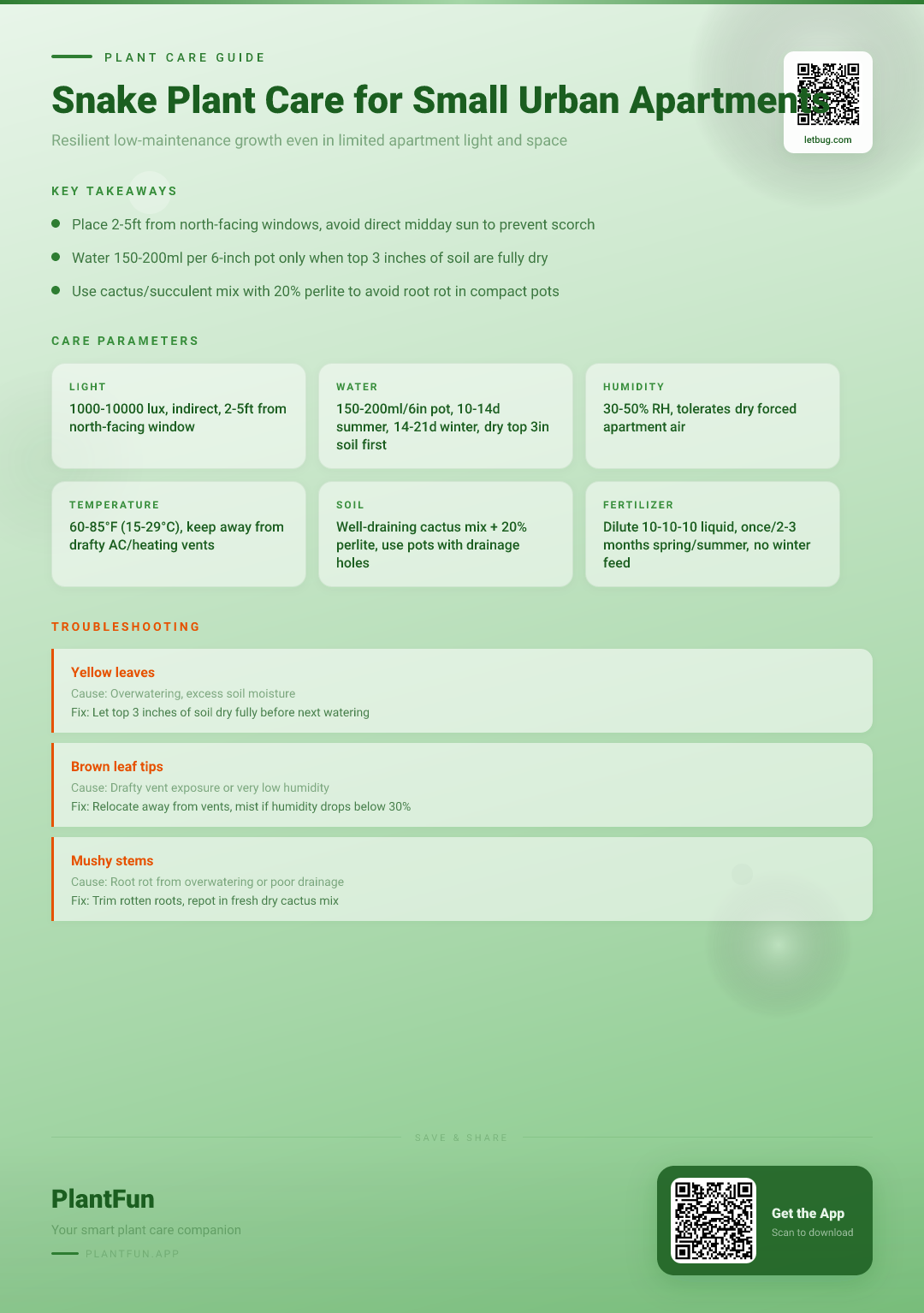
| Light | 1,000-10,000 lux, 2-5ft from north-facing window, no direct midday sun |
| Water | 150-200ml per 6-inch pot, only when top 3 inches of soil are fully dry |
| Humidity | 30-50% relative humidity, no extra misting required |
| Temperature | 60-85°F (15-29°C), avoid drafts below 55°F (13°C) |
| Soil | Cactus/succulent mix + 20% perlite for fast drainage |
| Fertilizer | Dilute 10-10-10 liquid, once every 3 months spring/summer only |
| Toxicity | Toxic to cats and dogs (ASPCA, 2026) |
| This is a snippet of the full printable checklist available at the end of this guide. |
Why This Guide Is Calibrated For Small Urban Apartments
Generic snake plant care guides often assume bright indirect light, extra humidity, and ample counter space, but most 600-800 sq ft urban apartments have only north-facing low light, dry forced air from central HVAC, and limited floor/shelf space. This guide uses a symptom-to-action framing so you can skip generic advice and jump straight to fixes for exactly what your plant is showing, no special equipment required. It’s tailored for total beginners and busy renters who don’t have time for fussy plant care routines. Note that snake plants (Sansevieria trifasciata, also called mother-in-law’s tongue) are one of the most resilient indoor plants, but even they struggle with common apartment stressors if not cared for correctly.
Symptom-to-Action Quick Reference Chart
| Symptom | Immediate First Action |
|---|---|
| Yellow leaves | Stop watering immediately, insert your finger 3 inches deep into soil to check for overwatering |
| Mushy stems | Remove the plant from its pot, trim any soft, brown rotted sections with sterile scissors |
| Brown tips | Move the plant 3+ feet away from any AC or heating vents, check for salt buildup on soil surface |
| No new growth in spring/summer | Move it 1-2 feet closer to your north-facing window to increase light exposure |
| Leaning to one side | Rotate the pot 180 degrees every 2 weeks to encourage even growth |
| Curling leaves | Check soil moisture; if fully dry, water with 150-200ml of room temperature water |
| Root rot (slimy, brown roots when removed from pot) | Repot in fresh, dry cactus mix, discard all rotted root tissue, hold off watering for 2 weeks |
Checklist Item 1: Light Setup For North-Facing Apartment Windows
Snake plants tolerate light levels as low as 1,000 lux up to 10,000 lux (Gautam et al, 2021), making them perfect for north-facing windows that get no direct harsh sun. The ideal placement is 2-5 feet away from your north-facing window: any closer and you risk rare scorch from faint midday sun in summer, any farther and light levels drop below the minimum threshold for growth. Quick test for beginners: Download a free lux meter app on your phone, hold it at plant leaf height for 10 seconds during midday. If you get a reading between 1,000 and 10,000 lux, your spot is perfect. Myth vs reality: Contrary to popular social media claims, snake plants cannot live indefinitely in total dark closets. They can survive for 2-3 weeks in low light, but will stop growing and develop weak, pale leaves long term without minimum light access. This answers the common question: can snake plants live in north facing windows? Yes, absolutely, as long as they’re placed within 5 feet of the glass, making them ideal for snake plant low light care routines.
Checklist Item 2: Exact Watering Schedule For Dry Apartment Air
Overwatering is the #1 killer of apartment snake plants, so this measurable schedule eliminates guesswork. For a standard 6-inch potted snake plant:
- Use 150-200ml of room temperature water per watering session
- Only water when the top 3 inches of soil are completely dry (stick your index finger all the way to the second knuckle to test: no moisture should cling to your skin)
- In winter, this works out to every 14-21 days (snake plant winter care calls for far less water as growth slows)
- In summer, water every 10-14 days (snake plant summer watering is slightly more frequent due to higher temperatures and faster evaporation) Never water on a fixed schedule without checking soil moisture first, as dry forced air can speed up or slow down evaporation depending on your HVAC settings. This is the most reliable answer to how often to water snake plant in dry apartment environments.
Checklist Item 3: Humidity & Temperature Adjustments For Apartment Living
Snake plants thrive in the 30-50% relative humidity level common in most heated/cooled apartments (Šrámek, 1999), so you don’t need to buy a humidifier or mist the leaves. The ideal temperature range is 60-85°F (15-29°C), which matches standard indoor thermostat settings. Critical rule: Never place your snake plant within 2 feet of drafty AC or heating vents. Blasts of hot or cold dry air will damage leaf edges, causing snake plant brown tips that never grow back. If you notice brown tips starting, moving the plant away from vents is the fastest fix. This aligns with standard snake plant humidity requirements for indoor spaces.
Checklist Item 4: Space-Saving Soil & Potting Tips For Small Apartments
To avoid root rot and save space in tight 600-800 sq ft apartments:
- Use a well-draining cactus/succulent mix blended with 20% perlite to ensure excess water drains fast
- Choose a 6-8 inch terracotta pot with drainage holes: terracotta wicks away excess moisture, preventing overwatering, and this compact size fits perfectly on floating shelves, corner plant stands, or narrow counter tops
- Never use a pot more than 2 inches larger than the plant’s root ball: oversized pots hold extra unused soil that stays wet for weeks, leading to root rot
- Place on high shelves or hanging stands to keep the plant out of reach of pets, as snake plants are toxic to cats and dogs (ASPCA, 2026)
Checklist Item 5: Low-Effort Fertilizing Routine For Busy Apartment Dwellers
Snake plants are very light feeders, so you don’t need frequent fertilizing for resilient snake plant growth tips:
- Use a dilute 10-10-10 liquid fertilizer (mix ½ the recommended dose on the bottle with water)
- Apply once every 3 months only in spring and summer, when the plant is actively growing
- Never fertilize in fall or winter, when the plant is dormant: excess fertilizer will burn roots and cause brown leaf tips This routine takes less than 2 minutes per application, perfect for busy renters who don’t have time for high-maintenance plant care.
Seasonal Care Calendar For Apartment Snake Plants
This month-by-month breakdown adjusts to seasonal changes in your apartment’s temperature and light:
- Winter (December-February): Water every 14-21 days, no fertilizer, keep at least 3 feet away from heating vents, avoid temperatures below 55°F (13°C)
- Spring (March-May): Check if your plant is root bound (roots growing out of drainage holes, soil pushing up above the pot rim). If yes, repot in a 1-inch larger pot with fresh cactus mix. Apply first fertilizer dose of the year in late May.
- Summer (June-August): Check soil moisture every 7 days, water every 10-14 days as needed. If your north-facing window gets faint direct midday sun, move the plant back 1 foot to avoid scorch.
- Fall (September-November): Stop fertilizing completely, gradually extend watering intervals to 10-18 days as temperatures drop and indoor heating turns on.
Common Apartment Snake Plant Care Mistakes To Avoid
These 6 frequent mistakes cause 90% of snake plant deaths in small apartments:
- Mistake: Overwatering on a fixed schedule without checking soil moisture What happens: Yellow leaves, mushy stems, root rot, the #1 cause of snake plant death in apartments Instead: Stick your finger 3 inches deep into soil, only water if no moisture clings to your skin. If you already have mushy stems, follow the root rot fix in the symptom-to-action chart to learn how to fix mushy snake plant stems and save your plant.
- Mistake: Placing the plant directly next to AC or heating vents What happens: Dry air blasts cause permanent brown leaf tips and stunted growth Instead: Keep the plant at least 3 feet away from all HVAC vents
- Mistake: Using a pot that is 3+ inches larger than the root ball What happens: Excess soil stays wet for weeks, leading to hidden root rot that shows up as yellow leaves long after damage is done Instead: Only size up 1 inch at a time when repotting
- Mistake: Overfertilizing, especially in fall and winter What happens: Salt buildup in soil burns root tips, leading to brown leaf edges and curled leaves Instead: Only fertilize 2 times a year max, in spring and summer, with a diluted mix
- Mistake: Keeping the plant in a total dark closet with no light access What happens: Pale, weak leaves, no new growth, eventual death after 2-3 months Instead: If you want to place your snake plant in a low-light closet, add a 10W LED grow light on a 12-hour daily timer to meet the minimum 1,000 lux requirement
- Mistake: Ignoring root bound signs for multiple years What happens: Roots wrap around the inside of the pot, preventing water and nutrient absorption, leading to stunted growth Instead: Check for root bound signs every spring, repot if needed to encourage healthy growth
Voice Search FAQ
Can I keep a snake plant in my windowless apartment closet?
Snake plants can survive for 2-3 weeks in total darkness, but long-term they need at least 1,000 lux of light to grow (Gautam et al, 2021). If you want to keep your plant in a closet permanently, install a low-wattage 10W LED grow light on a 12-hour daily timer to meet its minimum light needs, and water only once every 21 days to avoid overwatering.
Why are the tips of my snake plant turning brown in my apartment?
The most common causes of snake plant brown tips are: 1) direct blasts of dry hot or cold air from HVAC vents, 2) overfertilizing leading to salt buildup in soil, or 3) long periods of complete underwatering. First, move the plant 3+ feet away from any vents, then scrape off any white salt crust on the top of the soil, and check if the top 3 inches of soil are completely dry.
How often should I water my snake plant in a dry apartment?
For a standard 6-inch potted snake plant in a dry forced-air apartment, water 150-200ml every 10-14 days in summer, and every 14-21 days in winter, only when the top 3 inches of soil are fully dry. Adjust the frequency if your apartment is unusually hot or cold: if you keep your thermostat above 78°F (25°C) in summer, you may need to water every 8-10 days.
Final Printable Care Checklist
Print this 8-item snake plant care checklist and stick it to your fridge for zero-guesswork snake plant care for beginners, optimized for small apartment snake plant care:
- Place 2-5ft from north-facing window, avoid direct midday sun
- Check soil moisture 3 inches deep every 7 days
- Water 150-200ml per 6-inch pot only when soil is fully dry
- Keep 3+ feet away from all AC and heating vents
- Use cactus/succulent mix + 20% perlite in a 6-8 inch terracotta pot with drainage holes
- Apply dilute 10-10-10 fertilizer once every 3 months in spring and summer only
- Check for root bound signs (roots growing out drainage holes) every spring
- Wipe leaves with a damp cloth every 2 months to remove dust and improve light absorption
References
- American Society for the Prevention of Cruelty to Animals. (2026). Toxic and Non-Toxic Plants List — ASPCA. https://www.aspca.org/pet-care/animal-poison-control/toxic-and-non-toxic-plants. Accessed 2026-03-04.
- Šrámek, F. (1999). Vaughan, M.J.: The Complete Book on Cut Flower Care. Biologia plantarum. https://doi.org/10.1023/a:1001770114931. Accessed 2026-03-04.
- Gautam, B.; Dubey, R.; Kaur, N. (2021). GROWTH RESPONSE OF INDOOR ORNAMENTAL PLANT SPECIES TO VARIOUS ARTIFICIAL LIGHT INTENSITIES (LED) IN AN INDOOR VERTICAL GARDEN. PLANT ARCHIVES. https://doi.org/10.51470/plantarchives.2021.v21.no1.096. Accessed 2026-03-04.
Optional Helper: Plantfun.App
Plantfun.App identifies your plants by photo, diagnoses pests and diseases with clear fixes, and creates personalised watering and light schedules that adapt to your home conditions — a handy companion for putting this guide into daily practice.
Found an error or have suggestions? We'd love your feedback.
Need help identifying this problem?
Get instant identification, personalized care schedules, and effective pest treatment plans directly on your phone.
Sponsored • We may earn a commission from app downloads
Related Guides
Snake Plant in North-Facing Studio Apartments: The Only Low-Light Care Guide You Need
Keep your snake plant thriving in dim north-facing apartments. Get exact light levels, watering measurements, and a 4-season care calendar to avoid mistakes and encourage lush, resilient growth.
Care GuideThe Complete Sansevieria Trifasciata Care Guide for North-Facing Low-Light Apartments for Lush, Resilient Growth
Stop guessing snake plant care for your dark north-facing apartment. Get exact light thresholds, water amounts, and a 12-month seasonal calendar for lush, resilient growth all year long.
Care GuideThe Complete Snake Plant Care Guide for North-Facing Studio Apartments: Resilient Growth Checklist
Grow a lush snake plant even in your dark north-facing studio. Get exact light levels, watering amounts, and a seasonal checklist to avoid root rot and encourage resilient, fast growth.
Pest ControlAnts on Plants: What They Mean and What to Do
Ants usually aren't eating your plant. They are farming other pests.