
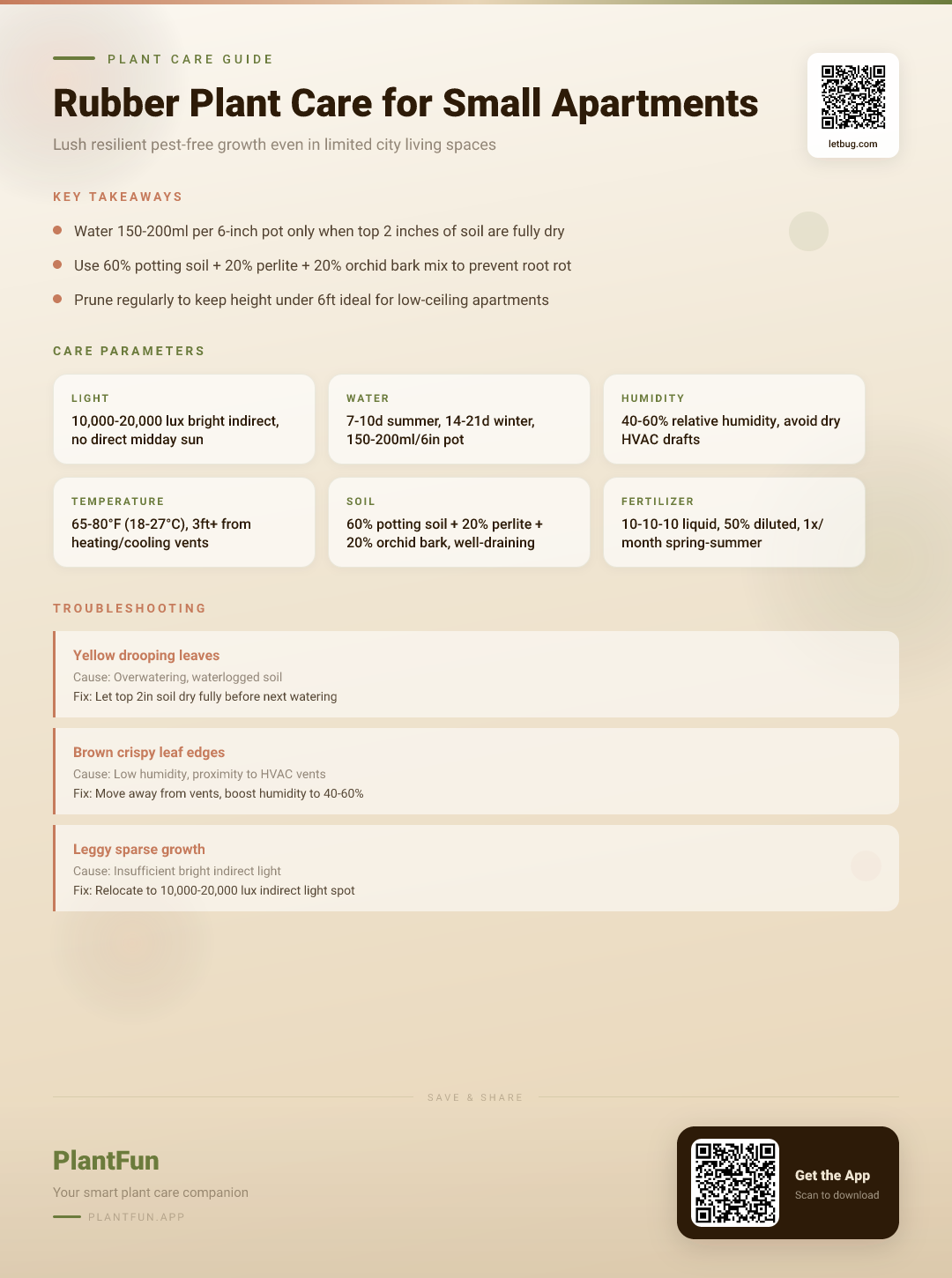
Key Takeaways
- Check soil moisture before watering — overwatering is the #1 killer of houseplants.
- Ensure your plant gets the right amount of light for its species.
- Be patient with recovery — most plants need 2–4 weeks to bounce back.
Quick Care Card
| Metric | Exact Threshold for Small Apartments |
|---|---|
| Light | 10,000-20,000 lux bright indirect light, no direct midday sun |
| Water | 150-200ml per 6-inch pot, only when top 2 inches of soil are completely dry |
| Humidity | 40-60% relative humidity |
| Temperature | 65-80°F (18-27°C), no exposure to drafts |
| Soil | 60% potting soil, 20% perlite, 20% orchid bark, well-draining |
| Fertilizer | 10-10-10 liquid fertilizer diluted 50%, once monthly March to August |
| Toxicity | Toxic to cats, dogs, and humans if ingested (ASPCA, 2026) |
Why This Guide Is Different for Small Apartment Dwellers
Standard rubber plant care guides assume you have full sun exposure, extra floor space, and no forced air HVAC systems, which rarely applies to 500-1000 sq ft urban apartments. We adjusted every care threshold to account for low natural light, dry winter heating, limited shelf and floor space, and low ceilings, so you don’t have to guess if generic advice works for your space. A common myth we bust: you don’t need a large empty corner to grow a rubber plant—with targeted pruning and space-smart placement, you can keep it compact and thriving in even the smallest layouts. This guide is perfect for rubber plant care for beginners and intermediate owners alike.
Step 1: Optimal Space-Saving Placement for Rubber Plants in Small Apartments
Rubber plant light requirements sit at 10,000-20,000 lux of bright indirect light (Šrámek, 1999), which you can easily achieve in compact spots that don’t take up valuable living space:
- Corner tiered floor stand: Uses vertical space instead of wide floor footprint, place the rubber plant on the lower or middle tier for even light exposure
- Above upper kitchen cabinets: Taps into dead elevated space, perfect for small kitchens, as long as it’s within 3 feet of a window for adequate light
- 12-inch narrow side table: Fits next to couches or beds without blocking walkways If you’re wondering can rubber plant grow in low light apartments, they can tolerate down to 7,000 lux short-term, but growth will be leggy. Add a 10W grow light 12 inches above the plant for 8 hours a day if your space consistently gets less than 8,000 lux.
Step 2: Watering Schedule & Exact Amounts for Apartment Conditions
If you’re unsure how often to water rubber plant in apartment settings, use this measurable rule: for a 6-inch pot, give 150-200ml of water only when the top 2 inches of soil are completely dry. Test this by sticking your index finger 2 inches deep into the soil—if no moisture sticks to your skin, it’s time to water.
- Rubber plant summer watering schedule: Every 7-10 days, as higher temperatures and light speed up soil drying
- Winter schedule: Every 14-21 days, as forced heating dries the top layer of soil faster than lower layers, so always test before watering to avoid overwatering
Step 3: Space-Efficient Potting & Soil Mix for Compact Living
Rubber plant pot size for small spaces should stay between 6-10 inches, with only a 1-inch increase in pot size when you repot (only when roots are growing out of drainage holes). Oversized pots waste valuable floor space and hold excess moisture that causes root rot. Choose lightweight terracotta or BPA-free plastic pots with drainage holes for easy moving. For the ideal rubber plant soil mix for apartments, combine:
- 60% organic potting soil
- 20% perlite (for drainage)
- 20% orchid bark (for aeration) This mix prevents root rot without requiring extra deep pots that take up excess space.
Step 4: Humidity & Temperature Adjustments for Apartment HVAC Conditions
Rubber plant humidity needs sit at 40-60% relative humidity (Hayashi, 2009), but most apartment HVAC systems drop humidity to 20-30% in winter. Use these space-efficient fixes to boost humidity without bulky humidifiers:
- Group your rubber plant with 2-3 other small houseplants to raise local humidity by 10-15%
- Place a 4-inch pebble tray under the pot, filled with water up to the bottom of the pot
- Never place your rubber plant within 3 feet of heating or cooling vents, as direct drafts cause sudden leaf drop Keep temperatures between 65-80°F (18-27°C) year-round, and avoid placing it near drafty windows or entryways in winter.
Step 5: Fertilizing & Pruning Tips for Compact Growth
Fertilize with 10-10-10 liquid fertilizer diluted to 50% strength once a month from March through August, and skip fertilizing entirely in fall and winter when growth slows. Over-fertilizing causes leggy growth that takes up extra space. If you want to know how to keep rubber plant small for apartments, use these pruning tips:
- Prune in early spring before new growth starts
- Wear gloves to avoid contact with irritating sap
- Cut the main stem 1/4 inch above a leaf node at your desired maximum height (we recommend 6 feet or shorter for standard 8ft apartment ceilings)
- The plant will grow two bushy side branches from the cut node instead of growing taller, keeping it compact for small spaces. This is the core of how to prune rubber plant for compact growth.
Seasonal Care Calendar for Small Apartment Rubber Plants
Use this month-by-month guide tailored to apartment light and temperature shifts:
- January-February (Winter): Follow winter watering schedule, no fertilizer, add a grow light if natural light drops below 8,000 lux (rubber plant winter care for apartments), mist leaves once a week if humidity is below 30%
- March-April (Spring): Increase watering to every 10 days, start monthly diluted fertilizing, prune if the plant has outgrown its space
- May-August (Summer): Follow summer watering schedule, fertilize monthly, rotate the pot 15 degrees every 2 weeks for even growth, check for spider mites on leaf undersides
- September-October (Fall): Reduce watering to every 10-14 days, stop fertilizing, move away from drafty windows as temperatures drop
- November-December: Return to winter watering schedule, move at least 3 feet away from heating vents to avoid dry air damage
Common Small Apartment Rubber Plant Mistakes to Avoid
- Mistake: Placing in dark entryways with less than 7,000 lux of light What happens: Leggy, sparse growth, yellowing lower leaves, sudden leaf drop Instead: Place within 3 feet of an east or west facing window, or add a small grow light 12 inches above the plant for 8 hours a day
- Mistake: Watering on a fixed schedule without testing soil moisture What happens: Overwatering leading to root rot, mushy yellow leaves, leaf drop Instead: Test soil moisture 2 inches deep every 7 days, only water when completely dry, use 150-200ml per 6-inch pot
- Mistake: Using a pot more than 1 inch larger than the root ball to skip repotting What happens: Wastes valuable floor/shelf space, excess soil holds moisture leading to root rot Instead: Stick to 6-10 inch pots, repot only when roots grow out of drainage holes, go up 1 inch in size max
- Mistake: Ignoring dry forced air from heating vents in winter What happens: Crispy brown leaf edges, widespread leaf drop Instead: Keep the plant at least 3 feet away from vents, use a pebble tray to boost local humidity
Voice Search FAQ
Why is my apartment rubber plant dropping lower leaves?
This common issue (why is my rubber plant dropping leaves) is almost always caused by one of three factors we covered earlier: insufficient light below 10,000 lux, overwatering leading to root rot, or placement within 3 feet of heating/cooling vents. First test your light with a cheap lux meter, check soil moisture by sticking your finger 2 inches deep, and confirm the plant is not exposed to direct HVAC drafts (Šrámek, 1999).
Can I keep a rubber plant on my small apartment balcony in summer?
Yes, as long as temperatures stay between 65-80°F (18-27°C) and the plant only gets early morning or late afternoon sun (no direct midday sun, which will scorch leaves). Bring it back indoors immediately if temperatures drop below 60°F (15°C) or rise above 85°F (29°C) to avoid permanent stress damage.
How do I prune my rubber plant so it doesn’t get too tall for my apartment?
Follow these simple steps for compact growth:
- Wear gloves to avoid contact with irritating sap
- Use clean, sharp pruning shears to avoid spreading disease
- Cut the main stem 1/4 inch above a leaf node at your desired maximum height (6 feet or shorter for standard 8ft apartment ceilings)
- Wipe away any excess sap with a damp cloth
- The plant will grow two bushy side branches from the cut node instead of growing taller, keeping it compact for small spaces
Quick Printable Checklist for Fridge Reference
Print this 5-item checklist and stick it on your fridge for fast, no-fuss care reminders:
- Test soil moisture 2 inches deep every 7 days, water only if completely dry
- Check light levels: 10,000-20,000 lux, add grow light if <8,000 lux in winter
- Keep 3+ feet away from HVAC vents, use a pebble tray if humidity <40%
- Fertilize with diluted 10-10-10 once monthly only from March to August
- Prune to <6 feet tall in early spring if it outgrows your space
References
- ASPCA. (2026). Toxic and Non-Toxic Plants List — ASPCA. https://www.aspca.org/pet-care/animal-poison-control/toxic-and-non-toxic-plants. Accessed 2026-03-05.
- Šrámek, F. (1999). Vaughan, M.J.: The Complete Book on Cut Flower Care. Biologia plantarum. https://doi.org/10.1023/a:1001770114931. Accessed 2026-03-05.
- Hayashi, Y. (2009). Production of natural rubber from Para rubber tree. Plant Biotechnology. https://doi.org/10.5511/plantbiotechnology.26.67. Accessed 2026-03-05.
Optional Helper: Plantfun.App
Plantfun.App identifies your plants by photo, diagnoses pests and diseases with clear fixes, and creates personalised watering and light schedules that adapt to your home conditions — a handy companion for putting this guide into daily practice.
Found an error or have suggestions? We'd love your feedback.
Need help identifying this problem?
Get instant identification, personalized care schedules, and effective pest treatment plans directly on your phone.
Sponsored • We may earn a commission from app downloads
Related Guides
Ficus Elastica (Rubber Plant) Care Guide for Small Urban Apartments: Budget Tips for Resilient Growth
Grow a lush, hardy rubber plant in your small urban apartment without fancy supplies. Get exact light, water, and humidity thresholds plus 7 budget-friendly tips for resilient, fast growth all year.
Care GuideThe Complete Rubber Plant Care Checklist for Year-Round Resilient Growth in Typical Apartments
Grow a lush, unkillable rubber plant in your apartment. Get exact light levels, watering amounts, and a free seasonal checklist to avoid yellow leaves and stunted growth all year long.
Care GuideThe Complete Rubber Plant Care Guide for Small Urban Apartments: Lush Resilient Growth
Grow a lush, compact rubber plant even in a tiny apartment. Get exact light levels, watering amounts, space-saving pruning tips, and a free printable care checklist to skip guesswork.
Pest ControlAnts on Plants: What They Mean and What to Do
Ants usually aren't eating your plant. They are farming other pests.