
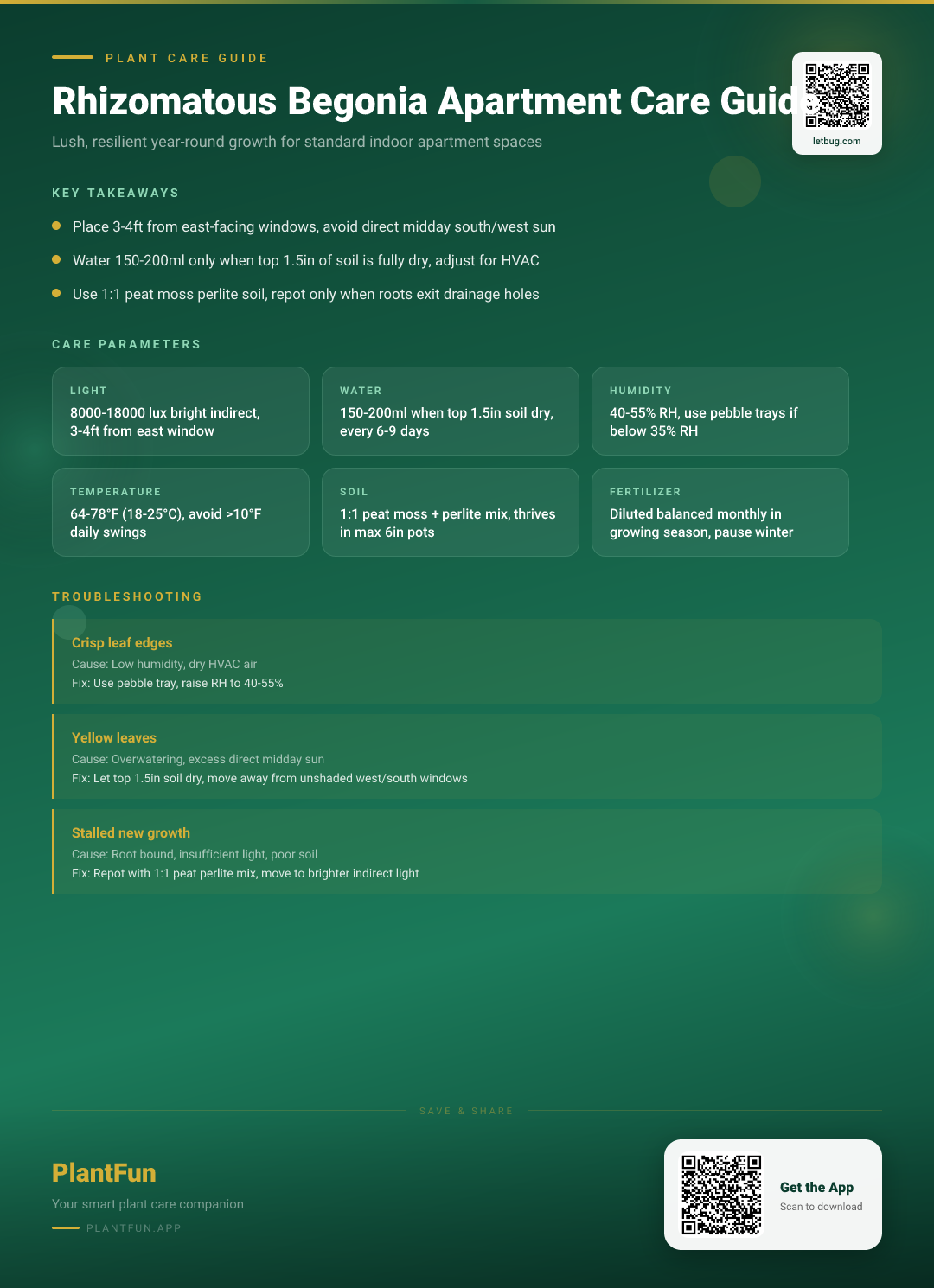
Key Takeaways
- Check soil moisture before watering — overwatering is the #1 killer of houseplants.
- Ensure your plant gets the right amount of light for its species.
- Be patient with recovery — most plants need 2–4 weeks to bounce back.
Quick Care Card
| Care Parameter | Exact Apartment Threshold |
|---|---|
| Light | 8,000-18,000 lux bright indirect, 3-4ft from east-facing window |
| Water | 150-200ml when top 1.5in of soil is dry, every 6-9 days on average |
| Humidity | 40-55% RH, no humidifier required |
| Temperature | 64-78°F (18-25°C), no >10°F daily swings |
| Soil | 1:1 peat moss + perlite well-draining mix |
| Fertilizer | 1/4 strength balanced houseplant food monthly in summer, none in winter |
| Toxicity | Toxic to cats, dogs, and humans if ingested (ASPCA, 2026) |
Why Rhizomatous Begonias Are Ideal for Apartment Living
Rhizomatous begonias get their name from their thick, horizontal, root-like rhizomes that store water and nutrients, making them far more forgiving of fluctuating apartment conditions than finicky rex or tuberous begonia varieties. A 2021 study of indoor begonia durability found they tolerate lower light levels and inconsistent watering far better than most tropical houseplants (Hanum et al, 2021), making them perfect for rhizomatous begonia care for beginners. Unlike tuberous begonias, they do not require a dormant period, so they stay green year-round in standard apartment temperatures. Note that the ASPCA classifies all begonia varieties as toxic to cats, dogs, and humans if large quantities are ingested, so keep plants out of reach of small pets and toddlers (ASPCA, 2026).
30-Second Health Diagnosis
Tailor your care routine to your plant’s exact needs with this 3-step check:
- Leaf edge check: Run your finger along leaf margins. Crisp brown edges signal low humidity or sun burn; soft brown edges signal overwatering.
- Foliage color check: Pale yellow leaves mean too little light; soft, mushy yellow lower leaves mean overwatering.
- Growth check: Inspect the tip of the exposed rhizome. No new leaf growth for 4+ weeks means your plant is stressed from temperature swings, poor light, or being root-bound.
Light Setup Checklist
Begonia light requirements indoors are 8,000-18,000 lux of bright indirect light (Pecháčková, 1999), which is easy to achieve in standard apartments:
- Place your plant 3-4 feet from an east-facing window, which delivers gentle morning sun with no harsh midday heat (answers can I keep begonia in east facing apartment).
- For south or west-facing windows, hang a sheer curtain to block direct sun between 10am and 3pm to avoid leaf burn.
- Quick test: Hold your hand 1 foot above the plant at midday. If you see a sharp, defined shadow, the light is too strong; move the plant 1-2 feet further back or add a curtain.
Watering Checklist for Apartment HVAC Cycles
Wondering how often to water begonia indoors? Follow these no-guess steps, calibrated for central heating and cooling:
- Give 150-200ml of room-temperature water only when the top 1.5 inches of soil feel completely dry, which works out to every 6-9 days on average.
- Adjust for your HVAC: If your heater runs 24/7 in winter, check soil moisture 1 day earlier than usual; if your AC runs constantly in summer, you may only need to water every 9-10 days.
- Quick test: Stick your index finger 1.5 inches into the soil. If no moisture sticks to your finger, it’s time to water. Pour directly at the soil line to avoid getting leaves wet, which can cause fungal spots.
Humidity Checklist Without Fancy Gear
The ideal begonia humidity level indoor is 40-55% RH, which matches the standard output of most central HVAC systems, so no humidifier is required for most users (begonia care no humidifier). If your hygrometer reads below 35% RH (common in cold winter months with heating):
- Fill a shallow tray with pebbles and water, then set your plant pot on top of the pebbles, making sure the pot base is not sitting in standing water.
- Group your begonia with 2-3 other houseplants to raise ambient humidity naturally via transpiration.
- Mist the air around the plant 1x every 2 days, avoiding direct contact with the leaves.
Temperature & Airflow Checklist
Rhizomatous begonias thrive in consistent 64-78°F (18-25°C) temperatures, which is the standard temperature range for most occupied apartments (Hanum et al, 2021):
- Keep plants at least 2 feet away from AC vents, radiators, baseboard heaters, and drafty exterior doors or windows, which can cause >10°F daily temperature swings that trigger leaf drop and stunted growth.
- Avoid placing plants on windowsills in winter, where cold glass can drop temperatures below 60°F overnight.
Soil & Repotting Checklist for Small Spaces
The optimal rhizomatous begonia soil mix is a fast-draining 1:1 blend of peat moss and perlite, which prevents root rot by letting excess water drain quickly:
- Only repot your begonia when you see roots growing out of the drainage holes at the bottom of the pot, typically every 2-3 years.
- Most apartment rhizomatous begonia varieties stay compact, so they thrive in a maximum 6-inch pot, perfect for small shelves, desks, or countertop spaces.
- When repotting, only go up 1 pot size (e.g., from 4 inch to 5 inch) to avoid excess soil holding unwanted moisture around the rhizome.
Seasonal Care Calendar for Apartment Dwellers
Adjust your routine for seasonal HVAC changes to keep your plant healthy year-round:
Winter Adjustments (Begonia Winter Care Apartment)
- Reduce watering volume by 30% (give 100-140ml per watering) to account for slower growth and drier air from heating.
- Pause all fertilizer completely, as the plant’s growth slows significantly in shorter daylight hours.
- Keep plants at least 3 feet away from radiators to avoid drying out foliage.
Summer Adjustments (Begonia Summer Watering Schedule)
- Check soil moisture 1 day earlier than your usual schedule to account for faster evaporation from warmer air.
- Mist the air around the plant 1x per week if humidity drops below 40% RH.
- Fertilize monthly with 1/4 strength balanced houseplant food to make begonia grow faster indoors and support potential blooming.
Common Apartment Care Mistakes to Avoid
- Mistake: Watering on a fixed weekly schedule without checking soil moisture first. What happens: Overwatering leads to soft, yellow begonia leaves, root rot, and eventual rhizome decay. Instead: Check the top 1.5 inches of soil every 5 days, and only water when it is completely dry.
- Mistake: Placing the plant in unfiltered midday sun from south or west windows. What happens: Crisp brown leaf edges, bleached foliage, and stunted growth. Instead: Hang a sheer curtain over south/west windows, or move the plant 5+ feet away from unfiltered exposures.
- Mistake: Repotting every year to give the plant more space. What happens: Rhizome stress, stalled growth, and excess soil holds moisture that rots delicate roots. Instead: Repot only when roots grow out of the drainage holes, and never go larger than a 6-inch pot for most apartment varieties.
- Mistake: Placing plants near drafty entryways or HVAC vents. What happens: Sudden temperature swings cause mass leaf drop and failed new growth. Instead: Keep plants at least 2 feet away from vents, radiators, and exterior doors.
- Mistake: Using full-strength fertilizer year-round. What happens: Salt buildup in the soil leads to brown leaf tips and root burn. Instead: Use only 1/4 strength fertilizer in summer, and pause all feeding in winter.
FAQ
Why is my rhizomatous begonia getting brown leaf edges?
The most common causes are humidity below 35% RH, exposure to direct midday sun, or salt buildup from over-fertilizing. First test your humidity with a low-cost hygrometer, then check for sharp shadows at midday to rule out sun burn. If you’ve been fertilizing more than once a month in summer, flush the soil with 3x the pot volume of water to remove excess salt.
Can I keep my begonia in a dark apartment bedroom?
Rhizomatous begonias need a minimum of 8,000 lux of light to grow, which is brighter than most dark bedrooms with no windows. If your bedroom has an east-facing window, placing the plant 3-4 feet away works perfectly. If you only have overhead artificial light, leave it on for 12 hours per day minimum to support healthy growth.
How often do rhizomatous begonias bloom indoors?
Healthy mature rhizomatous begonias will bloom once per year in late spring to early summer, producing clusters of small pink or white flowers for 2-4 weeks, as long as they receive 12,000+ lux of light for 3+ months leading up to bloom season.
How to fix yellow begonia leaves?
First identify the cause: If lower leaves are soft, mushy, and yellow, you are overwatering. Stop watering until the top 2 inches of soil are completely dry, and check for brown, mushy roots if the problem persists. If leaves are pale yellow with no mushy texture, move the plant to a brighter spot with 10,000+ lux of indirect light.
References
- ASPCA. (2026). Toxic and Non-Toxic Plants List — ASPCA. https://www.aspca.org/pet-care/animal-poison-control/toxic-and-non-toxic-plants. Accessed 2026-02-28.
- Hanum, S.; Rahayu, A.; Darma, I. (2021). Begonia muricata Blume and Begonia serratipetala Irmsch durability as indoor pot plant in Eka Karya Bali Botanic Garden. Berkala Penelitian Hayati. https://doi.org/10.23869/bphjbr.26.2.20217. Accessed 2026-02-28.
- Pecháčková, S. (1999). Root response to above-ground light quality – Differences between rhizomatous and non-rhizomatous clones of Festuca rubra. Plant Ecology. https://doi.org/10.1023/a:1009800517530. Accessed 2026-02-28
Optional Helper: Plantfun.App
Plantfun.App identifies your plants by photo, diagnoses pests and diseases with clear fixes, and creates personalised watering and light schedules that adapt to your home conditions — a handy companion for putting this guide into daily practice.
Found an error or have suggestions? We'd love your feedback.
Need help identifying this problem?
Get instant identification, personalized care schedules, and effective pest treatment plans directly on your phone.
Sponsored • We may earn a commission from app downloads
Related Guides
Rhizomatous Begonia Care Checklist for Resilient, Bloom-Heavy Growth in Typical Low-Humidity Apartments
Stop struggling to keep your rhizomatous begonia thriving in your apartment. Get 8 actionable checklist steps, exact light, water, and humidity thresholds for lush, blooming growth year-round.
Care GuideThe Rhizomatous Begonia Care Checklist for Resilient Growth in Typical Urban Apartments
Stop struggling to keep your rhizomatous begonia thriving in your apartment. Grab our science-backed checklist with exact light, water, and humidity parameters for resilient, year-round growth.
Care GuideAnthurium andraeanum in Small Urban Apartments: The Complete Resilient Growth Checklist for Year-Round Blooms
Stop watching your Anthurium wilt and drop blooms. Get exact light, water, and humidity thresholds, plus a 12-point checklist to keep it thriving in your apartment year-round.
Pest ControlAnts on Plants: What They Mean and What to Do
Ants usually aren't eating your plant. They are farming other pests.