
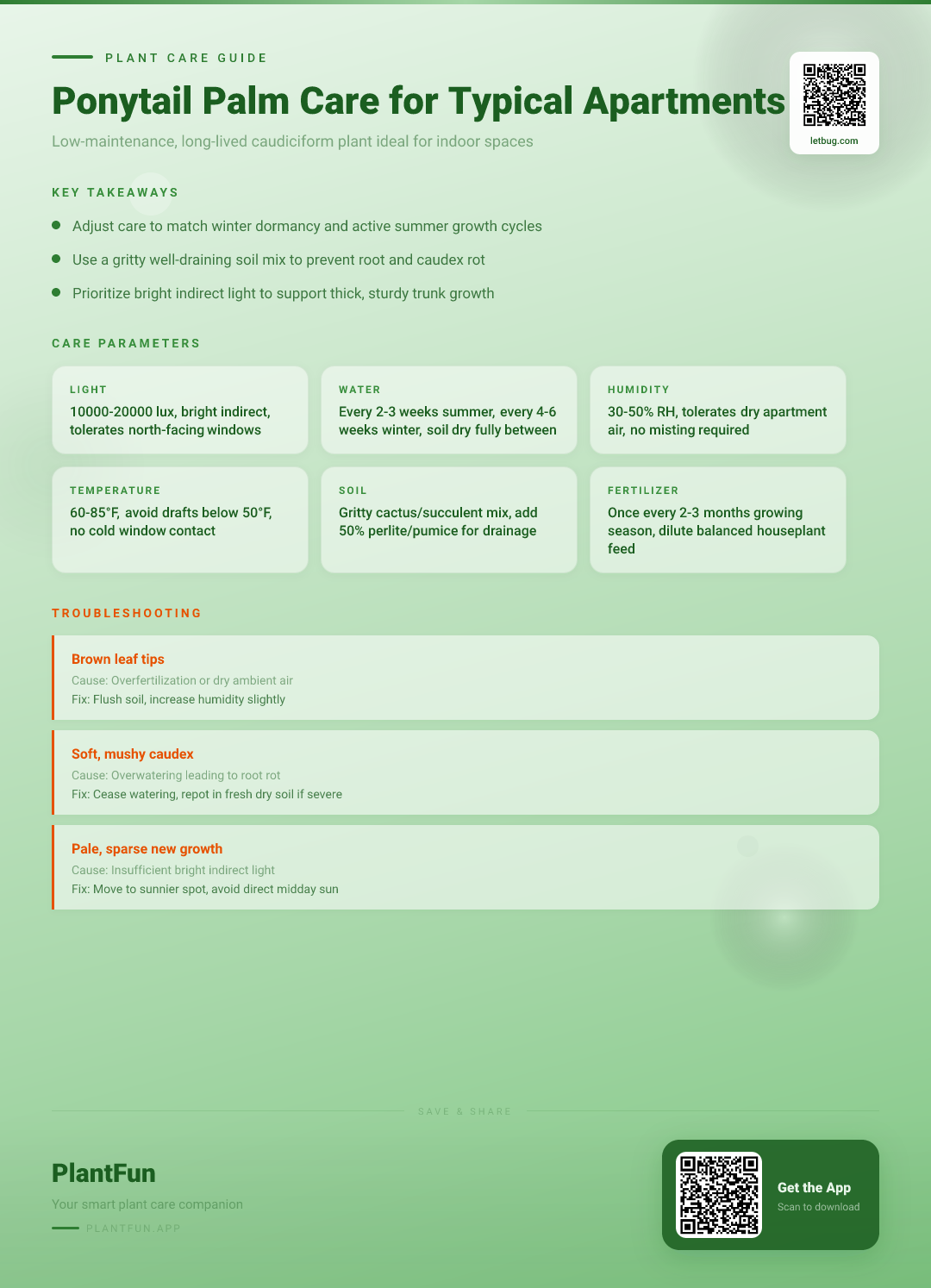
Key Takeaways
- Check soil moisture before watering — overwatering is the #1 killer of houseplants.
- Ensure your plant gets the right amount of light for its species.
- Be patient with recovery — most plants need 2–4 weeks to bounce back.
Quick Care Card: Essential Data Points for Apartment Success
| Feature | Requirement |
|---|---|
| Light | Bright, indirect to direct (10,000–20,000 lux) |
| Water | Only when the soil is 100% dry; wait 2 weeks in winter |
| Humidity | Low to moderate (30-50%) |
| Temperature | 60°F–85°F (15°C–29°C) |
| Soil | Fast-draining succulent/cactus mix with perlite |
| Fertilizer | Balanced 10-10-10, half-strength, mid-summer only |
| Toxicity | Non-toxic to cats and dogs (ASPCA, 2026) |
TL;DR: The 60-Second Ponytail Palm Philosophy
Forget everything you know about tropical houseplants. The Ponytail Palm (Beaucarnea recurvata) is a desert dweller, not a rainforest fern. To keep yours thriving in an apartment, treat it like a sculpture that happens to have leaves. Provide maximum light, ignore it when the soil is damp, and ensure its “feet” never sit in water. If you are debating whether or not to water it, wait another week.
Understanding the Caudex: Why Your Apartment Environment Matters
When I first bought my Beaucarnea recurvata, I made the classic mistake of treating it like a peace lily. I kept the soil consistently moist, and within a month, the trunk—the swollen, water-storing base known as the caudex—began to feel soft.
The caudex is an evolutionary marvel (Gilman & Watson, 2003). It acts as a biological water tank. In a typical apartment, where air can be stagnant, a damp caudex is a death sentence. By keeping the soil bone-dry between waterings, you force the plant to rely on these reserves, which promotes that signature trunk health and prevents fungal decay.
Light Requirements: Achieving 10,000-20,000 Lux Without a Greenhouse
Many indoor gardeners struggle with low light Ponytail Palm survival. While these plants can tolerate dimmer corners, they will not grow, and their trunk will fail to thicken. In an apartment, I aim for a south or west-facing window. If you don’t have one, use a dedicated grow light to hit the 10,000–20,000 lux range. Without sufficient light, the plant becomes leggy and loses its drought tolerance.
Precision Watering: Avoiding Rot in Containers Without Drainage Holes
If your apartment pot lacks drainage, you are playing with fire. If you must use a decorative cachepot, keep the plant in its original nursery liner.
The Finger Test: Stick your finger two inches into the soil. If you feel any dampness, step away. When you do water, soak it until water exits the bottom (if using a nursery pot), then discard any remaining water in the saucer. Excess moisture in the root zone is the leading cause of decline (Annals of Agricultural Science, 2014).
The Seasonal Care Calendar: Adjusting for Winter Dormancy vs. Summer Growth
- Summer (Active Growth): Water once every 2–3 weeks, depending on heat levels. This is when the plant builds its structure.
- Winter (Dormancy): Growth slows to a crawl. I often go 6–8 weeks between waterings. If you overwater during this time, root rot is almost guaranteed.
Soil Science: Creating the Perfect Gritty Mix for Indoor Resiliency
A heavy potting soil will suffocate your palm. I recommend a mix of 50% high-quality potting soil and 50% inorganic material, such as coarse sand, perlite, or pumice. This ensures rapid drainage and high oxygen levels at the root zone (Annals of Agricultural Science, 2014).
Common Apartment Mistakes: Why Less is Always More
- Mistake: Watering on a strict weekly schedule.
- What happens: The roots stay wet, causing the caudex to rot.
- Instead: Water based on soil dryness, not the calendar.
- Mistake: Placing the plant in a dark corner.
- What happens: Weak, thin foliage and trunk atrophy.
- Instead: Rotate the plant weekly to ensure even growth toward the light source.
FAQ: Why is the tip of my Ponytail Palm leaf turning brown?
Symptom: Dry, crispy, brown leaf tips.
Likely cause: Usually a combination of tap water salts and low humidity, or erratic watering.
Fix:
- Switch to filtered or distilled water to avoid mineral buildup.
- Ensure you are watering deeply but infrequently, rather than small sips.
FAQ: Can I keep my Ponytail Palm in a north-facing window?
While it will survive, it will not thrive. If a north window is your only option, place the plant directly on the windowsill and supplement with a high-intensity LED light to mimic the bright light needs required for structural development.
FAQ: How often should I fertilize my plant in an apartment setting?
In a containerized environment, nutrients leach out faster than in nature, but this plant is a slow grower. I use a balanced 10-10-10 fertilizer at half-strength only once during the peak of summer. Excessive fertilization leads to soft, weak tissue (Annals of Agricultural Science, 2014).
Expert Tips for Long-Term Structural Growth
- Repotting: Only repot when the roots are severely cramped, typically every 3–4 years. Use a terracotta pot to allow the root system to “breathe” through the porous walls (NC State Extension, 2026).
- Cleaning: Use a damp microfiber cloth to wipe dust off the long, strap-like leaves. Dust interferes with photosynthesis.
- Pet Safety: Unlike many other indoor palms, the Ponytail Palm is safe for households with curious pets (ASPCA, 2026).
References and Botanical Best Practices
- Gilman, E.; Watson, D. (2003). Beaucarnea recurvata: Ponytail palm. https://doi.org/10.32473/edis-st093-1993. Accessed 2026-03-12.
- Annals of Agricultural Science, Moshtohor. (2014). Effect of different growing media and chemical fertilization on growth and chemical composition of ponytail palm (Beaucarnea recurvata) plant. https://doi.org/10.21608/assjm.2014.111131. Accessed 2026-03-12.
- ASPCA. (2026). Toxic and Non-Toxic Plants List — ASPCA. https://www.aspca.org/pet-care/animal-poison-control/toxic-and-non-toxic-plants. Accessed 2026-03-12.
- NC State Extension. (2026). The Complete Ponytail Palm — NC State Extension Gardener Plant Toolbox. https://plants.ces.ncsu.edu/plants/palm-care/. Accessed 2026-03-12.
Optional Helper: Plantfun.App
Plantfun.App identifies your plants by photo, diagnoses pests and diseases with clear fixes, and creates personalised watering and light schedules that adapt to your home conditions — a handy companion for putting this guide into daily practice.
Found an error or have suggestions? We'd love your feedback.
Need help identifying this problem?
Get instant identification, personalized care schedules, and effective pest treatment plans directly on your phone.
Sponsored • We may earn a commission from app downloads
Related Guides
The Complete Ponytail Palm Care Checklist for Resilient Growth in Small Urban Apartments
Grow a lush, full Ponytail Palm in your small urban apartment without expensive gear. Get exact light levels, water amounts, and a free printable care checklist for resilient, low-fuss growth.
Care GuidePonytail Palm Care Checklist for Resilient Growth in Typical Urban Apartments: Fixes for Common Beginner Mistakes
Stop guessing at Ponytail Palm care. Get our apartment-specific checklist with exact light, water, and soil specs to prevent brown tips and encourage steady, resilient growth all year.
Care GuidePonytail Palm in a Low-Humidity Apartment: The Only Care Guide You’ll Ever Need
Revive your apartment-dwelling Ponytail Palm with precise water-to-pot ratios and light metrics. Stop the cycle of leaf browning today with this expert guide.
Pest ControlAnts on Plants: What They Mean and What to Do
Ants usually aren't eating your plant. They are farming other pests.