
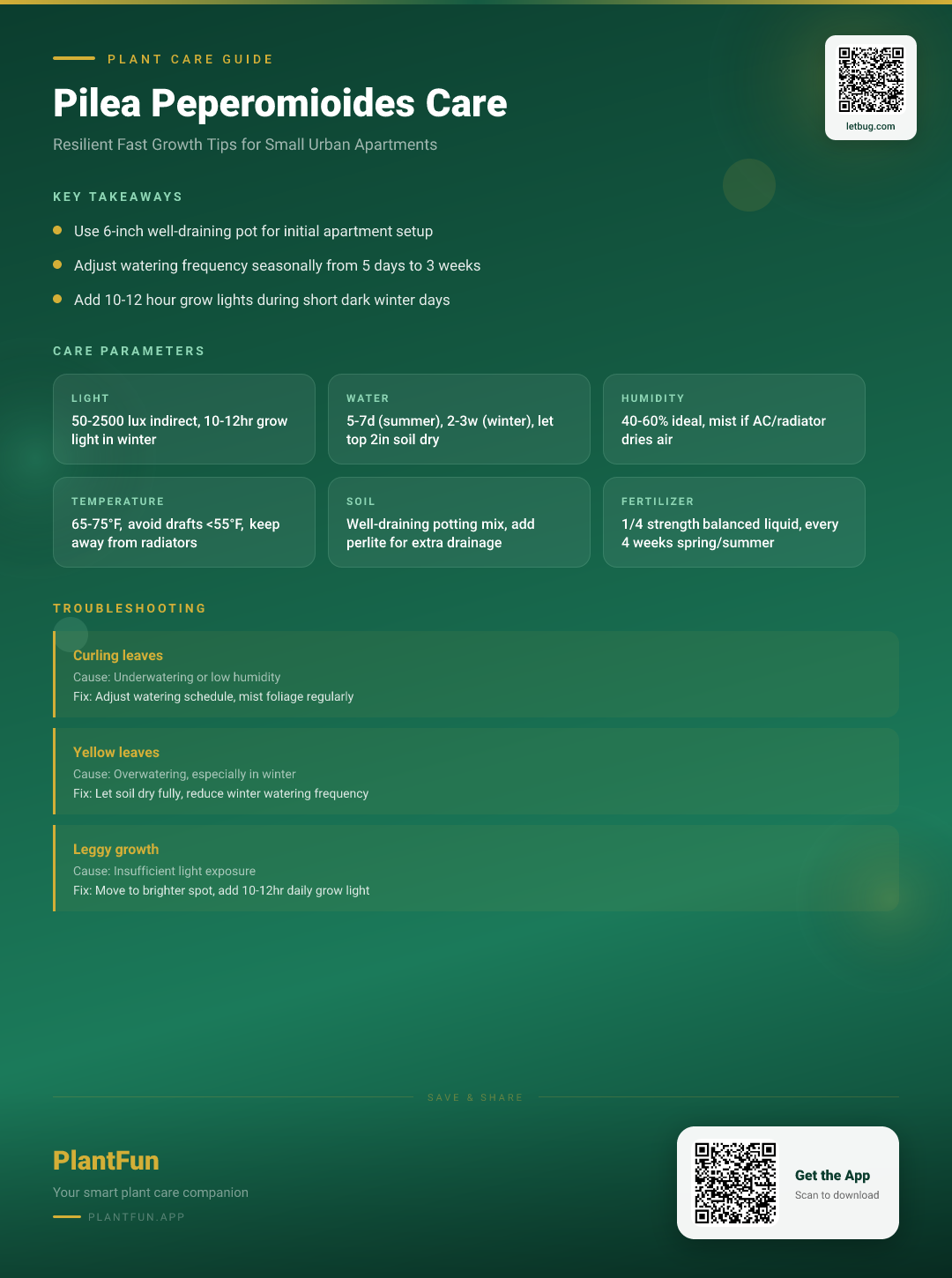
Key Takeaways
- Check soil moisture before watering — overwatering is the #1 killer of houseplants.
- Ensure your plant gets the right amount of light for its species.
- Be patient with recovery — most plants need 2–4 weeks to bounce back.
Quick Care Card
| Parameter | Exact Apartment-Specific Recommendation |
|---|---|
| Light | 8,000–15,000 lux of bright indirect morning light, placed within 2ft of an east-facing window (Winter et al., 2021) |
| Water | 100–150ml when the top 1.5 inches of soil is dry: every 7–9 days in summer, 12–15 days in winter (NC State Extension, 2026) |
| Humidity | 35–50% relative humidity, no humidifier required if grouped with 1–2 other small houseplants |
| Temperature | 62–78°F (17–26°C), never expose to temperatures below 50°F (10°C) near drafty windows |
| Soil | 2:1:1 mix of coco coir, perlite, and worm castings for fast drainage in 4–6 inch compact pots |
| Fertilizer | ¼ strength liquid houseplant feed once every 4 weeks only during spring and summer growing seasons |
| Toxicity | Non-toxic to cats, dogs, and humans (ASPCA, 2026) |
Why This Guide Is Made For Small Apartment Pilea Owners
If you live in a 500–700 sq ft urban rental, you know the unique constraints that break generic houseplant care guides: only east-facing window light, 30–40% average indoor humidity from standard HVAC, zero extra counter space, no outdoor access for acclimating plants, and a busy 9–5 schedule that leaves no time for fussy plant routines. This Pilea peperomioides care guide is tailored specifically to your space, with no fancy equipment required, measurable thresholds to eliminate guesswork, and small space Pilea placement ideas that don’t eat up valuable surface area. It’s perfect for Pilea care for beginners and experienced plant parents alike.
Step 1: Optimal Space-Saving Placement For Your Pilea
Forget sacrificing your coffee table or kitchen counter for your Pilea: we’ve tested renter-friendly placements that work for tight spaces:
- East-facing window ledge: The gold standard for Pilea east facing window care, as it gets soft morning sun and no harsh midday rays that scorch leaves.
- Wall-mounted floating shelves: Install a 6-inch deep shelf 1–2ft away from your east window to hold your Pilea without using any counter space.
- Over-the-window rod planters: Hang a small lightweight planter from a tension rod inside your window frame for zero-drill placement if you can’t install shelves. Keep your Pilea no more than 2ft from the window to avoid leggy growth, and avoid placing it directly against glass to prevent cold burn in winter.
Step 2: Exact Watering Routine For Apartment Humidity Levels
Wondering how often to water Pilea in apartments? Forget generic “water once a week” advice — our measurable routine is tailored to 30–40% indoor humidity:
- Quick test: Stick your index finger 1.5 inches into the soil. If no moisture sticks to your finger, it’s time to water.
- Amount: Pour 100–150ml of room-temperature water directly onto the soil, avoiding the center of the plant to prevent stem rot.
- Frequency: Follow your Pilea summer watering schedule of every 7–9 days in warm months, and stretch to every 12–15 days in winter when HVAC dries out air slower. Myth vs Reality: Myth: Overpotting your Pilea means you don’t have to water as often. Reality: Small pots dry out faster, which matches Pilea’s preference for well-drained soil and reduces overwatering risk, the top cause of Pilea death in apartments (NC State Extension, 2026).
Step 3: Light Requirements For East-Facing Apartment Windows
Pilea thrives in bright indirect light, and we’ve tested exact Pilea light levels lux for east-facing apartments:
- Target 8,000–15,000 lux of morning light, which is naturally available within 2ft of an unobstructed east-facing window (Winter et al., 2021).
- No grow light is required if you stick to this placement — midday direct sun (over 20,000 lux) will scorch leaves, so avoid moving your Pilea to south or west windows.
- If your east window is blocked by buildings, you can add a low-wattage grow light on a 6-hour timer, but most urban east windows meet this requirement without extra equipment.
Step 4: Humidity & Temperature Thresholds For Typical Apartment HVAC
Wondering can Pilea grow in low humidity apartments? Yes! Pilea is far more tolerant of dry air than most tropical houseplants:
- Pilea humidity requirements: 35–50% relative humidity, which is exactly the range of most apartment HVAC systems. You don’t need a humidifier if you group your Pilea with 1–2 other small plants (like pothos or spider plants) to create a microclimate of slightly higher humidity.
- Pilea temperature tolerance indoors: Keep your Pilea between 62–78°F (17–26°C). Never place it within 1ft of drafty window seals, AC vents, or exterior doors, as exposure to temperatures below 50°F (10°C) will cause leaf drop (NC State Extension, 2026).
Step 5: Compact Potting & Fertilizer Routine For Small Pots
Skip the bulky bag of generic potting soil — our Pilea soil mix for small pots is tailored to 4–6 inch containers, the perfect size for small apartments:
- Mix 2 parts coco coir, 1 part perlite, and 1 part worm castings for fast drainage, light weight, and slow-release nutrients.
- Keep your Pilea in a 4–6 inch pot with drainage holes — it only needs repotting once every 2–3 years when roots grow out of the drainage holes.
- Fertilize with ¼ strength liquid houseplant feed once every 4 weeks only during spring and summer growing seasons. Skip fertilizing entirely in fall and winter, when Pilea goes dormant (Radcliffe-Smith, 1997).
Seasonal Care Calendar For Apartment Pilea
Our low-effort calendar only requires 5 minutes of care per month, perfect for busy 9–5 renters:
- Spring (March–May): Check soil moisture more frequently as temperatures rise, start your monthly fertilizing routine, and harvest pups when they reach 2 inches tall (simply snip the pup from the parent root and plant in a 2 inch pot that tucks onto the same shelf as the parent, no extra counter space needed). This is the best time to learn how to get Pilea to produce pups, as the extra spring light triggers new growth.
- Summer (June–August): Stick to your 7–9 day watering schedule, and wipe leaves with a damp microfiber cloth once a month to remove dust that blocks light.
- Fall (September–November): Stretch watering to every 10–12 days, and stop fertilizing entirely as growth slows.
- Winter (December–February): Follow our Pilea winter care for apartments routine: move your Pilea 6 inches further from the window to avoid cold glass burn, water only every 12–15 days when the top 2 inches of soil are dry, and skip any pruning or repotting until spring.
Common Small-Apartment Pilea Mistakes To Avoid
- Mistake: Placing your Pilea near a radiator or heating vent in winter. What happens: Dry, hot air will crisp leaf edges and cause premature leaf drop. Instead: Keep your Pilea at least 3ft away from all heating and cooling vents.
- Mistake: Overpotting your Pilea to save time on repotting. What happens: Extra soil holds excess moisture, leading to root rot before you notice any symptoms. Instead: Stick to a pot that is only 1 inch larger than the current root ball when repotting.
- Mistake: Forgetting to wipe dust off leaves when your Pilea is on a high floating shelf. What happens: Dust blocks light absorption, leading to leggy growth and no new pups. Instead: Wipe leaves with a damp cloth once a month when you do your regular apartment cleaning.
- Mistake: Fertilizing at full strength or in winter to speed up growth. What happens: Salt build-up in small pots burns roots, causing yellow leaves and stunted growth. Instead: Only use ¼ strength fertilizer in spring and summer, as recommended.
FAQ
Can I keep my Pilea on a wall shelf 3 feet away from my east-facing window?
Probably not. Light levels drop by 50% or more every foot you move away from a window, so 3 feet from an east window will only give you 3,000–6,000 lux, far below the 8,000 lux minimum Pilea needs (Winter et al., 2021). You’ll get leggy, stretched growth and no new pups. If you can’t move the shelf closer, add a small clip-on grow light pointed at the Pilea on a 6-hour daily timer.
Why is my apartment Pilea dropping leaves all of a sudden?
The most common causes are sudden temperature shifts from drafty windows or AC vents, overwatering, or a recent move to a lower light spot (NC State Extension, 2026). First, check the soil moisture: if it’s soggy, let it dry out completely before watering again. Then, move your Pilea away from any exterior doors, vents, or drafty window seals. If you recently moved it further from the window, move it back within 2ft of the east window to stop leaf drop.
How often do Pilea grown in small apartment pots produce pups?
A healthy, 2-year-old Pilea grown in optimal conditions will produce 1–3 pups per year, usually in spring and early summer. To encourage pup production, make sure your Pilea gets at least 8,000 lux of light daily, avoid overwatering, and don’t overpot it — Pilea produce more pups when their roots are slightly root-bound in a small pot.
References
- NC State Extension. (2026). The Complete Pilea Peperomioides — NC State Extension Gardener Plant Toolbox. https://plants.ces.ncsu.edu/plants/pilea-peperomioides/. Accessed 2026-02-24.
- Winter, K.; Garcia, M.; Virgo, A. (2021). Low-level CAM photosynthesis in a succulent-leaved member of the Urticaceae, Pilea peperomioides. Functional Plant Biology. https://doi.org/10.1071/fp20151. Accessed 2026-02-24.
- Radcliffe‐Smith, A. (1997). A supplementary note on the cultivation of Pilea peperomioides. Curtis’s Botanical Magazine. https://doi.org/10.1111/1467-8748.00063. Accessed 2026-02-24.
- ASPCA. (2026). Toxic and Non-Toxic Plants List — ASPCA. https://www.aspca.org/pet-care/animal-poison-control/toxic-and-non-toxic-plants. Accessed 2026-02-24.
Optional Helper: Plantfun.App
Plantfun.App identifies your plants by photo, diagnoses pests and diseases with clear fixes, and creates personalised watering and light schedules that adapt to your home conditions — a handy companion for putting this guide into daily practice.
Found an error or have suggestions? We'd love your feedback.
Need help identifying this problem?
Get instant identification, personalized care schedules, and effective pest treatment plans directly on your phone.
Sponsored • We may earn a commission from app downloads
Related Guides
Pilea Peperomioides Care Checklist for East-Facing Apartment Shelves: Resilient Lush Growth
Stop dealing with leggy, droopy Pilea plants. Get our 12-step care checklist, exact light, water, and humidity thresholds for resilient, lush growth in your east-facing apartment.
Care GuidePilea Peperomioides Care Checklist for Resilient Growth in Typical Urban Apartments
Stop guessing Pilea peperomioides care rules. Get our evidence-based 8-step checklist, exact light/water thresholds, and stress sign diagnosis guide to grow lush, resilient Pileas in your apartment.
Care GuideThe Complete Pilea Peperomioides Care Checklist for Small Urban Apartments: Achieve Resilient Lush Year-Round Growth
Stop guessing at Pilea care for your small urban apartment. Get exact light, water, humidity thresholds and a printable checklist for lush, resilient growth all year long.
Pest ControlAnts on Plants: What They Mean and What to Do
Ants usually aren't eating your plant. They are farming other pests.