
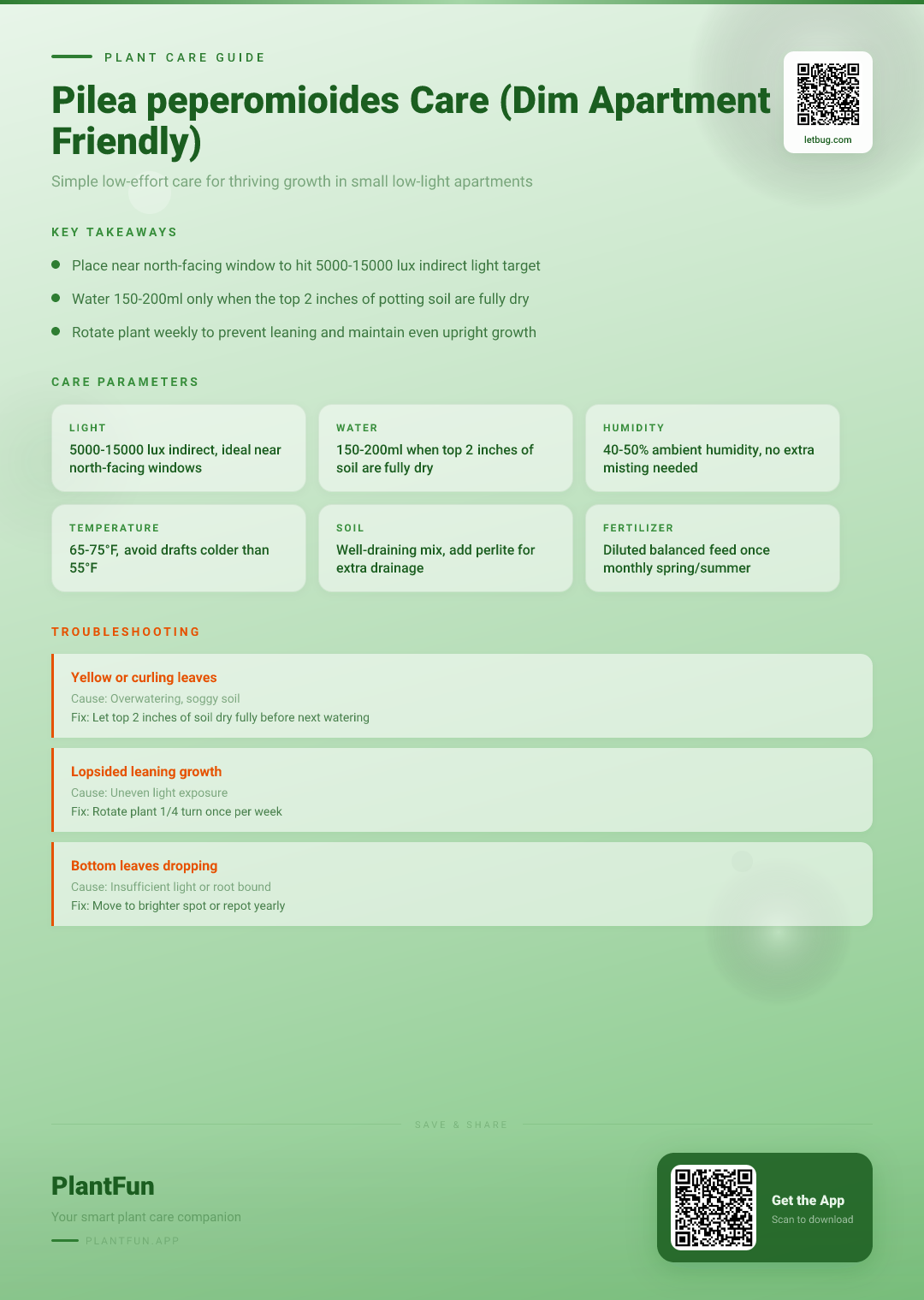
Key Takeaways
- Check soil moisture before watering — overwatering is the #1 killer of houseplants.
- Ensure your plant gets the right amount of light for its species.
- Be patient with recovery — most plants need 2–4 weeks to bounce back.
TL;DR: Quick Success
To thrive in an apartment, your Pilea peperomioides requires consistent, bright indirect light (5,000–15,000 lux) and a “soak-and-dry” watering approach. Rotate the pot 90 degrees weekly to ensure symmetric growth. If your space is dim, prioritize placement within two feet of a window and avoid overwatering, which is the leading cause of leaf drop.
Quick Care Card: Essential Metrics
| Metric | Requirement |
|---|---|
| Light | 5,000–15,000 lux (bright, indirect) |
| Water | 150–200ml when top 2” of soil are dry |
| Humidity | 40–50% |
| Temperature | 65–75°F (18–24°C) |
| Soil | Well-draining, peat-based mix with perlite |
| Fertilizer | Balanced liquid feed, half-strength, monthly in spring/summer |
| Toxicity | Non-toxic to cats and dogs (ASPCA, 2026) |
My Experience: The “Leggy” Lesson
When I first brought home my Pilea, I placed it on a bookshelf six feet from a window, thinking it would enjoy the “ambient light.” Within a month, the stems stretched, the leaves grew sparse, and it began leaning aggressively toward the glass. I learned the hard way that while these plants are hardy, they are not “low-light” plants in the way a Pothos or Snake Plant is. Through trial and error, I found that moving it to a west-facing windowsill and rotating it religiously completely reversed the “leggy” look, resulting in the compact, saucer-shaped leaves I love today.
Why Your Apartment’s Microclimate Matters for Pilea Peperomioides
Apartments are notorious for microclimates—areas near drafts, heaters, or stagnant air pockets. Pilea peperomioides prefers stable conditions (NC State Extension, 2026). In a small space, avoid placing your plant directly against a radiator or in the direct path of an AC vent, as these can cause rapid leaf curling or dehydration.
Decoding Light: Optimizing 5,000-15,000 Lux in North-Facing Windows
In a dim apartment, every photon counts. Pilea light requirements are best met in the 5,000 to 15,000 lux range (Radcliffe-Smith, 1997). If you have only north-facing windows, place your plant on the windowsill itself. Use a light-meter app on your smartphone to check the intensity—if you are reading below 3,000 lux, the plant will struggle to photosynthesize effectively (Winter et al., 2021).
Watering Mastery: Applying 150-200ml Only When the Top 2 Inches of Soil Feel Dry
One of the biggest mistakes in Pilea care is “schedule watering.” Instead, I use the finger test: poke your index finger two inches into the soil. If it feels damp, wait. If it is dry, apply 150–200ml of water. Ensure your pot has drainage holes; sitting in water is a death sentence for Pilea roots, leading to immediate yellowing.
Strategic Rotation: How to Stop Your Pilea from Leaning Towards the Window
Because the Pilea is heliotropic, it will always reach toward the light source. To prevent this, rotate your pot 90 degrees every time you water. This keeps the stem straight and encourages a full, circular shape rather than a lopsided one.
Soil Science: Creating the Perfect Drainage Mix for Small-Space Pots
For apartment growing, I swear by a blend of 60% high-quality potting soil, 20% perlite for aeration, and 20% coco coir. This prevents the soil from compacting in smaller pots, which is vital since the roots need oxygen as much as they need water (NC State Extension, 2026).
Step-by-Step Seasonal Care Calendar
- Spring (Active Growth): Increase watering to once every 7–10 days. Apply a balanced liquid fertilizer at half-strength once a month.
- Summer: Rotate weekly. Watch for scorching if the sun hits the leaves directly; add a sheer curtain if needed.
- Autumn: Growth slows. Reduce fertilizer to zero. Let the soil dry slightly more between waterings.
- Winter: Dormancy period. Water only every 14–20 days. Keep away from cold window drafts (NC State Extension, 2026).
FAQ: Your Pilea Questions
- Can I keep my Pilea on a desk far from a window? No. Without sufficient light intensity (5,000 lux minimum), your Pilea will become leggy and eventually stop producing new leaves (Radcliffe-Smith, 1997). Use a small LED grow light if you must keep it on your desk.
- Why is my Pilea losing its bottom leaves in a small apartment? This is often a sign of uneven light or overwatering. If the leaves yellow and drop, check your soil moisture first.
- How often do I actually need to repot my Pilea to prevent root-bound stress? I recommend repotting every 18–24 months, or when you see roots circling the drainage hole. Choose a pot only 1-2 inches larger than the current one.
Common Mistakes: The Top 3 Reasons Pilea Leaves Curl or Yellow
Overwatering
Symptom: Lower leaves turn yellow and feel mushy.
Likely cause: Roots are suffocating in stagnant water.
Fix:
- Check for drainage holes.
- Let the soil dry completely before the next watering.
Inadequate Light
Symptom: Leaves pale and stems become thin and stretched.
Likely cause: Not enough light reaching the plant surface.
Fix:
- Move closer to a window.
- Use a supplemental grow light.
Low Humidity / Temperature Swings
Symptom: Leaf edges curl downward or brown crispy tips.
Likely cause: Dry apartment air or heater proximity.
Fix:
- Move away from heating vents.
- Use a small room humidifier to maintain 40-50% humidity (NC State Extension, 2026).
References
- ASPCA. (2026). Toxic and Non-Toxic Plants List — ASPCA. https://www.aspca.org/pet-care/animal-poison-control/toxic-and-non-toxic-plants. Accessed 2026-03-14.
- Winter, K., Garcia, M., Virgo, A. (2021). Low-level CAM photosynthesis in a succulent-leaved member of the Urticaceae, Pilea peperomioides. Functional Plant Biology. https://doi.org/10.1071/fp20151. Accessed 2026-03-14.
- Radcliffe-Smith, A. (1997). A supplementary note on the cultivation of Pilea peperomioides. Curtis’s Botanical Magazine. https://doi.org/10.1111/1467-8748.00063. Accessed 2026-03-14.
- North Carolina State University Extension. (2026). The Complete Pilea peperomioides — NC State Extension Gardener Plant Toolbox. https://plants.ces.ncsu.edu/plants/pilea-peperomioides/. Accessed 2026-03-14.
Optional Helper: Plantfun.App
Plantfun.App identifies your plants by photo, diagnoses pests and diseases with clear fixes, and creates personalised watering and light schedules that adapt to your home conditions — a handy companion for putting this guide into daily practice.
Found an error or have suggestions? We'd love your feedback.
Need help identifying this problem?
Get instant identification, personalized care schedules, and effective pest treatment plans directly on your phone.
Sponsored • We may earn a commission from app downloads
Related Guides
The Complete Pilea Peperomioides Care Guide for Small Apartments: Resilient Growth All Year
Grow a lush, happy Pilea in your small apartment with exact care thresholds, a seasonal routine, and a printable checklist that prevents overwatering and yellow leaves all year.
Care GuidePilea Peperomioides in a Small Apartment: The Ultimate Care Guide for Resilient Year-Round Growth
Transform your Pilea's health with this apartment-tested care guide. Master precise light, watering schedules, and seasonal routines for lush, pancake-leaf growth.
Care GuideThe Complete Pilea Peperomioides Care Checklist for Resilient Growth in Small Urban Apartments
Grow a bushy, happy Pilea in your small urban apartment with our science-backed checklist. Get exact light levels, water amounts, and mistake fixes to avoid yellow leaves or leggy growth.
Pest ControlAnts on Plants: What They Mean and What to Do
Ants usually aren't eating your plant. They are farming other pests.