
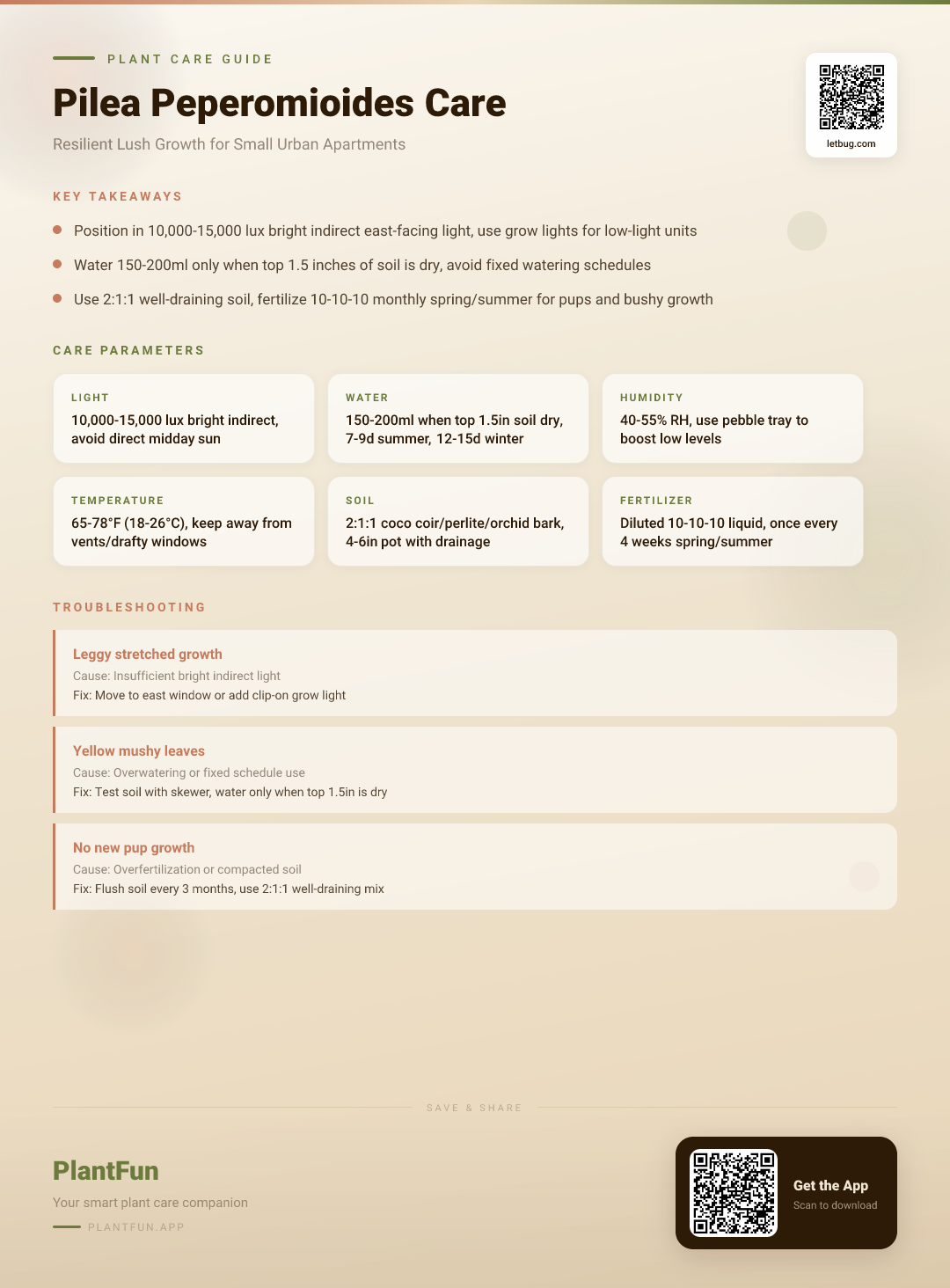
Key Takeaways
- Check soil moisture before watering — overwatering is the #1 killer of houseplants.
- Ensure your plant gets the right amount of light for its species.
- Be patient with recovery — most plants need 2–4 weeks to bounce back.
Quick Care Card
Print this cheat sheet and hang it on your fridge or plant shelf for at-a-glance reference:
| Category | Measurable Threshold |
|---|---|
| Light | 10,000-15,000 lux bright indirect light, 12-14 hours daily |
| Water | 150-200 ml when top 1.5 inches of soil is dry (7-9 days summer, 12-15 days winter) |
| Humidity | 40-55% relative humidity |
| Temperature | 65-78°F (18-26°C) |
| Soil | 2:1:1 mix of coco coir, perlite, orchid bark (well-draining) |
| Fertilizer | Diluted 10-10-10 liquid fertilizer every 4 weeks, spring and summer only |
| Toxicity | Non-toxic to humans, cats, and dogs (ASPCA, 2026) |
Why Pilea Care Is Different in Small Urban Apartments
Generic Pilea care guides often assume you have full sun exposure, consistent humidity, and plenty of shelf space—luxuries most small urban apartment dwellers don’t have. Common apartment constraints that impact your Pilea’s health include low east-facing light, dry forced air in winter, drafty old window sills, and limited counter or shelf space for large pots. Pilea peperomioides is naturally adaptable thanks to its low-level CAM photosynthesis (Winter et al, 2021), but it needs targeted adjustments to thrive in these unique conditions, which this checklist covers exclusively for small apartment owners.
Step 1: Light Placement for Steady, Non-Leggy Growth
Ideal Pilea light requirements indoors are 10,000-15,000 lux of bright indirect light, which is easily achieved by placing your plant 1-2 feet away from an east-facing window (NC State Extension, 2026).
- Common mistake: Placing your Pilea in dark corners (causes leggy growth) or directly in midday west/south-facing sun (burns leaf edges).
- Quick fix: For low-light units, use a $10 clip-on LED grow light positioned 6-12 inches above the plant, run for 14 hours a day.
- Quick test: Hold your hand 1 foot above the plant’s leaves at midday. If you see a soft, diffused shadow, you’re in the ideal lux range. No shadow means light is too low, and a sharp, dark shadow means you have too much direct sun.
Step 2: Exact Watering Schedule to Avoid Root Rot
Water your Pilea with 150-200 ml of room-temperature water only when the top 1.5 inches of soil is completely dry: this works out to every 7-9 days in summer, and 12-15 days in winter (Radcliffe-Smith, 1984).
- Common mistake: Following a fixed weekly watering schedule regardless of soil moisture, which leads to overwatering and root rot, the #1 cause of Pilea death in apartments.
- Quick fix: Use a plain wooden skewer to test soil moisture: insert it 1.5 inches deep, if it comes out clean with no damp soil clumps, it’s time to water.
- Myth vs Reality: A common myth is that Pilea needs frequent, weekly watering year-round. The reality is its thick, succulent leaves store water for long periods, so underwatering is almost always less harmful than overwatering.
Step 3: Humidity & Temperature Adjustments for Apartment Conditions
Ideal Pilea humidity needs are 40-55% relative humidity, with a temperature range of 65-78°F (18-26°C) (NC State Extension, 2026).
- Common mistake: Placing your Pilea directly on drafty window sills or within 2 feet of heating/AC vents, which causes leaf curling, dry edges, or sudden leaf drop.
- Quick fix: For low humidity (common in winter with forced air heating), use a $5 pebble tray: fill a shallow tray with pebbles and water, set your pot on top of the pebbles, ensuring the pot base never touches standing water.
- Quick test: If your skin feels dry and itchy after spending an hour in your apartment, your humidity is likely below 40% and your Pilea will benefit from a pebble tray.
Step 4: Soil & Potting Requirements for Compact Spaces
Use a well-draining 2:1:1 potting mix: 2 parts coco coir, 1 part perlite, 1 part orchid bark. For small apartment spaces, stick to a 4-6 inch pot with drainage holes, which fits on most shelves and window sills.
- Common mistake: Using an oversized pot to skip repotting, which holds excess moisture around the roots and leads to root rot, plus takes up unnecessary space in small apartments.
- Quick fix: Only repot your Pilea when you see roots growing out of the drainage holes, and only move up to a pot that is 1 inch larger than the current one to save space and reduce overwatering risk.
Step 5: Fertilizing Routine for Lush, Bushy Growth and Pup Production
Use a diluted half-strength 10-10-10 liquid fertilizer once every 4 weeks only during spring and summer growing months (NC State Extension, 2026). This will help you grow a bushy Pilea and encourage pup production for propagation.
- Common mistake: Fertilizing in winter, when the plant is dormant, which causes salt buildup in the soil and burnt leaf tips.
- Quick fix: Flush your soil every 3 months by running 3x the pot volume of room-temperature water through the drainage holes to wash away accumulated salt residue.
Seasonal Care Calendar for Apartment Pileas
Adjust your care routine to match apartment seasonal conditions:
- January-February (Winter): Follow Pilea winter care guidelines: water every 12-15 days, skip fertilizer, move 1 foot away from drafty windows, add a grow light if daylight is less than 10 hours a day.
- March-April (Spring): Gradually increase watering to every 9 days, start your 4-week fertilizing routine, check for new pup growth at the soil line.
- May-August (Summer): Follow Pilea summer watering guidelines: water every 7-9 days, keep the plant 2 feet away from AC vents, avoid direct west-facing midday sun.
- September-October (Fall): Reduce watering to every 10 days, stop fertilizing, move away from windows as nighttime temperatures drop below 60°F (15°C).
- November-December (Late Fall/Winter): Return to winter watering schedule (every 12-15 days), skip fertilizer, add a grow light to compensate for shorter daylight hours.
Top 5 Pilea Care Mistakes (And 24-Hour Fixes)
Yellow Leaves
Symptom: Pale, mushy yellow lower leaves or crispy yellow leaf edges.
Likely cause: Overwatering or salt buildup from excess fertilizer, the most common answer to “why is my Pilea turning yellow”.
Fix:
- Test soil with a skewer: if damp, let it dry completely for 3-5 days before watering again.
- Flush soil with 3x pot volume of room-temperature water to remove salt buildup.
Leggy Stems
Symptom: Long, thin stems with wide gaps between leaves, leaning toward light sources.
Likely cause: Insufficient light levels below 10,000 lux.
Fix:
- Move to an east-facing windowsill immediately, or clip a grow light 6-12 inches above the plant for 14 hours a day (Pilea leggy growth fix).
- Prune the top 1/3 of the stem to encourage bushier, more compact growth (how to make Pilea bushy).
No Pups
Symptom: Mature Pilea over 1 year old with no small offshoots growing from the soil line.
Likely cause: Too little light or insufficient fertilizer during the growing season.
Fix:
- Move to a brighter spot with 12+ hours of bright indirect light daily.
- Apply diluted 10-10-10 fertilizer within 24 hours, and continue every 4 weeks through spring and summer.
Curling Leaves
Symptom: Leaves curling inward or downward, with dry, crispy edges.
Likely cause: Low humidity below 30% or placement near heating/AC vents.
Fix:
- Move the plant at least 3ft away from any air vents immediately.
- Set up a pebble tray under the pot, and mist the leaves once with room-temperature water.
Root Rot
Symptom: Wilting leaves even with moist soil, soft black stems, and foul-smelling soil.
Likely cause: Overwatering or poorly draining soil, leading to fungal root damage.
Fix:
- Remove the plant from its pot, trim all black, mushy roots with sterilized scissors, and discard all old soil (Pilea root rot treatment).
- Repot in fresh 2:1:1 well-draining mix in a 4-6 inch pot with drainage holes, do not water for 5 days after repotting.
Frequently Asked Questions
Why is my Pilea not growing any pups in my apartment?
Pilea not growing pups almost always comes down to two factors: light and fertilizer. Your plant needs a minimum of 12 hours of 10,000+ lux bright indirect light daily, plus diluted 10-10-10 fertilizer every 4 weeks during spring and summer to produce offshoots (NC State Extension, 2026). Mature plants over 1 year old are also more likely to grow pups than younger, smaller specimens.
Can I keep my Pilea on my apartment balcony in summer?
You can keep your Pilea on your apartment balcony in summer only if temperatures stay between 65-78°F (18-26°C) and it is protected from direct midday sun, which will burn its leaves (Radcliffe-Smith, 1984). Bring it back indoors if temperatures drop below 60°F (15°C) or rise above 85°F (29°C), and never leave it exposed to heavy rain which can cause overwatering and root rot.
How often do I need to repot my Pilea in a small apartment?
You only need to repot your Pilea once every 2-3 years, and only when you see roots growing out of the pot’s drainage holes. For small apartment spaces, stick to a pot that is only 1 inch larger than the current one to avoid taking up extra shelf space and reducing the risk of overwatering from excess soil holding too much moisture.
Understanding the Science
Pilea peperomioides is a member of the Urticaceae family, and unlike most common houseplants, it uses low-level crassulacean acid metabolism (CAM) photosynthesis (Winter et al, 2021). This means it can store carbon dioxide at night to use for photosynthesis during the day, making it far more tolerant of lower light conditions than many other houseplants, which is why it is so well-suited for small apartment settings.
References
- NC State Extension. (2026). The Complete Pilea Peperomioides — NC State Extension Gardener Plant Toolbox. https://plants.ces.ncsu.edu/plants/pilea-peperomioides/. Accessed 2026-03-06.
- Winter, K.; Garcia, M.; Virgo, A. (2021). Low-level CAM photosynthesis in a succulent-leaved member of the Urticaceae, Pilea peperomioides. Functional Plant Biology. https://doi.org/10.1071/fp20151. Accessed 2026-03-06.
- Radcliffe‐Smith, A. (1984). PILEA PEPEROMIOIDES Urticaceae. Curtis’s Botanical Magazine. https://doi.org/10.1111/j.1467-8748.1984.tb00168.x. Accessed 2026-03-06.
- ASPCA. (2026). Toxic and Non-Toxic Plants List — ASPCA. https://www.aspca.org/pet-care/animal-poison-control/toxic-and-non-toxic-plants. Accessed 2026-03-06.
Optional Helper: Plantfun.App
Plantfun.App identifies your plants by photo, diagnoses pests and diseases with clear fixes, and creates personalised watering and light schedules that adapt to your home conditions — a handy companion for putting this guide into daily practice.
Found an error or have suggestions? We'd love your feedback.
Need help identifying this problem?
Get instant identification, personalized care schedules, and effective pest treatment plans directly on your phone.
Sponsored • We may earn a commission from app downloads
Related Guides
Pilea Peperomioides Care Checklist for East-Facing Apartment Shelves: Resilient Lush Growth
Stop dealing with leggy, droopy Pilea plants. Get our 12-step care checklist, exact light, water, and humidity thresholds for resilient, lush growth in your east-facing apartment.
Care GuidePilea Peperomioides in Small Urban Apartments: The Only Resilient Growth Care Checklist You Need
Grow a lush, full Pilea peperomioides even in a cramped urban apartment. Get 12 actionable checklist steps, exact light, water, and humidity thresholds to avoid common leaf issues and boost resilient growth.
Care GuideThe Complete Pilea Peperomioides Care Checklist for Small Urban Apartments: Achieve Resilient Lush Year-Round Growth
Stop guessing at Pilea care for your small urban apartment. Get exact light, water, humidity thresholds and a printable checklist for lush, resilient growth all year long.
Pest ControlAnts on Plants: What They Mean and What to Do
Ants usually aren't eating your plant. They are farming other pests.