
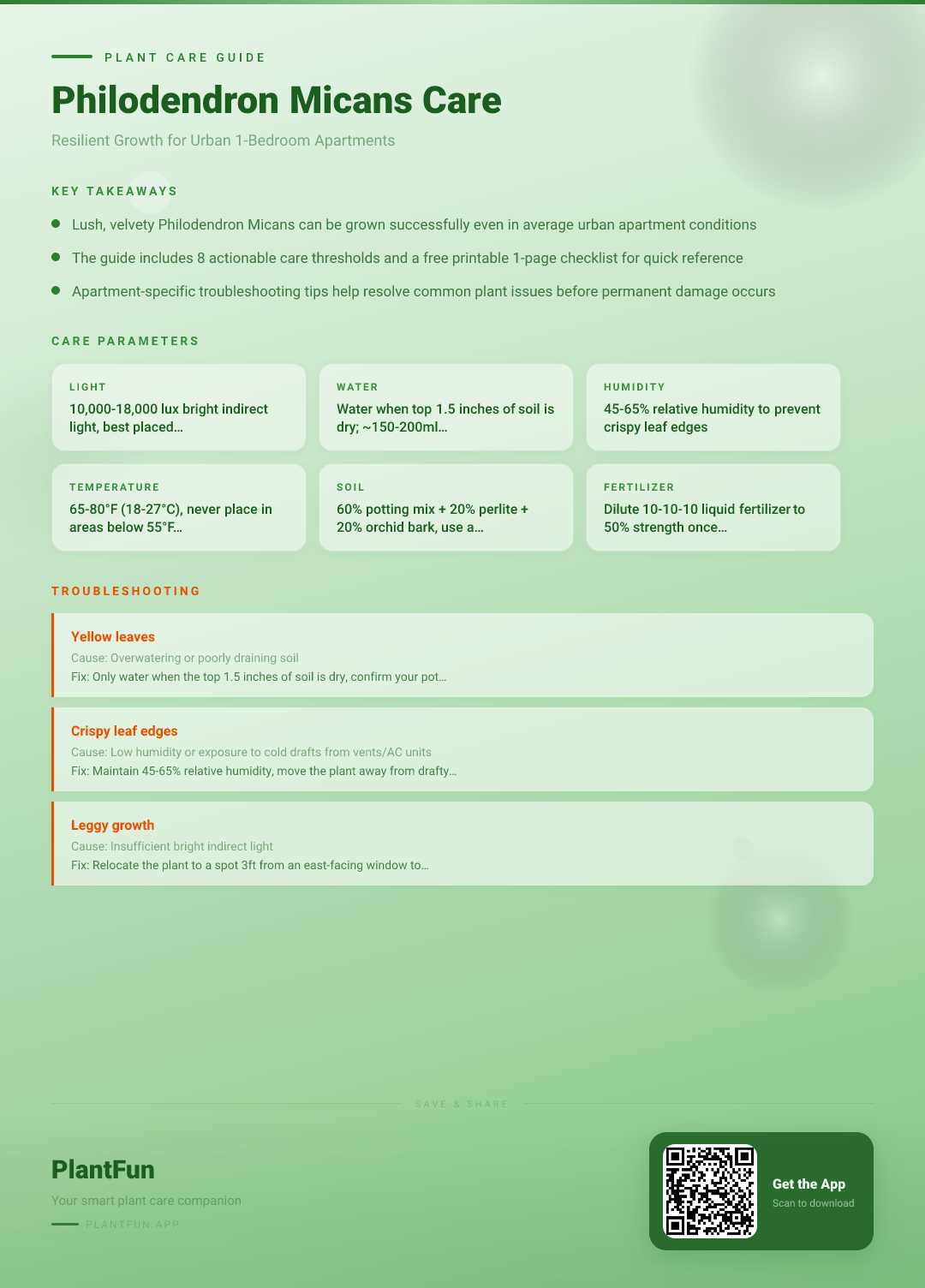
Key Takeaways
- Check soil moisture before watering — overwatering is the #1 killer of houseplants.
- Ensure your plant gets the right amount of light for its species.
- Be patient with recovery — most plants need 2–4 weeks to bounce back.
Quick Care Card
| Parameter | Exact Measurable Value |
|---|---|
| Light | 10,000-18,000 lux bright indirect light |
| Water | 150-200ml per 6in pot when top 1.5 inches of soil is dry; 7-9 days growing season, 14-18 days winter |
| Humidity | 45-60% relative humidity |
| Temperature | 65-80°F (18-27°C); never below 55°F/13°C |
| Soil | Well-draining aroid mix (1 part potting soil, 1 part perlite, 1 part orchid bark) |
| Fertilizer | Half-strength 20-20-20 liquid fertilizer every 4 weeks spring/summer; no winter fertilizing |
| Toxicity | Toxic to cats, dogs, and humans if ingested (ASPCA, 2026) |
Why Philodendron Micans Thrive (or Struggle) in Typical Apartments
Philodendron hederaceum var. hederaceum (Micans) is native to tropical Central American understories, so it is naturally adapted to low, filtered light and warm, humid conditions — making it a great fit for most apartment environments (NC State Extension, 2026). The most common issues apartment owners face stem from three easily fixable stressors: drafty HVAC vents, inconsistent light levels, and fluctuating humidity from heating/cooling systems. Unlike fussier aroids, Micans will bounce back quickly from minor stress with small, targeted adjustments.
Myth vs Reality: You don’t need a luxury humidifier or sunroom to grow healthy Micans. They thrive at standard apartment humidity levels with basic care tweaks.
Symptom-to-Action Pre-Check
If your Micans is already showing signs of stress, use this guide to fix issues immediately before following the regular care routine.
Curled Leaves
Symptom: Leaf edges curl inward, leaves feel dry and crisp to the touch.
Likely cause: Underwatering or exposure to dry drafty air from HVAC vents.
Fix:
- Test soil moisture, water immediately if top 2 inches are dry
- Move the plant at least 2ft away from all AC/heat vents and drafty windows
Brown Leaf Tips
Symptom: Crispy brown edges on leaf tips, rest of the leaf is green and healthy.
Likely cause: Low humidity, excess fertilizer salts, or chlorinated tap water (NC State Extension, 2026).
Fix:
- Boost humidity to 45%+ using one of the DIY hacks outlined later
- Flush soil with 3x the pot volume of filtered water to leach excess fertilizer salts
Leggy Growth
Symptom: More than 2 inches of bare stem between leaves, vines grow long and sparse.
Likely cause: Insufficient light below the 10,000 lux minimum requirement.
Fix:
- Move the plant to a brighter spot within 3ft of an east-facing window
- Prune bare vine ends just above a leaf node to encourage bushier new growth
Yellowing Lower Leaves
Symptom: Soft, mushy yellow leaves on the lower part of the plant, soil feels constantly damp.
Likely cause: Overwatering leading to early root rot, common in poorly ventilated apartments.
Fix:
- Hold off watering until the top 2 inches of soil are completely dry
- If soil stays damp for more than 10 days, repot into fresh dry aroid mix
Lost Velvet Sheen
Symptom: Leaves lose their signature velvety texture, look shiny or scorched.
Likely cause: Excess direct sun exposure or consistent humidity below 40% (NC State Extension, 2026).
Fix:
- Move the plant out of direct midday sun, add a sheer curtain to south/west windows
- Boost humidity to 50%+; new growth will regrow the velvet texture as it matures
Step 1: Apartment Light Setup
The Philodendron Micans light requirement is a strict 10,000-18,000 lux of bright indirect light for consistent, lush growth (NC State Extension, 2026). The best apartment placement is 3ft from an east-facing window, which delivers gentle morning sun without harsh midday rays that scorch leaves. For south or west-facing windows, hang a cheap sheer curtain to filter direct sun and keep lux levels within the target range.
Wondering can Philodendron Micans grow in low light? North-facing windows typically only deliver 2,000-6,000 lux, which is too low for healthy growth. Fix this by adding a low-wattage grow light 12 inches above the plant, running for 10 hours per day in low-light apartments.
For Philodendron Micans leggy growth fix: If you notice gaps between leaves, move the plant 1ft closer to a bright window, and prune the ends of long vines to stimulate new bushier growth at the base.
Step 2: Apartment Watering Rules
How often to water Philodendron Micans depends on your apartment’s ventilation and season, but always use the finger test first: stick your index finger 1.5 inches into the soil — if no soil sticks to your finger, it’s time to water. For a standard 6in pot, use 150-200ml of filtered or rainwater per watering (NC State Extension, 2026).
Stick to this schedule as a baseline, adjusting based on soil moisture:
- Spring/summer growing season: Every 7-9 days
- Winter dormant season: Every 14-18 days
Poor apartment ventilation slows soil drying, so never follow a rigid schedule without testing the soil first — overwatering is the top cause of Micans death in indoor settings. For Philodendron Micans summer watering, check soil moisture every 5 days during heat waves, as higher temperatures will speed up drying.
Step 3: Humidity & Temperature Adjustments
The ideal Philodendron Micans humidity level is 45-60% relative humidity (Han & Park, 2008), which is achievable in even dry, air-conditioned apartments with these 3 renter-friendly DIY hacks:
- Pebble tray: Fill a shallow tray with pebbles and water, set the nursery pot on top of the pebbles (make sure the pot is not sitting in standing water, which causes root rot)
- Plant grouping: Place your Micans near other tropical plants to create a shared humid microclimate
- Portable humidifier: Use a small, low-cost desktop humidifier near your plant collection, no installation required
Keep temperatures between 65-80°F (18-27°C) year-round, and never expose your Micans to temperatures below 55°F/13°C, which causes permanent leaf damage (NC State Extension, 2026).
Step 4: Renter-Friendly Soil & Potting
The best Philodendron Micans soil mix is a well-draining aroid blend: 1 part standard potting soil, 1 part perlite, and 1 part orchid bark. This mix delivers the aeration and fast drainage that Micans roots need to avoid rot in poorly ventilated apartments.
For renters who cannot drill drainage holes in decorative pots: Use a standard nursery pot with pre-drilled drainage holes, and place it inside a decorative cache pot. Empty any excess water from the cache pot 15 minutes after watering to prevent root rot. Repot your Micans every 18-24 months, only moving up to a pot 2 inches larger than the current one to avoid overwatering from excess unused soil.
Step 5: Fertilizing for Resilient Growth
Micans are light feeders, so use half-strength 20-20-20 liquid fertilizer once every 4 weeks only in spring and summer. Never fertilize in winter, as plants are dormant and cannot absorb excess nutrients, which leads to fertilizer burn and Philodendron Micans brown tips.
If you notice brown crispy tips from over-fertilizing: Flush the soil with 3x the pot volume of filtered water to leach excess salt buildup, and hold off fertilizing for 3 months to let the plant recover.
Step 6: Pruning & Training Tips
Prune your Micans 1-2 times per year in spring to encourage fuller growth: Use clean, sharp scissors to cut vines just above a leaf node (the small bump on the stem where leaves grow). Each cut will stimulate 2 new vines to grow from the node, creating a bushier plant.
For renters, train trailing vines using command strip wall hooks (no drilling required) or drape them over shelf edges for a cascading look. You can also train vines up a small moss pole for upright climbing growth if you have limited shelf space.
Seasonal Apartment Care Calendar
Adjust your care routine with these simple monthly tweaks for year-round health:
| Season | Key Adjustments |
|---|---|
| Winter (Philodendron Micans winter care) | Move 2ft away from drafty heater vents and cold exterior windows; reduce watering to every 14-18 days; stop fertilizing; add a pebble tray to boost humidity from dry heater air |
| Summer | Check soil moisture every 5 days; increase humidity to 60% if temperatures exceed 80°F; move away from unshaded south-facing windows to avoid leaf scorch; fertilize every 4 weeks as scheduled |
Common Apartment Micans Care Mistakes to Avoid
- Mistake: Placing your Micans directly next to AC or heat vents What happens: Rapid moisture loss leads to curled leaves, brown tips, and stunted growth Instead: Keep all Micans at least 2ft away from HVAC vents, and use a draft guard near leaky windows in winter
- Mistake: Overwatering in winter when plant growth slows What happens: Soggy soil causes root rot, mushy yellow leaves, and plant death Instead: Only water when the top 2 inches of soil are completely dry, and reduce water volume by 30% in winter
- Mistake: Using heavy garden potting soil with no added drainage amendments What happens: Soil retains too much moisture and cuts off oxygen to roots, leading to rot Instead: Use the aroid mix outlined earlier, and add extra perlite if your apartment is very humid or poorly ventilated
- Mistake: Exposing Micans to more than 2 hours of direct midday sun What happens: Brown scorch marks on leaves, lost velvet sheen, and leaf drop Instead: Use a sheer curtain on south/west windows, and keep plants 3ft away from unshaded windows in summer
Voice Search FAQ
Why is my Philodendron Micans losing its velvet sheen?
This is almost always caused by too much direct sun or consistent humidity below 40% (NC State Extension, 2026). Move the plant to a shadier spot, boost humidity to 50%+, and new growth will regain its signature velvety texture as it matures. This is the simplest answer for how to make Philodendron Micans velvety again.
Can I keep my Philodendron Micans in a north-facing apartment?
Yes, as long as you supplement with a low-wattage grow light placed 12 inches above the plant, running for 10 hours per day. North-facing windows only deliver 2,000-6,000 lux, which is below the 10,000 lux minimum required for healthy non-leggy growth.
How often should I mist my Philodendron Micans?
Misting only provides temporary humidity for 1-2 hours, so it is not a replacement for a pebble tray or humidifier. If you enjoy misting, do it 2-3 times per week in the morning, and avoid misting at night which can lead to fungal leaf spots on damp foliage.
Printable Weekly Care Checklist
Spend 1 minute per week on these 3 checks to keep your Micans thriving with zero guesswork:
- Soil test: Stick your finger 1.5 inches into soil, water if no soil sticks to your finger
- Leaf check: Scan for curled edges, brown tips, or discoloration, and adjust care using the symptom-to-action guide if needed
- Light check: Confirm the plant is not getting direct midday sun, and is within 3ft of a bright window (or under a grow light in low-light apartments)
Print this checklist and stick it to your fridge to never miss a care task, even on busy weeks.
References
- NC State Extension. (2026). The Complete Philodendron Micans — NC State Extension Gardener Plant Toolbox. https://plants.ces.ncsu.edu/plants/micans-care/. Accessed 2026-03-08.
- Han, B.; Park, B. (2008). In vitro micropropagation of Philodendron cannifolium. Journal of Plant Biotechnology. https://doi.org/10.5010/jpb.2008.35.3.203. Accessed 2026-03-08.
- Journal of Plant Biotechnology. (2004). Micropropagation of Philodendron wend-imbe through Adventitious Multi-bud Cluster Formation. Journal of Plant Biotechnology. https://doi.org/10.5010/jpb.2004.31.2.115. Accessed 2026-03-08.
- ASPCA. (2026). Toxic and Non-Toxic Plants List — ASPCA. https://www.aspca.org/pet-care/animal-poison-control/toxic-and-non-toxic-plants. Accessed 2026-03-08.
Optional Helper: Plantfun.App
Plantfun.App identifies your plants by photo, diagnoses pests and diseases with clear fixes, and creates personalised watering and light schedules that adapt to your home conditions — a handy companion for putting this guide into daily practice.
Found an error or have suggestions? We'd love your feedback.
Need help identifying this problem?
Get instant identification, personalized care schedules, and effective pest treatment plans directly on your phone.
Sponsored • We may earn a commission from app downloads
Related Guides
The Complete Philodendron Micans Care Checklist for Resilient Growth in Small Urban Apartments
Grow lush, velvety Philodendron Micans in your apartment without the guesswork. Get exact light, water, and humidity thresholds plus a 10-step checklist for stress-free, resilient growth year-round.
Care GuideThe Complete Philodendron Micans Care Checklist for Resilient Velvet Growth in Typical City Apartments
Grow lush, velvety Philodendron Micans in your apartment without fancy humidifiers. Get 8 actionable care steps, common mistake fixes, and measurable thresholds to keep your plant thriving year-round.
Care GuideThe Complete Philodendron Micans Care Checklist for Thriving Growth in Small Urban Apartments
Stop guessing at Philodendron Micans care for your small urban apartment. Get exact light levels, watering amounts, and a printable checklist to grow lush, velvety leaves year-round.
Pest ControlAnts on Plants: What They Mean and What to Do
Ants usually aren't eating your plant. They are farming other pests.