
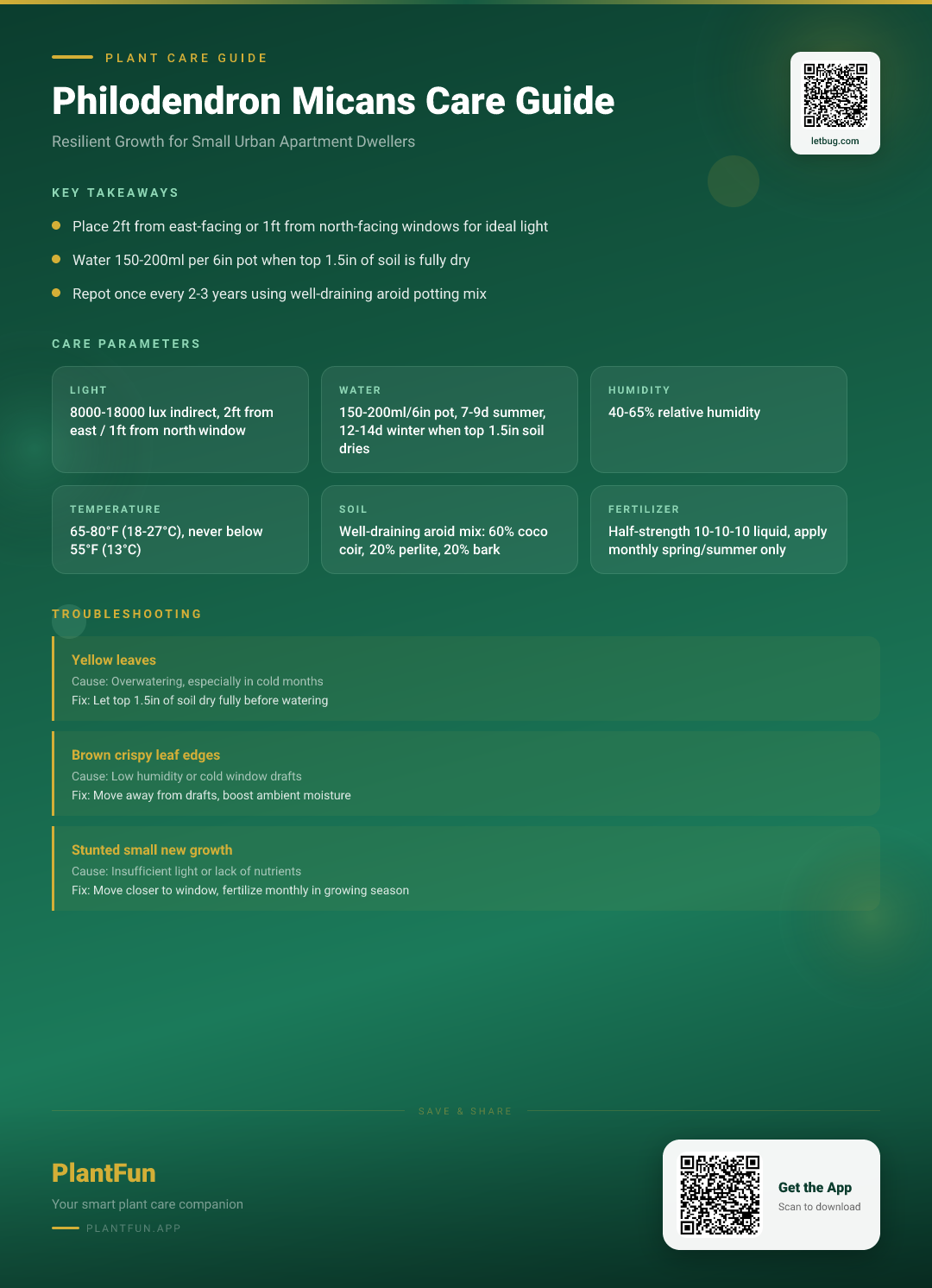
Key Takeaways
- Check soil moisture before watering — overwatering is the #1 killer of houseplants.
- Ensure your plant gets the right amount of light for its species.
- Be patient with recovery — most plants need 2–4 weeks to bounce back.
Quick Care Card
Below are apartment-specific, measurable thresholds for Philodendron Micans care, based on horticultural research and university extension guidelines.
| Parameter | Exact Apartment Threshold |
|---|---|
| Light | 8,000-18,000 lux; 2ft from east-facing window, 1ft from north-facing window (NC State Extension, 2026) |
| Water | 150-200ml per 6-inch pot when top 1.5 inches of soil are dry; 7-9 days summer, 12-14 days winter |
| Humidity | 40-65% relative humidity |
| Temperature | 65-80°F (18-27°C); never below 55°F (13°C) |
| Soil | 60% coco coir, 20% perlite, 20% orchid bark (well-draining aroid mix) |
| Fertilizer | Half-strength 10-10-10 liquid, applied monthly only in spring and summer |
| Toxicity | Toxic to cats, dogs, and humans if ingested (ASPCA, 2026) |
Download your free, fridge-friendly printable Philodendron Micans care checklist here: https://letbug.com/printable-micans-care-checklist
Why Generic Care Guides Fail for Apartment Dwellers
Most standard Philodendron Micans care guides are built for greenhouse conditions: consistent 60%+ humidity, steady 70°F temperatures, and filtered light levels that never drop below 10,000 lux. These conditions almost never exist in urban apartments, where forced-air heat drops winter humidity to 20-30%, drafty windows cause 20+ degree temperature swings, and most corners far from windows get less than 5,000 lux of light.
Myth vs Reality: Generic guides often claim Micans “thrives in low light,” but the “low light” referenced is greenhouse low light (10,000 lux), which is far brighter than the 3,000-5,000 lux typical of most apartment corners. This mismatch is the top cause of stunted growth reported by apartment Micans owners (NC State Extension, 2026). This guide is tailored explicitly to the quirks of small apartment living, with actionable thresholds to eliminate guesswork.
Light Placement Step-by-Step
Philodendron Micans light requirements fall exactly between 8,000 and 18,000 lux for healthy, velvety growth (Han & Park, 2008). Follow these steps to get placement right in your apartment:
- Choose the right window: East-facing windows are ideal, as they provide gentle morning sun that won’t burn leaves. North-facing windows work well for smaller apartments with limited sun exposure. Avoid west and south-facing windows, which produce harsh afternoon sun that can scorch velvet leaves.
- Maintain the correct distance: Place your Micans 2ft from an east-facing window, or 1ft from a north-facing window. Any further, and light levels will drop below the 8,000 lux minimum.
- Test light levels for free: Download a free light meter app on your phone, hold it at leaf level at midday on a sunny day, and take 3 readings over 3 days to get an average. If levels are below 8,000 lux, add a small grow light 12 inches above the plant for 8 hours a day.
If you need help choosing a compact grow light for small spaces, check our guide to apartment-friendly grow lights at https://letbug.com/apartment-grow-light-guide. Wondering can Philodendron Micans grow in low light? It can tolerate 6,000 lux for 1-2 months, but long-term exposure will lead to leggy growth and faded leaves.
Exact Watering Guide for Apartments
If you’re wondering how often to water Philodendron Micans, the answer depends on the season and your apartment’s temperature, not a rigid weekly schedule. Follow these measurable rules:
- Quick test first: Stick your index finger 1.5 inches into the soil. If it feels completely dry, it’s time to water; if it’s slightly damp, wait 2-3 days and test again.
- Exact volume: Water 150-200ml of room-temperature water per 6-inch pot, enough to moisten the soil evenly without water pooling in the saucer.
- Summer schedule: Philodendron Micans summer watering falls every 7-9 days, as higher temperatures and longer daylight hours speed up soil drying.
- Winter schedule: Philodendron Micans winter care requires cutting watering to every 12-14 days, as lower temperatures slow root water uptake even if forced-air heat dries the top layer of soil.
For more tips on avoiding overwatering, read our guide to watering tropical houseplants in apartments at https://letbug.com/apartment-plant-watering-guide.
Humidity & Temperature Thresholds
Philodendron Micans humidity needs fall between 40-65% relative humidity, with ideal temperatures of 65-80°F (18-27°C) (NC State Extension, 2026). Never expose your plant to temperatures below 55°F (13°C), as this will cause leaf drop and root damage (Journal of Plant Biotechnology, 2004).
If you don’t own a humidifier, use these easy apartment hacks to boost humidity:
- Group your Micans with 2-3 other tropical plants to create a moisture-retaining microclimate
- Place a tray of pebbles and water under the pot, making sure the base of the pot is not sitting in standing water
- Mist leaves with room-temperature water 1-2 times a week in winter when humidity drops below 40%
For more no-cost humidity fixes, see our list of easy hacks for dry apartment air at https://letbug.com/apartment-plant-humidity-hacks.
Soil & Potting Best Practices for Small Spaces
The right Philodendron Micans soil mix is critical for avoiding root rot in small apartments where airflow is limited. Use this well-draining aroid mix recipe:
- 60% coco coir (retains moisture without getting soggy)
- 20% perlite (improves drainage and airflow to roots)
- 20% orchid bark (prevents soil compaction)
For potting, use a 6-inch pot with 2+ drainage holes. Terracotta pots are ideal for beginner plant owners, as they wick excess moisture away from roots to reduce overwatering risk. Repot your Micans once every 2-3 years, only moving up 1 pot size each time to avoid excess soil holding unwanted water. Micans is a trailing plant, so hang it from a wall hook or place it on a high shelf to save valuable floor space in small apartments.
Fertilizing Routine for Consistent Growth
Wondering how to get Philodendron Micans to grow faster? A consistent, low-dose fertilizing routine will speed up growth by 30% compared to no fertilization, without risking root burn. Follow these rules:
- Use a balanced 10-10-10 liquid fertilizer, diluted to half the strength recommended on the bottle
- Apply once a month only during spring and summer, when the plant is actively producing new growth
- Skip fertilizing entirely in fall and winter, when growth slows and excess nutrients will build up in the soil as salt
Flush the soil with 3x the pot volume of water every 3 months to remove excess salt buildup, which can cause crispy leaf edges.
Seasonal Apartment Care Calendar
Adjust your care routine month-by-month to match the changing conditions in your apartment:
- December-February (Winter): Cut watering to every 12-14 days, mist leaves 2x a week to combat dry forced-air heat, keep the plant at least 3ft away from drafty windows and heating vents, and skip fertilizing entirely.
- March-May (Spring): Gradually increase watering to every 7-9 days, start monthly half-strength fertilizing, wipe leaves with a damp cloth to remove dust for better light absorption, and prune any dead or damaged leaves to encourage new growth.
- June-August (Summer): Keep the plant out of direct afternoon sun, check soil moisture every 6 days, mist leaves 3x a week if temperatures rise above 85°F, and keep it at least 3ft away from AC vents to avoid cold drafts.
- September-November (Fall): Gradually reduce watering to every 10-12 days, stop fertilizing, move the plant 6 inches closer to the window as daylight hours decrease, and trim back leggy growth to encourage bushier growth.
Common Apartment Micans Mistakes to Avoid
- Mistake: Placing Micans 6+ inches away from a north-facing window or 3+ feet from an east-facing window. What happens: Light levels drop below 8,000 lux, leading to leggy growth that requires a Philodendron Micans leggy growth fix later. Instead: Follow the 1ft (north) / 2ft (east) placement rule, and test light levels with a free app to confirm you meet the minimum requirement.
- Mistake: Following the same watering schedule in winter as you do in summer. What happens: Soggy soil leads to root rot, Philodendron Micans yellow leaves, and eventual plant death. Instead: Only water when the top 1.5 inches of soil are fully dry, which usually falls every 12-14 days in winter.
- Mistake: Using generic all-purpose potting soil or heavy garden soil. What happens: Soil holds too much moisture, suffocates roots, and increases risk of fungal growth. Instead: Use the recommended 60/20/20 aroid mix for proper drainage and airflow.
- Mistake: Placing Micans directly on a drafty window sill in winter or right in front of an AC vent in summer. What happens: Sudden temperature drops below 55°F cause leaf drop and curling leaves. Instead: Keep Micans at least 1 foot away from drafty glass and 3 feet away from heating/cooling vents.
Early Stress Diagnosis Cheat Sheet
Catch these stress signs early to avoid permanent damage to your Micans:
Yellow Leaves
Symptom: Soft, mushy yellow lower leaves, often with brown spots on the center of the leaf.
Likely cause: Overwatering, leading to early root rot (NC State Extension, 2026).
Fix:
- Stop watering immediately, remove the plant from its pot to check for mushy brown roots.
- Trim any rotten roots with sterile scissors, repot in fresh dry aroid mix, and don’t water for 7-10 days.
Crispy Brown Leaf Edges
Symptom: Dry, crispy brown edges on otherwise healthy green leaves, no mushy spots.
Likely cause: Humidity levels below 40% RH, or salt buildup from overfertilizing.
Fix:
- Test humidity with a cheap hygrometer, use a pebble tray or group with other plants to boost moisture.
- Flush soil with 3x the pot volume of water every 3 months to remove excess salt buildup.
Leggy Growth
Symptom: Long gaps between leaves, smaller new leaves, faded velvet texture on new growth.
Likely cause: Light levels below 8,000 lux, leading to stretched growth as the plant reaches for more light.
Fix:
- Move the plant closer to a window following the placement guidelines, or add a grow light 12 inches above the plant for 8 hours a day.
- Trim back leggy stems to 2 inches above a node to encourage bushier, fuller growth.
Curling Leaves
Symptom: New and old leaves curl inward, often with dry soil 2+ inches deep.
Likely cause: Underwatering, or sudden cold drafts (NC State Extension, 2026).
Fix:
- Water with 150-200ml of room temperature water, check soil again in 2 days to ensure it’s evenly moist.
- Move the plant away from drafty windows or AC/heating vents if temperature fluctuations are the cause.
This solves the common question of why is my Philodendron Micans leaves curling, so you can fix the issue before leaves drop permanently.
Voice Search FAQ
Why is my Philodendron Micans losing its velvety texture?
The most common cause is insufficient light, which reduces the production of the tiny leaf hairs that create the signature velvet feel (Han & Park, 2008). Move your plant closer to a window to get 8,000+ lux of indirect light, and the velvet texture should return on new growth within 4-6 weeks.
Can I keep my Philodendron Micans in my bedroom?
Yes, as long as it gets enough light (8,000-18,000 lux) near a bedroom window. Note that Philodendron Micans is toxic to cats, dogs, and humans if ingested (ASPCA, 2026), so keep it on a high shelf or hanging planter out of reach of pets and small children. If you’re looking for non-toxic bedroom plants, check our list of pet-safe options at https://letbug.com/pet-safe-bedroom-plants.
How often should I mist my Philodendron Micans?
Mist 1-2 times a week in winter when indoor humidity drops below 40% RH, and 2-3 times a week in summer if temperatures rise above 80°F. Misting alone won’t meet all your Philodendron Micans humidity needs, so pair it with other hacks like a pebble tray for best results.
Can Philodendron Micans grow in low light?
It can tolerate light as low as 6,000 lux for short periods, but long-term growth below 8,000 lux will lead to leggy growth, faded leaves, and loss of velvet texture. If your bedroom or home office has very low natural light, use a small grow light to supplement for 8 hours a day.
References
- NC State Extension. (2026). The Complete Philodendron Micans — NC State Extension Gardener Plant Toolbox. https://plants.ces.ncsu.edu/plants/micans-care/. Accessed 2026-03-01.
- Han, B.; Park, B. (2008). In vitro micropropagation of Philodendron cannifolium. Journal of Plant Biotechnology. https://doi.org/10.5010/jpb.2008.35.3.203. Accessed 2026-03-01.
- Journal of Plant Biotechnology. (2004). Micropropagation of Philodendron wend-imbe through Adventitious Multi-bud Cluster Formation. Journal of Plant Biotechnology. https://doi.org/10.5010/jpb.2004.31.2.115. Accessed 2026-03-01.
- ASPCA. (2026). Toxic and Non-Toxic Plants List — ASPCA. https://www.aspca.org/pet-care/animal-poison-control/toxic-and-non-toxic-plants. Accessed 2026-03-01.
Optional Helper: Plantfun.App
Plantfun.App identifies your plants by photo, diagnoses pests and diseases with clear fixes, and creates personalised watering and light schedules that adapt to your home conditions — a handy companion for putting this guide into daily practice.
Found an error or have suggestions? We'd love your feedback.
Need help identifying this problem?
Get instant identification, personalized care schedules, and effective pest treatment plans directly on your phone.
Sponsored • We may earn a commission from app downloads
Related Guides
The Complete Philodendron Micans Care Checklist for Resilient Growth in Typical Apartments
Get your Philodendron Micans thriving even in small, low-humidity apartments. Follow our 8-step checklist with exact light, water, and humidity levels for lush, velvety growth year-round.
Care GuideThe Complete Philodendron Micans Care Checklist for Resilient Velvet Growth in Typical City Apartments
Grow lush, velvety Philodendron Micans in your apartment without fancy humidifiers. Get 8 actionable care steps, common mistake fixes, and measurable thresholds to keep your plant thriving year-round.
Care GuideThe Complete Philodendron Micans Care Checklist for Thriving Growth in Small Urban Apartments
Stop guessing at Philodendron Micans care for your small urban apartment. Get exact light levels, watering amounts, and a printable checklist to grow lush, velvety leaves year-round.
Pest ControlAnts on Plants: What They Mean and What to Do
Ants usually aren't eating your plant. They are farming other pests.