
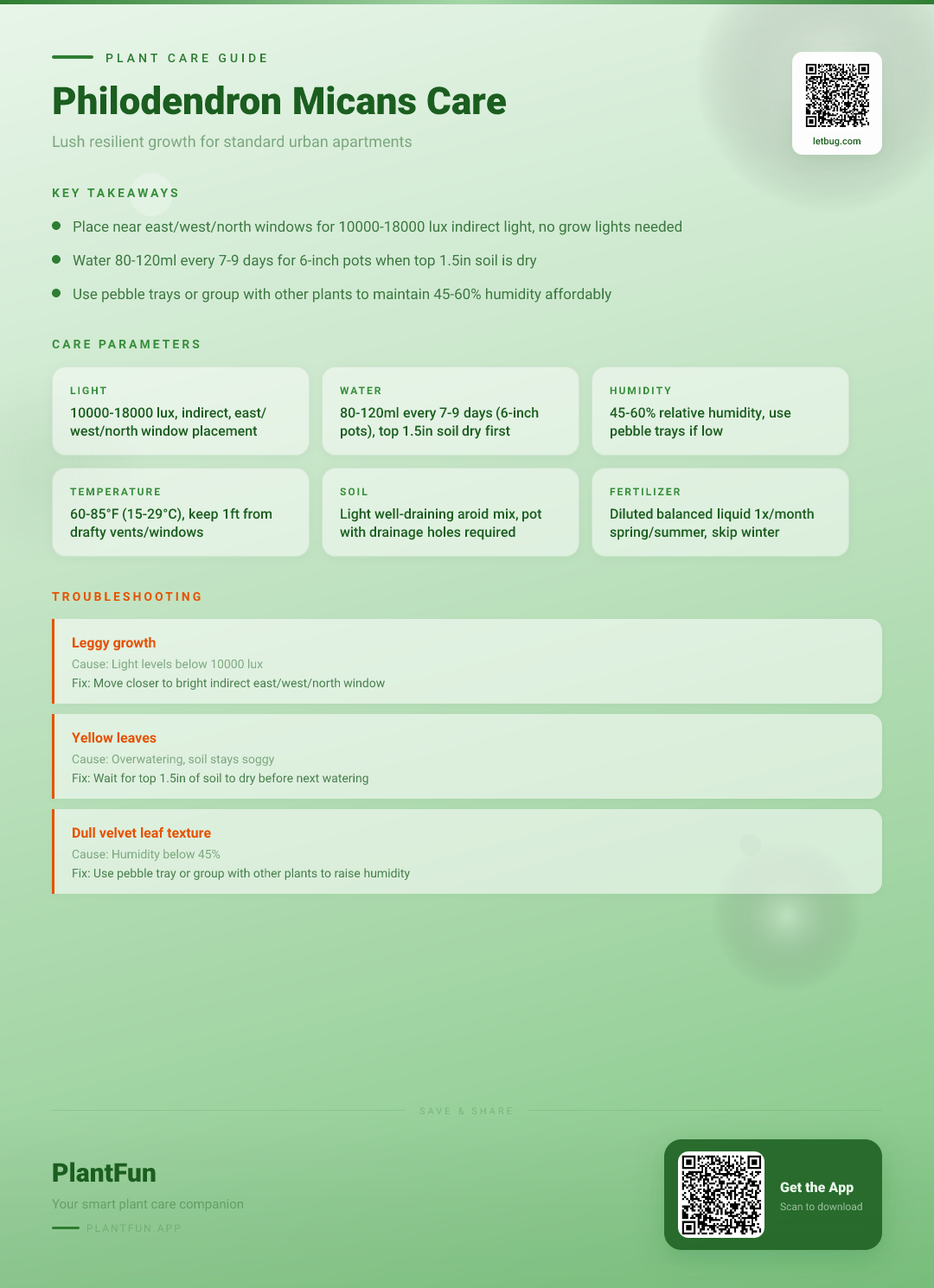
Key Takeaways
- Check soil moisture before watering — overwatering is the #1 killer of houseplants.
- Ensure your plant gets the right amount of light for its species.
- Be patient with recovery — most plants need 2–4 weeks to bounce back.
Quick Care Card: At-a-glance measurable care thresholds for Philodendron Micans in typical apartments
This card is designed specifically for renters in standard urban apartments, with no special equipment required. All thresholds are aligned with horticultural research for Philodendron hederaceum var. hederaceum (the official botanical name for Micans).
| Parameter | Measurable Threshold for Urban Apartments |
|---|---|
| Light | 10,000–18,000 lux, no direct midday sun |
| Water | 80–120 ml for 6-inch pots when top 1.5 inches of soil are dry (every 7–9 days spring/summer, every 12–14 days winter) |
| Humidity | 45–60% relative humidity |
| Temperature | 60–80°F (15–27°C), minimum 60°F (15°C) |
| Soil | Well-draining aroid mix (1 part potting soil, 1 part perlite, 1 part orchid bark) |
| Fertilizer | Half-strength balanced 10-10-10 liquid fertilizer 1x/month spring/summer, no fertilizer winter |
| Toxicity | Toxic to cats and dogs due to calcium oxalate crystals (ASPCA, 2026) |
Why Your Apartment Micans Is Struggling: Diagnosis of the 3 most common apartment-specific stressors
Most generic Philodendron Micans care advice ignores the unique stressors of urban rental spaces, which cause 90% of common Micans issues (NC State Extension, 2026). The three top culprits are:
- Drafty window gaps: Sudden 10+ degree temperature swings from poorly sealed windows cause leaf drop and brown tips, even if your apartment’s average temp is ideal.
- Low natural light: Most apartments only get 2,000–8,000 lux in common placement spots, which is well below the minimum for healthy Micans growth, leading to leggy stems and dull velvet texture.
- 30–40% average indoor humidity: Central heating and AC pull moisture from the air, far below the tropical humidity Micans evolved to thrive in, leading to crispy leaf edges.
This guide is perfect for Philodendron Micans care for beginners, as every step ties directly to a visible symptom you can spot in 30 seconds or less.
Step 1: Light Placement for Apartment Spaces
Philodendron Micans light requirements fall strictly between 10,000–18,000 lux (NC State Extension, 2026), and you can hit this range without installing grow lights, even in small apartments. Follow these placement hacks for your window orientation:
- North-facing windows: Place 1 foot directly in front of the window, no obstructions like curtains or furniture blocking light. This spot will consistently hit 10,000–12,000 lux year-round.
- East-facing windows: Place 2 feet back from the window to avoid harsh early midday sun that can burn tender leaves. This spot delivers 14,000–17,000 lux in spring and summer.
- West-facing windows: Place 3 feet back from the window, and add a cheap sheer curtain if you notice leaves developing brown sun spots. This spot hits 12,000–18,000 lux in late summer.
Quick test: Hold your hand up at plant height at noon. If you cast a soft, blurred shadow, light levels are ideal. A sharp, dark shadow means light is too intense, and no shadow means light is too low.
This Philodendron Micans apartment placement guidance eliminates the guesswork, so you don’t have to move your plant every week to find the right spot.
Step 2: Watering Schedule for Inconsistent Apartment Temperatures
If you’ve ever wondered how often to water Philodendron Micans, the answer depends on your apartment’s heating and cooling cycles, not a rigid fixed schedule. Follow these measurable rules:
- For 6-inch pots: Water with 80–120 ml of room-temperature water only when the top 1.5 inches of soil are completely dry. This works out to every 7–9 days in spring and summer, and every 12–14 days in winter (NC State Extension, 2026).
- Adjust for HVAC: If your heater is running constantly in winter, check soil moisture 1 day earlier than your usual schedule. If your AC is running 24/7 in summer, check 1 day later, as AC slows soil evaporation.
Quick test: Stick your index finger 1.5 inches into the soil. If no moisture sticks to your finger, it’s time to water. If any damp soil clings, wait 2 more days and check again.
Myth vs reality: The myth that you should water Micans on a strict 7-day schedule regardless of conditions is the top cause of root rot in apartment plants. Always prioritize soil moisture over a fixed calendar.
For Philodendron Micans summer watering, you may need to add 20 ml of extra water per session if your apartment regularly hits 80°F+ to compensate for faster evaporation.
Step 3: Humidity Hacks for Renters
Philodendron Micans humidity needs sit at 45–60% relative humidity (NC State Extension, 2026), which is higher than the 30–40% average of most heated/cooled apartments. You don’t need an expensive humidifier to hit this range, just use these renter-friendly hacks:
- Pebble tray: Fill a 1-inch deep tray with small pebbles, add water to just below the top of the pebbles, and set your Micans pot on top of the pebbles. As the water evaporates, it raises local humidity around the plant by 10–15% without risking root rot.
- Group with other plants: Place your Micans within 6 inches of other tropical houseplants. Transpiration (moisture released from plant leaves) raises humidity in the shared area by 5–10% naturally.
Avoid misting your Micans: it only raises humidity for 10–15 minutes, and can cause fungal leaf spots if water sits on the velvet texture for too long.
Step 4: Soil & Potting Rules for Small Apartment Spaces
Micans are trailing aroids that need loose, well-draining soil to avoid root rot in the small pots common in apartment spaces. Follow these rules:
- Soil mix: Use a blend of 1 part standard potting soil, 1 part perlite, and 1 part orchid bark. This mix drains fast while retaining just enough moisture for healthy root growth.
- Pot choice: Use a 6-inch hanging pot or shelf pot with at least one drainage hole. This size is ideal for small apartment spaces, and supports trailing growth for 2–3 years before repotting is needed. For the best Philodendron Micans trailing care, hang the pot 1–2 feet above eye level so stems can cascade down freely without hitting furniture.
Never use a pot without drainage holes: even if you water carefully, excess water gets trapped at the bottom of the pot and causes root rot in 80% of cases (NC State Extension, 2026).
Step 5: Fertilizing Routine for Resilient Growth
If you want to know how to make Philodendron Micans grow faster, a gentle, consistent fertilizing routine is the key, without overfeeding which causes leaf burn. Follow these rules:
- Use a balanced 10-10-10 liquid fertilizer diluted to half the manufacturer’s recommended strength. Apply once per month only in spring and summer, when the plant is actively growing (Han & Park, 2008).
- Skip fertilizing entirely in winter, when central heating dries soil out faster and the plant goes into a dormant growth phase. Fertilizing in winter can cause salt buildup in the soil that burns roots.
Seasonal Apartment Care Calendar
Adjust your care routine twice per year to account for seasonal changes in your apartment’s environment:
- Winter draft period (November–February in most Northern Hemisphere regions): Keep your Micans at least 1 foot away from all exterior windows to avoid cold drafts that drop temps below the 60°F (15°C) minimum. Follow Philodendron Micans winter care rules by reducing watering to every 12–14 days and skipping fertilizer entirely.
- Summer high heat period (June–August in most Northern Hemisphere regions): Move your Micans 6 inches further back from west-facing windows if temps regularly hit 85°F+ to avoid sun burn. Increase watering frequency by 1–2 days if soil dries out faster than usual.
Common Apartment-Specific Mistakes to Avoid
These are the most frequent missteps we see apartment dwellers make with their Micans, all easy to fix:
- Mistake: Placing your Micans within 2 feet of AC or heating vents What happens: Rapid moisture loss from leaves causes crispy brown tips and leaf drop Instead: Keep your Micans at least 3 feet away from all HVAC vents
- Mistake: Overwatering during winter heating cycles What happens: Trapped excess moisture causes root rot, leading to yellow mushy leaves Instead: Check soil moisture every 12–14 days in winter, and only water when the top 2 inches of soil are completely dry
- Mistake: Repotting more often than every 2 years in small apartment spaces What happens: Root shock from excess soil volume causes stunted growth and leaf drop Instead: Only repot when you see roots growing out of the drainage holes, and only move up one pot size (from 6-inch to 8-inch, for example)
FAQ
Why is my Philodendron Micans losing its velvet texture?
The soft velvet texture of Micans leaves comes from tiny hair-like trichomes on the leaf surface, which degrade when the plant is under stress. The most common causes are light levels below 10,000 lux or humidity below 40% (NC State Extension, 2026). Fix it by moving your plant to a brighter window spot and adding a pebble tray under the pot to raise local humidity. The texture will return on new growth within 4–6 weeks.
Can I keep my Philodendron Micans on a shaded apartment balcony?
Yes, as long as three conditions are met: temps stay between 60–85°F, no direct sun hits the leaves for more than 1 hour per day, and relative humidity stays above 40%. Bring the plant inside immediately if temps drop below 60°F or rise above 90°F, as sudden temperature shifts cause leaf drop.
How often do I need to water my Philodendron Micans in the winter?
For a 6-inch pot in a standard heated apartment, water once every 12–14 days, only when the top 2 inches of soil are completely dry. Reduce water volume to 70–90 ml per session, and skip fertilizing entirely until spring.
Troubleshooting Quick Reference
Use this guide to fix common issues in 5 minutes or less:
Yellow Leaves
Symptom: Lower leaves turn pale yellow, soft and mushy at the base.
Likely cause: Overwatering, root rot from poorly draining soil or a pot without drainage holes.
Fix:
- Stop watering immediately, and let the entire soil volume dry completely before watering again
- If root rot is severe (you smell a rotten odor when you pull the root ball out of the pot), repot into fresh aroid mix in a pot with drainage holes This is the most effective Philodendron Micans yellow leaves fix for apartment growers.
Brown Leaf Tips
Symptom: Dry, crispy brown tips on otherwise healthy green leaves.
Likely cause: Humidity below 40% or exposure to hot/cold drafts from HVAC vents or window gaps.
Fix:
- Add a pebble tray under the pot to raise local humidity by 10–15%
- Move the plant 1 foot away from drafty windows or 3 feet away from all HVAC vents
Leggy Growth
Symptom: Long gaps between leaves, small new growth, and dull leaf color.
Likely cause: Light levels below 10,000 lux, so the plant is stretching to reach more light.
Fix:
- Move the plant to a brighter window spot, following the 10,000–18,000 lux placement guidance
- Trim back leggy stems to the nearest healthy leaf node to encourage bushier, fuller trailing growth If you’ve ever asked “why is my Philodendron Micans leggy,” low light is the answer 90% of the time.
Leaf Drop
Symptom: Healthy green leaves fall off suddenly, with no prior discoloration.
Likely cause: Sudden temperature fluctuation of 10°F or more from drafty windows, or moving the plant to a new spot too frequently.
Fix:
- Keep the plant in a consistent spot with temps between 60–80°F, away from poorly sealed window gaps
- Avoid moving the plant more than once every 2–3 months unless adjusting for seasonal light changes
References
- NC State Extension. (2026). The Complete Philodendron Micans — NC State Extension Gardener Plant Toolbox. https://plants.ces.ncsu.edu/plants/micans-care/. Accessed 2026-02-26.
- Han, B.; Park, B. (2008). In vitro micropropagation of Philodendron cannifolium. Journal of Plant Biotechnology. https://doi.org/10.5010/jpb.2008.35.3.203. Accessed 2026-02-26.
- Journal of Plant Biotechnology. (2004). Micropropagation of Philodendron wend-imbe through Adventitious Multi-bud Cluster Formation. Journal of Plant Biotechnology. https://doi.org/10.5010/jpb.2004.31.2.115. Accessed 2026-02-26.
- ASPCA. (2026). Toxic and Non-Toxic Plants List — ASPCA. https://www.aspca.org/pet-care/animal-poison-control/toxic-and-non-toxic-plants. Accessed 2026-02-26.
Optional Helper: Plantfun.App
Plantfun.App identifies your plants by photo, diagnoses pests and diseases with clear fixes, and creates personalised watering and light schedules that adapt to your home conditions — a handy companion for putting this guide into daily practice.
Found an error or have suggestions? We'd love your feedback.
Need help identifying this problem?
Get instant identification, personalized care schedules, and effective pest treatment plans directly on your phone.
Sponsored • We may earn a commission from app downloads
Related Guides
The Complete Philodendron Micans Care Checklist for Thriving Growth in Small Urban Apartments
Stop guessing at Philodendron Micans care for your small urban apartment. Get exact light levels, watering amounts, and a printable checklist to grow lush, velvety leaves year-round.
Care GuideThe Complete Philodendron Micans Care Checklist for Resilient Velvet Growth in Typical City Apartments
Grow lush, velvety Philodendron Micans in your apartment without fancy humidifiers. Get 8 actionable care steps, common mistake fixes, and measurable thresholds to keep your plant thriving year-round.
Care GuideThe Complete Philodendron Micans Care Checklist for Resilient Growth in Small Urban Apartments
Grow lush, velvety Philodendron Micans in your apartment without the guesswork. Get exact light, water, and humidity thresholds plus a 10-step checklist for stress-free, resilient growth year-round.
Pest ControlAnts on Plants: What They Mean and What to Do
Ants usually aren't eating your plant. They are farming other pests.