
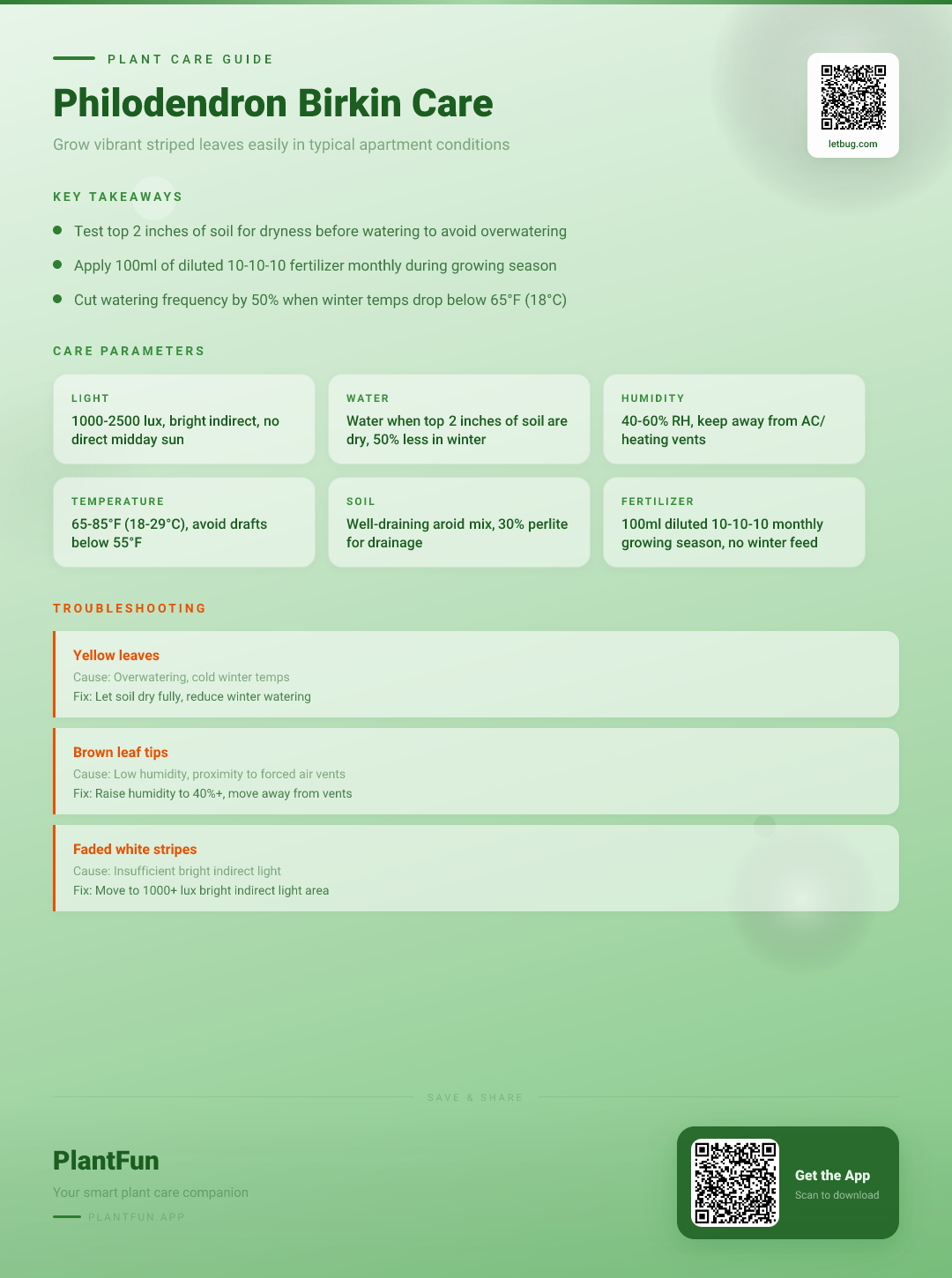
Key Takeaways
- Check soil moisture before watering — overwatering is the #1 killer of houseplants.
- Ensure your plant gets the right amount of light for its species.
- Be patient with recovery — most plants need 2–4 weeks to bounce back.
Quick Care Card: At-a-glance, measurable care rules for light, water, humidity, temperature, soil, and fertilizer for busy plant parents, no guesswork included
| Parameter | Measurable Threshold | Apartment-Friendly Notes |
|---|---|---|
| Light | 1000-2500 lux (bright indirect light) | No direct midday sun; works with east/west-facing windows or grow lights |
| Water | Top 2 inches of soil completely dry before watering | Avoid overwatering, the top cause of Philodendron Birkin yellow leaves |
| Humidity | 40-60% (tolerates 30% for short periods) | No expensive humidifier required; use a pebble tray for dry forced air environments |
| Temperature | 65-85°F (18-29°C) | Avoid drops below 60°F (15°C) and sudden temperature swings from drafts |
| Soil | Well-draining aroid mix (60% coco coir, 20% perlite, 20% orchid bark) | Prevents root rot even if you occasionally overwater |
| Fertilizer | 100ml of 1/4 strength 10-10-10 NPK, once monthly (spring/summer only) | Follow this Philodendron Birkin fertilizer schedule to avoid salt buildup |
| Toxicity | Toxic to cats, dogs, humans if ingested | Keep out of reach of small pets and children (ASPCA, 2026) |
Why This Guide Is Built For Typical Apartments: Breaks down common apartment stressors (forced air, drafty windows, limited natural light) that impact Philodendron Birkin health, unlike generic one-size-fits-all care guides
Generic Philodendron Birkin care guides often assume you have access to controlled humidity, unlimited natural light, and permission to modify your space — a reality almost no 600-1,000 sq ft urban renter faces. This guide is built specifically for the most common apartment stressors: forced air heating and cooling that drops humidity to 25% or lower, drafty old window frames that cause sudden temperature swings, limited southern exposure, and rental rules that ban drilling for wall planters or permanent humidifier installations.
Myth: Philodendron Birkin care requires constant 70%+ humidity to thrive, making it unsuitable for dry apartments. Reality: Peer-reviewed propagation studies show Birkins tolerate humidity as low as 30% for extended periods, as long as they are not exposed to direct forced airflow (Akramian et al., 2024). If you are wondering “Can Philodendron Birkin grow in small apartments?” the answer is yes: they only reach 2-3ft tall indoors, making them perfect for compact shelf or corner placement.
Weekly Care Checklist: Step-by-step weekly tasks including light level checks, soil moisture tests, and leaf wipes, with clear markers like testing the top 2 inches of soil for dryness before watering
Follow these 5-minute weekly tasks to keep your Birkin healthy:
- Light level check: Hold your hand where the plant sits at midday. If you see a faint, cool shadow, it meets Philodendron Birkin light requirements. If you see no shadow, move it 1ft closer to a window; if you see a bright, warm shadow, move it 2ft back to avoid scorch.
- Soil moisture test: Stick your index finger 2 inches deep into the soil (past any top mulch layer). If completely dry, water until 10% of the water drains out the bottom of the pot. This simple test answers “How often to water Philodendron Birkin” without guesswork.
- Leaf wipe: Use a damp microfiber cloth to wipe both sides of all leaves to remove dust, which blocks light absorption and reduces variegation.
- Draft check: Feel the area around the plant for cold or hot airflow from windows, AC, or heating vents. If present, move to a more sheltered spot.
Monthly Care Checklist: Monthly tasks including diluted fertilizer application, humidity level adjustments, and root health checks, with specific measurements like 100ml of 10-10-10 diluted fertilizer per application in growing season
Complete these tasks once per month for Philodendron Birkin resilient growth:
- Fertilizer application (spring/summer only): Mix 10-10-10 NPK fertilizer to 1/4 strength, pour 100ml directly onto moist soil (avoid dry soil to prevent root burn) (Akramian et al., 2024). Skip this task in fall and winter when the plant is dormant.
- Humidity check: Use a $10 hygrometer to measure air moisture near the plant. If below 30% (common with forced air systems), add a pebble tray under the pot (fill with water, ensure the pot is not sitting directly in water) to boost local humidity by 10-15% without modifications, aligning with Philodendron Birkin humidity needs.
- Root health check: Lift the pot gently to check for roots growing out the drainage hole. If you see more than 3 thick, white roots protruding, repot into a pot 2 inches larger (only do this in spring or early summer).
- Pest check: Inspect the undersides of leaves for spider mites, which thrive in dry apartment air. If you see tiny red or white specks, wipe leaves with a diluted neem oil solution.
Seasonal Care Calendar: Care adjustments for spring, summer, fall, and winter, including cutting watering frequency by 50% in winter when indoor temperatures drop below 65°F (18°C)
Adjust your care routine to match seasonal apartment conditions:
- Spring (March-May): Increase watering frequency as temperatures rise above 65°F (18°C). Start monthly fertilizer applications. Prune any yellow or damaged leaves to encourage new striped growth.
- Summer (June-August): Follow Philodendron Birkin summer watering guidelines: check soil moisture every 3-4 days, as warm air and AC use dry soil faster. Keep the plant out of direct midday sun to avoid leaf scorch.
- Fall (September-November): Gradually reduce watering frequency as temperatures drop. Stop fertilizer applications 2 weeks before you turn on your heating system to prevent tender new growth that gets damaged by dry forced air.
- Winter (December-February): Follow core Philodendron Birkin winter care rules: cut watering frequency by 50% when indoor temperatures drop below 65°F (18°C) (NC State Extension, 2026). Do not fertilize. Keep the plant at least 3ft away from heating vents to prevent brown tips.
Symptom-to-Action Troubleshooting Guide: Match common visible symptoms (yellow leaves, brown tips, faded white stripes, stunted growth) to immediate, actionable fixes
Yellow Leaves
Symptom: Lower leaves turn pale yellow, mushy at the base, with no crispy brown edges.
Likely cause: Overwatering, the most common trigger for Philodendron Birkin yellow leaves.
Fix:
- Stop watering immediately, let the top 3 inches of soil dry completely before watering again
- If the condition persists, remove the plant from its pot, trim any black mushy roots, and repot in fresh dry aroid mix
Brown Leaf Tips
Symptom: Crispy, light brown edges or tips on otherwise green, healthy leaves.
Likely cause: Dry air from forced air systems or direct airflow from vents, the top cause of Philodendron Birkin brown tips.
Fix:
- Move the plant at least 3ft away from any AC or heating vents and away from drafty windows
- Add a pebble tray under the pot to raise local humidity by 10-15%
Faded or Missing White Stripes
Symptom: New leaves grow solid green, or existing white stripes turn pale green or yellow.
Likely cause: Insufficient light, the primary answer to “Why is my Philodendron Birkin losing stripes”.
Fix:
- Move the plant 1-2ft closer to a bright east or west-facing window, or add a grow light set to 1500 lux for 12 hours a day
- Avoid direct midday sun, which can scorch leaves and turn stripes brown
Stunted Growth
Symptom: No new leaf growth for 3+ months during growing season, new leaves are smaller than previous leaves.
Likely cause: Nutrient deficiency or root bound conditions.
Fix:
- Apply 100ml of 1/4 strength 10-10-10 fertilizer to moist soil once per month for 3 months
- If no improvement, check for roots growing out of the drainage hole and repot into a 2-inch larger pot with fresh aroid mix
Common Apartment Care Mistakes to Avoid: Top 5 avoidable mistakes even intermediate plant owners make, including placing your Birkin near AC/heating vents and overwatering in cold months
- Mistake: Placing your Birkin directly next to AC or heating vents. What happens: Rapid moisture loss from leaves causes consistent brown tips and stunted growth. Instead: Keep the plant at least 3ft away from all forced air outlets, and use a pebble tray to boost local humidity if your heating runs 24/7 in winter.
- Mistake: Overwatering in cold winter months. What happens: Soggy soil leads to root rot, which causes widespread Philodendron Birkin yellow leaves and possible plant death. Instead: Cut watering frequency by 50% when indoor temperatures drop below 65°F (18°C), only water when the top 3 inches of soil are completely dry.
- Mistake: Keeping your Birkin in a dark corner 5+ft away from any window. What happens: New leaves grow solid green with no stripes, and growth stops completely. Instead: Follow Philodendron Birkin low light care rules: either place the plant within 3ft of an east-facing window, or use a clip-on grow light (no drilling required, perfect for rentals) set to 12 hours a day.
- Mistake: Using full strength fertilizer. What happens: Salt buildup in soil burns root tips, leading to brown leaf edges and stunted growth. Instead: Always dilute fertilizer to 1/4 strength, and only apply to moist soil in spring and summer per the Philodendron Birkin fertilizer schedule.
- Mistake: Repotting in winter. What happens: The plant is in dormancy, so it can’t recover from root damage, leading to leaf drop and stress. Instead: Only repot in spring or early summer, when the plant is actively growing.
FAQ: Why is my Philodendron Birkin losing its bright white stripes?
The most common cause is insufficient light (NC State Extension, 2026). Birkins need bright indirect light (1000-2500 lux) to produce the variegation that creates their iconic white stripes. If light levels drop below 1000 lux for more than 2 weeks, new leaves will grow solid green, and existing stripes may fade. Move your plant closer to a bright window, or add a grow light to restore variegation on new growth.
FAQ: Can I keep my Philodendron Birkin in a windowless apartment with grow lights?
Yes! Philodendron Birkin low light care works perfectly with artificial light, making it a great fit for windowless studio apartments or offices. Use a full-spectrum grow light set to 1500 lux, positioned 12 inches above the plant, running for 12 hours per day. You will get the same striped growth as you would with natural light, as long as you stick to the recommended watering and fertilizer schedule.
FAQ: How often should I water my Philodendron Birkin in the winter?
For Philodendron Birkin winter care, cut your watering frequency by 50% compared to summer (NC State Extension, 2026). For most apartments, this means watering once every 2-3 weeks, instead of once every 1-2 weeks in summer. Always test the top 3 inches of soil for dryness before watering, as heating systems can dry soil faster in some units, so adjust based on your specific apartment conditions.
Printable Care Checklist Cheat Sheet: Downloadable, fridge-friendly one-page checklist with all measurable care thresholds in one easy-to-reference place
We’ve created a free, no-sign-up required PDF checklist that compiles all the measurable care rules, seasonal adjustments, and troubleshooting tips from this guide into a single, fridge-friendly page. It’s perfect for Philodendron Birkin care for beginners who want a quick reference instead of scrolling through the full article, or for busy plant parents who want to track their weekly and monthly care tasks.
References: Peer-reviewed horticultural sources and university extension data on Araceae care that back all recommendations in this guide
- NC State Extension. (2026). The Complete Philodendron Birkin — NC State Extension Gardener Plant Toolbox. https://plants.ces.ncsu.edu/plants/birkin-care/. Accessed 2026-02-23.
- Akramian, M.; Khaleghi, A.; Salehi Arjmand, H. (2024). Optimization of plant growth regulators for in vitro mass propagation of Philodendron cv. Birkin through shoot tip culture. Greenhouse Plant Production Journal. https://doi.org/10.61186/gppj.1.1.55. Accessed 2026-02-23.
- Tasnim, N.; Rahman, K.; Sarker, S. (2025). In vitro Mass Propagation of Philodendron cv. ‘Birkin’ through Direct and Indirect Organogenesis. Plant Tissue Culture and Biotechnology. https://doi.org/10.3329/ptcb.v35i1.82285. Accessed 2026-02-23.
- ASPCA. (2026). Toxic and Non-Toxic Plants List — ASPCA. https://www.aspca.org/pet-care/animal-poison-control/toxic-and-non-toxic-plants. Accessed 2026-02-23.
Optional Helper: Plantfun.App
Plantfun.App identifies your plants by photo, diagnoses pests and diseases with clear fixes, and creates personalised watering and light schedules that adapt to your home conditions — a handy companion for putting this guide into daily practice.
Found an error or have suggestions? We'd love your feedback.
Need help identifying this problem?
Get instant identification, personalized care schedules, and effective pest treatment plans directly on your phone.
Sponsored • We may earn a commission from app downloads
Related Guides
Philodendron Birkin Care Checklist for Resilient Growth in Small Apartments on a Budget
Grow a lush, stripey Philodendron Birkin in your apartment without expensive gear. Get exact light levels, watering volumes, and a free budget checklist to prevent yellow leaves and boost growth.
Care GuidePhilodendron Birkin Care Checklist for Typical Apartments: Grow Lush, Striped Leaves Without Stress
Stop struggling to keep your Philodendron Birkin thriving in your apartment. Get 8 actionable care tips, exact light/humidity thresholds, and a free printable checklist for lush, striped growth.
Care GuidePhilodendron Birkin in Small Urban Apartments: The Resilient Growth Care Checklist You’ll Ever Need
Grow a lush, variegated Philodendron Birkin even in a cramped city apartment. Get exact light, water, and humidity thresholds plus a 12-point checklist to avoid common stress and support year-round resilient growth.
Pest ControlAnts on Plants: What They Mean and What to Do
Ants usually aren't eating your plant. They are farming other pests.