
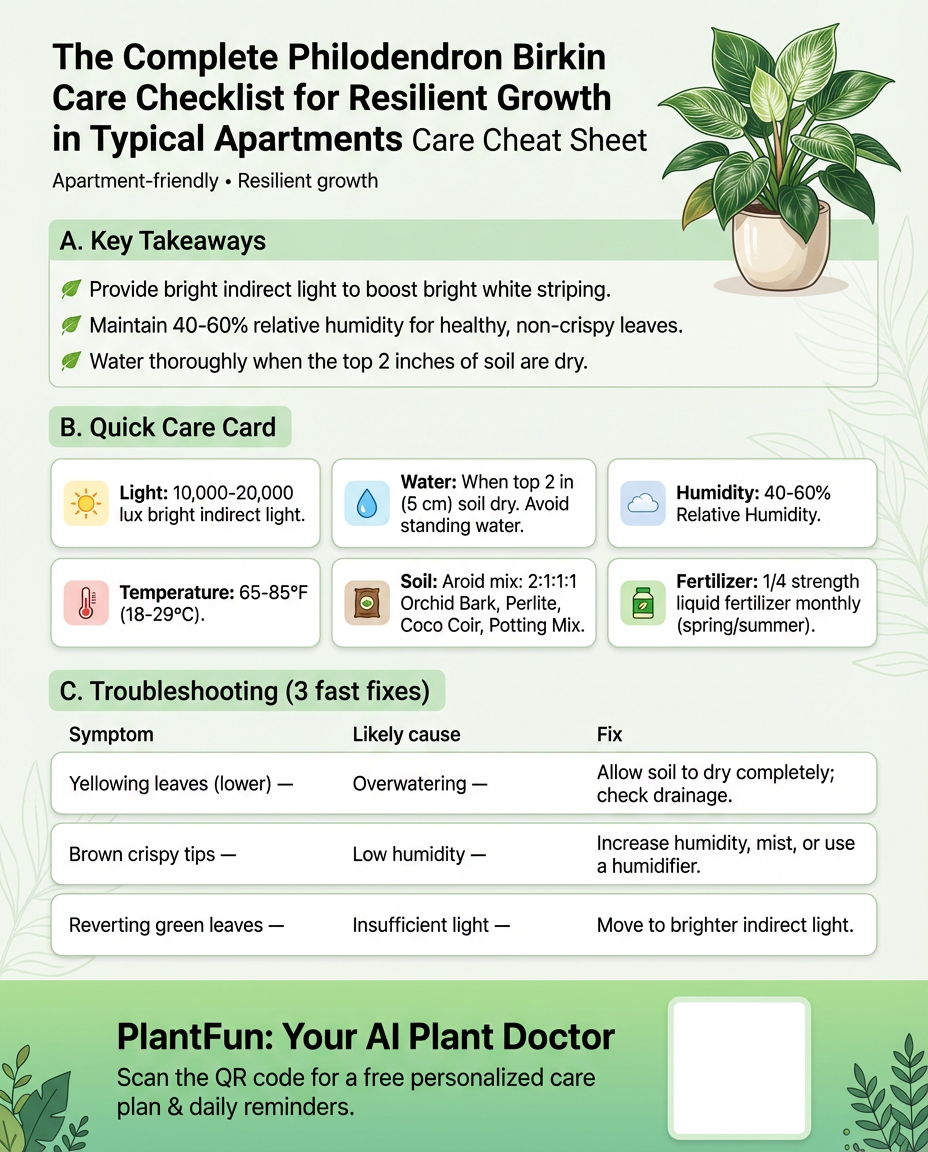
Key Takeaways
- Check soil moisture before watering — overwatering is the #1 killer of houseplants.
- Ensure your plant gets the right amount of light for its species.
- Be patient with recovery — most plants need 2–4 weeks to bounce back.
Quick Care Card
Print this at-a-glance reference for fast, no-guess Philodendron Birkin care tailored to apartment conditions:
| Care Factor | Apartment-Specific Threshold | Quick Notes |
|---|---|---|
| Light | 10,000–18,000 lux bright indirect light | Avoid direct midday sun that burns variegated leaves |
| Water | 150–200ml filtered water when top 1.5 inches of soil are completely dry | Adjust frequency for HVAC dryness in winter |
| Humidity | 45–60% relative humidity | Do not let levels drop below 40% for extended periods |
| Temperature | 65–80°F (18–27°C) | Never place near drafts below 55°F (13°C) |
| Soil | Well-draining aroid mix | Prioritize aeration to prevent root rot in small pots |
| Fertilizer | Half-strength 10-10-10 liquid fertilizer, monthly only in summer | Skip fertilizing entirely in fall and winter |
| Toxicity | Toxic to cats and dogs if ingested | Keep out of reach of chewing pets (ASPCA, 2026) |
Why Birkin Care Is Unique For Typical Apartments
Unlike solid-green philodendron varieties, the Birkin’s signature white variegation means it has less chlorophyll to convert light to energy, making it far more sensitive to common apartment stressors (NC State Extension, 2026). The three biggest hurdles for apartment-grown Birkins are:
- Low natural light from small, north-facing or blocked windows that causes faded stripes and stunted growth
- Dry HVAC air that drops indoor humidity to 20-30% RH, far below the plant’s preferred range
- Limited shelf and counter space that restricts pot size and repotting frequency
This guide is tailored to solve all three of these stressors without requiring expensive equipment or major lifestyle changes, making it perfect for Philodendron Birkin care for beginners and experienced renters alike.
Weekly 2-Minute Care Routine Overview
Catch issues before they become permanent with this fast step-by-step check you can fit in between work meetings or chores:
- (30 sec) Stick your index finger 1.5 inches into the soil to confirm dryness before watering
- (45 sec) Flip through top and lower leaves to look for yellowing, brown edges, or faded stripes
- (30 sec) Verify the plant is not directly in the path of AC, heater, or cold window drafts
- (15 sec) Brush off any visible dust on large leaves if buildup is present
Exact Light Requirements for Apartment Placement
Philodendron Birkin light requirements sit at a measurable 10,000–18,000 lux of bright indirect light (Akramian et al., 2024). If you don’t own a light meter, this is equivalent to bright light where you can read a book comfortably without overhead lights, but no direct sun hits the plant’s leaves. The three best apartment spots for your Birkin are:
- 6ft back from a south-facing window (filtered with a sheer curtain if midday sun reaches the spot)
- East-facing window sill (only gets gentle morning sun that won’t burn variegation)
- Bright living room corner with full-spectrum overhead LED lights (12 hours per day for low-light units)
Light levels below 10,000 lux are the most common cause of faded white stripes, a top concern for Birkin owners.
Watering Guidelines Tailored to Apartment Humidity
Stick to this exact rule to avoid overwatering or underwatering: Give your plant 150–200ml of filtered, room-temperature water only when the top 1.5 inches of soil feel completely dry, with no moisture clinging to your finger when you remove it.
For apartments with forced air heat in winter, check soil dryness 2 days earlier than your usual schedule, but never add extra water to compensate for dry air — this is a common mistake that leads to root rot. If you struggle with consistent watering, check out our guide to how to water houseplants for beginners for more tips.
Humidity and Temperature Thresholds
Philodendron Birkin humidity needs fall between 45–60% relative humidity, with a preferred temperature range of 65–80°F (18–27°C) (Tasnim et al., 2025). Never expose your plant to temperatures below 55°F (13°C), as this causes permanent leaf damage and stunted growth. Keep it at least 3ft away from drafty windows, AC vents, and heater vents to avoid rapid temperature fluctuations.
For low-humidity apartments, try a pebble tray or group your Birkin with other plants to boost humidity without bulky equipment. Learn more in our guide to raising indoor humidity for small apartments.
Soil and Potting Tips for Small Apartment Spaces
For Philodendron Birkin small apartment care, use a light, well-draining aroid mix made of 1 part perlite, 1 part orchid bark, 1 part coco coir, and 0.5 part worm castings. You can find pre-mixed options tailored to small spaces in our best aroid soil for apartments roundup.
Stick to 4-inch pots for young Birkins, and a maximum 6-inch pot for mature plants to fit on standard shelves and counters. Only upsize your pot by 1–2 inches at a time to avoid excess soil that holds too much moisture and causes root rot. Always use a pot with drainage holes, even if you hide it inside a decorative cache pot.
Seasonal Care Calendar for Apartment Dwellers
Adjust your care routine with the seasons to support consistent Philodendron Birkin resilient growth tips:
- Winter (October–February, Northern Hemisphere): For Philodendron Birkin winter care, water every 12–16 days, skip all fertilizer, and move the plant 2ft away from cold windows to avoid draft damage.
- Summer (June–August): For Philodendron Birkin summer watering, water every 7–10 days, apply half-strength 10-10-10 liquid fertilizer once per month, and mist every 3 days if relative humidity drops below 40%.
- Spring/Fall: Adjust watering frequency based solely on soil dryness, and only apply fertilizer if you see active new growth.
Common Apartment-Specific Mistakes to Avoid
Steer clear of these frequent errors that cause 90% of Birkin health issues in rental units:
- Mistake: Placing your Birkin directly in harsh midday south-facing window sun What happens: The delicate white variegation burns, leaving brown, crispy patches that don’t heal Instead: Keep it 6ft back from south windows, or filter light with a sheer curtain
- Mistake: Using drainage-free decorative pots to match your apartment decor What happens: Excess water gets trapped at the bottom of the pot, leading to root rot and yellow lower leaves Instead: Use a plastic nursery pot with drainage holes inside your decorative cache pot, and empty any standing water after watering
- Mistake: Overwatering to compensate for dry HVAC air What happens: Soggy soil suffocates roots, leading to drooping leaves and eventual plant death Instead: Boost humidity with a pebble tray or plant grouping, and stick to the 1.5-inch soil dryness rule for watering
- Mistake: Repotting into an oversized pot to skip future repotting in your small space What happens: Extra soil holds excess moisture that roots can’t absorb, leading to root rot Instead: Only upsize 1–2 inches at a time, and stick to 4–6 inch pots for small apartment shelves
- Mistake: Keeping your Birkin directly in the path of AC or heater vents What happens: Rapid temperature fluctuations and dry air cause crisp brown leaf edges Instead: Place it at least 3ft away from all HVAC vents
- Mistake: Skipping leaf dusting in closed, low-airflow apartments What happens: Dust blocks light absorption, leading to faded stripes and slow growth Instead: Wipe leaves with a damp microfiber cloth once per month to remove buildup
Symptom-to-Action Troubleshooting Guide
Match your plant’s symptoms to fast, actionable fixes:
Yellow Lower Leaves
Symptom: Older, lower leaves turn soft yellow, with no browning on edges
Likely cause: Overwatering, the most common Philodendron Birkin yellow leaves fix trigger
Fix:
- Stop watering immediately until the entire pot of soil is almost completely dry
- Check for root rot if leaves continue to yellow, and repot into fresh dry aroid mix if needed
- Adjust your watering schedule to only water when the top 1.5 inches of soil are dry
Crisp Brown Leaf Edges
Symptom: Dry, crispy brown edges on otherwise healthy green leaves, often with a thin yellow border
Likely cause: Low humidity or exposure to drafty vents, the top trigger for Philodendron Birkin brown edges treatment
Fix:
- Move the plant at least 3ft away from AC, heater, or drafty window vents
- Boost humidity to 45–60% using a pebble tray or plant grouping
- Trim off brown edges with clean scissors to improve appearance
Faded White Stripes
Symptom: New leaves grow in solid green, or existing white stripes fade to pale green
Likely cause: Insufficient light, the main answer to why is my Philodendron Birkin losing stripes
Fix:
- Move the plant to a brighter spot that meets the 10,000–18,000 lux threshold
- Add a full-spectrum grow light if your apartment has no bright window spots
- Avoid direct sun that burns the new variegated leaves as they grow in
Brown Spots with Yellow Halos
Symptom: Circular brown spots surrounded by bright yellow rings on leaves
Likely cause: Fungal leaf spot from overwatering or high humidity combined with poor airflow
Fix:
- Remove affected leaves with clean scissors to prevent spread
- Reduce watering frequency, and avoid getting water on the leaves when you water
- Add a small fan nearby to improve airflow in closed apartment spaces
Drooping Leaves
Symptom: Soft, limp leaves that droop downward, with no discoloration
Likely cause: Either underwatering or overwatering, check soil to confirm
Fix:
- If the top 1.5 inches of soil are completely dry, water with 150–200ml of filtered water
- If the soil is soggy, stop watering and let it dry out completely before watering again
- Check that the pot has drainage holes to prevent standing water
Voice Search Optimized FAQ
Why is my Philodendron Birkin losing its white stripes?
Your Birkin is likely not getting enough light. Variegated leaves require more light to maintain their white coloring, as the white portions have no chlorophyll (Akramian et al., 2024). Move it to a spot with 10,000–18,000 lux of bright indirect light, and new leaves should grow in with their signature white stripes.
Can I keep my Philodendron Birkin in my apartment bedroom?
Yes, you can keep a Philodendron Birkin in your bedroom, as it does not produce any toxic fumes and thrives in typical bedroom temperature and light levels. Note that Philodendron Birkin is toxic to cats and dogs if ingested (ASPCA, 2026), so keep it on a high shelf out of reach of chewing pets if you have animals in your home. Learn more about pet-safe plant placement in our pet-safe apartment plant guide.
How often do I water my Birkin in winter?
For Philodendron Birkin winter care, water every 12–16 days, depending on your apartment’s temperature and humidity. Always confirm the top 1.5 inches of soil are completely dry before watering, as lower light and cooler temperatures mean the plant uses less water in winter. For more winter care tips, see our winter houseplant care for apartments guide.
Low-Effort Hacks for Busy Renters
You don’t need to spend hours a week on Philodendron Birkin care to keep it thriving:
- Group with other plants: Placing your Birkin near other houseplants creates a microclimate that boosts humidity naturally, no humidifier required.
- Use a self-watering spike for travel: If you’re gone for 1–2 weeks, insert a self-watering spike filled with filtered water to keep the soil evenly moist without overwatering.
- Wipe leaves monthly: A quick wipe with a damp microfiber cloth once per month removes dust that blocks light absorption, supporting faster growth and brighter variegation.
References
- NC State Extension. (2026). The Complete Philodendron Birkin — NC State Extension Gardener Plant Toolbox. https://plants.ces.ncsu.edu/plants/birkin-care/. Accessed 2026-03-04.
- Akramian, M.; Khaleghi, A.; Salehi Arjmand, H. (2024). Optimization of plant growth regulators for in vitro mass propagation of Philodendron cv. Birkin through shoot tip culture. Greenhouse Plant Production Journal. https://doi.org/10.61186/gppj.1.1.55. Accessed 2026-03-04.
- Tasnim, N.; Rahman, K.; Sarker, S. (2025). In vitro Mass Propagation of Philodendron cv. ‘Birkin’ through Direct and Indirect Organogenesis. Plant Tissue Culture and Biotechnology. https://doi.org/10.3329/ptcb.v35i1.82285. Accessed 2026-03-04.
- ASPCA. (2026). Toxic and Non-Toxic Plants List — ASPCA. https://www.aspca.org/pet-care/animal-poison-control/toxic-and-non-toxic-plants. Accessed 2026-03-04.
Optional Helper: Plantfun.App
Plantfun.App identifies your plants by photo, diagnoses pests and diseases with clear fixes, and creates personalised watering and light schedules that adapt to your home conditions — a handy companion for putting this guide into daily practice.
Found an error or have suggestions? We'd love your feedback.
Need help identifying this problem?
Get instant identification, personalized care schedules, and effective pest treatment plans directly on your phone.
Sponsored • We may earn a commission from app downloads
Related Guides
Philodendron Birkin Care Checklist for Typical Apartments: Grow Lush, Striped Leaves Without Stress
Stop struggling to keep your Philodendron Birkin thriving in your apartment. Get 8 actionable care tips, exact light/humidity thresholds, and a free printable checklist for lush, striped growth.
Care GuideThe Complete Philodendron Birkin Care Checklist for Resilient Growth in Small Urban Apartments
Skip expensive plant gadgets with this actionable Philodendron Birkin care checklist. Get exact light, water, and soil specs to grow lush, pinstriped plants in any standard urban apartment.
Care GuideThe Complete Philodendron Birkin Care Checklist for Resilient Growth in Average Apartments
Grow a lush, striped Philodendron Birkin even in a standard apartment. Get exact light levels, watering amounts, and a seasonal care checklist to avoid yellow leaves and stunted growth.
Pest ControlAnts on Plants: What They Mean and What to Do
Ants usually aren't eating your plant. They are farming other pests.