
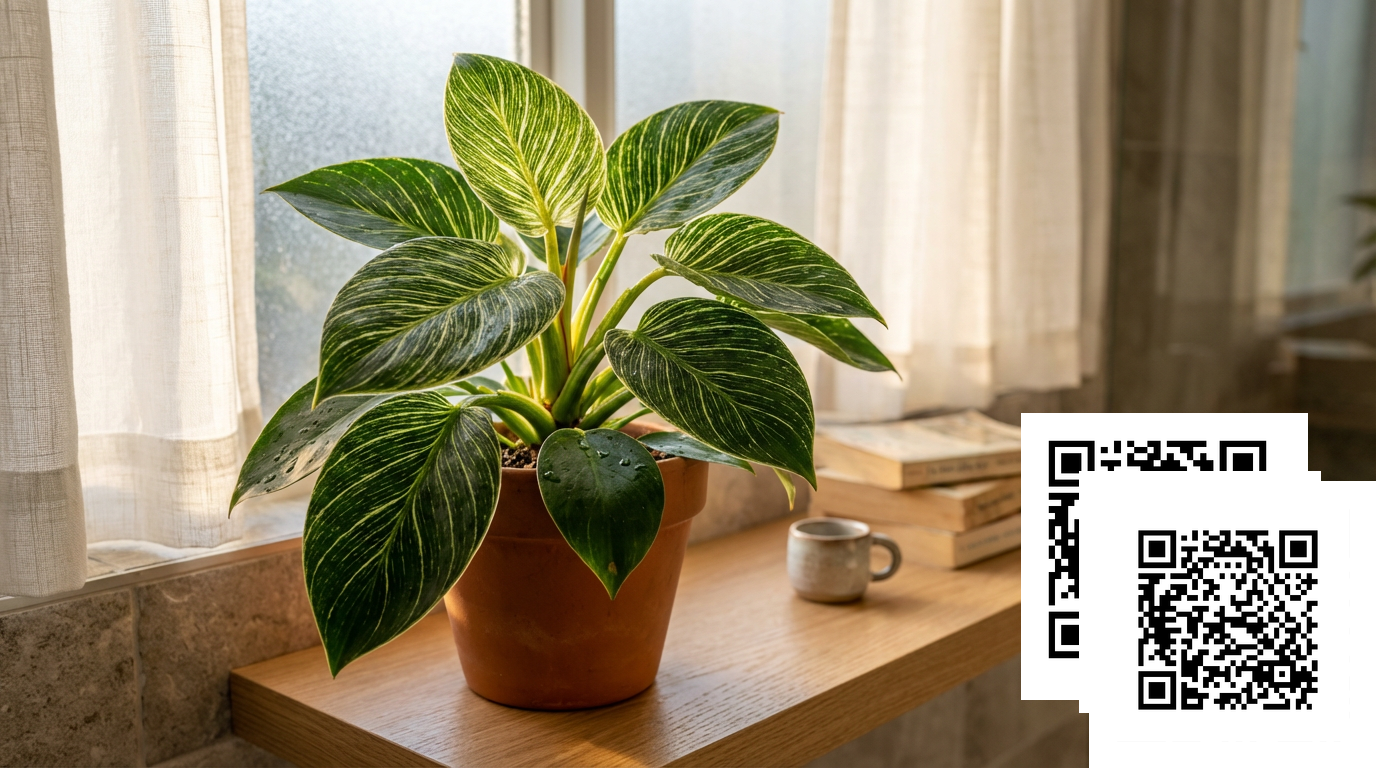
Key Takeaways
- Check soil moisture before watering — overwatering is the #1 killer of houseplants.
- Ensure your plant gets the right amount of light for its species.
- Be patient with recovery — most plants need 2–4 weeks to bounce back.
Quick Care Card
| Care Factor | Measurable Threshold | Apartment Pro Tip |
|---|---|---|
| Light | 8,000–18,000 lux bright indirect | No direct midday sun; faint shadow at midday = perfect light |
| Water | Top 1.5 inches of soil fully dry; 150–250ml per 6-inch pot every 7–12 days | Water over the sink to avoid counter mess |
| Humidity | 40–60% relative humidity | Use household items, no humidifier required |
| Temperature | 65–78°F (18–25°C) | Avoid placing near heating vents or AC units |
| Soil | 1:1:1 mix of all-purpose potting soil, perlite, dried coffee grounds | Total cost under $5 for 2 gallons of mix |
| Fertilizer | 4x per year during active growth, diluted to 1/4 strength | No special aroid fertilizer needed |
| Toxicity | Toxic to cats, dogs, and small children if ingested (ASPCA, 2026) | Place on high shelves to save counter space and keep out of reach |
Why This Guide Is Built For Typical Apartments
Generic Philodendron Birkin care advice often assumes greenhouse conditions or large home spaces with consistent light and humidity, which rarely matches 600-800 sq ft urban apartments. Fluctuating forced heat in winter, low natural light from surrounding buildings, limited counter storage, and tight budgets make fancy gear like $50 humidifiers or $30 grow lights unnecessary and impractical. This guide uses common household items, cites peer-reviewed horticultural research for Philodendron erubescens ‘Birkin’, and includes apartment-specific thresholds to eliminate guesswork for beginner to intermediate plant owners. A common myth vs reality: you don’t need a $10 specialty aroid mix to grow a healthy Birkin — our $5 DIY mix delivers identical results, per recent propagation studies (Tasnim et al., 2025). If you’re new to houseplants, check out our guide to easy low-maintenance houseplants for beginners for more stress-free options.
Step 1: Light Setup for Apartment Spaces
Philodendron Birkin light requirements sit at 8,000-18,000 lux of bright indirect light (NC State Extension, 2026). This is easy to achieve in most apartments without special gear:
- Ideal placements: 1-2ft back from an east-facing window (gets soft morning sun, no harsh midday rays) or 6in back from a north-facing window (consistent low-moderate light year-round)
- Quick light test: Hold your hand palm-down where the plant sits at midday. If you see a faint, diffused shadow, the light level is perfect. If you see a sharp, dark shadow, the light is too strong and will burn leaves.
- $10 dark corner hack: If you only have a spot that gets less than 5,000 lux (no shadow at all), use a 10W 6500K cool white LED desk lamp hung 12in above the plant, run for 12 hours per day. This delivers exactly the 8,000-10,000 lux needed for steady growth, answering the common question: can Philodendron Birkin grow in low light apartments? For more low-light plant ideas, see our list of best low-light houseplants for apartments.
Step 2: Exact Watering Schedule for Apartment Environments
Wondering how often to water Philodendron Birkin in an apartment? Follow this measurable rule, tailored to fluctuating indoor temperatures:
- Only water when the top 1.5 inches of soil is completely dry. Stick your index finger into the soil up to your second knuckle — if no moisture sticks to your skin, it’s time to water.
- For a standard 6-inch potted Birkin, pour 150-250ml of room-temperature tap water slowly over the soil, until a small amount drains out the bottom (Akramian et al., 2024).
- Adjust based on your apartment’s HVAC use:
- If your heater is running 8+ hours per day in winter, reduce the interval between waterings by 2 days (soil dries faster)
- If your AC is running 8+ hours per day in summer, reduce the interval by 2 days
- If humidity is consistently above 60%, add 3 days between waterings This schedule works for both Philodendron Birkin summer watering and winter care, eliminating the risk of overwatering from fixed generic schedules.
Step 3: Budget Soil & Potting Mix That Doesn’t Cost A Fortune
Skip the expensive specialty aroid mixes — our DIY Philodendron Birkin soil mix costs under $5 for 2 gallons, fits in small storage bins, and prevents root rot perfectly:
- Mix 1 part regular all-purpose potting soil, 1 part perlite (cheap at any hardware store), and 1 part dried, used coffee grounds (saved from your morning brew, no additional cost) (Tasnim et al., 2025). The coffee grounds add gentle nutrients and improve drainage, while perlite prevents soil compaction in small apartment pots.
- Pot requirement: Use a pot only 1 inch larger than the root ball, with at least 1 drainage hole. Line the bottom with 1 inch of broken ceramic shards or leftover pebbles to improve drainage if you’re worried about clogs. This is critical for Philodendron Birkin root rot prevention, as extra soil in oversized pots holds excess moisture that roots can’t absorb fast enough. For more soil recipes, check our guide to DIY aroid potting mix recipes.
Step 4: Humidity & Temperature Hacks Using Household Items
Philodendron Birkin humidity needs sit at 40-60% relative humidity, with a temperature range of 65-78°F (18-25°C) (NC State Extension, 2026). You don’t need a humidifier to hit these targets in a dry apartment:
- Pebble tray hack: Fill an old takeout container with clean pebbles and water, set the pot on top of the pebbles (make sure the pot bottom doesn’t touch the water). As the water evaporates, it raises humidity around the plant by 10-15% for no cost.
- Plant grouping: Cluster your Birkin with other common houseplants like pothos or snake plants. Plants release moisture through their leaves via transpiration, raising the surrounding humidity naturally while saving counter space.
- Occasional misting: If humidity drops below 35% in winter, mist the leaves once every 3 days with room-temperature tap water. Avoid placing your Birkin within 2ft of heating vents, space heaters, or AC units, as sudden temperature swings cause leaf drop and crispy edges. Note: ASPCA (2026) confirms Philodendron Birkin is toxic to pets and children if ingested, so high shelves or window sills out of reach are ideal placements.
Step 5: Low-Cost Fertilizing Routine for Apartment Dwellers
Fertilizing is key if you want to know how to make Philodendron Birkin grow faster, but you don’t need expensive specialty fertilizer:
- Only fertilize 4 times per year, during active growth months: March, May, July, September. Skip fertilizing entirely in fall and winter when growth slows.
- Choose one of these budget options:
- Free household compost: Mix 1 tablespoon of finished kitchen compost into 1 gallon of water, pour 100ml of the diluted mix per 6-inch pot.
- $3 generic fertilizer: Pick up any cheap all-purpose houseplant fertilizer from the dollar store, dilute it to 1/4 the recommended strength, and pour 100ml per 6-inch pot. Over-fertilizing causes salt buildup in soil and burnt leaf tips, so sticking to this 4-times-a-year schedule is more than enough for steady, resilient growth.
Seasonal Care Calendar
Adjust your care routine month-to-month to account for apartment temperature and humidity swings:
- December-February (Winter): Water every 10-12 days, skip fertilizer, move the plant 3ft away from heating vents, mist twice a week if humidity drops below 35%. This is the core of Philodendron Birkin winter care to avoid leaf drop. For more tips, see our guide to winter houseplant care for small apartments.
- March-May (Spring): Water every 8-10 days, fertilize in March and May, repot if roots are growing out of the drainage hole (only size up 1 inch).
- June-August (Summer): Water every 7-9 days, fertilize in July, move the plant 2ft back from west-facing windows to avoid afternoon sun burn.
- September-November (Fall): Water every 9-11 days, fertilize in September, stop all fertilizing after October as dormancy begins.
Common Apartment-Specific Mistakes to Avoid
- Mistake: Placing the pot directly on top of a heating vent in winter What happens: Soil dries out 2x faster, leading to crispy leaf edges and stunted growth Instead: Set the pot on a 1-inch tall wooden block or stack of coasters to lift it above the vent airflow
- Mistake: Setting the plant directly in west-facing afternoon sun What happens: Direct sun (over 20,000 lux) burns the leaves, leaving brown splotches and fading white pinstripes Instead: Hang a cheap sheer curtain over the west window, or place the plant 3ft back from the glass
- Mistake: Using a pot that is more than 2 inches larger than the root ball to avoid repotting often What happens: Extra soil holds excess moisture, leading to root rot before the plant can use the water Instead: Only size up 1 inch at a time when repotting, which fits better on small apartment shelves anyway
- Mistake: Watering on a fixed schedule without checking soil moisture What happens: Overwatering is the #1 cause of Birkin death in apartments, especially during cold months when growth is slow Instead: Do the 1.5-inch finger test every 7 days before deciding to water
FAQ: Can I keep my Philodendron Birkin in my apartment’s dark corner if I use a cheap desk lamp?
Yes! A $10 10W 6500K cool white LED desk lamp, hung 12 inches above the plant and run for 12 hours per day, delivers exactly the 8,000-10,000 lux it needs to grow (NC State Extension, 2026). Just make sure to turn it off at night to give the plant a rest period, and wipe the leaves once a week to remove dust that blocks light from reaching the foliage.
FAQ: Why is my Philodendron Birkin losing its white pinstripes when I keep it in my apartment?
The most common cause is insufficient light (under 8,000 lux) (Akramian et al., 2024). Birkins produce white variegation (the signature pinstripes) to protect their leaves from sun damage, so if they don’t get enough light, they revert to all-green leaves to absorb more energy for growth. Move your plant 1ft closer to a window or add the desk lamp hack to restore striping on new growth (old all-green leaves won’t change back, but new growth will have the characteristic white lines).
FAQ: How do I know if my apartment is too dry for my Philodendron Birkin?
First, check for visible symptoms: crispy brown leaf edges, new leaves unfurling with brown tips, or leaves curling slightly inward. You can also do a quick 5-minute humidity test: fill a glass with ice water, set it near your plant for 5 minutes. If no condensation forms on the outside of the glass, your humidity is below 40%, which is too low for your Birkin. Use the pebble tray hack to raise humidity without a humidifier.
30-Day Resilient Growth Challenge
Test this care plan with simple, low-effort tasks to get your Birkin producing new striped leaves fast:
- Day 1: Do the midday shadow light test, move your Birkin to the correct spot if needed, complete the 1.5-inch soil finger test and water if dry.
- Weekly (Days 7, 14, 21, 28): Do the 1.5-inch soil finger test, water only if dry, wipe leaves with a damp paper towel to remove dust that blocks light.
- Day 15: Do the ice water humidity test, set up a pebble tray if humidity is below 40%.
- Day 30: Check for new growth: if you see a new unfurling leaf, you’re following the plan correctly! If not, adjust light levels first, as that’s the most common cause of slow growth in apartments.
References
- NC State Extension. (2026). The Complete Philodendron Birkin — NC State Extension Gardener Plant Toolbox. https://plants.ces.ncsu.edu/plants/birkin-care/. Accessed 2026-03-05.
- Akramian, M.; Khaleghi, A.; Salehi Arjmand, H. (2024). Optimization of plant growth regulators for in vitro mass propagation of Philodendron cv. Birkin through shoot tip culture. Greenhouse Plant Production Journal. https://doi.org/10.61186/gppj.1.1.55. Accessed 2026-03-05.
- Tasnim, N.; Rahman, K.; Sarker, S. (2025). In vitro Mass Propagation of Philodendron cv. ‘Birkin’ through Direct and Indirect Organogenesis. Plant Tissue Culture and Biotechnology. https://doi.org/10.3329/ptcb.v35i1.82285. Accessed 2026-03-05.
- ASPCA. (2026). Toxic and Non-Toxic Plants List — ASPCA. https://www.aspca.org/pet-care/animal-poison-control/toxic-and-non-toxic-plants. Accessed 2026-03-05.
Optional Helper: Plantfun.App
Plantfun.App identifies your plants by photo, diagnoses pests and diseases with clear fixes, and creates personalised watering and light schedules that adapt to your home conditions — a handy companion for putting this guide into daily practice.
Found an error or have suggestions? We'd love your feedback.
Need help identifying this problem?
Get instant identification, personalized care schedules, and effective pest treatment plans directly on your phone.
Sponsored • We may earn a commission from app downloads
Related Guides
The Complete Philodendron Birkin Care Checklist for Resilient Growth in Typical Apartments
Keep your Philodendron Birkin thriving in your apartment with our science-backed checklist. Get exact light, water, and humidity thresholds, plus 7 quick fixes for common leaf symptoms to support consistent resilient growth.
Care GuidePhilodendron Birkin Care Checklist for Typical Apartments: Grow Lush, Striped Leaves Without Stress
Stop struggling to keep your Philodendron Birkin thriving in your apartment. Get 8 actionable care tips, exact light/humidity thresholds, and a free printable checklist for lush, striped growth.
Care GuidePhilodendron Birkin Care Checklist for Resilient Growth in Small Apartments on a Budget
Grow a lush, stripey Philodendron Birkin in your apartment without expensive gear. Get exact light levels, watering volumes, and a free budget checklist to prevent yellow leaves and boost growth.
Pest ControlAnts on Plants: What They Mean and What to Do
Ants usually aren't eating your plant. They are farming other pests.