
Key Takeaways
- Check soil moisture before watering — overwatering is the #1 killer of houseplants.
- Ensure your plant gets the right amount of light for its species.
- Be patient with recovery — most plants need 2–4 weeks to bounce back.
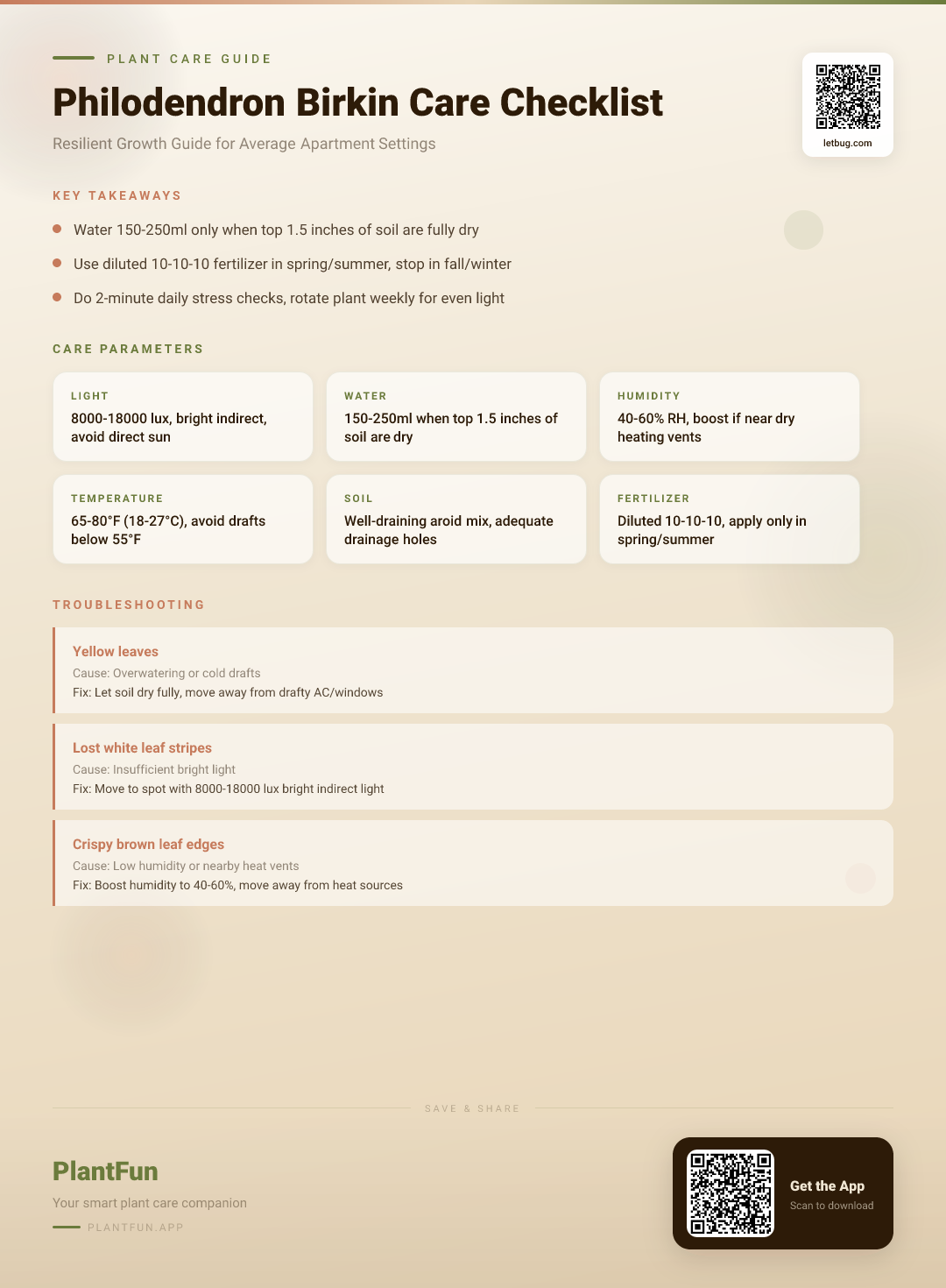
Quick Care Card: At-a-glance printable checklist with all measurable care thresholds for Philodendron Birkin in average apartment settings
| Parameter | Exact Apartment-Friendly Threshold |
|---|---|
| Light | 8,000-18,000 lux bright indirect light (no direct midday sun) |
| Water | 150-250ml filtered/rainwater when top 1.5 inches of soil are completely dry |
| Humidity | 40-60% (tolerates down to 35% short-term) |
| Temperature | 65-80°F (18-27°C), avoid drafts below 55°F (13°C) |
| Soil | Well-draining aroid mix (1 part perlite, 1 part orchid bark, 1 part potting soil, 0.5 parts worm castings) |
| Fertilizer | 1/4 strength 10-10-10 balanced liquid fertilizer every 4 weeks in spring/summer, no applications in fall/winter |
| Toxicity | Toxic to cats, dogs, and humans if ingested (ASPCA, 2026) |
Why Philodendron Birkins Struggle in Typical Apartments
Most generic Philodendron Birkin care advice is derived from greenhouse conditions, which are unachievable for 90% of apartment renters. Common stressors that trip up new owners include:
- Dry forced heating in winter that drops baseline humidity to 20-30%, far below the plant’s preferred range
- Drafty AC vents in summer that cause sudden 10+°F temperature drops, shocking roots and triggering leaf drop
- Limited bright unobstructed light, with most apartments only offering 1-2 windows with suitable light levels
- Myth vs Reality: You do not need a fancy humidifier or grow light to grow a healthy Birkin. This guide is tailored explicitly to average 35-45% baseline humidity and standard apartment lighting (NC State Extension, 2026). Birkins are a chimeric cultivar with unstable genetic variegation, so even small stressors can cause stripe loss (Akramian et al, 2024).
Key Measurable Care Thresholds to Follow
All parameters below are tested for average apartment conditions, with no special equipment required:
- Light: 8,000-18,000 lux bright indirect light (NC State Extension, 2026). Quick test: Hold your hand 1 foot above the plant at midday. If you see a faint, blurry shadow, the light is perfect; sharp dark shadows mean too much direct sun, no shadow means too little light.
- Humidity: 40-60% (Tasnim et al, 2025). Short-term exposure to 35% baseline apartment humidity is fine as long as the plant is not placed near heat vents.
- Temperature: 65-80°F (18-27°C), avoid sustained temperatures below 55°F (13°C) (Akramian et al, 2024).
- Water: 150ml for 4-inch pots, 250ml for 6-inch pots, when the top 1.5 inches of soil are completely dry. Quick test: Stick your index finger into the soil up to the second knuckle. If no soil sticks to your finger, it is time to water (NC State Extension, 2026).
Step-by-Step Daily Care Routine for Year-Round Health
This 2-minute check requires no specialized tools:
- Glance at leaves for new yellowing, brown spots, or pest signs (tiny webbing, sticky residue) — 30 seconds
- Check for direct midday sun: If leaf shadows are sharp on the floor, move the plant 1 foot back from the window — 30 seconds
- If the plant is within 2 feet of a running heater or AC vent, move it 1 foot away temporarily — 1 minute
Step-by-Step Weekly Care Routine
Tailored to apartment living with no fancy equipment:
- Test soil moisture by sticking your finger 1.5 inches deep. If dry, pour the appropriate amount of water directly onto the soil (avoid wetting leaves to prevent fungal spots)
- Rotate the plant 90 degrees to ensure even, non-lopsided growth
- Wipe leaves with a damp microfiber cloth to remove dust, which blocks light absorption (skip commercial leaf shine products)
- Optional humidity boost: Fill a tray with pebbles and water, set the plant pot on top (ensure the pot is not sitting directly in water) to raise local humidity by 5-10% for 3-4 days. Try more no-humidifier humidity hacks for extra dry apartments.
Spring Care Adjustment Checklist
Kick off growing season with these tasks:
- Repot only if roots are growing out of the drainage holes or circling the top of the soil — follow our step-by-step repotting guide to avoid root damage, and move up only 1 pot size (2 inches larger diameter max) to avoid overwatering risk
- Start fertilizing: Mix 1/4 teaspoon of 10-10-10 balanced liquid fertilizer into 1 quart of water, apply once every 4 weeks after watering to avoid root burn (Tasnim et al, 2025)
- Prune any yellow or damaged leaves from winter to redirect energy to new growth
- Move the plant 6 inches closer to your brightest window to take advantage of longer daylight hours, as long as it does not get direct midday sun
Summer Care Adjustment Checklist
Prevent heat stress and pest infestations:
- Increase watering frequency by 30%: Test soil every 5 days instead of every 7, as higher temperatures dry soil faster (this is standard Philodendron Birkin summer watering for average apartments)
- Check for spider mites weekly (our no-pesticide spider mite guide has fast fixes for small infestations), as warm dry conditions attract these pests
- If your apartment hits 85°F (29°C) or higher for more than 2 days, place a small fan 3 feet away on low setting to improve air circulation
- Avoid placing the plant near open windows that get direct afternoon sun, which can scorch leaves in 1-2 hours
Fall Care Adjustment Checklist
Prep for lower light and heating season:
- Gradually reduce watering frequency: Test soil every 10 days, as shorter days slow growth and soil stays wet longer
- Stop fertilizing 2 weeks before your first expected heating turn-on date, to avoid salt buildup in soil during slow growth periods
- Move the plant 6 inches away from windows if you get cold drafts at night, as sudden temperature drops below 55°F can damage leaves
- Wipe leaves more frequently to remove dust, as shorter days mean less available light for photosynthesis
Winter Care Adjustment Checklist
Avoid the #1 cause of Birkin death (overwatering) in low light:
- Water only when the top 2 inches of soil are dry, to avoid overwatering in low-light conditions (NC State Extension, 2026) — this is the core of safe Philodendron Birkin winter care for apartments
- If you place the plant near a window, make sure leaves do not touch the cold glass, which can cause frost damage
- Maintain humidity: If your heating system drops humidity below 35%, group the Birkin with other plants to create a microclimate that boosts local humidity by 10-15%
- Keep the plant at least 3 feet away from active heater vents, as dry hot air will cause brown tips in 2-3 days
Common Apartment Care Mistakes to Avoid
- Mistake: Watering on a fixed schedule instead of testing soil moisture What happens: Overwatering leads to root rot, yellow leaves, and plant death Instead: Test soil moisture every 5-10 days depending on season, only water when the top 1.5-2 inches are completely dry
- Mistake: Placing the Birkin in a dark corner away from windows for decoration What happens: Stunted growth, loss of white stripes, and weak floppy stems Instead: Keep it within 3 feet of a north or east-facing window for ideal bright indirect light
- Mistake: Repotting every year even if roots are not overgrown What happens: Excess soil holds too much water, leading to root rot Instead: Repot only every 2-3 years, when you see roots growing out of the drainage holes
- Mistake: Using full-strength fertilizer to make your Philodendron Birkin grow faster What happens: Salt buildup burns roots, causing brown tips and stunted growth Instead: Always dilute 10-10-10 fertilizer to 1/4 strength, only apply in spring and summer
- Mistake: Misting leaves daily to boost humidity What happens: Wet leaves lead to fungal spots and bacterial infections, and misting only raises humidity for 10-15 minutes Instead: Use a pebble tray or group with other plants for sustained local humidity
Voice Search FAQ 1: Why is my Philodendron Birkin losing its white stripes?
Birkins are a chimeric cultivar, meaning their signature white stripes come from an unstable genetic mutation (Akramian et al, 2024). The most common cause of stripe loss is insufficient light (below 8,000 lux): the plant reverts to its solid green parent plant (Philodendron Rojo Congo) to absorb more light for photosynthesis. Fix the issue by moving the plant to a brighter spot with 8,000-18,000 lux bright indirect light, and prune any fully green leaves to encourage new striped growth.
Voice Search FAQ 2: Can I keep my Philodendron Birkin next to a heater vent?
No, even if your apartment is very dry, direct hot air from a heater vent will lower local humidity to 20% or lower, and can raise leaf temperature to 90°F+ which causes rapid water loss, brown tips, and leaf drop (NC State Extension, 2026). If you have no other space, keep the plant at least 3 feet away from the vent, and use a pebble tray to boost local humidity.
Voice Search FAQ 3: How often should I water my Philodendron Birkin in a dry apartment?
It depends on the season, but in a dry 35% humidity apartment, you will typically water every 5-7 days in spring and summer, and every 10-14 days in fall and winter. Always test the top 1.5 inches of soil first: if it is completely dry, give 150-250ml of water depending on your pot size. This rule eliminates guesswork for Philodendron Birkin dry apartment care.
Troubleshooting Quick Reference
Philodendron Birkin Yellow Leaves
Symptom: Lower leaves turn pale yellow, mushy, and fall off easily
Likely cause: Overwatering leading to early root rot
Fix:
- Stop watering immediately, and let the top 2-3 inches of soil dry completely
- If the soil is soaking wet, remove the plant from the pot, wrap the root ball in paper towels to absorb excess moisture, and repot in fresh dry aroid mix if rot is present
Philodendron Birkin Brown Tips
Symptom: Dry, crispy brown tips on the edges of mature leaves, with the rest of the leaf green
Likely cause: Low humidity (below 35%) or exposure to direct hot air from heating vents
Fix:
- Move the plant at least 3 feet away from any active heater or AC vents
- Add a pebble tray under the pot to boost local humidity by 5-10%
Stunted Growth
Symptom: No new leaves for 3+ months, or new leaves are small and fully green with no stripes
Likely cause: Insufficient light (below 8,000 lux) or lack of fertilizer during growing season
Fix:
- Move the plant to a spot within 3 feet of a north or east-facing window to get 8,000-18,000 lux bright indirect light
- Apply 1/4 strength 10-10-10 fertilizer once every 4 weeks in spring and summer
Mild Root Rot
Symptom: Wilting leaves even when soil is wet, foul smell coming from the pot, brown mushy roots
Likely cause: Consistent overwatering, or planting in a pot with no drainage holes
Fix:
- Remove the plant from the pot, trim off all brown mushy roots with clean sterilized scissors, leaving only firm white roots
- Repot in fresh well-draining aroid mix in a pot with drainage holes, and do not water for 7 days after repotting
References
- NC State Extension. (2026). The Complete Philodendron Birkin — NC State Extension Gardener Plant Toolbox. https://plants.ces.ncsu.edu/plants/birkin-care/. Accessed 2026-03-02.
- Akramian, M.; Khaleghi, A.; Salehi Arjmand, H. (2024). Optimization of plant growth regulators for in vitro mass propagation of Philodendron cv. Birkin through shoot tip culture. Greenhouse Plant Production Journal. https://doi.org/10.61186/gppj.1.1.55. Accessed 2026-03-02.
- Tasnim, N.; Rahman, K.; Sarker, S. (2025). In vitro Mass Propagation of Philodendron cv. ‘Birkin’ through Direct and Indirect Organogenesis. Plant Tissue Culture and Biotechnology. https://doi.org/10.3329/ptcb.v35i1.82285. Accessed 2026-03-02.
- ASPCA. (2026). Toxic and Non-Toxic Plants List — ASPCA. https://www.aspca.org/pet-care/animal-poison-control/toxic-and-non-toxic-plants. Accessed 2026-03-02.
Optional Helper: Plantfun.App
Plantfun.App identifies your plants by photo, diagnoses pests and diseases with clear fixes, and creates personalised watering and light schedules that adapt to your home conditions — a handy companion for putting this guide into daily practice.
Found an error or have suggestions? We'd love your feedback.
Need help identifying this problem?
Get instant identification, personalized care schedules, and effective pest treatment plans directly on your phone.
Sponsored • We may earn a commission from app downloads
Related Guides
Philodendron Birkin Care Checklist for Typical Apartments: Grow Lush, Striped Leaves Without Stress
Stop struggling to keep your Philodendron Birkin thriving in your apartment. Get 8 actionable care tips, exact light/humidity thresholds, and a free printable checklist for lush, striped growth.
Care GuideThe Complete Philodendron Birkin Care Checklist for Resilient Growth in Typical Apartments
Keep your Philodendron Birkin thriving in your apartment with our science-backed checklist. Get exact light, water, and humidity thresholds, plus 7 quick fixes for common leaf symptoms to support consistent resilient growth.
Care GuidePhilodendron Birkin in East-Facing Apartments: Seasonal Checklist for Resilient Striped Growth That Works Year-Round
Grow a lush, crisp-striped Philodendron Birkin in your east-facing apartment with this seasonal care checklist. Get exact light, water, and humidity levels that prevent yellow leaves and stunted growth all year long.
Pest ControlAnts on Plants: What They Mean and What to Do
Ants usually aren't eating your plant. They are farming other pests.