
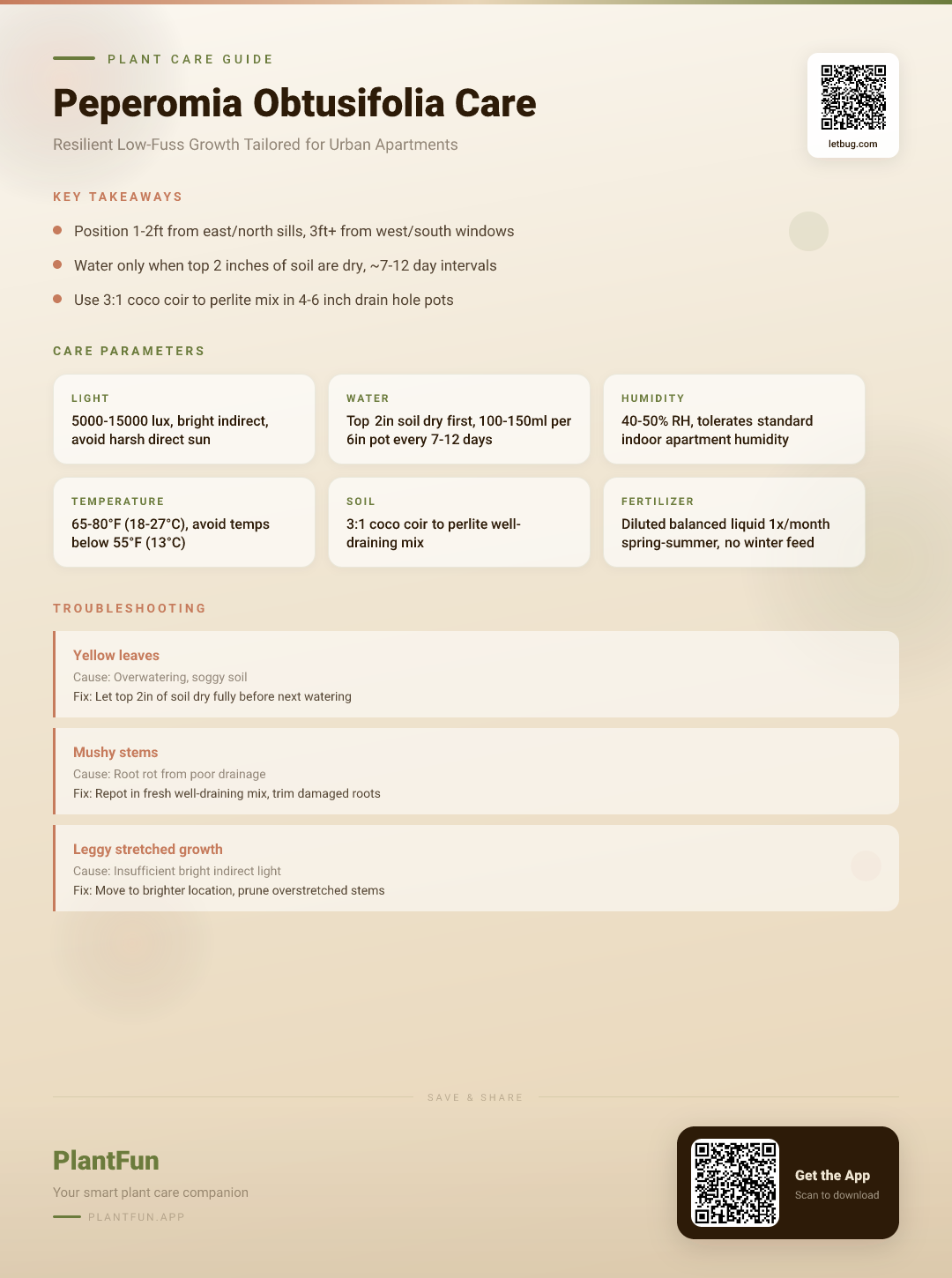
Key Takeaways
- Check soil moisture before watering — overwatering is the #1 killer of houseplants.
- Ensure your plant gets the right amount of light for its species.
- Be patient with recovery — most plants need 2–4 weeks to bounce back.
Quick Care Card: At-a-glance printable cheat sheet with all key measurable care thresholds for peperomia obtusifolia in urban apartment settings
| Parameter | Exact Apartment-Friendly Threshold |
|---|---|
| Light | 5,000-15,000 lux bright indirect |
| Water | 100-150ml per 6-inch pot, only when top 2 inches of soil are fully dry (~every 7-12 days) |
| Humidity | 40-50% relative humidity |
| Temperature | 65-80°F (18-27°C), never below 55°F (13°C) |
| Soil | 3:1 coco coir to perlite well-draining mix |
| Fertilizer | Diluted balanced liquid fertilizer once every 2 months during growing season (Mar-Oct) |
| Toxicity | Non-toxic to cats, dogs, and humans (ASPCA, 2026) |
Why This Guide Is Different: Breakdown of how standard peperomia care advice changes for apartment constraints, plus our diagnosis-first framing overview
Generic Peperomia obtusifolia care guides rarely account for the unique constraints of 600-800 sq ft urban apartments: low natural light, dry forced air heating/cooling, and limited counter space. Unlike one-size-fits-all resources, we use a diagnosis-first framework that lets you spot stress signals before they cause permanent damage, with all recommendations adjusted for apartment living and no fancy tools required. A common myth we bust: peperomia does not need greenhouse-level humidity to thrive (Gilman, 2007), it adapts extremely well to apartment conditions with a few simple tweaks. This guide includes a printable Peperomia care checklist you can use to cross-reference your current routine in 2 minutes flat, making it ideal for Peperomia care for beginners and intermediate plant owners alike. If you’re new to low-light apartment planting, check out our roundup of the best low-light houseplants for small apartments for more easy options.
Step 1: Light Placement for Apartment Spaces: Exact 5,000-15,000 lux bright indirect light requirement, best window positions (1-2ft from east/north-facing sills, 3ft+ from west/south-facing windows), and how to spot scorch or legginess early
Peperomia light requirements indoors fall in the 5,000-15,000 lux bright indirect range (NC State Extension, 2026), which is easy to achieve in most apartments without grow lights. The best placements are: 1-2ft from east or north-facing sills, where they get gentle morning or constant filtered light, and 3ft+ back from west or south-facing windows to avoid harsh midday and afternoon sun that causes scorch. Quick tool-free lux test: Hold your hand 6 inches above the plant at midday on a bright day. If you see a faint, soft shadow of your hand on the leaves, you’re in the ideal range. A sharp, dark shadow means too much light (risk of scorch, brown crispy leaf edges), while no shadow means too little light (risk of legginess, long gaps between leaves and leaning towards the light source). If you have extremely low light, you can use a small grow light for 4 hours a day to boost growth, as we outline in our guide to choosing grow lights for small apartment spaces.
Step 2: Watering Schedule for Inconsistent Apartment Heating: Measurable rule (water only when top 2 inches of soil are fully dry, ~7-12 days, 100-150ml per 6-inch pot per watering), plus adjustments for HVAC and radiator use
The number one question new owners ask is How often to water peperomia, and the answer is tailored directly to your apartment’s heating and cooling setup. The base rule: Water only when the top 2 inches of soil are fully dry, which works out to ~every 7-12 days, with 100-150ml of water per 6-inch pot (Gilman, 2007). Adjust for your apartment’s HVAC: If you run radiators 24/7 in winter, check soil moisture 2 days earlier than your usual schedule, as dry heat evaporates soil moisture faster. If you run AC constantly in summer, add 2-3 days between waterings, as cool air slows evaporation and increases risk of overwatering. Quick test: Stick your index finger 2 inches into the soil, all the way to your second knuckle. If any part of the soil feels damp, wait to water. If it’s completely dry, it’s time to water. Peperomia summer watering may require slightly more frequent checks, while Peperomia winter care requires cutting back watering by 50% on average. If you overwater and notice early signs of root rot, follow our step-by-step root rot treatment guide for houseplants to rescue your plant.
Step 3: Soil & Potting for Small Counter Space: Recommended 3:1 coco coir to perlite well-draining mix, 4-6 inch pot size with drainage holes, tips to avoid overpotting in tight apartment quarters
The right Peperomia potting soil mix and pot size is critical for small apartment spaces, where overpotting can take up valuable counter space and cause root rot. Use a 3:1 mix of coco coir to perlite, which drains quickly while retaining just enough moisture for the plant’s epiphytic root system (NC State Extension, 2026). Choose a 4-6 inch pot with drainage holes (Do peperomia need drainage holes? Yes, non-negotiable, as their thick fleshy roots rot easily in standing water). For small counter spaces, avoid overpotting: only size up by 1 inch when the plant is root bound, as larger pots hold excess moisture that kills roots and takes up unnecessary space. You can slip the nursery pot into a decorative cachepot for display, just make sure to empty any excess water that collects in the bottom after watering.
Step 4: Temperature & Humidity Adjustments for Urban Apartments: Target 65-80°F (18-27°C) temperature range (never below 55°F/13°C), 40-50% relative humidity, no-humidifier hacks to boost moisture near radiators or AC vents
Peperomia humidity needs are far lower than most tropical houseplants, making them ideal for apartments. Aim for 40-50% relative humidity, which is the average range for most heated or cooled apartments (Gilman, 2007). If your air is extra dry near radiators or AC vents, use these no-humidifier hacks: Place a tray of pebbles and water under the pot (make sure the pot is sitting on the pebbles, not in the water), group it with other small plants to create a microclimate of higher moisture, or mist the leaves once a week. Keep temperatures between 65-80°F (18-27°C), and never let the plant be exposed to temperatures below 55°F (13°C), which causes leaf drop and permanent damage. Avoid placing your peperomia within 3ft of exterior doors, drafty windows, or AC vents where temperature swings are common.
Seasonal Care Calendar: Month-by-month adjustments for winter (reduce watering by 50%, move 1ft+ away from drafty windows) and summer (increase light exposure, mist biweekly) for apartment dwellers
Follow this simple month-by-month calendar tailored to apartment conditions:
- Winter (Dec-Feb): Reduce watering by 50% (Peperomia winter care), move 1ft+ away from drafty windows and exterior doors, stop fertilizing entirely.
- Spring (Mar-May): Resume regular watering schedule, apply diluted balanced liquid fertilizer once every 2 months, rotate the pot ¼ turn every 2 weeks for even, compact growth.
- Summer (Jun-Aug): Move 6 inches closer to north/east windows for extra light, mist leaves biweekly to counteract dry AC air, check soil moisture every 6 days for Peperomia summer watering adjustments.
- Fall (Sep-Nov): Gradually reduce watering frequency, stop fertilizing at the end of October, move 1ft back from west/south windows as late-afternoon sun gets stronger.
Common Apartment Care Mistakes to Avoid: Diagnosis of top stress symptoms (yellow leaves, mushy stems, leggy growth) linked directly to apartment-specific habits like overwatering and placing plants near entryways
These are the most common apartment-specific mistakes that cause peperomia stress:
- Mistake: Overwatering immediately after turning on radiators for winter. What happens: Excess moisture causes Peperomia obtusifolia yellow leaves, mushy stems, and root rot. Instead: Always do the 2-inch finger test before watering, even if you think it’s time based on your usual schedule.
- Mistake: Placing your peperomia near a frequently used exterior entryway. What happens: Cold drafts from open doors cause sudden leaf drop, which is the top answer to Why is my peperomia dropping leaves for apartment dwellers. Instead: Keep your plant at least 3ft away from all exterior doors and drafty AC vents.
- Mistake: Using a large decorative pot without drainage holes to save counter space. What happens: Standing water collects at the root zone, leading to root rot and plant death in as little as 2 weeks. Instead: Use a small 4-6 inch nursery pot with drainage holes, and slip it into a decorative pot only when you have guests over, emptying any excess water after 10 minutes.
- Mistake: Leaving your peperomia in direct afternoon sun from a west-facing window. What happens: Harsh UV rays cause brown crispy scorch marks on leaves, which do not heal. Instead: Place the plant 3ft+ back from west/south windows, or hang a cheap sheer curtain to filter the light.
Voice Search FAQ 1: Why is my peperomia dropping leaves in my apartment?
The two most common apartment-specific causes of leaf drop are cold drafts from AC vents or exterior entryways, and overwatering (Gilman, 2007). These 2-minute fixes will resolve most cases:
- First, check if your plant is within 3ft of a drafty door, window, or AC vent. Move it to a spot with stable temperatures immediately.
- Do the 2-inch finger soil test. If the soil is damp, hold off on watering for 3-5 days. If the soil is soggy, repot into fresh dry 3:1 coco coir perlite mix right away.
Voice Search FAQ 2: How often should I water my peperomia in a dry apartment?
For a standard 6-inch pot, use 100-150ml of water every 7-12 days, only when the top 2 inches of soil are fully dry (NC State Extension, 2026). Adjust for your apartment’s heating/cooling:
- If your radiator is running 24/7 in winter, check soil moisture 2 days earlier than your usual schedule, as dry heat speeds up evaporation.
- If your AC is running constantly in summer, add 2-3 days between waterings, as cool air slows evaporation and increases overwatering risk.
Voice Search FAQ 3: Can I keep a peperomia in a north-facing apartment window?
Yes, Peperomia in north-facing apartment windows thrives as long as it’s placed 1-2ft from the sill, where it gets 5,000-10,000 lux of bright indirect light (Henny, 1985). Quick tool-free lux test: At midday on a bright day, hold a piece of white paper where the plant sits. If you can see a faint shadow of your hand held 6 inches above the paper, you have enough light. Expected growth rate is 2-4 new leaves per growing season, slightly slower than in east-facing light, but the plant will stay compact and healthy. If you want to know How to make peperomia grow faster in low light, add a small grow light 1ft above the plant for 4 hours a day during the growing season.
References: Peer-reviewed horticultural sources on peperomia epiphytic care, indoor light measurement for houseplants, and urban apartment plant stress mitigation
- Gilman, E. (2007). Peperomia obtusifolia Peperomia, Baby Rubber Plant. EDIS. https://doi.org/10.32473/edis-fp466-1999. Accessed 2026-03-02.
- Henny, R. (1985). BA Induces Lateral Branching of Peperomia obtusifolia. HortScience. https://doi.org/10.21273/hortsci.20.1.115. Accessed 2026-03-02.
- ASPCA. (2026). Toxic and Non-Toxic Plants List — ASPCA. https://www.aspca.org/pet-care/animal-poison-control/toxic-and-non-toxic-plants. Accessed 2026-03-02.
- NC State Extension. (2026). The Complete Peperomia Obtusifolia — NC State Extension Gardener Plant Toolbox. https://plants.ces.ncsu.edu/plants/peperomia-obtusifolia/. Accessed 2026-03-02.
Optional Helper: Plantfun.App
Plantfun.App identifies your plants by photo, diagnoses pests and diseases with clear fixes, and creates personalised watering and light schedules that adapt to your home conditions — a handy companion for putting this guide into daily practice.
Found an error or have suggestions? We'd love your feedback.
Need help identifying this problem?
Get instant identification, personalized care schedules, and effective pest treatment plans directly on your phone.
Sponsored • We may earn a commission from app downloads
Related Guides
The Complete Peperomia Obtusifolia Care Checklist for Resilient Growth in Typical Urban Apartments
Keep your peperomia thriving even in a small, low-humidity urban apartment. Grab our printable care checklist, exact light/water thresholds, and stress-fixing tips for resilient growth all year.
Care GuideBaby Rubber Plant (Peperomia obtusifolia) in Small City Apartments: The Only Care Guide You'll Ever Need
Stop guessing at your Peperomia care routine. Get exact light levels, water amounts, and a seasonal apartment-specific calendar to grow lush, resilient Baby Rubber Plants all year.
Care GuidePeperomia obtusifolia in a Low-Light Apartment: The Ultimate Seasonal Growth and Care Guide
Transform your dim apartment into a thriving indoor jungle. Get specific lux, precise watering ml, and a 4-season care calendar to keep your Peperomia vibrant.
Safety GuidePeperomia Obtusifolia Placement Guide for Family Living Rooms: Pet & Child Safe Substitutions Included
Keep your family and pets safe while growing beautiful indoor greenery. Get exact Peperomia obtusifolia placement tips, care thresholds, and 3 non-toxic substitutions for common toxic living room plants.