
Key Takeaways
- Check soil moisture before watering — overwatering is the #1 killer of houseplants.
- Ensure your plant gets the right amount of light for its species.
- Be patient with recovery — most plants need 2–4 weeks to bounce back.
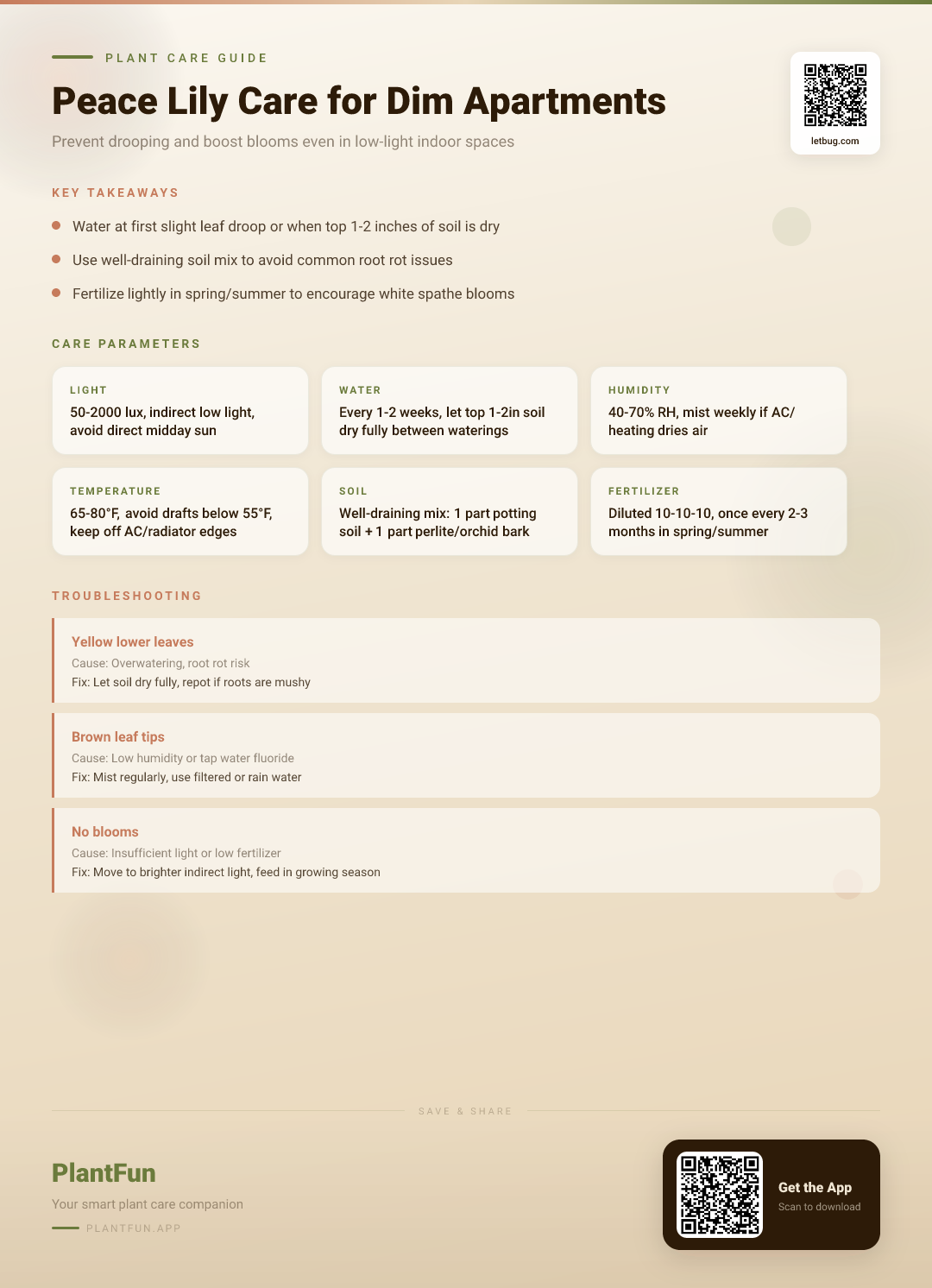
Quick Care Card: Light, Temperature, Humidity, and Water Thresholds
| Feature | Requirement |
|---|---|
| Light | Bright, indirect (150-500 foot-candles) |
| Water | Keep evenly moist; water when top 1 inch is dry |
| Humidity | 40-60% (Moderate) |
| Temperature | 65-80°F (18-27°C) |
| Soil | Well-draining peat-based mix |
| Fertilizer | Balanced liquid feed every 6-8 weeks (spring/summer) |
| Toxicity | Toxic to cats and dogs (ASPCA, 2026) |
TL;DR: Why Your Peace Lily is a Forest Floor Resident
Peace Lilies (Spathiphyllum) are not desert succulents; they are evolved for the dappled light and consistent moisture of the tropical forest floor (NC State Extension, 2026). In an apartment, they suffer when forced into direct sunlight or allowed to dry out completely. To keep them thriving, mimic their natural habitat: prioritize consistent soil moisture and avoid harsh, direct rays.
Decoding the Droop: Why Peace Lilies Signal Thirst
When I first started keeping Peace Lilies, I panicked every time I saw a leaf sag. I immediately flooded the pot, which only made things worse. I learned that the “droop” is a biological alarm system. According to the NC State Extension (2026), the plant uses turgor pressure—water pressure within cells—to hold its foliage upright. When the soil moisture drops, the pressure decreases, causing the plant to wilt. Instead of over-watering, check the soil first: if it feels dry to the touch, it is time to hydrate. If the soil is wet and the plant is wilting, you may have damaged the root system (NC State Extension, 2026).
Step-by-Step Care: Measuring Lux and Humidity for Apartment Growth
- Measure Light: Use a simple light meter app or sensor. Your goal is 200–500 lux (approx. 150-500 foot-candles). Avoid placing them in direct window paths.
- Hydration Check: Stick your finger 2 inches deep into the soil. If it is dry, pour water until it flows from the drainage holes (NC State Extension, 2026).
- Monitor Humidity: Use a digital hygrometer. If your apartment dips below 40%, group your plants or use a humidity tray to maintain the tropical environment they crave.
The Budget-Friendly Soil Mix: Ingredients You Already Have
You do not need expensive boutique mixes. Combine 2 parts standard potting soil, 1 part perlite for drainage, and 1 part coconut coir or peat moss to retain moisture. This structure ensures oxygen reaches the roots while preventing the common issues of root rot.
Seasonal Care Calendar: Adjusting for AC and Radiator Heat
- Winter: Radiators dry out the air. Mist your leaves or use a humidifier to keep the ambient moisture levels stable (NC State Extension, 2026).
- Summer: AC units can cause temperature fluctuations. Keep your Peace Lily away from direct vents to prevent shock.
Common Mistakes: Stop the Root Rot Before it Starts
- Mistake: Using a pot without holes.
- What happens: Water accumulates, depriving roots of oxygen.
- Instead: Always use a pot with adequate drainage holes (NC State Extension, 2026).
- Mistake: Using cold tap water.
- What happens: Cold shock to the root system.
- Instead: Use water at room temperature.
Yellowing Leaves
Symptom: Leaves turn yellow, starting from the bottom up.
Likely cause: Overwatering or poor drainage.
Fix:
- Reduce watering frequency immediately.
- Inspect roots for mushy, brown textures indicating rot.
Brown Leaf Tips
Symptom: Browning, crispy edges on the tips.
Likely cause: Low humidity or salt buildup from tap water.
Fix:
- Increase ambient humidity.
- Use filtered or distilled water to flush out mineral buildup.
FAQ: Why is my Peace Lily leaf turning brown at the tips?
This is typically a response to low humidity or mineral accumulation in the soil (NC State Extension, 2026). Try grouping your plant with others to create a micro-climate or switch to filtered water.
FAQ: Can I keep my Peace Lily in a windowless bathroom?
While they are low-light tolerant, they still require photosynthesis (Šrámek, 1999). Without any ambient light, the plant will eventually fade. If you have no windows, consider a high-quality LED grow light to provide the necessary spectrum.
FAQ: How often should I fertilize my Peace Lily to see blooms?
Apply a balanced liquid fertilizer at half-strength every 6-8 weeks during the growing season. Excessive fertilizer can actually inhibit bloom production (NC State Extension, 2026).
Science Corner: How Photosynthesis Works in Low-Light Conditions
Peace Lilies are remarkably adapted to low light through high-efficiency chlorophyll production. However, light remains the limiting factor for energy production. Studies suggest that even in shaded environments, providing the correct spectral quality is vital for maintaining metabolic homeostasis (Šrámek, 1999). Proper gas exchange through the stomata is essential; keep leaves free of dust to maximize light absorption (Karzai, 2023).
References
- ASPCA. (2026). Toxic and Non-Toxic Plants List — ASPCA. https://www.aspca.org/pet-care/animal-poison-control/toxic-and-non-toxic-plants. Accessed 2026-03-13.
- Karzai, S. (2023). In Care of a Peace Lily. The Massachusetts Review. https://doi.org/10.1353/mar.2023.a900402. Accessed 2026-03-13.
- NC State Extension. (2026). The Complete Peace Lily — NC State Extension Gardener Plant Toolbox. https://plants.ces.ncsu.edu/plants/lily-care/. Accessed 2026-03-13.
- Šrámek, F. (1999). Vaughan, M.J.: The Complete Book on Cut Flower Care. Biologia plantarum. https://doi.org/10.1023/a:1001770114931. Accessed 2026-03-13.
Optional Helper: Plantfun.App
Plantfun.App identifies your plants by photo, diagnoses pests and diseases with clear fixes, and creates personalised watering and light schedules that adapt to your home conditions — a handy companion for putting this guide into daily practice.
Found an error or have suggestions? We'd love your feedback.
Need help identifying this problem?
Get instant identification, personalized care schedules, and effective pest treatment plans directly on your phone.
Sponsored • We may earn a commission from app downloads
Related Guides
The Complete Peace Lily Care Checklist for Resilient Year-Round Growth in Typical Low-Light Apartments
Stop guessing at Peace Lily care for your apartment. Get a 10-point actionable checklist, exact light, water, and humidity thresholds, and fixes for yellow leaves and drooping to keep your plant resilient all year.
Care GuideThe Budget Peace Lily Care Checklist for Resilient Growth in Small Urban Apartments
Grow a lush, flowering peace lily on a $5 monthly budget with our apartment-specific checklist. Get exact light, water, and humidity thresholds to avoid yellow leaves and boost blooms.
Care GuideThe Complete Peace Lily Care Checklist for Resilient Growth in Typical Urban Apartments
Stop dealing with yellow peace lily leaves and missed blooms. Get 12 actionable checklist steps, exact light/water thresholds, and tips to keep your plant thriving in any standard apartment.
Pest ControlAnts on Plants: What They Mean and What to Do
Ants usually aren't eating your plant. They are farming other pests.